Technical SEO or new content: what should a beauty brand fix first?
Start with technical SEO if a useful buying page cannot be reached or indexed. Improve the page if shoppers can find it but cannot understand the product. Create new content when a relevant customer question has no good answer. The first project should follow the evidence from your store.

In this article
Overview
Start with technical SEO if a useful buying page cannot be reached or indexed. Improve the page if shoppers can find it but cannot understand the product. Create new content when a relevant customer question has no good answer. The first project should follow the evidence from your store.
Start with a product a customer should find
Choose a priority product and a relevant shopping question. Identify the page that should answer it and inspect the current search and site evidence. Avoid turning a broad worry such as ‘our SEO is bad’ into a large task list before checking a representative example.
You do not need to diagnose every technical detail yourself. Ask the specialist to show whether the page can be crawled and indexed, fits what the searcher wants, and gives a useful answer. Each recommended change should connect to one of those findings.
Ask for a short evidence pack before approving a large SEO retainer. For one priority URL, it should show whether Google can access it, which version Google treats as canonical, the questions it currently appears for when data is available, and whether its contents answer the intended shopping task. An indexed page can still be irrelevant or unhelpful; indexing alone does not finish the diagnosis.
Four checks before writing
Can it be reached?
Check the destination, links and search access.
Is it the right page?
Match the shopping question to product, collection or guide.
Is it useful?
Explain the product and the decision with accurate facts.
What is missing?
Repair, improve or create only after the first checks.
adidas: why search and conversion teams should read the evidence together
In Will Critchlow’s SearchPilot recap, adidas’ Matthew Morrisey describes a more descriptive grid element that produced a flat conversion test but a positive SEO traffic result. The combined observation supported a rollout. The recap supplies no numerical uplift or raw experiment data, so it should be read as an operating example rather than a forecast.
The lesson for a smaller catalog is to define what a change should improve and what it must protect. A product or collection page can become easier to discover while remaining equally usable, or gain traffic that is less relevant. Ask the team to record both the intended discovery outcome and the purchase task that should not deteriorate. That is more informative than evaluating technical SEO and customer experience in separate reports.
A small store may have too few pages or visits to run an SEO split test like a large retailer’s. You can still keep a dated baseline, make a focused change and test the shopping task. When comparing results, note changes in stock, seasonality and campaigns, and describe a before-and-after comparison accurately.
Decide whether another article would solve the problem
Consider a hypothetical skincare store with twelve products, a growing editorial section and weak discovery for its actual assortment. Inspect a few important product and collection pages before authorizing more articles. Can the customer reach them from navigation? Do the current facts answer the relevant question? Does search see the intended version and destination? These checks narrow the problem before the team estimates a content package.
Suppose one collection is poorly described and a product needs a clearer comparison with its closest alternative. Improve those pages and link to them from relevant navigation or supporting content. Add a separate article only if an important question still needs its own explanation. Let the problem determine how many pages to create.
The brief should also explain what will be reviewed after implementation. Confirm the rendered changes and appropriate indexing behavior first; then examine relevant search and customer signals over a suitable period. Assign an owner to investigate unexpected effects. A plan that ends when the copy is delivered leaves the most important implementation and learning work unassigned.
| Finding | First action | Why another article may not help |
|---|---|---|
| Relevant commercial page is hard to reach | Repair the discovery path | The customer still needs the existing destination. |
| Variant or product facts are inconsistent | Update the product record and the pages using it | A new page can reproduce the inconsistency. |
| A distinct buying question has no suitable answer | Scope one complete guide and its links | The question needs an explanation the existing pages do not provide. |
Make the first SEO project answer a finding
Inspect
Start with a commercially important destination.
Prioritize
Choose the smallest complete answer to the obstacle.
Review
Verify implementation and observe customer response.
The same complaint can lead to different work
The same complaint—customers cannot find our products—can point to several different problems. These fictional examples show what to investigate first.
| Observation | Work to investigate first | Why more blogs may not help |
|---|---|---|
| A priority product page is accidentally excluded from indexing. | Correct the exclusion after confirming it is unintended; validate the page. | New articles do not repair access to the intended buying destination. |
| The page is accessible but barely explains the product. | Improve approved product facts, media and buying information. | A visitor still reaches an unconvincing purchase page. |
| Several products exist but shoppers cannot compare them. | Create or improve a useful collection or comparison. | A generic article may be the wrong destination for the choice. |
| The store is clear, but a distinct customer question has no answer. | Brief one substantive guide and connect it to relevant products. | This is a content gap, provided it does not duplicate an existing answer. |
A three-product store may need only a focused first project
Imagine a brand with three hair-care products. The products are reachable, but the store uses internal collection names and never explains which option suits which routine. A contained first scope could clarify navigation, improve the comparison and link each answer to the appropriate product.
The handoff should identify the changed pages and the customer task they support. A technical review may reveal additional work, but the proposal should explain why that work affects the chosen task. Do not make a small brand pay for an unexplained inventory of SEO jargon.
Create a page only when it earns a distinct job
A new guide can be worthwhile when customers need an explanation that does not fit naturally on a product or collection page. It should resolve a real decision, use accurate evidence and offer a relevant next step. A new title or a slightly different keyword is not enough to make a distinct topic.
Compare the intended outline with the existing library. If the answer is already there, improve its discovery from an appropriate page. If the existing destination is incomplete, consider improving that destination before making another URL.
Repair, improve, then expand
Access repair
Remove an unintended barrier to the right destination.
Page improvement
Make the current answer clearer and more useful.
New contribution
Answer a customer question the site does not cover.
Review
Check implementation, discovery and customer behavior.
Separate delivery from results
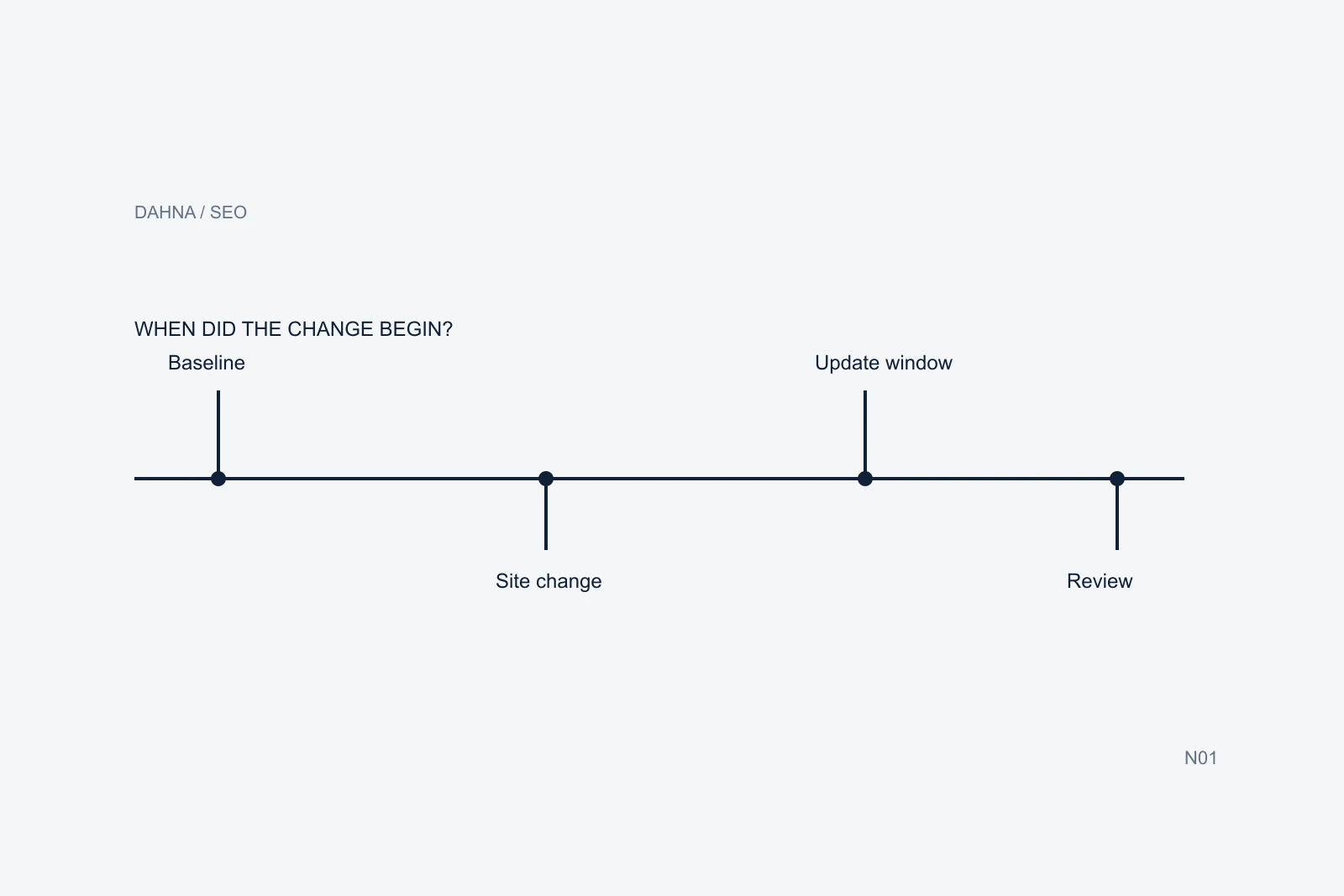
The first acceptance check is whether the promised change works: the page is accessible, the content is accurate, and navigation reaches the intended destination. Then review relevant search queries, landing pages and business outcomes over consistent periods.
Keep a dated change log and note other campaigns or stock changes. A 28-day or 56-day review is a learning checkpoint, not a promise about rankings. Dahna can connect the diagnosis to website and content implementation so the review leads to another practical decision.
- Named buyer question and intended destination
- Evidence for the recommended first fix
- A concrete deliverable and owner
- A check that the implementation works
- A dated review of relevant search and business signals
| Check | Evidence to ask for | Decision it informs |
|---|---|---|
| Access and indexing | The intended URL, inspection result and any blocking directive | Repair an unintended technical barrier before adding supporting content. |
| Page choice | Dated US search results for the intended customer question | Use a product, collection or guide that fits the task. |
| Existing demand | Available Search Console queries and pages, with dates and country filters | Improve an existing answer before creating a close variation; sparse data may leave this unresolved. |
| Product clarity | A comparison of page copy with the approved product record | Correct missing or contradictory facts on the buying page. |
| Delivery and follow-up | Completed changes, validation and a later review date | Separate a shipped improvement from a change in search visits or orders. |
Prioritize your first SEO fixes
Prepare a ranked backlog linking each issue to an affected URL, buyer question, evidence, proposed change, owner and expected observation after release.
Use the downloadable planning sheet linked below to adapt the examples to your brand. Add the current product information, the person responsible for each task and the check that will show the work is complete. Keep unanswered questions visible for the project discussion.
About the sources
The adidas example comes from SearchPilot’s interview recap with Matthew Morrisey and Will Critchlow, published in November 2025 and updated in February 2026. It describes a flat conversion test and a positive SEO result, without a numerical uplift or raw experiment data.
Alan Kent’s Google Search Central videos explain ecommerce search fundamentals. They are platform education from 2021–2022; check the linked current documentation for implementation requirements.
Sources & further reading
- Inside adidas: an insight-first SEO programSearchPilot / Will Critchlow / Matthew Morrisey
- Help Google understand your ecommerce website structureGoogle Search Central
- How to get your products into SearchGoogle Search Central / Alan Kent
- How to make your ecommerce website stand out in Google Search (6 Tips)Google Search Central / Alan Kent
- Share your product data with GoogleGoogle Search Central
Choose your first SEO project
Dahna can help identify the search problem and carry the fix through to the website or content. The first proposal should name the affected pages, the changes needed and how they will be checked.
Why consider Dahna for this work?
Dahna brings bilingual Korean and English strategy together with creator, content, and measurement work for brands growing in the US. You can review the people behind the recommendations and the kind of work we propose before starting a conversation.
Founder experience includes prior and contracted roles. Sample deliverables illustrate our approach; they are not client results or a performance promise.
We’ll agree on deliverables, responsibilities and approvals before work begins.