A Google spam update rolled out. What should your ecommerce brand check?
Start by identifying which pages, queries and markets changed. A traffic drop during a Google spam update is a reason to investigate, not a diagnosis. The next purchase should be a documented review of the evidence—not an expensive recovery package based only on a chart.
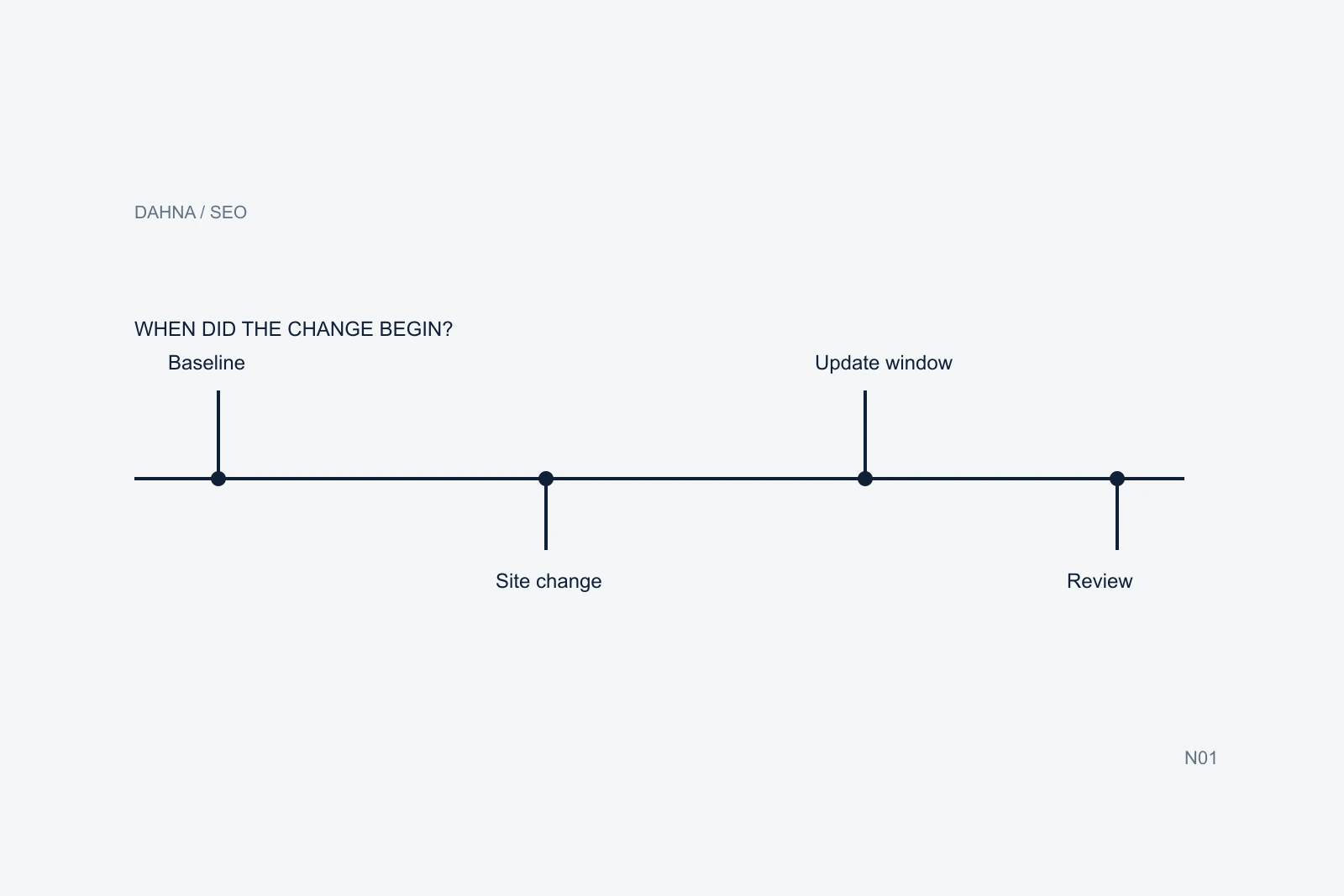
Dahna, original planning diagram
In this article
Overview
Start by identifying which pages, queries and markets changed. A traffic drop during a Google spam update is a reason to investigate, not a diagnosis. The next purchase should be a documented review of the evidence—not an expensive recovery package based only on a chart.
The decision in context
Google’s September 2026 spam update ran from September 24 to October 8 and applied globally across languages. Its announcement did not identify beauty brands, ecommerce platforms or one AI-writing product as a target. That distinction matters when someone claims to know exactly why your store lost visibility.
Write down the change you can actually observe
Open with a precise observation: which metric declined, over which complete dates, for which country and which pages? Clicks, impressions, sessions and orders are different measures. A decline in visits to a general-interest article may have little relationship to the visibility of a product collection or the number of qualified customers reaching it.
Use the same filters on both sides of a comparison. For a US acquisition project, retain a US view and a separate global view. Check whether a holiday, promotion, stock-out or tracking change makes the selected periods difficult to compare. Save the report settings so another person can reproduce the observation.
Google’s traffic-drop guidance discusses several possible causes, including technical problems, ranking changes and seasonality. Treat the update calendar as one evidence source. Put your own deployment and catalog history next to it before deciding that timing establishes causation.
Build two dated records before drawing a conclusion
Search observations
Affected pages, queries, countries and complete periods.
Site history
Deployments, product changes, tracking, availability and incidents.
Investigation
Check where the evidence supports or contradicts a proposed cause.
Check for a manual action without assuming one exists
A manual action follows human review and appears in Search Console’s Manual Actions report. When one is present, follow the stated issue and reconsideration process. An automated ranking change does not automatically create a manual action or a reconsideration request.
An empty report is useful information, but it is not a certificate that every page is healthy. The investigation may still find an indexing problem, a weaker search fit or an automated policy issue. Ask an agency to distinguish what the report confirms from what it cannot answer.
Preserve the exact affected scope. A statement about a section of the site should not become a claim that every product has been penalized. Similarly, a problem on one template may spread across many URLs without requiring a complete rewrite of the whole library. The work should follow the evidence at the smallest useful level.
Review the purpose of the pages, not their production tool
Google’s spam policies address practices such as scaled content abuse, doorway abuse and manipulative links. The relevant issue is whether pages or links are created to manipulate rankings without serving users well. AI assistance or an outside writer alone does not establish a violation.
For an ecommerce brand, inspect pages that differ mainly by a city, ingredient or keyword while leading to the same offer. Ask what separate buying question each destination resolves. A page with original comparison criteria, product-specific evidence and a clear task has a different purpose from a collection of interchangeable paragraphs.
Do the same review for purchased placements and product-for-link arrangements. Record the commercial relationship, destination and actual link attributes. Do not promise that removing one type of link will restore every lost position. Link work, content work and technical repair may solve different problems and should not be bundled into an unexplained cure.
| Page or practice | Question to investigate | Evidence to keep |
|---|---|---|
| Near-identical landing pages | What separate customer decision does each page answer? | Intent map, page differences and buyer use |
| Mass-produced advice | What useful contribution is specific to this product or audience? | Original examples, product facts and source records |
| Commercial backlinks | What was exchanged, and how is the link qualified? | Placement URL, agreement and link attributes |
| A publisher partnership | Why does this content belong with that audience? | Editorial purpose and actual publishing arrangement |
A fictional store with two different declines
Imagine a skincare store whose total organic clicks fall after September 24. Its trend articles lose visibility, but its US product-page impressions remain broadly stable. Separately, a navigation update accidentally removes links to two collections. Both changes happen during the update window. Only one is a confirmed implementation defect.
The first task is to restore and verify the missing navigation paths. The second is to review the affected trend articles against their actual search intent and content value. The team should not call the navigation repair a spam recovery or delete useful product guidance to make the total URL count smaller.
This fictional example illustrates why an investigation needs separate rows. Record observed change, competing explanation, evidence, proposed action and review date. Mark unresolved explanations explicitly. A good diagnosis can end with more than one cause and with some uncertainty remaining.
| Observation | Evidence | Action | What remains unknown |
|---|---|---|---|
| Two collections lost navigation links | Change appears in deployment diff and rendered navigation | Restore links; check crawl access and indexing | Whether this explains the full traffic change |
| Trend articles lost impressions | Consistent query/page comparison shows the affected group | Review intent and useful contribution | Whether a particular ranking update caused it |
| US product pages remained stable | Filtered comparison does not show the same decline | Preserve useful pages and monitor | Longer-term demand and ranking changes |
Choose a correction you can verify
Tie each change to the problem it addresses. A broken canonical needs a technical correction and rendered verification. An unsupported product statement needs evidence or removal of that statement. Two pages competing to answer the same question need an editorial decision that considers their history, links and existing URL obligations.
Avoid changing everything at once merely to demonstrate activity. A large redesign, a new content program and a link campaign launched together make later interpretation harder. Sequence urgent defects first, then make the remaining work understandable in a dated change log.
Do not remove, redirect or deindex valuable pages casually. Public URLs may have customers, inbound links and contractual or operational uses. For Dahna’s own library, protected URLs and frozen article records remain intact. For a client store, agree the actual change scope and migration responsibilities before implementation.
A correction needs an acceptance check
Finding
A specific defect or unsupported claim.
Change
The smallest scope that addresses it.
Verification
Rendered content, access, destination and reporting checks.
Observation
A later review with the same measurement definitions.
What an agency can and cannot promise
Google says improvements following spam-policy corrections can take months to be recognized, and changes do not guarantee recovery. Benefits previously gained from discounted spam links are not simply restored by cleaning up the links. A seller offering a fixed recovery date or guaranteed former rankings is promising more than the documentation supports.
An agency can still make a concrete commitment: investigate the agreed pages, document findings, implement specified corrections and report what changed. Ask for those deliverables in the proposal. A dated evidence log is more useful than a score with no explanation of what was inspected.
Review commercial outcomes separately from search movements. Better visibility for irrelevant queries may not help the brand. Keep the priority on relevant customer questions, useful visits and qualified inquiries or orders. That makes the recovery discussion part of the business’s growth work rather than a contest to restore an old traffic total.
What to send Dahna for an SEO investigation
Provide the affected URLs, the earliest date you noticed the change, recent site releases and the Search Console comparisons your team used. Include relevant markets, product availability changes and the pages that matter commercially. Sensitive access should be granted through appropriate permissions, not shared passwords in a brief.
Ask Dahna to scope a finding-by-finding review, with the supporting evidence, proposed correction, owner and acceptance check. Keep content expansion separate until the team can explain why a new page would help a distinct buyer decision. The first deliverable may be a repair plan, a content decision or a finding that the available evidence does not support a spam diagnosis.
Use this guide in your next brief
Download the tables from this guide as a working reference. Keep the example assumptions separate from your own figures, and record the source and date of any numbers you replace.
Sources & further reading
Plan your next SEO decision
Share the affected URLs, country filters, date of the decline and recent website changes. Tell us which pages matter most to customers and revenue.
Why consider Dahna for this work?
Dahna brings bilingual Korean and English strategy together with creator, content, and measurement work for brands growing in the US. You can review the people behind the recommendations and the kind of work we propose before starting a conversation.
Founder experience includes prior and contracted roles. Sample deliverables illustrate our approach; they are not client results or a performance promise.
External examples are research references, not Dahna client results or promised outcomes.