Korean skincare manufacturers with low minimum orders: what to expect
See what a low minimum order from a Korean skincare maker involves: one OEM company's published terms, three routes, US label rules and ten questions.
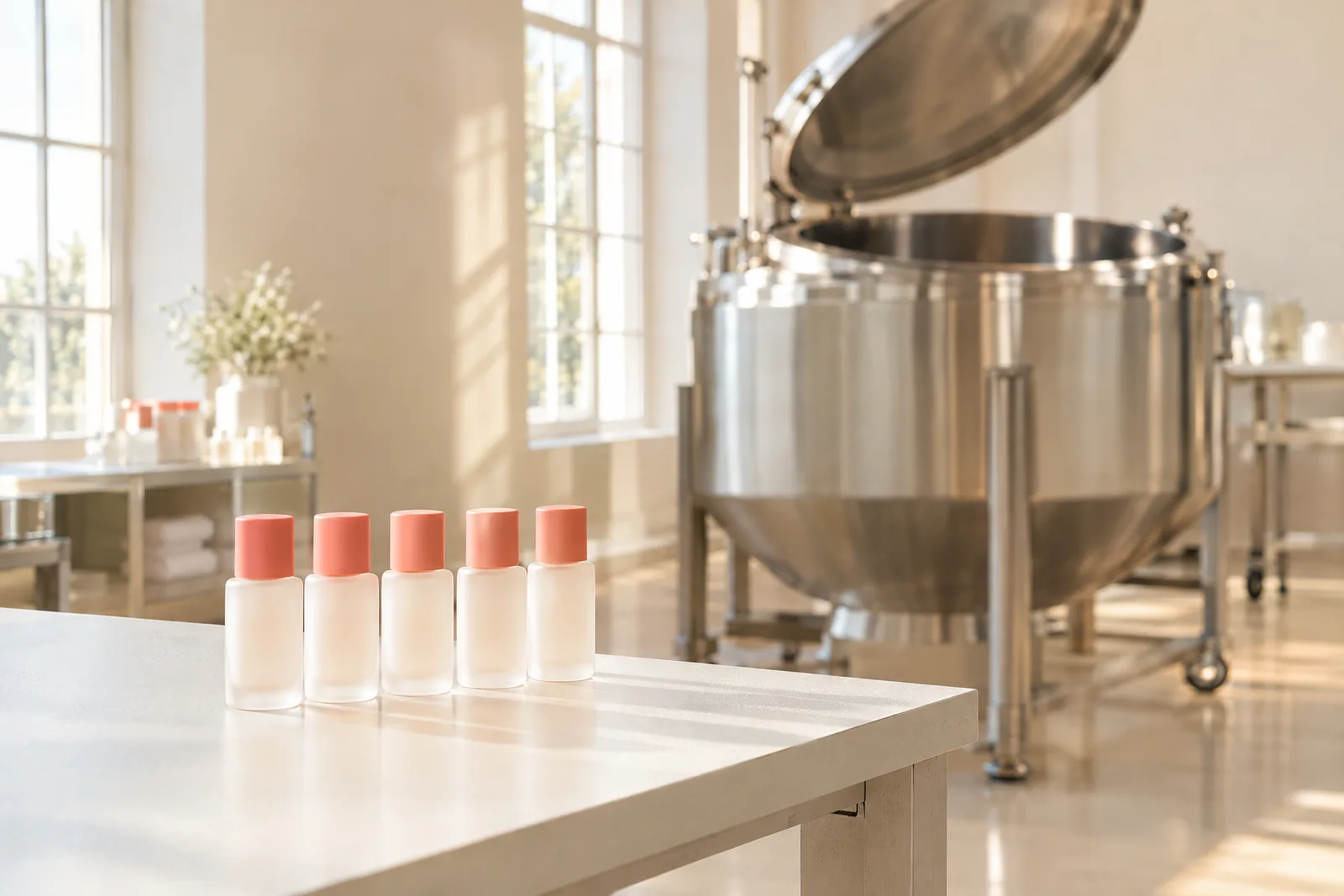
What does a low minimum order from Korean skincare manufacturers look like?
Say you’re a skincare founder with one serum you want to test in the US. Your budget covers a few hundred units, say 400 as an illustrative number. Yet every factory you email seems to want thousands. You start to wonder if a small first run is even possible.
It can be, with trade-offs. Korean skincare manufacturers that accept a low minimum order usually pair it with a stock formula and stock packaging. One Korean OEM company publishes its terms. An OEM is a factory that makes products to a brand’s order. Read on November 11, 2026, its terms start at 500 units for a serum or cream on a ready formula. A fully custom one starts at 2,000.
In our search that day, we found no other company that publishes its minimums on its own site. So expect your quoted minimum to depend on product type, formula route and packaging.
We quote minimum order figures only where a company states them on its own site. We give the date we read the page. We don’t name the company in the text. Its site is in the sources list. Our search on November 11, 2026 mostly returned figures from sourcing agents and marketplaces. We left those out. The US rules below come from FDA pages and the statute, read the same day. This is general information, not legal advice.
What does a Korean OEM that publishes its minimums say?
The one company we found shows a Busan business registration. It calls itself a Korean skincare OEM and ODM for brands abroad. An ODM is a maker that also supplies the formula. Its site says it has two factories in Pyeongtaek. One is a contracted GMP factory, meaning one run to good manufacturing practice. The company’s own staff and research team work on site there. The other is its own factory, due to finish in November 2026.
The table gives the minimums on that site as we read it on November 11, 2026. The page shows no publication date.
Treat these as one company’s stated terms. The site says the final price depends on your needs and is confirmed in a written quote. Other companies will differ. A manufacturer that publishes nothing may still accept a small order, so ask.
We haven’t worked with this company. Listing its terms isn’t a recommendation. By its own account, production today is at a contracted factory. We didn’t verify its factories, certificates or FDA registration, so ask for those yourself. The last row of ready formulas includes sunscreen. Say your serum idea turns into an SPF product. Then read our guide to selling a Korean sunscreen in the US before you order. That product needs a separate check.
Minimum orders stated by one Korean OEM company on its own site, read November 11, 2026 (the page shows no publication date)
| Route | Product types | Stated minimum |
|---|---|---|
| Ready library formula | Serums, ampoules, essences, creams, eye creams, face oils, cleansing oils, sleeping masks | 500 units |
| Ready library formula | Toners, mists, lotions, cleansers, body lotions and creams, body washes, scrubs, hand creams, shampoos, scalp serums | 1,000 units |
| Ready library formula | Single-dose sachets | 3,000 units |
| Ready library formula | Modeling and clay masks | 5,000 units |
| Ready library formula | Sunscreen, lip care, hydrogel masks, eye patches, sheet masks | 10,000 units |
| Adjusted library formula | A ready formula with a changed scent, texture, active level or free-from list | 1,000 units, or 1,500 where the ready minimum is 1,000 |
| Fully custom formula | Developed from scratch for the brand | 2,000 units |
Why do minimum orders exist, and what moves them?
Product type, formula route and packaging are the three things that move a minimum in the published terms above. Product type moves it most. The same company asks 500 units for a serum and 10,000 for a sheet mask.
The formula route comes next. It runs from 500 units on a ready formula to 1,000 or 1,500 when the formula is adjusted. It reaches 2,000 when the formula is new. Packaging is third. That company puts a stock container and a one-color label printed from your artwork in the unit price. It quotes custom packaging, decoration and boxes separately. For your serum, the cheapest first run is a ready formula in a stock bottle.
No source we read explains the factory costs behind those numbers. So the rest of this section is our reasoning. A batch has a practical lower size, set by the mixing and filling equipment. A formula made only for you has no other buyer to share a batch with. A stock base is already being made.
Bottles, pumps and printed cartons come from suppliers with their own minimums. The largest of those can set the order, even when the factory would fill fewer units. So ask each manufacturer which of these sets its figure.
Which route gives the lowest minimum, and what do you give up?
A first order follows one of three routes: a stock formula, an adjusted formula or a custom one. The formula terms in the table are the ones that company states on its site. Library concentrates are shared. These are the ready-made bases a factory sells to many brands. On the adjusted route, the adjusted version, packaging and label are yours. A custom formula isn’t offered to other brands.
The other cells are our view. We describe unit cost and lead time by direction only. We found no primary source that publishes them across manufacturers.
The trade is the same on every row. A lower minimum means less cash in the first order. It also means less stock to sell. In return, you accept a base other brands can buy. You pay more per unit. And you have less room to change the product.
In our view, watch the cash tied up in the first order, including boxes and freight. Weigh it against how long the stock will take to sell. Back to your serum. Say 500 units on a ready formula. That usually ties up less cash than 2,000 custom units. But only your sales plan says how fast either will sell. Dahna can build a unit cost and first-order cash model from your quotes. Then you can judge the minimum against a sales plan.
Three routes to a first order (formula terms as stated by one OEM company; other cells are our view)
| Route | Minimum | What you give up | Choose this if |
|---|---|---|---|
| Stock formula, also sold as private label | Lowest. Set mainly by product type and by packaging | The base is shared with other brands. Little room to change texture or actives | You are testing demand and the brand's difference is in positioning and design |
| Semi-custom ODM (an adjusted stock formula) | Higher than stock. Varies with how much you change | More time for samples. Ask who owns the adjusted version | You want a known base with your own scent, active level or free-from list |
| Full custom formula | Highest of the three. Varies with batch size and components | The longest development and the most cash in the first order | The formula is the reason the brand exists and you can fund a larger first run |
How does a small order affect US labels and MoCRA duties?
A US label is its own print job. So ask for the minimum on US labels and US cartons as a separate line. FDA’s labeling guide says required label statements must be in English. Ingredients are listed in descending order of predominance, which means the largest amount first. The label names the manufacturer, packer or distributor. If that company isn’t the maker, use a phrase such as “Manufactured for” or “Distributed by”.
Net quantity is stated in US customary units. Use fluid measure for liquids. Use weight for solids and thick, viscous products. FDA’s guide says metric units may be added. But the Fair Packaging and Labeling Act calls for both customary and metric units on consumer packages. So plan your label with both. The MoCRA statute adds a domestic address, a domestic phone number or electronic contact information for adverse event reports. Those are reports of bad reactions. A carton printed for Korea won’t carry all of that.
A small order doesn’t shrink your MoCRA duties. MoCRA is the Modernization of Cosmetics Regulation Act of 2022. It’s the US law that updated cosmetics rules. FDA describes an exemption for certain small businesses. It covers good manufacturing practice, facility registration and product listing. FDA’s guidance sets the small business line by average gross annual US sales of cosmetic products. That line is under $1,000,000 over the previous three years, adjusted for inflation. It excludes makers of certain product types.
The size of one order isn’t the test. Safety substantiation means having evidence the product is safe. It isn’t on FDA’s list of exempted requirements. Neither are the label contact and serious adverse event reports.
The duties sit with the responsible person. That’s the manufacturer, packer or distributor named on the label. If that’s your brand, you list each product with its ingredients. You also give the registration number of each facility where it’s made. A stock formula doesn’t change this. The statute puts the listing duty on the responsible person for each product. Nothing we read lets one brand rely on another brand’s listing of the same base.
One listing can cover products with identical formulations. It can also cover formulations that differ only in colors, fragrances or flavors, or quantity of contents. That helps if you sell one base in two sizes.
The factory must be registered too. FDA’s guidance says a contract manufacturer outside the US registers if its products are distributed in the US. One registration covers every brand it makes for. Say the facility is exempt and has no registration number. Then the guidance accepts its name and address in your listing. Our MoCRA checklist for Korean brands has the dates.
What should you ask Korean skincare manufacturers, and which documents should you get?
Send every manufacturer the same ten questions. Ask for written answers. The first six are about the minimum itself. The last four are about selling the order in the US. The worksheet has all ten. It has a column for each manufacturer’s answer, so you can compare them side by side.
Ten questions for a manufacturer that offers a low minimum, with the document to ask for
| Ask | Why it matters | Get in writing |
|---|---|---|
| What is the minimum for this product type on a stock formula, an adjusted one and a custom one? | The minimum changes with product and route | A quote with the minimum per route |
| Is the minimum per product, per scent or shade, or per size? | Three scents at the minimum each is three times the order | The unit the minimum applies to |
| Which packaging is included, and what are the minimums for custom containers, labels and cartons? | A component minimum can set the whole order | A component list with each minimum |
| What does the unit price leave out? | Boxes, decoration, tests and freight may be quoted separately | A line-item quote |
| Who else can buy this formula, and who owns an adjusted version? | A shared base can appear under another brand | The ownership and exclusivity clause |
| What is the minimum and the price for a reorder? | The second order shows whether the product can scale | Reorder terms |
| Is the facility registered with FDA, and who is its US agent? | Your product listing needs the facility's registration number | The registration number (FEI) and US agent |
| Will you give us the full ingredient list, including fragrances, flavors and colors? | The listing and the US label both need it | The ingredient list with percentages or order |
| Which safety tests exist for this formula in this packaging? | The responsible person keeps records that substantiate safety | Copies of the reports |
| Can the label and carton be printed in a US version, and what is that minimum? | US label rules differ from a Korean pack | A US label proof and the print minimum |
Does FDA approve your skincare product before it ships?
No. FDA’s page for cosmetics importers says cosmetic products and ingredients, other than color additives, don’t need FDA approval before they go on the market. The same page says cosmetics that appear to be adulterated or misbranded may be refused entry. Adulterated means unsafe or contaminated. Misbranded means wrongly or misleadingly labeled. So the label work above is where your effort goes.
What should you do before you ask Korean skincare manufacturers for quotes?
Work through these steps in order before you send a single request for a quote. For the serum founder at the top, they’ll likely point to a ready formula in a stock bottle. Size it to what you can sell before it expires.
Our earlier guides cover what to prepare before approaching a Korean OEM or ODM. They also show how to read the quotes that come back. All beauty and K-beauty marketing guides are on one page. Once your first order is sized and the US launch is next, see how Dahna works with Korean brands entering the US.
- Decide how many units you can sell before the product expires. Treat that as your ceiling.
- Pick the route first: stock, adjusted or custom.
- Choose stock packaging for the first run, unless the pack is what makes the product different.
- Send the ten questions to three or four manufacturers. Compare the written answers.
- Check each quoted minimum against the cash it ties up, with boxes, tests and freight included.
In summary
Korean skincare manufacturers usually offer a low minimum only on a stock formula in stock packaging. One Korean OEM company that publishes its terms starts at 500 units for a serum on a ready formula. A custom one starts at 2,000, as read on November 11, 2026. In our search we found no other company that publishes them. A small order doesn’t reduce your US label and MoCRA duties.
Sources & further reading
- Korean Skincare OEM and Private Label Manufacturer, the company's own terms (the page shows no publication date) (checked November 11, 2026)Idenbrick Co., Ltd.
- Cosmetics Labeling Guide, content current as of February 25, 2022 (checked November 11, 2026)U.S. Food and Drug Administration
- 15 U.S.C. 1453, Requirements of labeling; placement, form, and contents of statement of quantity (2024 edition) (checked November 11, 2026)U.S. Government Publishing Office
- 21 U.S.C. 364e, Labeling (2024 edition) (checked November 11, 2026)U.S. Government Publishing Office
- Modernization of Cosmetics Regulation Act of 2022 (MoCRA), content current as of October 29, 2026 (checked November 11, 2026)U.S. Food and Drug Administration
- Guidance for Industry: Registration and Listing of Cosmetic Product Facilities and Products, December 2024 (checked November 11, 2026)U.S. Food and Drug Administration
- 21 U.S.C. 364, Definitions (2024 edition) (checked November 11, 2026)U.S. Government Publishing Office
- 21 U.S.C. 364c, Registration and product listing (2024 edition) (checked November 11, 2026)U.S. Government Publishing Office
- 21 U.S.C. 364d, Safety substantiation (2024 edition) (checked November 11, 2026)U.S. Government Publishing Office
- Cosmetics Importers, content current as of November 18, 2025 (checked November 11, 2026)U.S. Food and Drug Administration
Judge the minimum against a sales plan.
Dahna does not source manufacturers or negotiate with them. Once you have quotes, Dahna can build them into one model with landed cost, channel fees and ad spend, so the first order is sized against what the launch can sell.
This article is general information, not legal or regulatory advice. The company's terms quoted are its own, read on the date shown, and can change.