Which ecommerce conversion problem should your brand fix first?
Fix the problem that most clearly prevents an important customer task, starting with a broken purchase path or material product confusion. A conversion review should tell your team what to change first and why. It should not turn every visual preference into a high-priority redesign project.
Dahna, original planning diagram
In this article
Overview
Fix the problem that most clearly prevents an important customer task, starting with a broken purchase path or material product confusion. A conversion review should tell your team what to change first and why. It should not turn every visual preference into a high-priority redesign project.
The decision in context
Use observed evidence, the affected audience and the cost of a repair to choose the next action. Keep strong evidence of a defect separate from an idea that still needs testing. That makes the backlog manageable for a small brand.
Start with a task a real buyer needs to complete
Write the task in the customer’s language: compare two moisturizers, choose a shade, confirm what is in a device kit, understand delivery timing, or complete a purchase. “Improve the product page” is a project label; it does not identify what currently goes wrong for the buyer.
Walk through that task on the devices and market settings the brand actually serves. Use realistic products, variants and delivery destinations. A homepage review on a large office monitor can miss a mobile selector that blocks purchase or a shipping message that changes for a US customer.
Keep a dated record of what happened. A screenshot, short recording, support question or reproducible failure gives the implementation team something concrete to inspect. Separate observed behavior from your interpretation of why it happened.
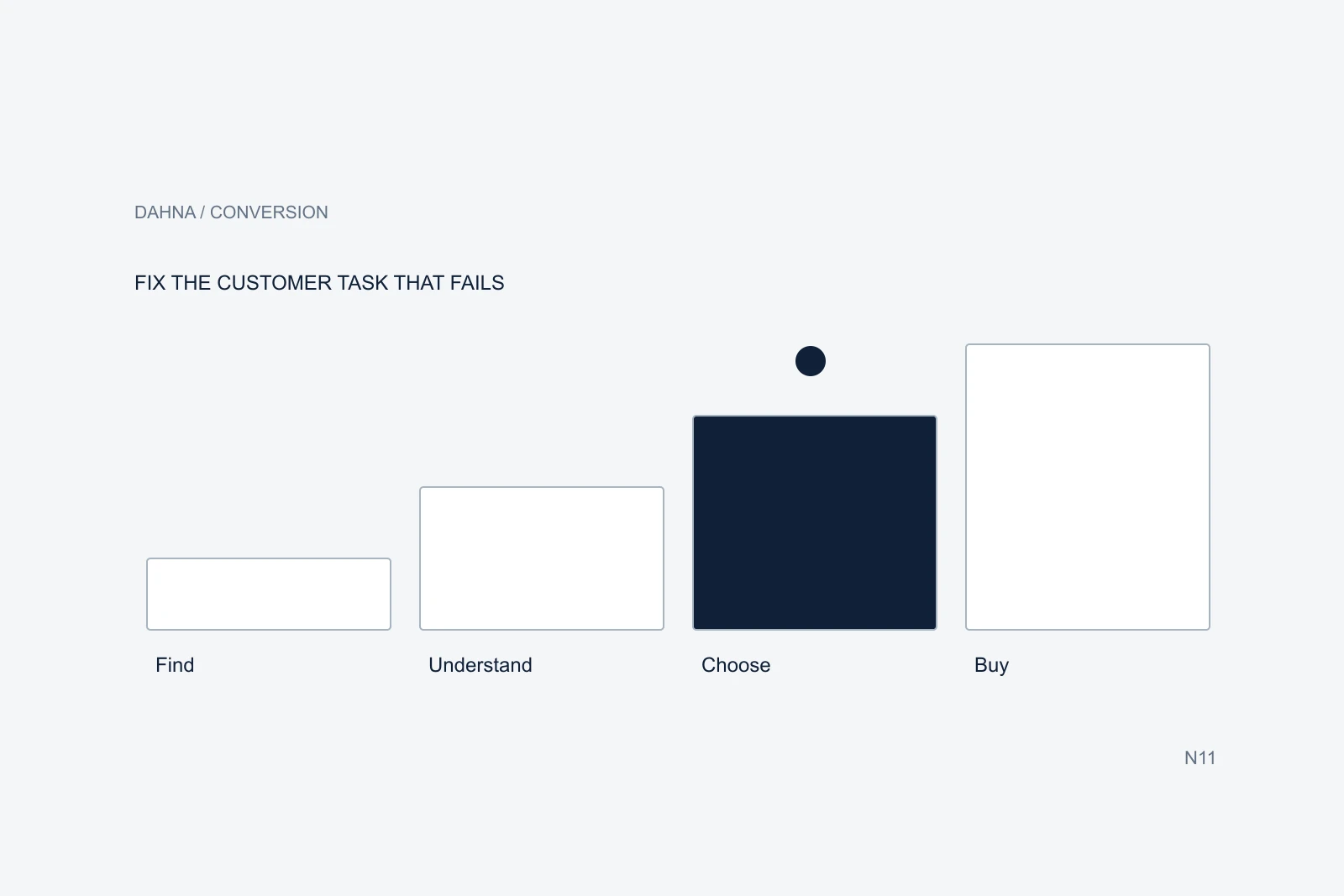
Follow the buying task to the point of failure
Understand
Can I identify the product and its role?
Choose
Can I compare the relevant option or variant?
Commit
Can I find price, delivery and return information?
Complete
Can I place the intended order?
Distinguish a blocker from a preference
A variant selector that cannot be used is a reproducible defect. A customer repeatedly misunderstanding what a kit includes is evidence of an information problem. A stakeholder disliking the color of a button is a preference unless there is a relevant usability or accessibility issue behind it.
Baymard’s checkout research uses qualitative usability work to investigate where people struggle with ecommerce tasks. The useful principle is to observe the interaction and its context. A published benchmark or potential improvement figure does not establish the uplift your store will achieve from one change.
Ask what evidence would strengthen or weaken the proposed fix. If a page seems too long, find out whether people can locate the important answer. If they cannot, the first repair may be structure or labeling rather than cutting all detail. The diagnosis should determine the design work.
A fictional skincare store with five competing requests
Imagine a store has a limited development allowance and five requests: repair a broken mobile shade selector, add kit contents, redesign the homepage, clarify delivery timing and animate a product image. The first two have reproducible evidence. Delivery questions appear in support messages. The other requests are preferences without an identified customer failure.
The selector repair comes first because it blocks an intended purchase. Kit contents and delivery information follow as defined customer-information work. The homepage and animation ideas remain in the backlog until the team can explain which task they improve and why that task deserves the investment.
This ordering is a proposed decision for the fictional situation, not a universal score. A different store may have no technical blocker and a genuine homepage navigation problem. Preserve the reasoning so a change in evidence can change the priority.
| Issue | Evidence | First action | Priority rationale |
|---|---|---|---|
| Mobile shade selection fails | Reproduced on the target device | Repair and retest the selection-to-order path | Blocks purchase |
| Device kit contents unclear | Customer task review and repeated questions | Add accurate included/not-included information | Affects product understanding |
| Delivery timing hard to find | Relevant support questions | Place current destination-specific information where needed | Affects commitment |
| Homepage feels dated | Stakeholder preference only | Define and observe the affected task | Evidence still needed |
| Product image should animate | No demonstrated task issue | Hold pending a useful purpose | Lower immediate decision value |
Make the repair small enough to verify
Describe the changed behavior, affected templates and acceptance check. “Improve variants” is vague. “The selected shade, displayed image, cart line and checkout order must agree on supported mobile devices” gives the team a concrete target.
Include the product owner where a correction changes customer-facing facts. A designer should not invent device compatibility, delivery promises or product benefits to fill an empty component. The scope needs an approved source and someone responsible for keeping it current.
Preserve useful content, working routes and existing measurement. A targeted repair can be a complete project. A broader rebuild becomes reasonable when the current structure cannot support the required work, not simply because several small changes appear on a list.
Verify the task before looking for a revenue effect
First confirm that the intended task now works. Test relevant variants, device sizes, error states and destinations. Then verify that measurement still records the agreed events correctly. A technically successful release can still break analytics or create a mismatch between product selection and the cart.
After implementation, observe commercial behavior over an appropriate period. Record other changes such as promotions, traffic mix and stock availability. A before-and-after conversion rate is useful context, but it does not isolate the effect of the repair when several conditions changed together.
Microsoft Research’s controlled-experiment work illustrates the value of a valid comparison. For a small store, a formal test may not be practical for every fix. A broken checkout does not need to remain broken while waiting for an experiment; correct it and be precise about which later conclusions the evidence can support.
Include effort and business constraints without inventing a score
Estimate the implementation effort and the affected scope, but avoid false precision. A score of 83.7 is not automatically more rigorous than a short explanation that a defect blocks the hero product on mobile. If the cost or impact estimate is uncertain, show the uncertainty.
Ask whether the business can use the improvement. A clearer product page will not solve an unavailable product, an unsupported delivery region or an offer that cannot support acquisition costs. Coordinate the website backlog with stock, customer service and paid-media plans.
When two fixes are similarly useful, choose the one that can resolve uncertainty sooner or remove a dependency for other work. The goal is a sequence that helps customers and the team, not the longest list of completed tickets.
| Question | What a useful answer provides |
|---|---|
| How strong is the evidence? | Reproduced failure, repeated customer issue or a clearly stated hypothesis |
| Who is affected? | Relevant products, markets, devices and tasks |
| What does the repair enable? | A specific buying or maintenance capability |
| What will it take? | Owner, dependency and bounded effort estimate |
| How will we verify it? | An acceptance check before outcome reporting |
What to ask Dahna to deliver
Bring the product path, customer questions and a short list of suspected problems. Dahna can help distinguish a product-explanation issue, a design problem, a technical defect and an untested idea. The first output should be a prioritized scope with evidence and acceptance criteria.
At handoff, your team should know what was fixed, how it was checked and what remains a hypothesis. That creates a better basis for the next website or advertising investment than a generic promise to increase conversion by redesigning everything.
Use this guide in your next brief
Download the tables from this guide as a working reference. Keep the example assumptions separate from your own figures, and record the source and date of any numbers you replace.
Sources & further reading
Plan your next conversion optimization decision
Share the product path and the customer task that seems difficult. Include reproducible problems, support questions and any development or inventory constraints.
Why consider Dahna for this work?
Dahna brings bilingual Korean and English strategy together with creator, content, and measurement work for brands growing in the US. You can review the people behind the recommendations and the kind of work we propose before starting a conversation.
Founder experience includes prior and contracted roles. Sample deliverables illustrate our approach; they are not client results or a performance promise.
External examples are research references, not Dahna client results or promised outcomes.