Data-driven marketing: turn a weekly report into a better decision
Marketing uses data to improve judgment: what customers need, what the team should create, where money is being spent and which results are commercially useful. The point is not to remove creativity or let the largest dashboard number make every decision. It is to make assumptions visible and learn which ones hold up.
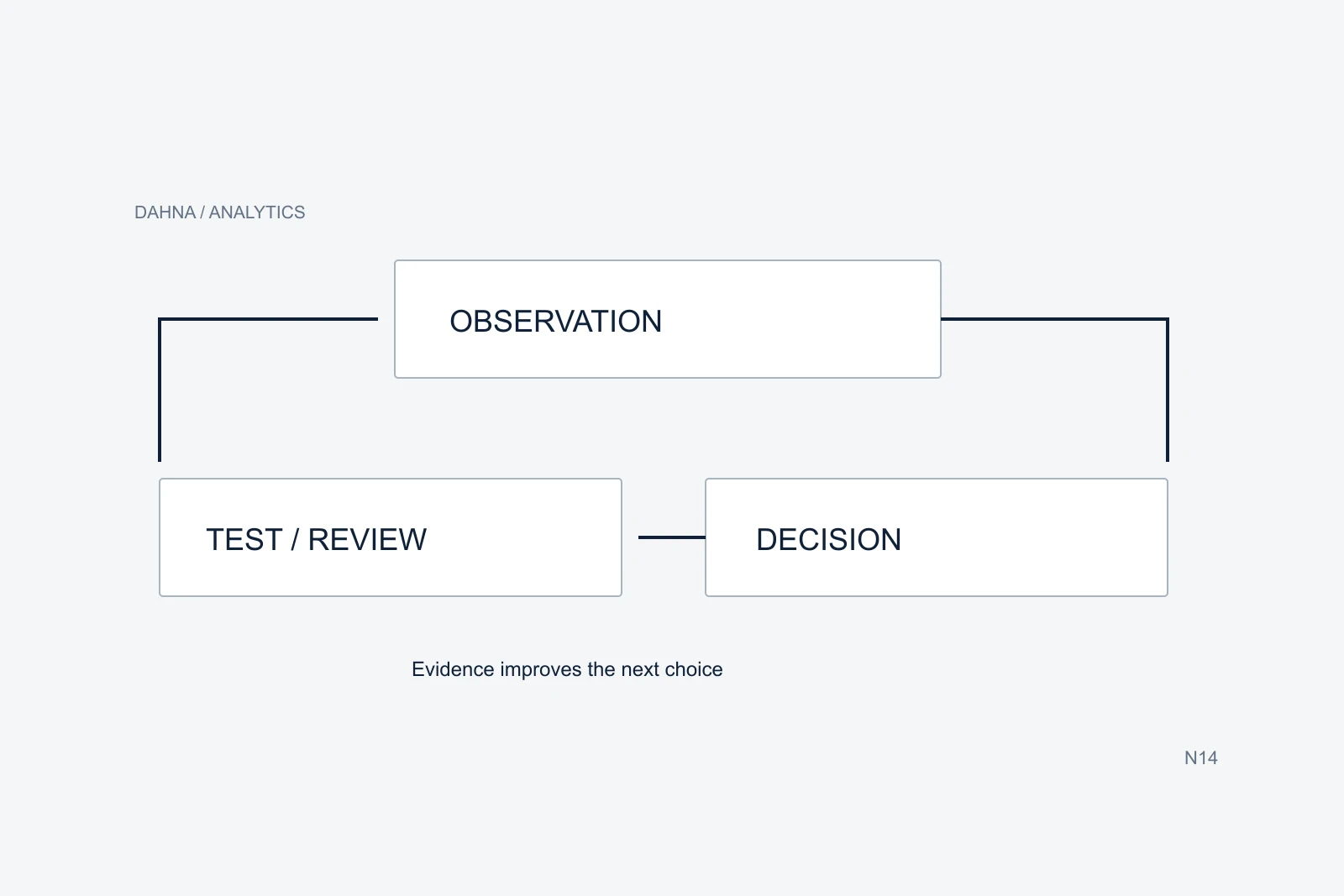
Dahna, original planning diagram
In this article
Overview
Marketing uses data to improve judgment: what customers need, what the team should create, where money is being spent and which results are commercially useful. The point is not to remove creativity or let the largest dashboard number make every decision. It is to make assumptions visible and learn which ones hold up.
The decision in context
A good weekly review ends with a small number of decisions, an owner for each and an explanation of what evidence would change the plan. If a report only records what happened, it is an archive. The work begins when the team uses it to decide what to do next.
Treat comments, behavior and transactions as different evidence
Customer questions tell you what may be unclear. Website behavior can show where an observed task stalls. Transactions show that someone bought under particular conditions. Interviews, support messages, search queries and financial records can all matter, but they do not answer the same question.
Keep the evidence close to its original meaning. A comment asking about a device’s power supply is a product-information question, not proof of market demand. A high video completion rate shows something about viewing behavior under that report’s definition, not that viewers will buy. A completed order still has costs and possible returns.
The useful habit is to ask what decision a piece of evidence can support. That prevents a team from using the easiest available metric as a substitute for the question it actually needs to answer.
Match the evidence to the decision
Customer language
What is confusing, attractive or missing?
Observed behavior
Can people complete the intended task?
Commercial record
What was bought, refunded and retained?
Causal evidence
What changed because of the intervention?
What the eBay advertising research teaches about interpretation
Thomas Blake, Chris Nosko and Steven Tadelis used field experiments at eBay to examine paid-search effectiveness. Their work illustrates why an advertising click and a subsequent purchase do not automatically establish that the ad created the purchase. Existing customer intent can influence both.
The lesson for a smaller brand is methodological, not a command to stop search advertising. Ask what the report observes and what causal conclusion the team wants to draw. Those are different steps. A new brand, product category or audience can behave differently from the business studied.
When a causal question materially affects investment, discuss whether an appropriate experiment is feasible. When it is not, make the limitation part of the decision. You can still use the best available evidence without calling every attributed order incremental.
Use data to improve the creative question
TikTok’s historical Queen Cosmetics case describes videos built around color combinations requested in comments. That is a concrete example of audience language informing what the brand shows. It does not prove that every request should become a video or that copying the format will reproduce the campaign’s results.
Imagine a fictional moisturizer brand repeatedly sees the question, “Which one should I use under makeup?” The next useful asset may be a clear comparison of the relevant products under approved use conditions. Producing another broad brand montage would answer a different question, even if the montage earns more views.
The creative team still needs judgment: which question matters, how to demonstrate it honestly, how to make the content engaging and what the product can substantiate. Data narrows and tests the brief. It does not write the idea on its own.
Run a short meeting around three decisions
Begin with what changed enough to matter. Show the count, definition, period and relevant context. Then ask whether the observation supports keeping, changing, stopping or investigating an activity. A meeting with three well-supported decisions can be more useful than a tour through twenty charts.
Review commitments from the previous meeting before adding new ones. Did the page fix ship? Was the stock issue resolved? Did the new demonstration answer the intended question? Without that check, a team can repeatedly discuss the same problem while mistaking meetings for progress.
Give each decision an owner, an action, a maximum resource commitment and a review condition. Avoid demanding a numerical target for something the current evidence cannot estimate responsibly. Sometimes the next milestone is a verified implementation or a completed customer task, not a promised sales uplift.
| Observation | Decision | Owner | Next evidence |
|---|---|---|---|
| Shoppers ask which moisturizer works under makeup | Create one side-by-side explanation with approved product facts | Content lead + product owner | Can relevant shoppers explain the difference afterward? |
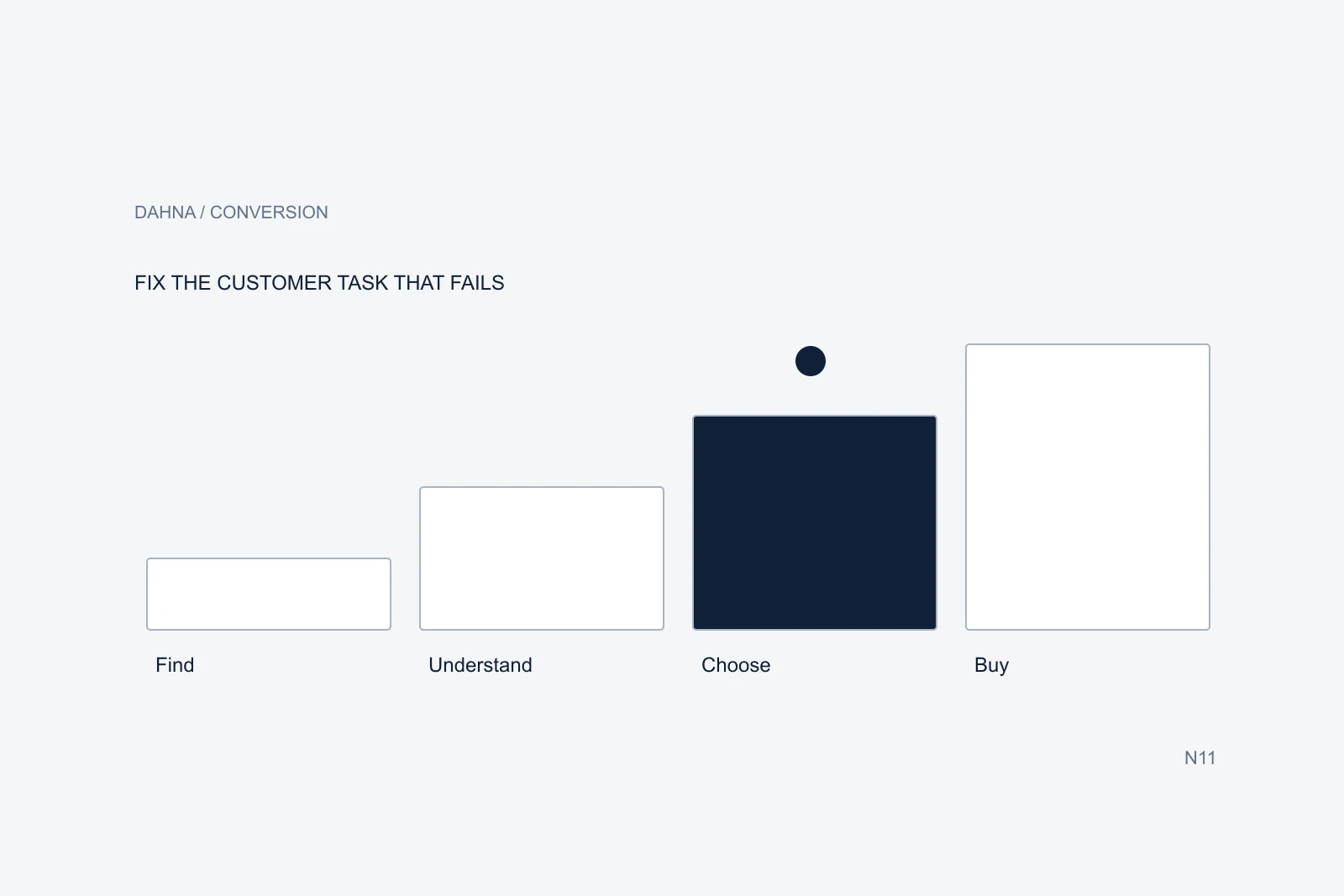
| Mobile buyers cannot select one variant | Repair and verify the selector before buying more traffic | Website owner | The intended selection and order path works on target devices |
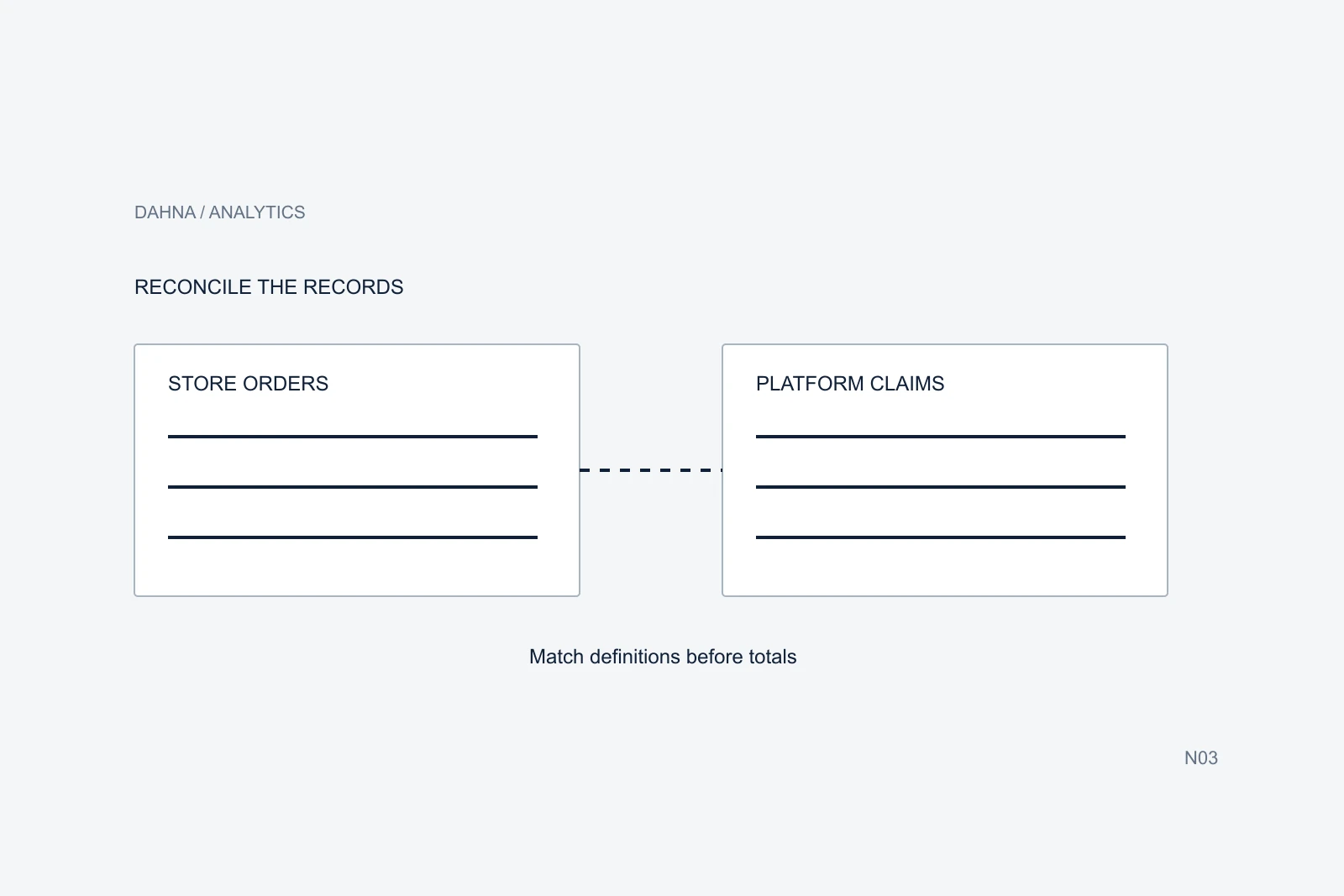
| Campaign return rose after attribution settings changed | Reconcile definitions before raising budget | Analyst + paid-media lead | Comparable periods and a contribution view |
| New article has only a few recorded visits | Continue observation; inspect relevance rather than claim a trend | Search lead | Complete reporting period and relevant landing-page activity |
What makes a test more informative than a before-and-after screenshot
Write the hypothesis before seeing the result. Define the changed element, the population, the primary outcome and important guardrails. Record whether the test uses a valid comparison group or simply observes a change over time. Both can be useful, but they support different strengths of conclusion.
Microsoft Research’s work involving Ronny Kohavi describes controlled experimentation as a way to evaluate ideas. A growing store can borrow the discipline of a clear question and trustworthy measurement without pretending it has Microsoft’s traffic or experimentation infrastructure.
Small samples require patience and proportion. If a change is obviously broken, fix it. If a difference is small and noisy, avoid declaring a winner from a few purchases. Choose a simpler task study or a longer observation period when that better matches the decision. Do not invent statistical certainty to keep a weekly reporting cadence.
Choose metrics that do not reward the wrong behavior
A creator team paid only for post count may prioritize easy placements over useful explanations. A content team judged only on traffic may chase unrelated queries. An agency paid on gross sales may have an incentive to discount aggressively. None of those measures is inherently useless, but each needs context and guardrails.
Pair the output with the result it should support. For a content program, record what useful work shipped and whether relevant people can find and use it. For a campaign, show attributed revenue alongside contribution and reporting limits. For lead generation, distinguish a form event, a received inquiry and a qualified opportunity.
Keep unknown outcomes unknown. If no one has reviewed the inquiries, the qualified-inquiry count is unavailable rather than automatically zero or equal to the number of form submissions. That distinction may feel less impressive, but it protects the next budget decision from a false success story.
| Headline measure | Guardrail or companion evidence |
|---|---|
| Video views | Relevant product questions and the intended buying task |
| Published content | Distinct intent, accurate evidence and useful discovery paths |
| Attributed revenue | Returns, contribution and attribution limitations |
| Inquiry submissions | Confirmed receipt and a documented qualification review |
| Experiment result | Sample size, comparison design and other changes during the period |
What a useful agency report should contain
Ask for the decision summary first: what the team recommends, why, and what would change its mind. The supporting report should include source definitions, comparisons, implementation history and unresolved items. The brand should own the accessible working files and understand how the numbers were produced.
Dahna can connect customer research, creative work, website behavior and commercial review in a shared operating rhythm. Bring the questions your current reports do not answer. The goal is a weekly process that helps the team make fewer unsupported moves and learn from the work it actually completes.
Use this guide in your next brief
Download the tables from this guide as a working reference. Keep the example assumptions separate from your own figures, and record the source and date of any numbers you replace.
Sources & further reading
Plan your next measurement decision
Share a recent report and the decision it failed to answer. Tell us who can validate order economics, review inquiries and approve changes to the website or creative.
Why consider Dahna for this work?
Dahna brings bilingual Korean and English strategy together with creator, content, and measurement work for brands growing in the US. You can review the people behind the recommendations and the kind of work we propose before starting a conversation.
Founder experience includes prior and contracted roles. Sample deliverables illustrate our approach; they are not client results or a performance promise.
External examples are research references, not Dahna client results or promised outcomes.