Can you trust your beauty agency? Check account ownership, data and accountability
Before hiring a beauty agency, check account ownership, access, decision records and exit terms so your brand keeps its data and accumulated learning.
How can you verify that a beauty marketing agency is trustworthy?
Trust in a beauty marketing agency should be supported by access you can verify and decisions you can understand. Before signing, establish who owns the accounts, who can inspect the underlying data, where strategy decisions are recorded and what remains with the brand when the relationship ends. A good relationship should accumulate knowledge without making that knowledge inaccessible to its owner.
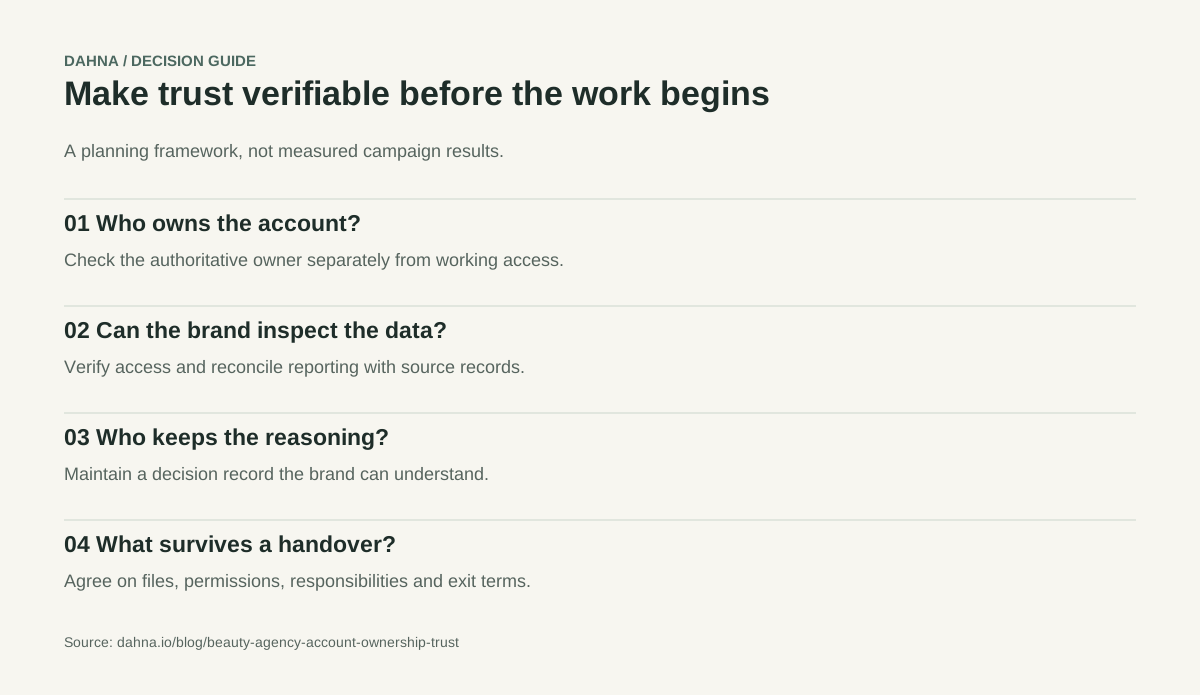
Make trust verifiable before the work begins
- Who owns the account?
- CheckCheck the authoritative owner separately from working access.
- Can the brand inspect the data?
- CheckVerify access and reconcile reporting with source records.
- Who keeps the reasoning?
- CheckMaintain a decision record the brand can understand.
- What survives a handover?
- CheckAgree on files, permissions, responsibilities and exit terms.
Ask to see how the relationship will remain verifiable
A persuasive pitch can explain what an agency wants to do. It does not show whether the brand will be able to inspect the work after it starts. Ask for a demonstration of the proposed reporting structure, account-access model and decision record, using a sample or appropriately redacted material. Evaluate whether a new internal employee could understand the work from those records.
The question is not whether the agency will share every private internal process. Distinguish its own tools and methods from the brand's accounts, purchased deliverables and agreed reporting. Put the expected access and outputs into the scope so both sides know what the relationship includes.
Does access to an ad account mean your brand owns it?
No. Working access to an advertising dashboard and account ownership are separate. List the authoritative owner, administrator, working users and billing responsibility individually. TikTok's Business Center documentation distinguishes management and ownership actions; verify the actual setup rather than relying on the word ‘access’ in a proposal.
For each platform, agree who controls recovery methods, who may invite partners and how permissions are removed. Use the platform's supported access model. Some assets or arrangements have transfer restrictions, so do not assume that an account created under one organization can simply be moved later.
Request equivalent clarity for analytics, domains, storefronts and files. A brand should understand where its source records live and which rights it has to use the delivered creative. Account access, exported data and permission to reuse a creator's likeness are separate questions.
| Asset | Evidence to request | Decision to record |
|---|---|---|
| AssetAdvertising account | Evidence to requestOwner and current permissions | Decision to recordWho controls access and what happens on exit |
| AssetAnalytics | Evidence to requestBrand access to the relevant property and definitions | Decision to recordWho can inspect and export the agreed data |
| AssetCreative | Evidence to requestDeliverables and usage permissions | Decision to recordWhat the brand can edit, reuse and retain |
| AssetStrategy | Evidence to requestA sample decision and test record | Decision to recordWhere the working history will be maintained |
| AssetReporting | Evidence to requestSource-to-report reconciliation | Decision to recordHow differences and errors are investigated |
Make the reasoning part of the deliverable
Historical results are difficult to interpret without context. A campaign may have run during a discount, a stock shortage or a change in tracking. Require a concise record of the question, assumptions, actions, results and limitations. Include what the team chose not to do and why when that decision will matter later.
A useful report makes disagreement possible. The brand should be able to ask whether an increase came from more spend, a different offer or genuinely better execution. If only the agency can explain the numbers and the explanation changes each month, the relationship is creating dependence rather than shared understanding.
Does switching agencies erase your data and campaign history?
Switching agencies does not inherently erase account history or require every strategy to restart. The transition does require onboarding, validation and a new working relationship. Missing permissions, source files or decision records can make that work expensive, so establish what stays accessible to the brand before changing partners.
Separate account continuity from changes to campaigns. TikTok documents that significant campaign changes can trigger a learning phase; that is a platform behavior tied to campaign conditions, not evidence that an agency change itself erases all learning. Require the incoming team to explain what it proposes to preserve, verify or change before rebuilding working structures.
A documented exit process is a trust signal, not a prediction that the partnership will fail. Confirm practical responsibilities and contractual terms with the appropriate reviewers. If a change becomes necessary, use the existing handover guide to manage it without abandoning the evidence already collected.
What should an agency show when a campaign goes wrong?
Ask how the team handles a missed deadline, an incorrect report or a test that does not support the original strategy. A useful answer names the owner, explains how the issue becomes visible and shows how the next decision is recorded. Guaranteed results and vague assurances do not replace those operating details.
The same standard applies to the brand. Provide timely approvals, accurate product facts and a person authorized to make commercial decisions. Trust becomes easier to sustain when responsibilities are explicit and both sides can see whether they are being met.
Start with a relationship you can understand
Ask Dahna to show how the proposed scope, account access, deliverables and decision records would work for your brand. Tell us what you need to preserve and what needs to improve.
Why consider Dahna for this work?
Dahna brings bilingual Korean and English strategy together with creator, content, and measurement work for beauty brands. You can review the people behind the recommendations and the kind of work we propose before starting a conversation.
Founder experience includes prior and contracted roles. Sample deliverables illustrate our approach; they are not client results or a performance promise.