US K-beauty growth experiments: a first-90-days test plan
Plan the first 90 days of US K-beauty growth: diagnose the constraint, choose a channel, test creators and expand only what the evidence supports.
What should a K-beauty brand test during its first 90 days of US growth?
A K-beauty brand's first 90 days of US growth should test the product explanation, creator approach, purchase path and readiness to expand. Confirm product and purchase readiness, choose one priority channel, and record the hypothesis, costs, owner and review window for each experiment. Use the results to decide what to change, stop or fund next; a 90-day plan cannot guarantee a revenue level.
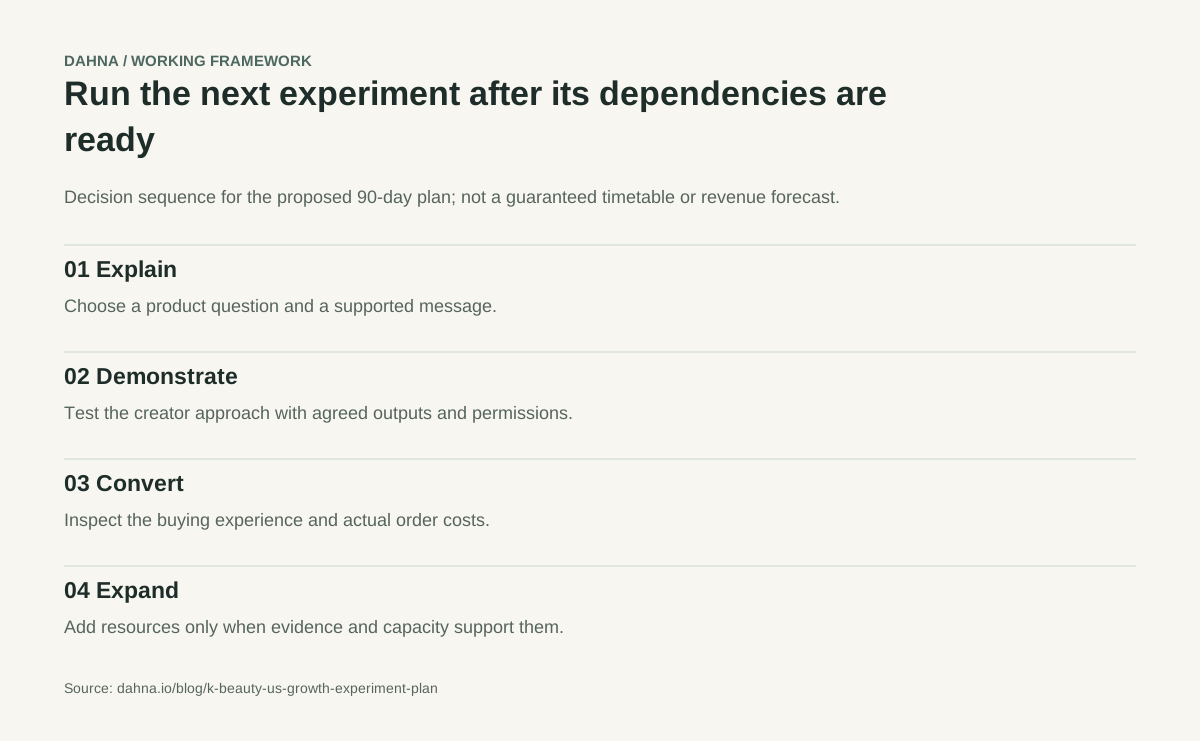
Run the next experiment after its dependencies are ready
Explain
Choose a product question and a supported message.
Demonstrate
Test the creator approach with agreed outputs and permissions.
Convert
Inspect the buying experience and actual order costs.
Expand
Add resources only when evidence and capacity support them.
Start from your US constraint, even if the brand is established elsewhere
An existing customer base in Korea is useful evidence about the product, but it does not establish which US customer will buy it, at what price or through which channel. A brand already selling in America has a different starting point: recent orders, returns, acquisition sources and customer questions can show where growth is constrained.
Choose a hero product and a specific customer problem for the first plan. Record the landed product cost, available inventory, margin assumptions, approved claims, fulfillment ownership and purchase destination. If those inputs are unresolved, describe the work as launch preparation rather than pretending that a larger marketing budget will fix them.
Translate the buying decision, not just the packaging language. Explain the product's role in a familiar routine, the amount to use and the evidence behind the benefit. A product celebrated in another market may need a different introduction in the US. Keep the product truth consistent while changing the explanation.
Use the first 90 days as decision windows
Use the first 90 days to answer a limited set of commercial questions. The worksheet below organizes experiments by dependency rather than prescribing an agency onboarding schedule. Finish readiness work before running a test that depends on it, and allow each measurement window to mature before making a comparison.
Name one decision owner on the brand side. Keep an approval record for the product story, creator brief, budget and destination. Parallel preparation can save time, but work that depends on an unresolved claim or unavailable product should not be rushed into publication.
| Experiment | Keep explicit | Decision evidence |
|---|---|---|
| ExperimentProduct explanation | Keep explicitCustomer question, product and destination | Decision evidenceRelevant visits and recurring objections |
| ExperimentCreator approach | Keep explicitBrief, deliverables, permissions and distribution | Decision evidenceUsable output and customer response |
| ExperimentPurchase path | Keep explicitPage change, availability, price and review window | Decision evidenceObserved buying friction and completed orders |
| ExperimentExpansion | Keep explicitAdditional spend, staffing, stock and margin assumptions | Decision evidenceWhether the next cycle remains supportable |
Should you launch on several US sales channels at once?
Use one priority channel for the initial experiment when that gives the team a clear customer, destination and success definition. A direct website, marketplace and TikTok Shop have different buying and operating requirements. Choose the channel your customer can use and your team can support, rather than opening several independent programs at once.
One priority channel does not require silence elsewhere. It means the test has one primary destination and success definition. Announcements and creator content can support that destination without launching several independent programs at once. If the brand already has reliable demand on one channel, investigate the existing bottleneck before opening another.
Make the creator test answer a product question
Write down the uncertainty the content should resolve. For a cleanser it might be how the texture fits an evening routine. For makeup it might be how a shade looks under consistent lighting. Choose creators who can demonstrate that point credibly, then compare clearly recorded approaches rather than asking everyone to repeat a generic launch script.
Separate asset production from audience distribution and paid usage. Contract the work and permissions needed for the test, preserve room for honest opinions and make disclosures clear. Decide how many usable outputs the team can review and deploy before deciding how many people to recruit.
Track the connection between the content and the destination. A video explaining one product concern should lead to a page that answers it. If comments repeatedly ask the same question, update the product explanation and the next brief together. The faster learning cycle comes from closing that loop.
What costs belong in a K-beauty growth-test budget?
Use an explicit test budget and separate production, creators, samples, logistics, media and management. Keep a reserve for correcting the purchase experience or producing a follow-up explanation. Spending the entire budget on the first wave leaves little room to act on what it teaches you.
An illustrative order with $50 in net revenue and $25 in product, fulfillment, transaction and expected return costs leaves $25 before marketing and overhead. That $25 is not a recommended acquisition cost: spending all of it on acquisition leaves nothing for overhead or profit. Replace every input with the brand's own costs and decide which additional margin must remain.
Do not justify unprofitable first orders with assumed lifetime value. If repeat purchase is part of the plan, use observed cohorts and a realistic time horizon. A replenishable product still needs evidence that customers buy it again at a cost the business can sustain.
What evidence should justify expanding a US growth test?
At review, write three separate conclusions: what the team delivered, what customers did and what remains uncertain. If conversion improves after a page change and a promotion, acknowledge that both changed. Attributed sales alone cannot establish which action caused the improvement.
Increase a supported activity in a bounded next cycle, with enough stock and people to handle it. If the evidence is weak, simplify the test or change the hypothesis. If demand is real but fulfillment is unreliable, the next investment may belong in operations. Scaling fast means removing the actual delay in the business, not increasing every activity at once.
Turn your US growth goal into an executable plan
Dahna can connect positioning, localization, creators, content and measurement around your current US growth constraint. Tell us the story so far and what you want to build next.
Why consider Dahna for this work?
Dahna brings bilingual Korean and English strategy together with creator, content, and measurement work for beauty brands. You can review the people behind the recommendations and the kind of work we propose before starting a conversation.
Founder experience includes prior and contracted roles. Sample deliverables illustrate our approach; they are not client results or a performance promise.