Can shoppers tell what makes your beauty brand different?
When beauty shoppers face more information than they can comfortably evaluate, clear branding and credible demonstrations can reduce the work of choosing. A recognizable brand helps people connect encounters; a useful creator explains what they tried and learned. Present the decision clearly and keep the evidence and limitations accessible so customers can assess the reasons behind a recommendation.

In this article
How can clear branding help beauty shoppers make a decision?
When beauty shoppers face more information than they can comfortably evaluate, clear branding and credible demonstrations can reduce the work of choosing. A recognizable brand helps people connect encounters; a useful creator explains what they tried and learned. Present the decision clearly and keep the evidence and limitations accessible so customers can assess the reasons behind a recommendation.
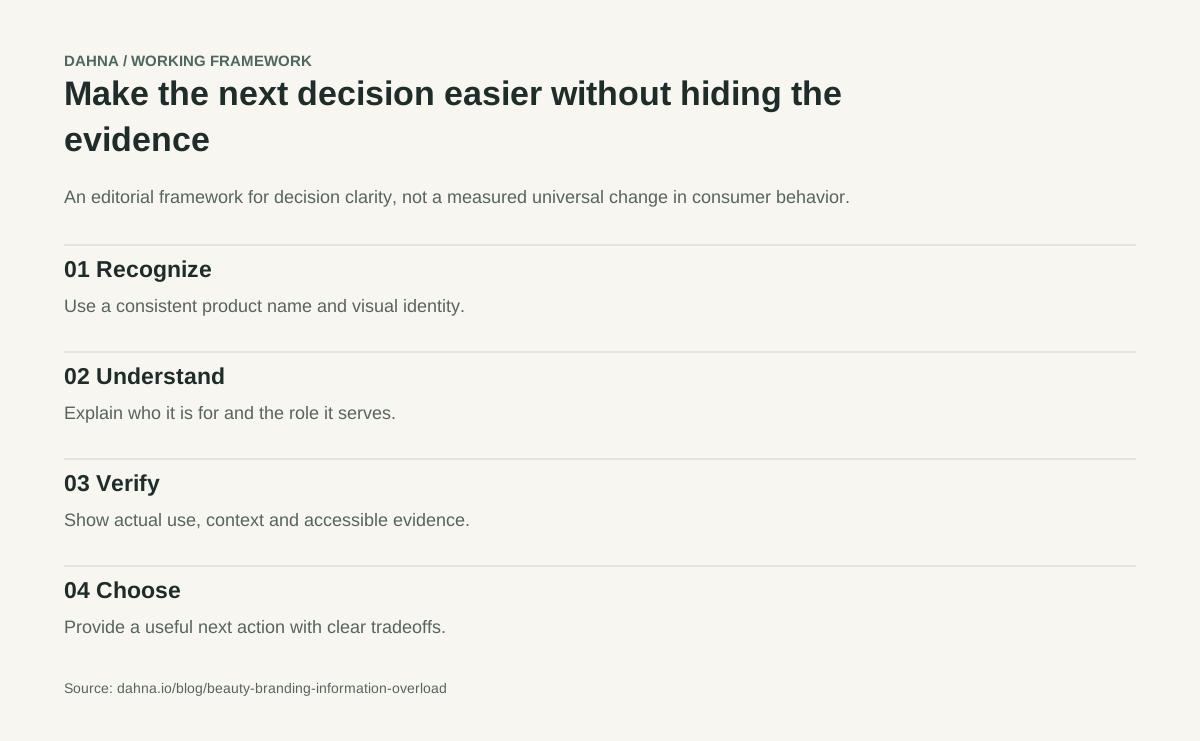
Make the next decision easier without hiding the evidence
- 01
Recognize
Use a consistent product name and visual identity.
- 02
Understand
Explain who it is for and the role it serves.
- 03
Verify
Show actual use, context and accessible evidence.
- 04
Choose
Provide a useful next action with clear tradeoffs.
Why do shoppers rely on creators to try and explain beauty products?
A shopper may not want to test every texture, compare every shade or read every product explanation personally. A creator who shows the work can provide a useful starting point: what they tried, the conditions, what they noticed and who might interpret the result differently. This is a lens for understanding delegated research, not evidence that all consumers are becoming less thoughtful.
Google's July 2020 Ads announcement summarizes its purchase-decision research through exploration and evaluation in a complex information environment. It does not establish how beauty shoppers use creators. Our application to beauty is that a useful explainer can help a person narrow the next question and inspect the reasons behind a recommendation.
The brand's task is to help the customer connect the explanation to the product. If every creator uses a different product name or describes a different promise, the campaign can add information without adding clarity. Consistency should preserve the facts while allowing individual experience and language.
Make the brand recognizable across encounters
A person might see a creator video, a review, a product page and a retail image at different times. Use a consistent name, visual identity and product role so those encounters can be connected. Branding does not have to explain everything at once; it should make the next encounter easier to recognize.
For example, a moisturizer described as a simple routine staple in one place and an elaborate transformation system in another creates a decision problem. Choose the supported role and carry it through the content. A distinctive presentation helps customers identify the brand, while a consistent explanation helps them evaluate it.
What makes a creator review useful evidence?
A useful creator review shows what the person tried, the relevant starting conditions, how they used the product and the limits of their conclusion. It helps a viewer inspect the work behind the recommendation. Confidence alone cannot establish that another person will have the same experience.
Separate a customer review from a paid endorsement and make the relationship clear. The FTC's reviews guidance addresses fake or false testimonials and buying reviews conditioned on sentiment. Do not manufacture independent-looking praise or use only positive reactions to create a misleading impression of consensus.
Choose what evidence belongs at each step. A short clip can show texture or an application method. A product page can hold ingredients, use instructions and substantiation. Make those details easy to reach when a viewer wants to know more. A stronger sales claim cannot substitute for that information.
| Customer request | Useful evidence | What it cannot establish alone |
|---|---|---|
| Try it for me | Actual use with relevant conditions | That everyone will have the same experience |
| Compare it for me | A fair comparison with stated criteria | That it is best for every buyer |
| Explain it for me | A clear product role and accessible sources | That a confident explanation is sufficient proof |
| Help me choose | A concise recommendation with fit and limits | That important tradeoffs can be omitted |
How do you simplify a beauty message without hiding important details?
Simplify the first decision by explaining who the product is for, its role, the support for its promise and the next useful action. Keep deeper evidence, use instructions, limitations and offer terms accessible where they matter. A short headline and a detailed evidence page can serve the same customer at different moments.
Illustrative edit for a fictional moisturizer: replace ‘Advanced glow technology for your ultimate skin transformation’ with ‘A lightweight moisturizer for the final moisturizing step of your morning routine.’ That replacement is appropriate only if the product's texture and approved instructions support it. Show the texture and application, then link to ingredients and directions. A texture clip can explain feel and use; it cannot establish a lasting hydration benefit by itself.
Keep safety information, material limitations and offer terms visible where they matter. If the shorter message causes shoppers to infer an unsupported benefit, revise the message rather than relying on a distant caveat to undo it.
Check whether people understand and remember the right thing
Review the questions customers still ask, whether product names are used consistently and where people get stuck between explanation and purchase. When conducting existing customer research or usability work, examine whether people can describe the product's intended role in their own words. A polished visual identity is not evidence that the message is understood.
Watch business outcomes alongside these signals, but do not attribute every change to branding. Distribution, price and availability also affect results. Treat the brand explanation as a durable reference for campaigns, then test individual executions without reinventing the identity every time a new format becomes popular.
Sources & further reading
Make your beauty brand easier to recognize and choose
Dahna can help connect positioning, product explanations and creator briefs around one supported brand story. Tell us where customers seem confused and what you want them to understand.
Why consider Dahna for this work?
Dahna brings bilingual Korean and English strategy together with creator, content, and measurement work for brands growing in the US. You can review the people behind the recommendations and the kind of work we propose before starting a conversation.
Founder experience includes prior and contracted roles. Sample deliverables illustrate our approach; they are not client results or a performance promise.