Why a celebrity-only beauty campaign can limit audience coverage
Evaluate the concentration risk of relying only on celebrities: audience coverage, creative variety, continuity and the budget left for useful repetition.
Why can using only celebrities limit a beauty campaign's audience coverage?
Hiring only celebrities can limit a beauty campaign when too much of its budget and message depends on a few audiences, posting windows or personalities. The risk is concentration, not celebrity status itself. A celebrity can provide valuable recognition, while a complementary creator roster can address different product questions and customer groups. Evaluate the combination by relevant coverage and full cost, not summed follower counts.
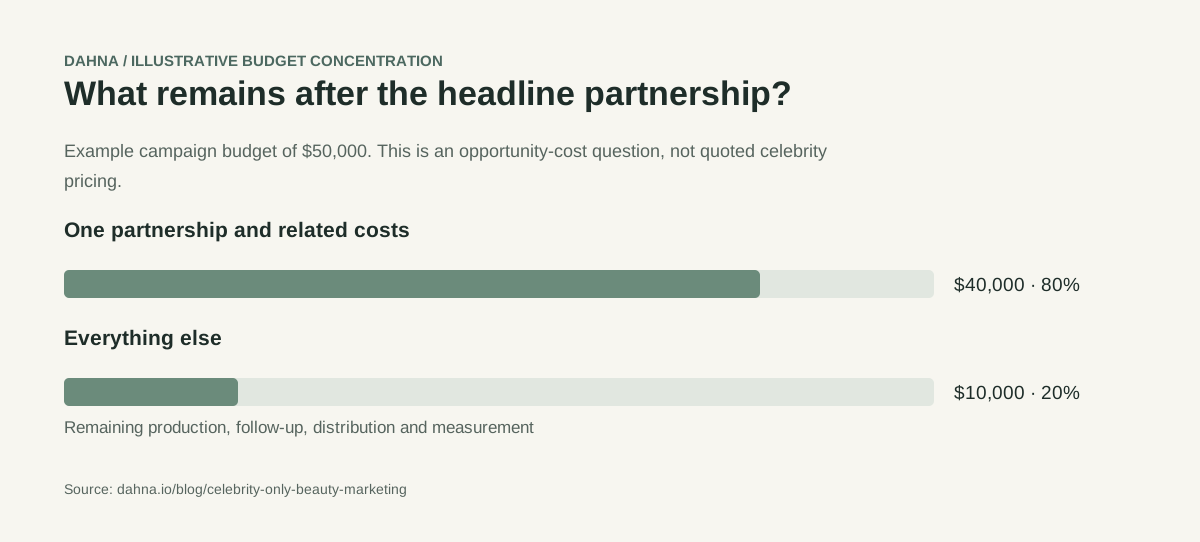
What remains after the headline partnership?
- One partnership and related costs$40,000 · 80%
- Everything elseRemaining production, follow-up, distribution and measurement$10,000 · 20%
Does a celebrity's large following guarantee relevant exposure?
No. A celebrity's follower count does not guarantee exposure to the customers a beauty brand can serve. Some followers are outside the market or follow for reasons unrelated to the product. Another celebrity with a similar audience may add less distinct exposure than the combined follower totals suggest.
The same issue can affect a roster of smaller creators. Ten similar profiles are not automatically diverse, and smaller audiences are not inherently more credible. Ask what each partner adds that the rest of the campaign lacks: a relevant community, a distinct use case, a different demonstration or a recurring relationship.
Build a coverage map before choosing names
List the customer groups and buying questions that matter to the product. For a complexion launch, that might include shade selection and application context. For haircare it might include routine and texture. Assign a useful job to each proposed partnership, then look for gaps and repeated coverage.
A celebrity may introduce the brand or give a launch cultural relevance. A specialist creator may explain a particular use condition. A repeat partner may show how the product fits over time. These are possible roles to test, not a claim that any tier performs one job better in every campaign.
| Need | Evidence to request | Concentration warning |
|---|---|---|
| NeedRecognition | Evidence to requestRelevant audience and credible product association | Concentration warningAll spend tied to one person's availability |
| NeedProduct understanding | Evidence to requestA clear, accurate demonstration | Concentration warningEveryone repeats an introduction without explaining use |
| NeedCustomer representation | Evidence to requestRelevant use conditions and audience context | Concentration warningThe same perspective appears in every asset |
| NeedRepeated learning | Evidence to requestFollow-up work and consistent reporting | Concentration warningOnly one launch moment is funded |
| NeedUsable creative | Evidence to requestDeliverables and rights for intended placements | Concentration warningA large fee leaves few assets the brand can reuse |
How do you assess the budget risk of one celebrity partnership?
The opportunity cost of a celebrity partnership depends on what remains available for the rest of the campaign. Include production, usage, exclusivity and management in the comparison. Ask whether the resulting plan can still fund demonstrations, customer questions, follow-up and measurement.
For illustration, if a $50,000 campaign allocates $40,000 to one partnership including its related costs, $10,000 remains for everything else. That 80% allocation is not automatically wrong. It does require a clear explanation of why the concentrated spend is worth the reduced flexibility. The figures illustrate the decision and are not quoted market rates.
A broader roster also has costs. More relationships require briefing, permissions, samples and review. Compare feasible delivery plans, not a celebrity invoice against an imaginary army of free creators. The right mix depends on the role, economics and operating capacity.
Plan for the campaign after the headline moment
A launch appearance may create interest that the rest of the brand must answer. Prepare the product page, stock information and follow-up content before the campaign begins. If the only recognizable voice is the celebrity's, ask how the product will remain understandable when that person is no longer posting.
Keep the brand's name, product identity and core explanation recognizable across collaborators. Creative variation should help different people understand the same product truth. A celebrity endorsement can support that process, but it cannot replace the brand's own identity or the evidence behind its claims.
Should a beauty brand avoid celebrity partnerships altogether?
No. A celebrity partnership can be appropriate when the person has strong fit, a clear campaign role and terms that leave the brand able to execute the rest of the plan. A mixed roster may be more useful when the launch needs several customer contexts or explanations. Compare complete plans rather than treating celebrity status as an automatic advantage or disqualification.
Review distinct audience coverage where reliable data exists, useful content, actual spend and business results. Do not claim that a wider roster caused more exposure simply because its total follower count is larger. Keep what can be measured separate from the strategic hypothesis you are testing.
Build a creator mix with a clear job for every partner
Dahna can help map product questions, audience coverage, rights and operating costs before you commit the creator budget. Bring the names you are considering and the gaps you need the campaign to fill.
Why consider Dahna for this work?
Dahna brings bilingual Korean and English strategy together with creator, content, and measurement work for beauty brands. You can review the people behind the recommendations and the kind of work we propose before starting a conversation.
Founder experience includes prior and contracted roles. Sample deliverables illustrate our approach; they are not client results or a performance promise.