Your first TikTok LIVE: what to prepare and how to judge it
A first TikTok LIVE shopping session should answer a useful customer question and reveal whether your team can run the experience well. Start with a product people benefit from seeing explained, a working purchase path and a small enough scope to review honestly afterward.
In this article
When should a beauty brand test TikTok LIVE?
A first TikTok LIVE shopping session should answer a useful customer question and reveal whether your team can run the experience well. Start with a product people benefit from seeing explained, a working purchase path and a small enough scope to review honestly afterward.
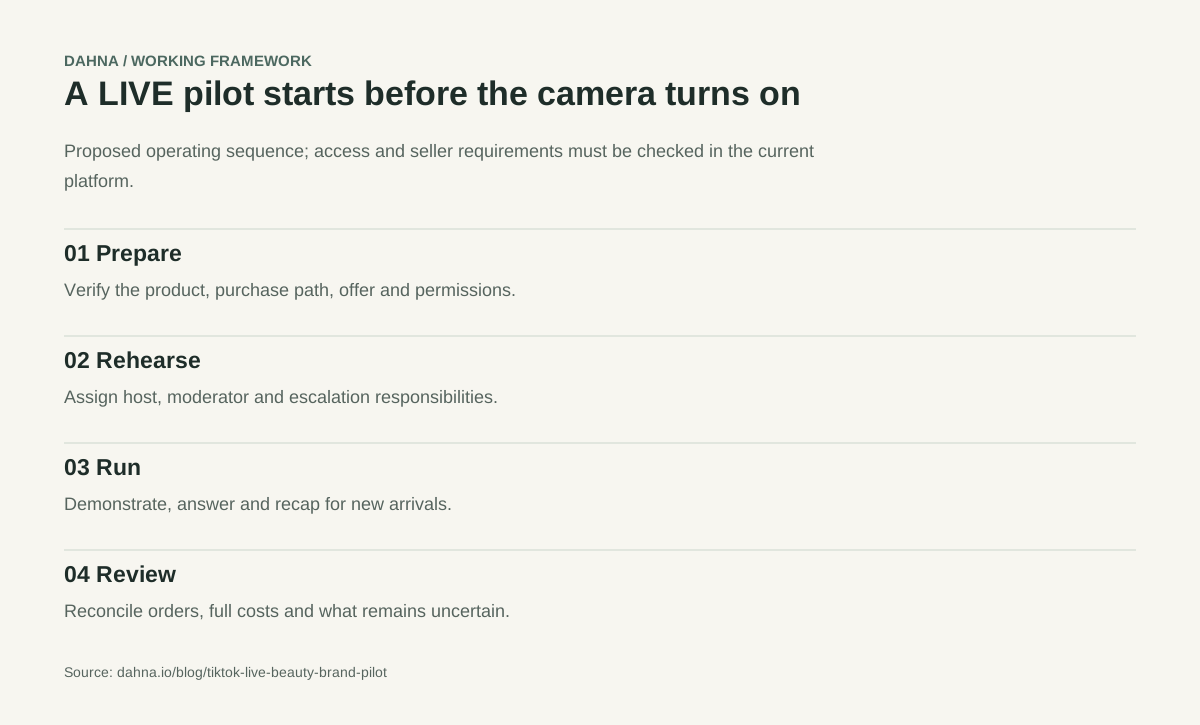
A LIVE pilot starts before the camera turns on
- 01
Prepare
Verify the product, purchase path, offer and permissions.
- 02
Rehearse
Assign host, moderator and escalation responsibilities.
- 03
Run
Demonstrate, answer and recap for new arrivals.
- 04
Review
Reconcile orders, full costs and what remains uncertain.
The decision in context
LIVE combines content and operations. The host needs accurate product information, the operator needs the correct products and offer, and someone must handle questions the host cannot answer safely or accurately. A good pilot makes those responsibilities visible before an audience arrives.
Choose a question that benefits from a live demonstration
A LIVE session can be useful when shoppers need to compare textures, understand a kit or ask a follow-up question during a demonstration. It is less compelling when the session merely repeats the same discount without helping anyone understand the product.
Choose one main buying uncertainty for the pilot. A skincare brand might explain the differences between two approved product options. A beauty-device brand might show what is included and how to find the official use instructions. Keep the demonstration within supported product facts; do not improvise personalized medical guidance or unsupported results.
List questions the host can answer and questions that need an escalation. The host should have a natural way to acknowledge uncertainty and route it to the responsible team. That is more credible than filling every silence with a guess.
Check the account and buying path before scheduling promotion
Confirm that the actual account and products are eligible for the planned LIVE and Shop features under the current rules. Eligibility can depend on market, account and feature, so do not plan the launch around a follower threshold copied from an unrelated guide. Check the relevant controls and guidance available to the brand’s account.
Verify the product version, price, offer, available inventory and destination. Test the customer path using the platform’s permitted methods and the team’s normal quality checks. Make sure the host’s sample matches what a shopper can buy. Prepare an alternative plan for an unavailable product.
Rehearse the practical setup: connection, sound, lighting, camera framing, product handling and the way viewers will identify the relevant item. A technically simple session that explains the product clearly can teach the team more than a complex production whose basic buying path has not been checked.
Include one failure in the rehearsal. For example, in an illustrative device-kit pilot, the operator flags that the selected listing contains a different accessory from the host's sample. The host stops presenting that kit, the operator removes the affected promotion where controls permit, and the brand owner confirms the correct listing before it resumes. Agree who can make that stop decision and what would end the session entirely. If the team cannot recover accurately in rehearsal, postpone promotion until the mismatch is resolved.
| Area | Owner | Ready when |
|---|---|---|
| Account and features | Shop/account owner | Actual account supports the planned activity |
| Product and claims | Brand product owner | Current facts and boundaries are approved |
| Stock and offer | Commercial/operations owner | The correct SKU, offer and availability agree |
| Production | Host and producer | Sound, framing, connection and demonstration are rehearsed |
| Customer questions | Moderator/support owner | Answers and escalation route are available |
| Measurement | Analyst or project owner | Revenue, cost and review definitions are written |
Give the host room to host
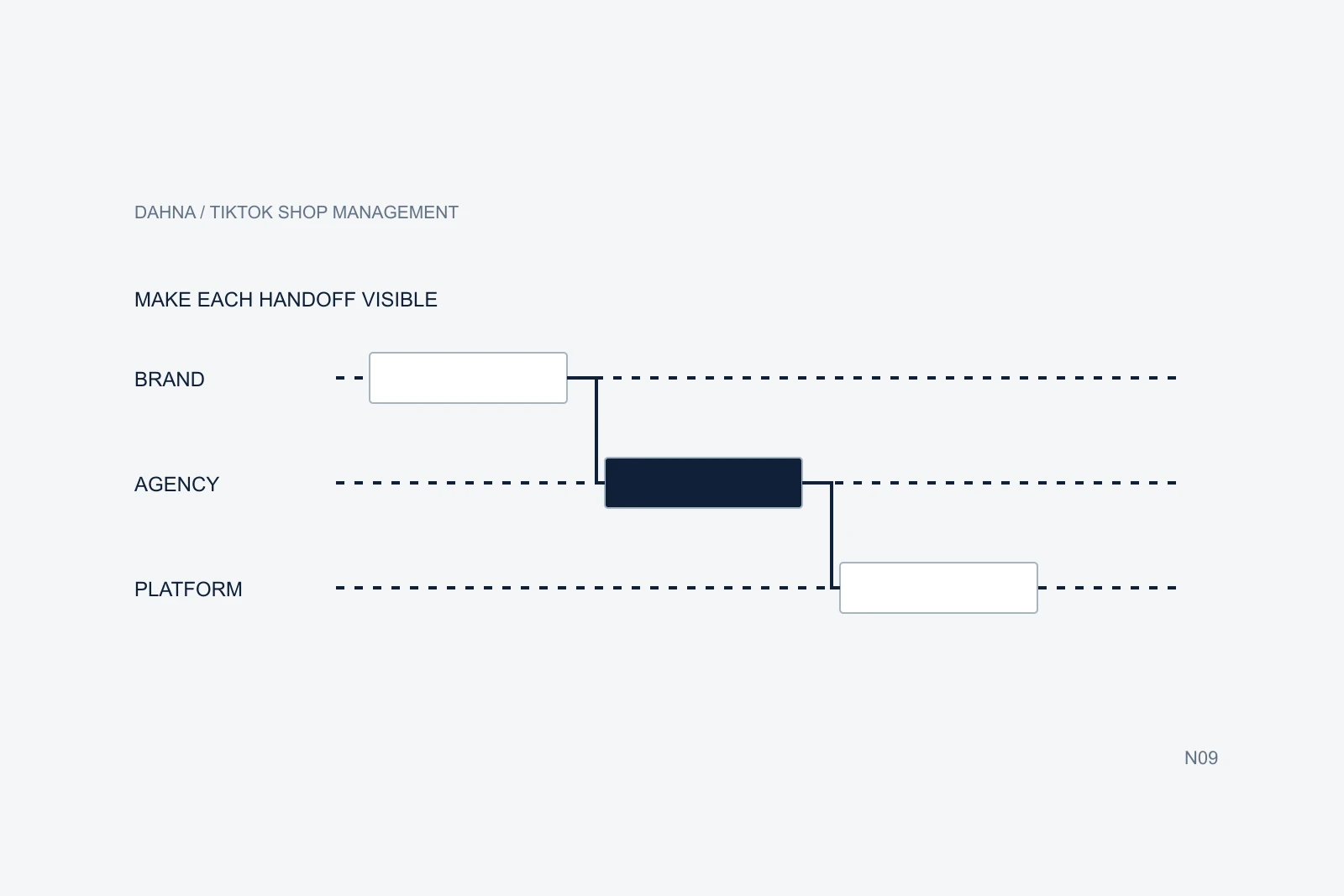
The host should be able to explain, demonstrate and respond without simultaneously managing every technical and commercial detail. Assign an operator or producer to the product presentation, timing and session issues, with moderation and customer-service responsibilities made explicit.
A small team may combine roles, but it still needs to know which tasks happen at the same time. During a demonstration, someone may need to correct a pinned item or flag an unanswered question. Rehearsing that moment reveals whether the staffing plan is realistic.
Provide a short host reference: approved names, key facts, offer conditions, common questions and escalation language. Avoid handing over a dense document that the host cannot use during the session. Keep the longer substantiation and operational records available to the people responsible for them.
The pilot team around the customer conversation
Host
Explain and demonstrate within the approved facts.
Operator
Manage timing, product presentation and technical issues.
Moderator
Surface relevant questions and route support issues.
Brand owner
Resolve factual and commercial decisions when needed.
Use a repeatable conversation, with room for new arrivals
People join at different moments. Build short recaps into the session so someone arriving halfway through can identify the product and current question. The example below is a fictional 45-minute pilot structure, not a platform-recommended duration or a guaranteed route to sales.
The host introduces the product, demonstrates one useful task, answers questions and then revisits the explanation from another angle. The operator watches for mismatches or issues. If the offer changes or a product becomes unavailable, the team updates the explanation and destination together or stops that part of the promotion.
Leave room for actual questions. A rigid script can prevent the team from learning what customers need to know. At the same time, keep the conversation anchored to the product and the approved facts so the session does not drift into claims the brand cannot support.
| Time | Host task | Operator/moderator task |
|---|---|---|
| 00–05 | Introduce the product and the question being answered | Confirm correct product/offer presentation |
| 05–15 | Demonstrate the first task or comparison | Surface relevant questions; note recurring confusion |
| 15–20 | Answer questions and recap for new arrivals | Route unsupported or personal questions appropriately |
| 20–30 | Show a second angle on the same buying question | Watch stock, product selection and technical issues |
| 30–40 | Repeat the useful explanation and answer new questions | Record objections and unresolved issues |
| 40–45 | Recap the facts, offer and next step | Confirm follow-up ownership and preserve session notes |
What Made By Mitchell illustrates—and what it cannot predict
TikTok’s July 2024 UK newsroom account describes Mitchell Halliday’s Made By Mitchell reaching $1 million in TikTok Shop sales in a day, with a 12-hour LIVE activation forming part of the event. The founder-led beauty business offers an example of product expertise brought to a live audience at substantial scale.
This historical UK platform-reported case is not a US pilot benchmark, a profit figure or proof that all the day’s revenue came through LIVE. A new brand should not use that headline as its first-session target.
For your own pilot, work out what the team would need to prepare, demonstrate and support in a much smaller session. Set the budget and expectations from your capacity and margin.
Review experience, orders and costs separately
Start with execution. Did the session show the correct product, answer the planned question and keep the buying path accurate? Review unanswered questions and interruptions while the details are still fresh. Those observations can improve product pages and future creator briefs even when sales evidence is limited.
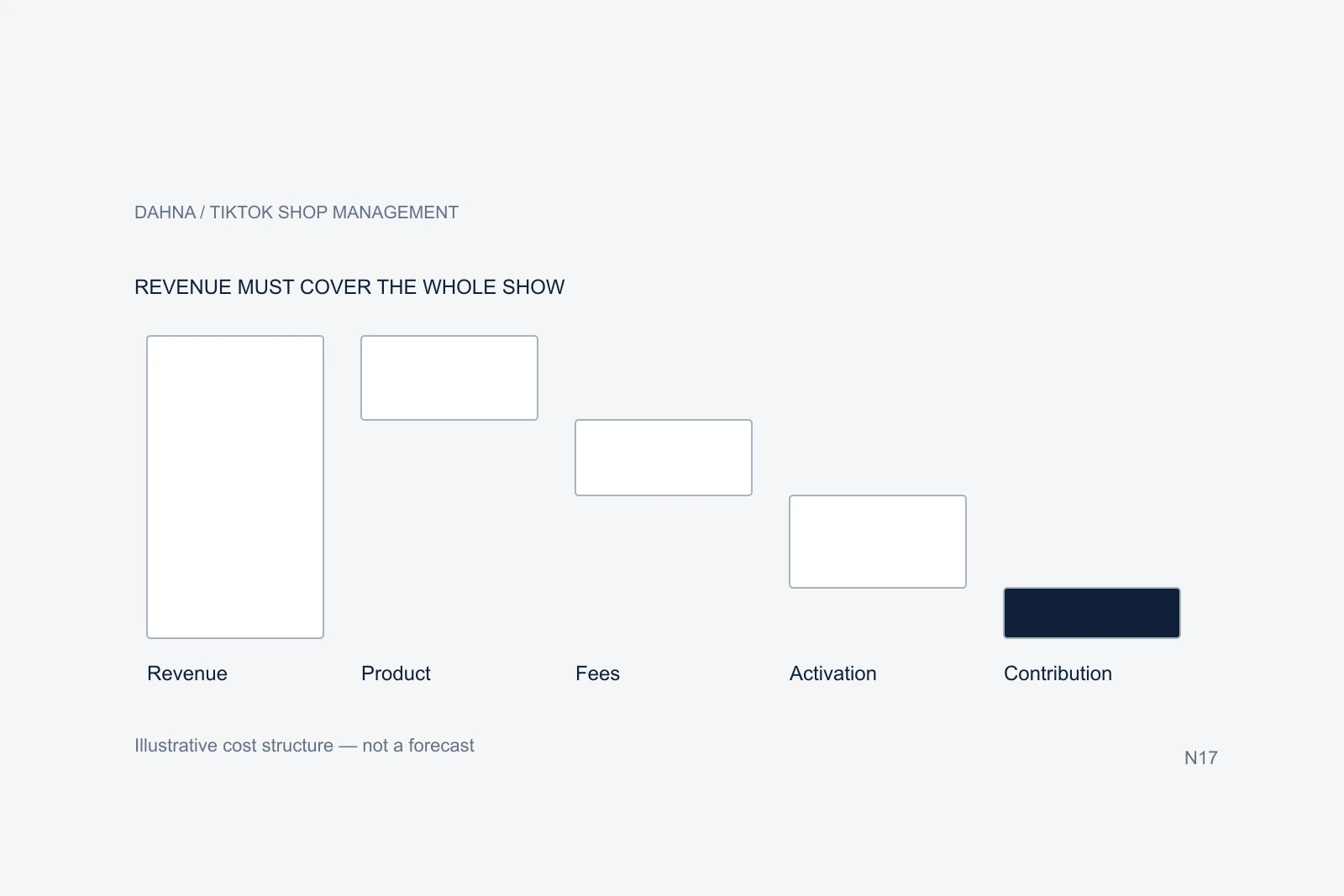
Then review the defined commerce measures and the complete pilot cost. TikTok’s LIVE GMV Max ROI compares liveroom revenue with ad spend; it is not a profit statement. Use the separate LIVE cost guide to include products, fulfillment, commissions, hosts, production and advertising in a clearly labeled contribution model.
Decide whether to repeat the session, revise the explanation, fix an operating problem or pause. A pilot can be operationally successful but commercially unproven. It can also produce orders while losing money. Naming those outcomes separately gives the brand a better next decision than a single pass/fail label.
| Finding | Reasonable next move |
|---|---|
| Useful questions, reliable session, limited sales data | Consider a bounded repeat with the same measurement definitions |
| Repeated misunderstanding of contents or use | Revise the demonstration and supporting product information |
| Orders arrive, contribution is negative | Review offer and costs before increasing the commitment |
| Stock or support failures disrupt buying | Repair the operating handoff before another promotion |
| Little relevant response and weak fit with the product | Reconsider the format or customer question |
Brief the pilot around the product and the constraint
Dahna can help plan the product explanation, creator or host brief, content preparation and Shop marketing responsibilities within an agreed scope. Bring the product, the question shoppers struggle with, the people available to operate the session and the amount you are prepared to spend on the pilot.
Ask for a proposal that specifies staffing, preparation, session time, paid distribution and reporting. It should also identify what the brand must supply and which issues would change the launch plan, so everyone knows what is needed to run and review the pilot.
Use this guide in your next brief
Download the tables from this guide as a working reference. Keep the example assumptions separate from your own figures, and record the source and date of any numbers you replace.
Sources & further reading
Plan your next TikTok Shop decision
Share the product, the customer question for the demonstration, the available operating team and the pilot budget you want to evaluate.
Why consider Dahna for this work?
Dahna brings bilingual Korean and English strategy together with creator, content, and measurement work for brands growing in the US. You can review the people behind the recommendations and the kind of work we propose before starting a conversation.
Founder experience includes prior and contracted roles. Sample deliverables illustrate our approach; they are not client results or a performance promise.
External examples are research references, not Dahna client results or promised outcomes.