How the TikTok algorithm works for beauty brands: discovery, search and relevance
Understand TikTok recommendations, search and paid delivery as different systems, then diagnose beauty content performance without relying on algorithm myths.
How does TikTok decide which beauty content to recommend?
TikTok describes recommendations as predictions of relevance informed by viewer activity and other contextual signals. For a beauty brand, the practical task is to make the product question clear and assess the audience response in its actual context: For You, search, LIVE or paid delivery. TikTok does not publish a complete ranking formula or a threshold that guarantees reach.
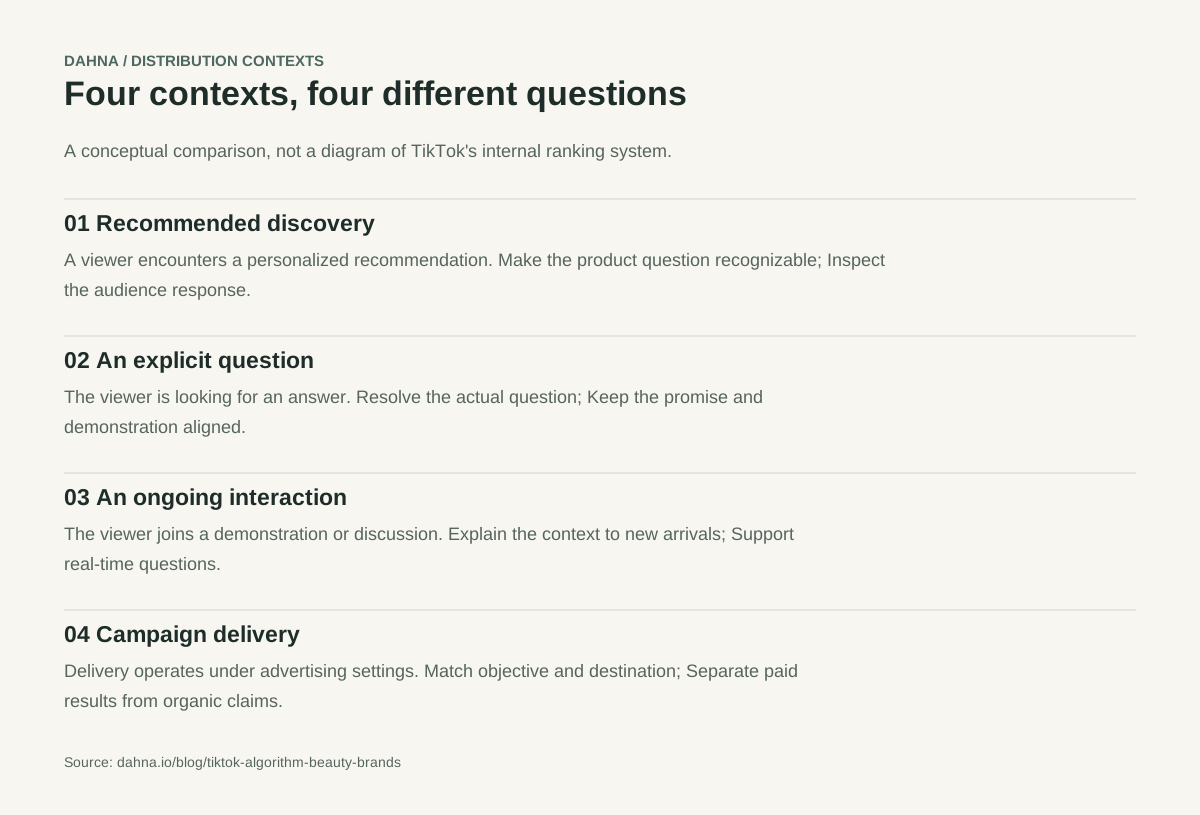
Four contexts, four different questions
- For You
Recommended discovery
A viewer encounters a personalized recommendation.
- Make the product question recognizable
- Inspect the audience response
- Search
An explicit question
The viewer is looking for an answer.
- Resolve the actual question
- Keep the promise and demonstration aligned
- LIVE
An ongoing interaction
The viewer joins a demonstration or discussion.
- Explain the context to new arrivals
- Support real-time questions
- Paid
Campaign delivery
Delivery operates under advertising settings.
- Match objective and destination
- Separate paid results from organic claims
Are For You, search, LIVE and paid delivery the same system?
For You, search, LIVE and paid delivery are different discovery contexts and should not be treated as one interchangeable source of results. A For You viewer may encounter a product without asking for it. Search expresses a question, LIVE is an ongoing interaction, and paid delivery operates under campaign settings.
Keep those contexts separate in reporting where the platform provides the information. A paid impression should not be presented as proof of organic recommendation, and a Shop order should not automatically be attributed to the last video the marketing team discussed. Begin with the source and definition of the metric.
| Context | Viewer situation | Brand question |
|---|---|---|
| ContextFor You | Viewer situationA personalized recommendation | Brand questionDoes the opening make the product question relevant? |
| ContextSearch | Viewer situationLooking for an answer | Brand questionDoes the content actually resolve the query? |
| ContextLIVE | Viewer situationJoining an ongoing demonstration or discussion | Brand questionCan a new arrival understand and participate? |
| ContextPaid delivery | Viewer situationAn advertising placement | Brand questionDo objective, audience, creative and destination align? |
Does TikTok publish exact ranking weights or guaranteed reach thresholds?
TikTok's published explanations describe user interactions and other contextual information as inputs to recommendations. Its 2022 explanation lists examples such as watching, liking, sharing, comments, searches and followed accounts. The current Help Center describes recommendations across several product surfaces. These sources explain categories of signals; they are not a complete ranking specification.
A brand should therefore avoid claims such as a fixed number of hashtags unlocking distribution, every post receiving an identical test audience or one watch-time threshold guaranteeing the next stage of reach. A correlation in a few posts cannot establish an internal platform rule. Record a hypothesis as a hypothesis until the evidence supports a narrower conclusion.
Make the promised answer recognizable
For a beauty demonstration, explain the product question early enough that the intended viewer understands why to keep watching. A shade comparison, a styling step and a fragrance sample explanation have different jobs. The opening, demonstration and destination should agree about what the viewer will learn.
Write captions and on-screen explanations for comprehension. If the video promises a comparison, show the relevant difference and the conditions of the demonstration. Repeating a keyword cannot repair a video that does not answer the question. A clear answer can serve people arriving through different routes without claiming to manipulate an undisclosed ranking signal.
What should a beauty brand check when TikTok reach is low?
When TikTok reach is low, first check that the post is available and whether the account shows an eligibility or restriction notice. Then inspect the content and audience evidence the platform provides. A confusing opening, a mismatched audience and limited distribution can lead to weak results, but they call for different investigations.
Review several comparable posts and their time in market. If one performs unusually well, examine what was different without assuming you have decoded the system. Product, format, creator, paid support and timing may all have changed. Keep your next test bounded enough that it teaches you something.
When a post earns attention but no useful action, evaluate the next step. The issue may be the offer, product availability or missing information. More reach does not by itself fix a customer journey that cannot turn interest into an informed purchase.
Keep a decision record instead of an algorithm-hack list
For each test, save the product question, intended audience, distribution context, creative version, destination and review date. Compare the evidence against the original purpose. Useful learning might be that a demonstration attracts the right questions, even when it does not produce the largest view count.
Treat a platform documentation update as a reason to review assumptions. Keep a dated reference to the source being used. Do not rewrite a strategy around an unsupported rumor or assume that a historical explanation describes every current feature in exact detail.
Build a TikTok test you can learn from
Dahna can help connect the customer question, creator brief, content and measurement so your team can distinguish useful discovery from activity without a clear business role.
Why consider Dahna for this work?
Dahna brings bilingual Korean and English strategy together with creator, content, and measurement work for beauty brands. You can review the people behind the recommendations and the kind of work we propose before starting a conversation.
Founder experience includes prior and contracted roles. Sample deliverables illustrate our approach; they are not client results or a performance promise.