How to find TikTok beauty trends worth testing for your brand
Research TikTok beauty trends using dated platform signals, customer questions and a brand-fit check before committing creators, content or inventory.
How do you find a TikTok beauty trend worth testing?
Find TikTok beauty trends by combining dated platform observations with the questions your customers actually ask. Record the market, time window and examples, then check product fit, evidence and a realistic next action. A trend is a reason to investigate a test; it is not proof of purchase demand or a reason to commit inventory immediately.
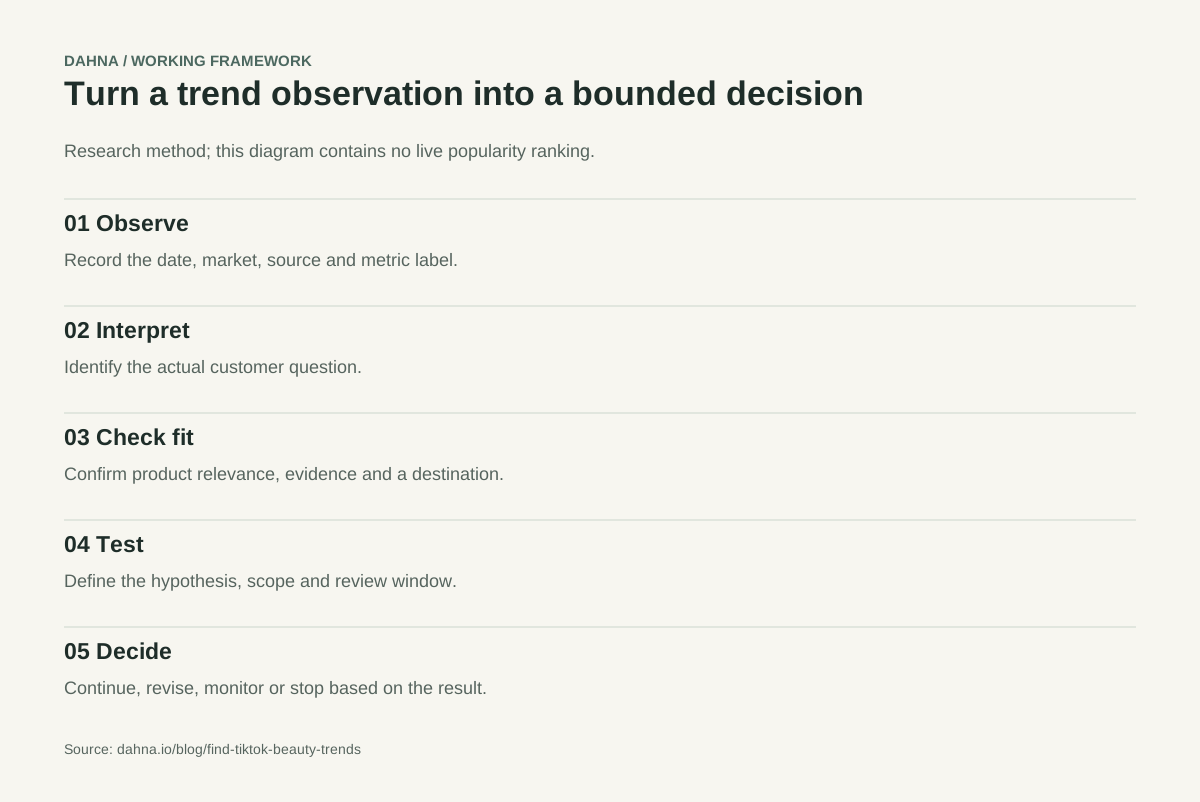
Turn a trend observation into a bounded decision
Observe
Record the date, market, source and metric label.
Interpret
Identify the actual customer question.
Check fit
Confirm product relevance, evidence and a destination.
Test
Define the hypothesis, scope and review window.
Decide
Continue, revise, monitor or stop based on the result.
Where can you research TikTok beauty trends?
Research TikTok beauty trends through Creative Center, available Creator Search Insights features, relevant public content and the questions your own customers ask. These sources show different kinds of evidence. Keep platform signals separate from sales data, and do not treat a personalized feed as a representative demand measure.
Search manually for the product problem, category and use occasion as well. Look at the actual videos and questions, not just a topic label. A broad beauty conversation can contain shoppers, professionals, entertainment viewers and creators researching their next post. The same phrase may mean different things to each group.
An individual For You feed is personalized. Use it to discover examples, but do not treat your own repeated exposure as a representative measure of market demand. Save the observation and compare it with additional evidence before describing it as a category-wide change.
What should you record when researching a TikTok trend?
For each candidate topic, record the date, geography, chosen period, source URL and the metric exactly as the source labels it. A cumulative view count is not a count of current US buyers. A list of popular examples is not a forecast of what a new brand video will achieve.
Save several relevant examples and note whether the signal comes from different creators or repeated exposure to one popular clip. Identify what appears to be changing: the product concern, the routine, the format or the language people use. A new edit style and a new buying need call for different responses.
| Field | What to record | Why |
|---|---|---|
| FieldObservation | What to recordDate, market, window and source | WhyAllows a like-for-like follow-up |
| FieldSignal | What to recordMetric label and representative examples | WhyPrevents unlike numbers being combined |
| FieldCustomer question | What to recordThe uncertainty visible in the discussion | WhyConnects the topic to a useful answer |
| FieldBrand fit | What to recordRelevant product, evidence and purchase destination | WhyShows whether the brand can participate credibly |
| FieldDecision | What to recordTest, monitor or pass; owner and review date | WhyTurns research into a bounded action |
Read the trend through the category's buying problem
Skincare discussions may revolve around routine fit and product understanding. Makeup often needs a legible shade or application example. Haircare needs context about the person and their routine. Fragrance requires a bridge from description to trial. These are lenses for investigation, not claims about which categories are currently growing fastest.
Use specific searches to narrow the task: a product type plus a use question, an application technique or a comparison people need to make. Record the wording customers use and explain it naturally in the content. Do not repeat a long list of near-identical phrases in a caption or article and assume that will create relevance.
A Korean beauty brand should also distinguish curiosity about Korean culture from an actual product decision. Cultural interest may introduce the brand, but a potential customer still needs to understand the product, price and purchase experience.
When should you test, monitor or pass on a beauty trend?
Test when the topic fits a real customer question, the product can support an honest answer and the team can deliver a useful next step. Monitor when interest is plausible but the evidence or product relevance is weak. Pass when participation would require an unsupported claim, misleading demonstration or a purchase experience the brand cannot fulfill.
Entertainment can still have a role. The question is what the brand expects it to achieve. If the aim is awareness, evaluate attention in the intended audience and keep the commercial claim modest. If the aim is orders, include the offer, destination and economics in the review.
Do not commit a large creator batch just because a format is accelerating. Establish the brand's interpretation with a manageable test, then decide whether the results justify additional work. Check content permissions and platform requirements for the intended placement before using a trend commercially.
Review the test without mistaking noise for growth
Write the hypothesis before publication: who the content should help, what it should explain and which action would count as useful progress. Keep the reporting window consistent. A clip published yesterday has not had the same opportunity as one posted several weeks ago.
Compare relevant visits, customer questions and order behavior alongside attention metrics. Note changes in price, media spend, stock and promotions that could explain the result. If performance is concentrated in a single clip, repeat the underlying explanation in another suitable execution before treating it as a reliable pattern.
Update the research record even when the decision is to stop. A trend that attracts the wrong audience can still teach the team how to narrow the message. Keep the evergreen article current through substantive evidence and examples; publish a new article when it answers a genuinely different question.
Choose the TikTok opportunities that fit your brand
Dahna can connect beauty research, product positioning and creator content in a focused test plan. Bring the topics you are seeing and the business question you want them to answer.
Why consider Dahna for this work?
Dahna brings bilingual Korean and English strategy together with creator, content, and measurement work for beauty brands. You can review the people behind the recommendations and the kind of work we propose before starting a conversation.
Founder experience includes prior and contracted roles. Sample deliverables illustrate our approach; they are not client results or a performance promise.