Beauty influencer campaign capacity planning: a monthly worksheet
Size the next monthly creator cohort using a worked budget, staffing and usable-content model. Find the capacity constraint before adding influencers.
How do you calculate the creator cohort your team can support?
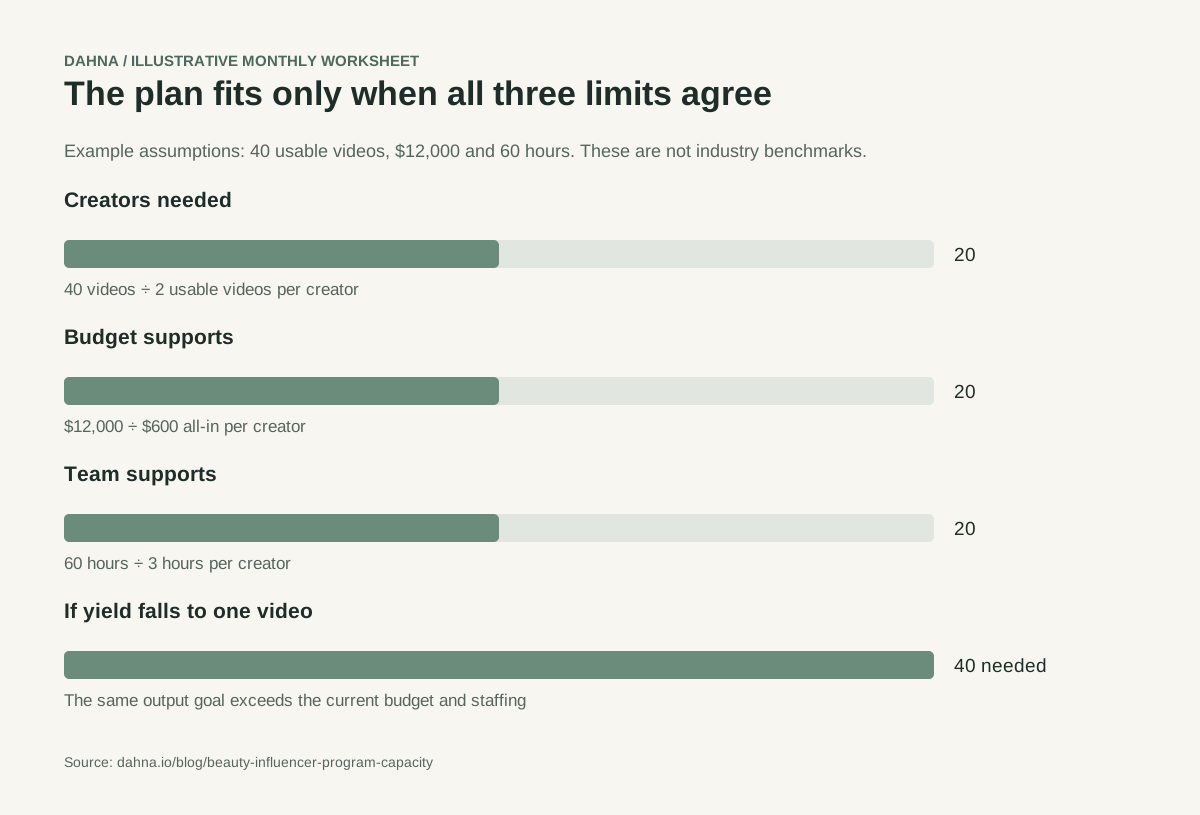
Calculate the creators needed by dividing required usable videos by usable videos per creator and rounding up. Calculate budget capacity and staffing capacity separately, rounding each down. The plan is feasible only if both capacities meet the requirement. In the illustrative worksheet, 40 videos at two per creator require 20 creators; the assumed budget and operating hours each support 20. These are planning inputs, not industry benchmarks or a promise of sales.
The plan fits only when all three limits agree
- Creators needed40 videos ÷ 2 usable videos per creator20
- Budget supports$12,000 ÷ $600 all-in per creator20
- Team supports60 hours ÷ 3 hours per creator20
- If yield falls to one videoThe same output goal exceeds the current budget and staffing40 needed
How do content needs, budget and team hours limit creator volume?
For a content-led program, divide the number of usable assets needed by the expected usable assets per creator, rounding up. Then check whether the budget and team can support that many relationships. If the requirement exceeds either limit, reduce the deliverables, change the production approach or add capacity before committing.
Use your own completed campaigns to estimate usable yield. A contracted video may arrive late, require revision or lack the agreed permission for a planned placement. Keep paid usage, editing rights, exclusivity, shipping, samples and management in the cost model. A low creator fee is not the full cost of getting useful work into market.
| Limit | Example calculation | Implication |
|---|---|---|
| LimitContent requirement | Example calculation40 usable videos ÷ 2 usable videos per creator = 20 | ImplicationNeed 20 active creators if that yield holds |
| LimitBudget capacity | Example calculation$12,000 available ÷ $600 all-in per creator = 20 | ImplicationCan fund 20 after reserving other campaign costs |
| LimitOperating capacity | Example calculation60 available hours ÷ 3 hours per creator = 20 | ImplicationCan manage 20 if the time assumption holds |
| LimitLower usable yield | Example calculation40 videos ÷ 1 usable video per creator = 40 | ImplicationCurrent budget and staffing cannot meet the same output goal |
What do 10, 20 or 50 active creators actually buy you?
Use roster sizes as scenarios to compare, not growth stages every brand must pass through. Ten active partners with two deliverables each produce 20 planned assets. Twenty produce 40. Fifty produce 100. Those counts say nothing about reach, distinct audiences, usable creative or sales until the work is delivered and evaluated.
A narrow test might compare a few clearly different product explanations while keeping the product and destination stable. A larger roster might be justified by additional customer segments, a launch calendar or a verified need for more assets. It is harder to learn from a large batch when every creator receives a different offer, product and measurement setup.
For illustration, a 20-person roster could retain 12 reliable partners and test eight new collaborators. This is a planning choice, not a recommended universal split. Record what each new creator contributes: a distinct audience, an underserved hair texture, a shade demonstration or a storytelling approach the existing roster cannot provide.
How many gifted packages will produce usable creator content?
There is no guaranteed package-to-content conversion rate for voluntary gifting. Forecast from your own completed cohorts, keeping delivered gifts, posting creators and permissioned usable content separate. Gifting without an agreed posting obligation does not guarantee publication, and a published post is not automatically licensed for advertising.
In a purely illustrative cohort, 100 delivered gifts lead to 30 posting creators, of whom 20 produce content the brand can use under the permissions obtained. That is a 30% posting rate and a 20% usable-creator yield for that cohort. At the same assumed yield, 40 usable creators would require 200 delivered packages. Future yield may differ, so this is a forecast to revisit, not a purchase guarantee.
Keep disclosure instructions in the workflow. The FTC explains that free products can create a material connection that needs disclosure when the recipient endorses the product. A brand should not require a positive opinion in exchange for a gift or payment.
When should you increase the size of the next creator cohort?
Before adding partners, inspect delivery, content usefulness, customer response and commercial outcomes separately. If people watch but do not click, the explanation or audience may need work. If qualified visits do not become orders, investigate price, availability and the purchase experience before recruiting more creators.
Review contribution after the costs relevant to the decision: product, fulfillment, fees, discounts, returns, creator compensation and paid distribution. Platform-attributed orders are evidence to examine, not proof that every order was incremental. Keep repeat customers and new customers distinct where the data allows it.
A workable expansion decision states the gap, the additional partners needed, the total cost, the person responsible and the review date. If the first roster cannot be evaluated because tracking or approvals are broken, a larger one will multiply the same uncertainty. Repair the process, then reconsider volume.
Build a creator roster your brand can use
Tell us what your existing program produces, where it gets stuck and what you want the next cohort to achieve. Dahna can connect creator selection, briefs, delivery and measurement around that decision.
Why consider Dahna for this work?
Dahna brings bilingual Korean and English strategy together with creator, content, and measurement work for beauty brands. You can review the people behind the recommendations and the kind of work we propose before starting a conversation.
Founder experience includes prior and contracted roles. Sample deliverables illustrate our approach; they are not client results or a performance promise.