What should a TikTok Shop agency own day to day?
A TikTok Shop agency scope should name the work, the person allowed to make each decision and the evidence that the task is complete. “Full management” is too broad to answer those questions on its own.
Dahna, original planning diagram
In this article
Overview
A TikTok Shop agency scope should name the work, the person allowed to make each decision and the evidence that the task is complete. “Full management” is too broad to answer those questions on its own.
The decision in context
A partner may coordinate listings, creators, content, LIVE and paid distribution without owning inventory, fulfillment or every customer-service decision. Agree the boundary before the first campaign. The hardest moments tend to arrive when a product is unavailable, a claim needs approval or an order problem interrupts an otherwise successful promotion.
Break the shop into operating responsibilities
Start with the path from approved product information to a fulfilled order. Identify who maintains listing facts, prepares content, coordinates creators, approves offers, monitors stock information and handles customer issues. A single agency may perform several of these jobs, but that is something to specify rather than assume.
Assign a decision owner as well as an execution owner. An agency can prepare a discount proposal while the brand approves its margin effect. A host can explain the product while a qualified brand owner approves the statements used in the show. A contractor doing the work does not automatically have authority to change every underlying business rule.
TikTok’s US seller terms distinguish third-party partner services from the platform’s role. Treat an agency proposal as a service agreement to evaluate on its own scope. A marketplace or partner listing is not a substitute for checking the deliverables, exclusions and relevant experience.
| Workstream | Agency task if contracted | Brand decision/input | Completion evidence |
|---|---|---|---|
| Listings | Prepare and maintain approved content | Accurate product facts and approvals | Correct live SKU/version and buying information |
| Creators | Source, brief and coordinate | Budget, products and approved claims | Agreed outreach/deliverables and status record |
| Offers | Propose and implement approved promotion | Margin, inventory and authorization | Correct dates, products and funded discount |
| LIVE | Produce agreed sessions and reports | Product expertise and operational readiness | Session record, issues and defined metrics |
| Paid distribution | Manage approved campaigns | Spend limit and commercial goals | Spend record and interpretable results |
| Fulfillment | Coordinate or monitor only if scoped | Named fulfillment owner and accurate stock | Escalation and resolution record |
| Customer service | Handle agreed queue or route issues | Policy and escalation authority | Cases assigned and resolved appropriately |
Make access match the agreed task
TikTok Shop’s US access-management guidance describes assigning roles to sub-accounts, including preset and custom roles controlled by the shop owner. Use the available account controls to support the work that is actually being commissioned. Confirm the current setup in the brand’s account rather than relying on an old screenshot.
Keep an access register with the account, owner, role, purpose and review date. Include the separate advertising or creator connections that the engagement needs. Someone responsible for a campaign should know which access is missing before a launch deadline arrives.
Plan the exit as well as the onboarding. The brand should be able to retain its records and remove access when work ends. Ask which materials will be handed over and which external accounts or licenses remain necessary. That conversation is easier before the relationship depends on a rushed transfer.
Work through a stock problem before it happens
Imagine a fictional brand plans a LIVE demonstration of a two-item kit. On the morning of the show, the fulfillment team reports that one item is unavailable. The agency has already prepared the offer and the host has rehearsed the original contents.
A vague management scope leaves everyone waiting for someone else to decide. A usable scope names who confirms stock, who approves an alternative, who changes the listing and who tells the host and customer-service team. If an accurate alternative is not ready, the promotional plan needs to change.
This is not simply a content correction. The destination, offer and spoken explanation must agree. Keep a short incident record so the same mismatch does not recur at the next session. The point is to restore a truthful buying path, not to preserve the calendar at any cost.
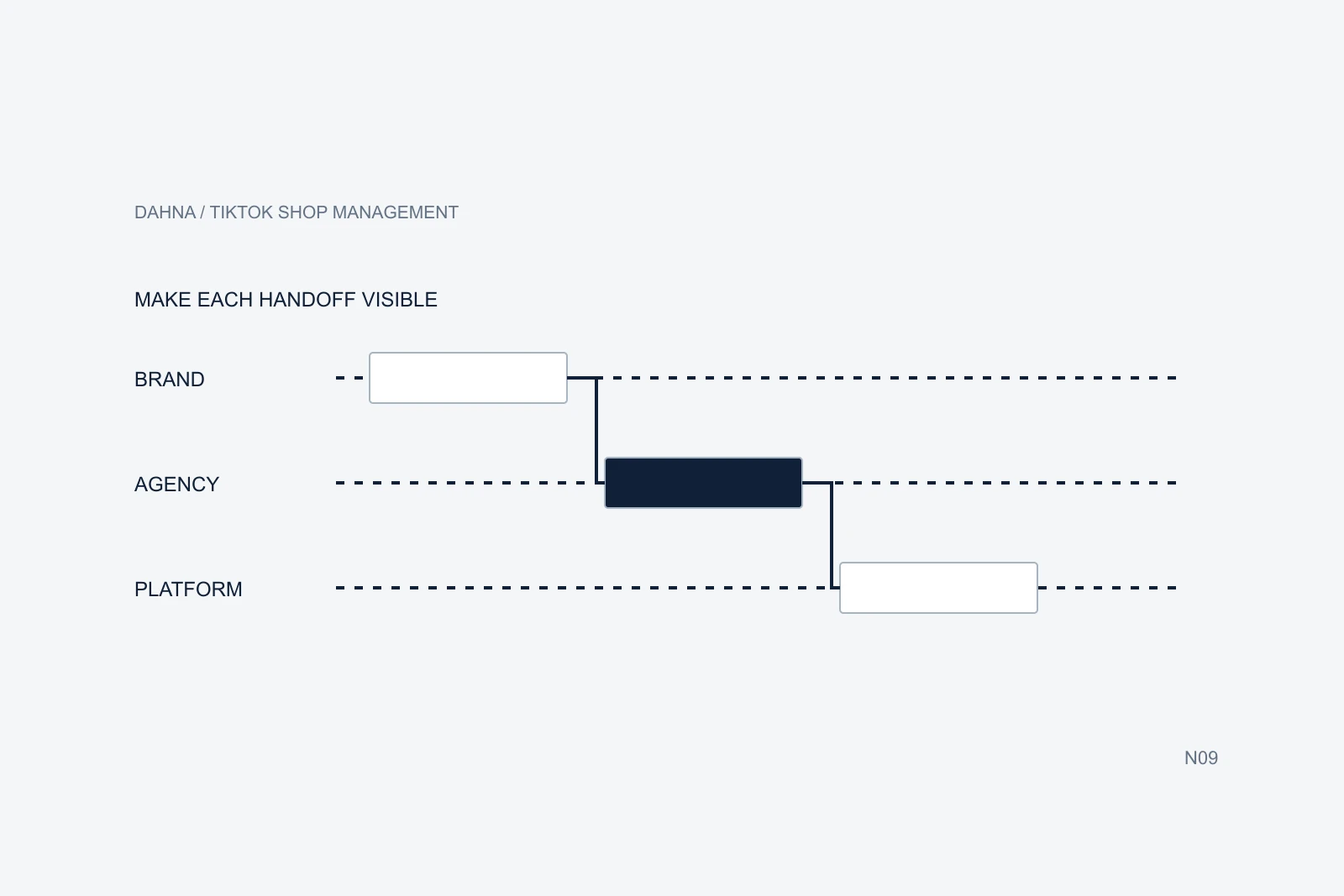
A stock issue moves through four owners
Operations
Confirm the affected SKU and available alternatives.
Brand owner
Approve the commercial decision and product facts.
Agency
Update the approved listing, creative and promotion.
Host/support
Use the new information and route unresolved questions.
Ask what the quoted unit includes
A monthly fee may buy ongoing Shop coordination, a fixed number of content assets or a limited set of LIVE hours. Those are different units of work. Ask for quantities, working hours, response expectations and exclusions where they matter to the service.
For LIVE, clarify whether the quoted hours include a host, producer, moderation, preparation, studio time and post-session reporting. For creator work, distinguish outreach activity from contracted deliverables and from eventual sales. A large outreach number does not guarantee that creators accept, post or sell.
If the fee includes a percentage of revenue or GMV, define the base, adjustments, attribution period and settlement source. Make separate ad spend, platform charges, creator commissions and product costs visible. The commercial agreement should be understandable without rebuilding it from several dashboard labels.
Ask for an operating report that ends in actions
The report should show what happened, what remains blocked and what decision is needed next. Separate delivered work from commercial outcomes. A completed listing update is an output; an order is an observed transaction; the claim that an agency caused an incremental sale requires stronger evidence.
Keep finance and operating records connected. Reconcile the chosen revenue definition with refunds and the costs included in the engagement. Use platform results for their intended reporting purpose, while being clear that they do not automatically represent company profit.
An unresolved issue should have a named owner and a date for the next action. If creators repeatedly ask the same product question, update the brief. If a stock mismatch interrupts promotion, repair the operating handoff. Reporting becomes useful when it changes the next week’s work.
| Issue | Owner | Next action | Evidence to close |
|---|---|---|---|
| Creators ask what the kit contains | Brand product owner + agency | Update approved brief and example image | Revised brief accepted for the next assignments |
| LIVE offer differs from listing | Brand commercial owner + operator | Align the approved price and destination | Verified offer on the intended SKU |
| Order question lacks an owner | Customer-service lead | Assign queue and escalation route | Case ownership visible |
| Attributed sales exceed reconciled orders | Analyst | Compare definitions and transaction records | Documented reconciliation, not forced equality |
Bring the operating problem to the agency discussion
A brand with strong internal fulfillment may need a partner for content, creators and commercial coordination. Another may need more project management around several external providers. The useful scope depends on the gap, not on how many services can fit into a proposal.
Dahna can connect TikTok Shop marketing with product explanation, creative and the wider customer journey. Ask for a defined operating scope, the required brand inputs and a review process that your team can inspect. Bring an example of a recent handoff that failed or slowed down; it often reveals the work that needs an owner.
Before signing, walk through a normal week and one difficult scenario. Confirm that the scope answers who notices, who decides, who acts and who reports back. That exercise makes the engagement much easier to evaluate than a promise to handle everything.
Use this guide in your next brief
Download the tables from this guide as a working reference. Keep the example assumptions separate from your own figures, and record the source and date of any numbers you replace.
Sources & further reading
Plan your next TikTok Shop decision
List the Shop tasks your team already owns, the recurring handoffs that fail and the specific work you want a partner to manage.
Why consider Dahna for this work?
Dahna brings bilingual Korean and English strategy together with creator, content, and measurement work for brands growing in the US. You can review the people behind the recommendations and the kind of work we propose before starting a conversation.
Founder experience includes prior and contracted roles. Sample deliverables illustrate our approach; they are not client results or a performance promise.
External examples are research references, not Dahna client results or promised outcomes.