TikTok LIVE shopping costs: hosts, agencies and the profit behind ROI
A TikTok LIVE budget needs more than a host fee and an ad budget. The useful question is how much revenue the show must generate after product costs, fulfillment, commissions, returns and production. A live event can look successful in an advertising dashboard and still leave the brand with little money.
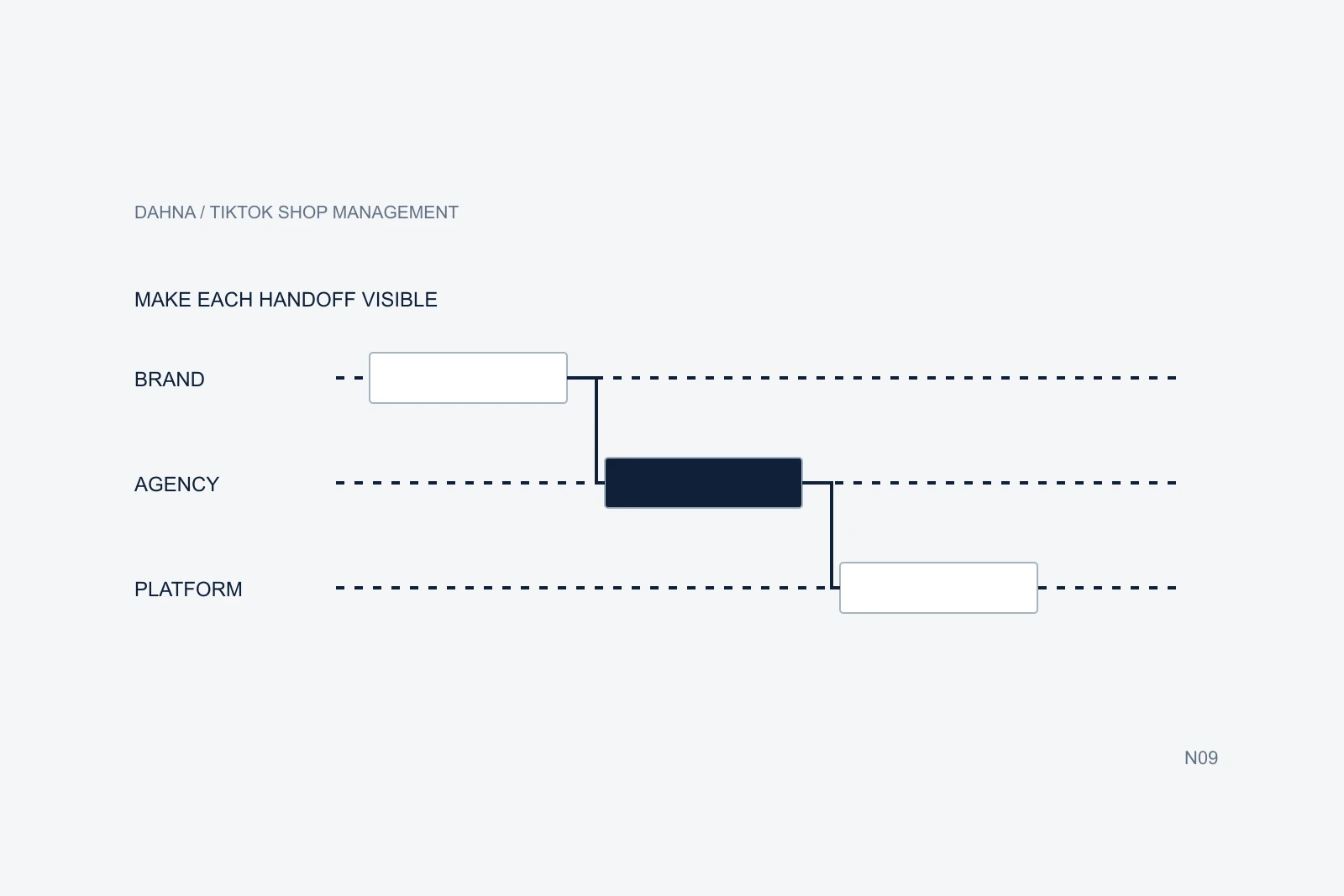
Dahna, original planning diagram
In this article
Overview
A TikTok LIVE budget needs more than a host fee and an ad budget. The useful question is how much revenue the show must generate after product costs, fulfillment, commissions, returns and production. A live event can look successful in an advertising dashboard and still leave the brand with little money.
The decision in context
Public US examples checked on October 13, 2026 range from a brand advertising a $20–25 hourly host base to a Los Angeles provider listing a $200-per-hour managed LIVE service. Those are different purchases, not the endpoints of a reliable market average. Start with the comparison below, then request a written quote for your actual show.
What publicly listed prices actually buy
Cadence’s Los Angeles host listing advertises a $20–25 hourly base plus commission and bonuses, with preparation and review included in paid work. NeoFlow Media Group lists a managed Daily Live service at $200 per hour and a Mega Live package starting at $8,000 plus commission. These are the providers’ advertised terms, not Dahna prices or independently audited market benchmarks.
MADA provides a useful comparison for general Shop management: it lists $2,500 a month below $25,000 monthly GMV, followed by a replacement commission structure at higher volumes. Its page separates advertising, creator commissions, samples and platform fees. Do not assume that a Shop-management retainer buys a staffed studio or a particular number of LIVE hours.
Ask what the quote means by an hour. Is it time on air, all booked studio time, or host labor including rehearsal? Confirm minimum bookings, producer and moderator coverage, overtime, cancellations, travel and clip editing. A price is comparable only after the deliverables and exclusions are comparable.
| Example | Listed amount | What the number represents | Still to confirm |
|---|---|---|---|
| Cadence, Los Angeles | $20–25/hour base + unspecified commission/bonuses | A brand’s advertised host compensation | Hiring terms, commission, hours and employment classification |
| NeoFlow Daily Live, Los Angeles | $200/hour | Advertised managed LIVE service | Minimums, billable hours, exact inclusions, ad spend and commissions |
| NeoFlow Mega Live | From $8,000 + commission | A larger event package | Commission basis, scope, talent and production inclusions |
| MADA Shop management | $2,500/month below $25,000 monthly GMV | Broader Shop operation; not a verified LIVE production quote | Whether LIVE staffing is offered or separately scoped |
Build the whole cost stack before booking
Separate setup, event delivery and order-dependent costs. Setup may include a set, equipment, product education and a rehearsal. Event delivery may include host time, producer time, moderation, technical support and editing. Order costs include product, packaging, fulfillment, shipping support, platform charges and the commissions that actually apply to those orders.
The US referral-fee document checked for this article describes a 6% qualified-order fee and category or promotional conditions. Its refund rules also retain an administration charge in specified circumstances. Check the current category schedule, seller account and settlement records rather than assuming that 6% is your only charge. Our worked model uses 6% as an explicit simplifying assumption.
Keep agency commission, host commission and affiliate commission on separate rows. They may refer to different recipients, different eligible orders and different definitions of revenue. A host selling on a brand’s own account does not automatically create an affiliate commission on every order. Equally, a provider’s production price may exclude commissions. Ask before treating either possibility as settled.
A show budget has three layers
Prepare
Products, approved explanations, set, rehearsal and setup.
Run
Host, producer, moderator, studio and paid traffic.
Fulfill
Goods, shipping, platform fees, commissions and returns.
Why a 6× LIVE ROI is not a 6× profit return
TikTok’s September 2026 LIVE GMV Max documentation defines LIVE ROI as total liveroom GMV divided by total advertising spend. Its metrics guidance counts conversions occurring within the liveroom while that campaign is active. The denominator does not include the full cost of running the business or producing the show.
For management decisions, keep three measures visible. Report the platform metric exactly as defined. Separately calculate event contribution after the costs you include. Then state what is known about incremental sales: the orders that would not have happened without the event. A dashboard attribution rule cannot establish that counterfactual by itself.
Use a clear name for the calculation you create. In this article, return on activation spend means event contribution divided by production plus advertising spend. It is a planning ratio, not TikTok’s metric, an annualized return, or an audited accounting profit measure. Define it beside the number so a founder and agency cannot accidentally discuss different results.
A worked two-hour show with $6,000 in sales
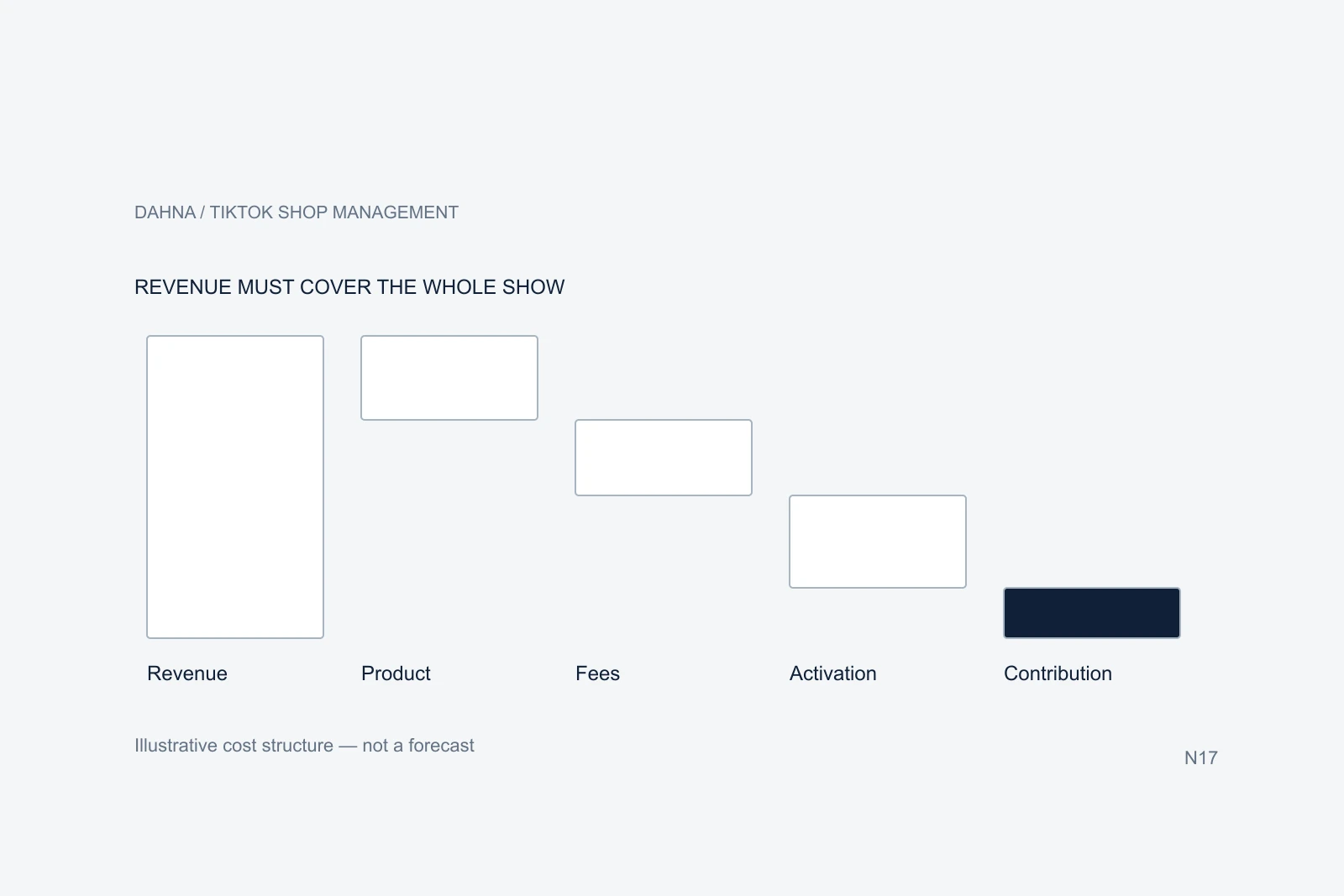
Consider a fictional two-hour skincare show with 100 placed orders averaging $60. Gross merchandise revenue is $6,000, excluding sales tax and customer shipping charges. Allow $300 for refunds, $1,800 for product costs, $600 for fulfillment and shipping support, $360 for platform charges and $600 for applicable sales commissions. Production and hosting cost $600; advertising costs $1,000.
The event leaves $740 in modeled contribution: $6,000 less $5,260 in the listed costs and allowances. TikTok-style gross revenue divided by ad spend is 6×. Return on the $1,600 activation spend is 46.25% because $740 ÷ $1,600 = 0.4625. These figures describe the same fictional event from different perspectives.
The example deliberately applies the percentage allowances to one gross-revenue base to make the arithmetic inspectable. Real fee and commission bases differ. Reconcile final refunds, seller-funded versus platform-funded discounts, settlement adjustments and recovered inventory before calling a result final. General payroll, rent, taxes and other overhead are not included, so $740 is not net company profit.
| Line | Calculation | Amount |
|---|---|---|
| Gross merchandise revenue | 100 orders × $60 | $6,000 |
| Refund allowance | 5% of gross revenue | −$300 |
| Product costs | 30% of gross revenue | −$1,800 |
| Fulfillment and shipping support | 10% of gross revenue | −$600 |
| Platform charge assumption | 6% of gross revenue | −$360 |
| Applicable sales commissions | 10% of gross revenue | −$600 |
| Production and hosting | Assumed fixed amount | −$600 |
| Advertising | Assumed event spend | −$1,000 |
| Modeled event contribution | Revenue less the listed costs | $740 |
Try your assumptions
What would your LIVE need to earn?
All variable allowances below use gross merchandise revenue, excluding tax and shipping revenue. Actual settlement, refund and commission bases can differ. Replace these illustrative inputs with your own costs.
Illustrative model. Overhead and tax are excluded; this does not establish incremental profit.
- Gross merchandise revenue
- Contribution after activation
- Revenue / ad spend
- Return on activation spend
- Break-even revenue
- Break-even orders
Find the sales level that covers the show
In this simplified model, 39% of gross revenue remains after the variable allowances. Production plus advertising totals $1,600. Break-even gross revenue is therefore $1,600 ÷ 0.39, or about $4,103. At a $60 order value, at least 69 orders are needed to exceed that modeled threshold. This is a calculation from assumptions, not a forecast that a LIVE will generate 69 orders.
Show the downside beside the central scenario. With the same cost proportions and fixed spend, $2,000 in gross revenue produces a loss of $820; $10,000 produces $2,300 contribution. A team should decide whether it can afford the downside before using the upside to justify the booking.
Commission negotiations can change the decision materially. Holding everything else constant, a 20% sales commission leaves a 29% contribution rate before fixed activation spend, raising break-even revenue to about $5,518. Do not lower a commission mechanically and assume the same creators, effort or sales will follow. The table isolates arithmetic; real behavior may change.
| Commission assumption | Revenue left before fixed spend | Break-even gross revenue |
|---|---|---|
| 5% | 44% | $3,637 |
| 10% | 39% | $4,103 |
| 20% | 29% | $5,518 |
Compare quotes using the same operating brief
Send each provider the same product range, target audience, event length, intended account, inventory position and advertising allowance. Ask them to state the number of hosts, rehearsals, live hours, moderation hours and report deliveries. Clarify whether the brand or the provider owns the recording, and what reuse is permitted. Qualified advisers should review contractual terms where needed.
Request a sample report with definitions rather than a screenshot of a large sales total. It should distinguish placed and settled orders, paid and other traffic, refunds, platform fees and the costs outside the agency invoice. Ask how the provider handles a sold-out hero product or a product-information error while the show is running.
A brand-side Reddit discussion asks precisely these practical questions: individual hosts or an agency, hourly rates or retainers, minimum hours, commissions and separate ad spend. That is useful evidence of buyer uncertainty. Anonymous replies cannot establish a normal US price, expected profit or the quality of a provider.
- Who is responsible for each on-air and back-office role?
- Which revenue definition is used for every percentage fee?
- What is charged if the show is shortened, canceled or interrupted?
- When will refunds and settlement adjustments enter the final report?
When LIVE is worth another test
Review the event after the orders have had time to mature under the actual return and settlement conditions. A useful early report can describe viewer questions, technical problems and placed orders; it should not pretend to be the final financial result. Keep a dated reconciliation so the team can see why contribution changed.
Repeat the show when the remaining uncertainty is worth paying to resolve and the business can support the cost. For example, a product demonstration may have attracted useful questions but lost buyers when a key variant sold out. That suggests a different next test from a show with adequate stock and almost no relevant interest. One event does not prove a scalable channel.
Dahna can help connect the LIVE brief, product explanation, creator coordination and measurement plan. Bring your SKU economics, proposed supplier quotes and expected operating responsibilities. The first useful deliverable is a budget that the brand and execution team can both inspect, followed by a show plan that fits it.
Use this guide in your next brief
Download the tables from this guide as a working reference. Keep the example assumptions separate from your own figures, and record the source and date of any numbers you replace.
Sources & further reading
- TikTok LIVE HostCadence
- Daily Live and Mega Live servicesNeoFlow Media Group
- How much does MADA charge to run a TikTok Shop?MADA
- TikTok Shop Referral Fee Updates – 2024TikTok Shop US Seller University
- How Standard Affiliate Commission WorksTikTok Shop US Seller University
- About LIVE GMV MaxTikTok for Business
- About video metrics for LIVE GMV Max campaignsTikTok for Business
- Has anyone outsourced TikTok Shop LIVE for their brand?Reddit, r/TikTokshop
Plan your next TikTok Shop decision
Share your products, contribution assumptions, planned LIVE hours and any host or agency quotes. Tell us who currently owns inventory, customer service and reporting.
Why consider Dahna for this work?
Dahna brings bilingual Korean and English strategy together with creator, content, and measurement work for brands growing in the US. You can review the people behind the recommendations and the kind of work we propose before starting a conversation.
Founder experience includes prior and contracted roles. Sample deliverables illustrate our approach; they are not client results or a performance promise.
External examples are research references, not Dahna client results or promised outcomes.