Why ad-platform orders and store orders disagree—and how to reconcile them
Your advertising platforms and your store can report different order totals without either total being a simple count of “the truth.” They may use different attribution windows, dates, identities and definitions. The useful task is to explain the difference, not to force every dashboard to agree.
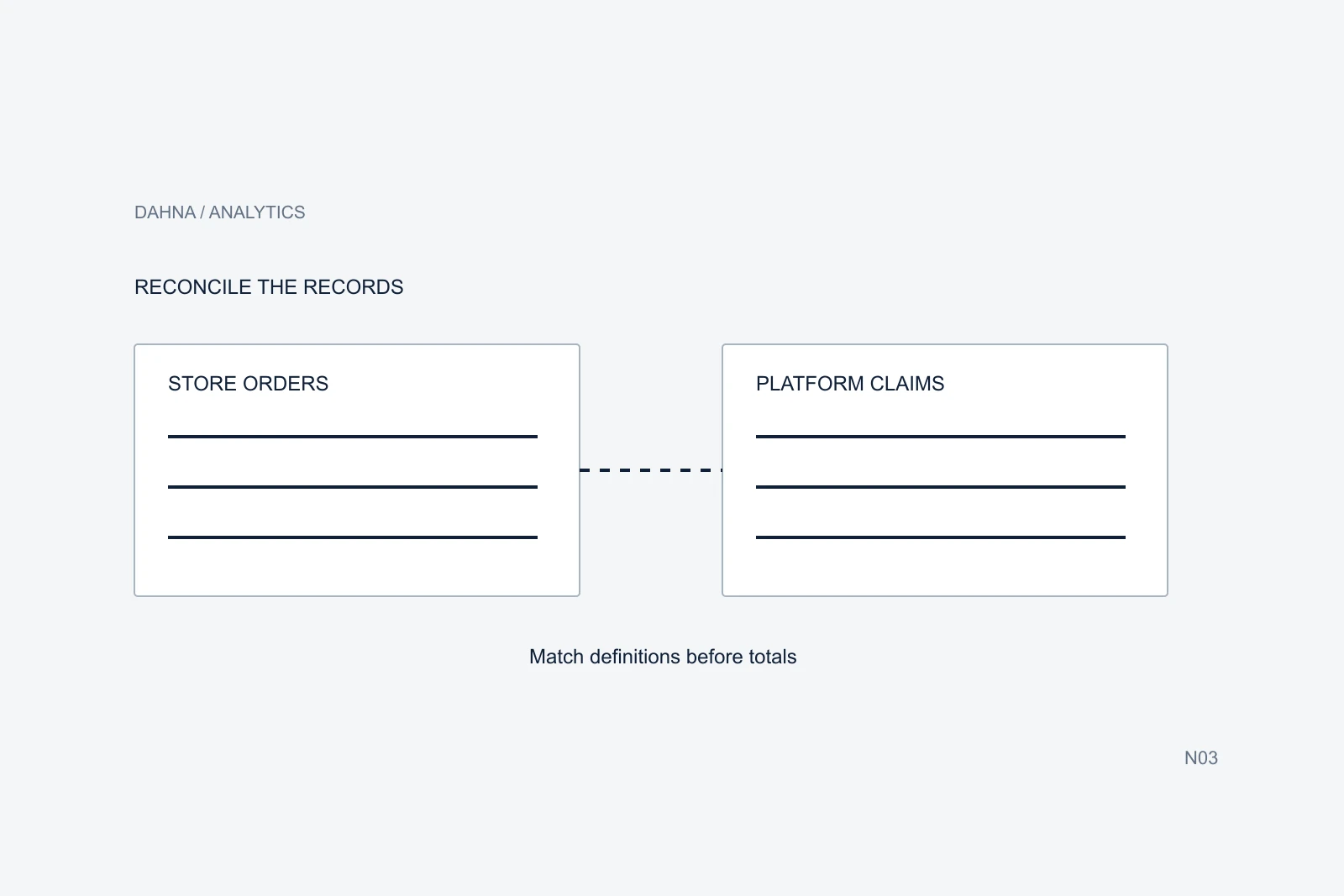
Dahna, original planning diagram
In this article
Overview
Your advertising platforms and your store can report different order totals without either total being a simple count of “the truth.” They may use different attribution windows, dates, identities and definitions. The useful task is to explain the difference, not to force every dashboard to agree.
The decision in context
Start from a defined store-order ledger, then compare the platform reports against it using the information each system actually provides. Keep sales accounting, analytics collection and marketing attribution separate enough to investigate them.
Write a short dictionary before comparing totals
For each report, record the date range, timezone, currency, order status, revenue definition and attribution model. State whether the number includes tax, shipping, discounts, canceled orders or later refunds. A total without those definitions can look precise while describing a different business event from the number beside it.
Shopify documents differences between its analytics and third-party services, and between some of its own reports. Its marketing guidance also explains that partner attribution can differ from Shopify’s view. Those differences are a reason to inspect collection and reporting rules, not automatic proof that an agency is inflating results.
Choose the question first. A finance team reconciling payouts needs a different view from a marketing team comparing two creatives. A store-order ledger can anchor commercial analysis while leaving the marketing report’s attribution rules visible as a separate layer.
| Field | Example of a choice to record |
|---|---|
| Period and timezone | September 1–28, America/Los_Angeles |
| Order population | Paid non-test orders; canceled orders separately recorded |
| Revenue | Merchandise sales excluding tax; discount/refund treatment stated |
| Attribution | Named model and click/view windows where applicable |
| Data maturity | Export date and outstanding returns or adjustments |
Use order-level records where they are available
Create a small, access-controlled reconciliation sample using order identifiers and the minimum fields needed. Avoid copying personal customer details into a general marketing workbook. Include the placed date, current status, merchandise amount, refund amount and the systems in which the order can be verified.
Shopify’s sales-discrepancy guidance points to Order ID or Order name as useful dimensions for consistent comparisons. Not every advertising platform exposes an order-level join, so do not imply that the ledger can reconstruct every customer journey. Aggregate or modeled reports may need aggregate checks instead.
When an identifier is unavailable, retain an unresolved status. Do not invent a match from similar revenue and timestamps, then present the result as certain. A smaller set of defensible matches is more useful than a supposedly complete attribution table built from guesses.
A fictional five-order example
Imagine a store records five paid orders totaling $400 before a later $60 refund. Meta attributes three orders, Google Ads attributes two, and one order appears in both platforms’ claims. Adding three and two does not demonstrate five distinct advertising-generated orders; the overlapping attribution has to remain visible.
In this example, one store order has no matching platform claim in the available data. That does not mean marketing had no influence. The shopper might have returned through a direct visit or encountered content whose referrer was not preserved. The correct record is that the available attribution is unknown.
The refund changes the commercial total to $340 under this simplified merchandise-only definition. A platform may update at a different time or follow different adjustment rules. Record the maturity date of each report instead of deciding that the first export is final.
| Order | Merchandise value | Refund | Meta claim | Google claim | What the row tells us |
|---|---|---|---|---|---|
| A101 | $80 | $0 | Yes | No | One recorded platform claim |
| A102 | $120 | $0 | Yes | Yes | Overlapping platform attribution |
| A103 | $60 | $60 | Yes | No | Commercial value changed after refund |
| A104 | $90 | $0 | No | No | Attribution unresolved |
| A105 | $50 | $0 | No | Yes | One recorded platform claim |
Classify the discrepancy before proposing a fix
A collection problem is different from a reporting difference. A purchase event firing twice is a collection problem. A click-date report and an order-date report using different windows can disagree even when both are operating as designed. A refund missing from a commercial review may be a process failure rather than an attribution failure.
Use a short set of categories: definition, timing, duplicate or missing event, attribution overlap, currency, order status and unresolved. Attach evidence to the category. A screenshot of two unequal totals is the beginning of the investigation, not the completed explanation.
Prioritize defects that could change spending decisions. A duplicate event affecting the optimization signal deserves prompt attention. A small, documented rounding difference may simply need a note. The team should not spend weeks pursuing perfect visual agreement while an important product or campaign decision remains blocked.
Route the mismatch to the right owner
Definitions differ
Align the comparison or document why it cannot align.
Collection is wrong
Repair and validate the event implementation.
Attribution overlaps
Preserve each rule; do not add claimed orders together.
Evidence is missing
Keep the item unresolved and define the next check.
Validate purchase and refund handling with a controlled check
Google’s ecommerce documentation specifies purchase and refund events with transaction identifiers and item information. The implementation needs to reflect the store’s actual order lifecycle. A successful page load does not prove that the right purchase amount, currency and identifier were recorded once.
Use an approved test procedure, label or exclude test activity from business reporting where appropriate, and verify both the initial order and the relevant adjustment. Do not submit repeated real inquiries or unnecessary purchases merely to make a dashboard change. The test should be designed around the specific suspected defect.
After a fix, record its deployment date and the affected scope. Historical reports may not repair themselves automatically, and comparisons spanning the change may need a note. Keep the technical validation separate from any claim that the campaign itself became more effective.
What the reconciled report should allow you to decide
End with a commercial question. Can the brand trust the purchase event enough to optimize toward it? Does the campaign appear affordable under a conservative contribution view? Which discrepancy is large enough to change the next budget decision? Those are more useful outcomes than a green check beside every platform total.
Ask the agency to publish the definitions and unresolved items alongside the results. A report can be useful even when it cannot attribute every order. What matters is that the decision-maker knows which figures are observed, modeled, overlapping or incomplete.
The brand-side questions on Reddit about Shopify and Google reporting provide useful language for this problem. Their technical answers vary in quality. Use the question to frame the article, but use official documentation and the brand’s own implementation evidence to determine what is happening.
| Finding | Owner | Evidence of completion |
|---|---|---|
| Duplicate purchase event | Implementation owner | One valid event per agreed test order |
| Different reporting windows | Analyst | Documented like-for-like comparison or explicit limitation |
| Refunds missing from review | Commerce/reporting owner | Dated order adjustment included in contribution view |
| Unresolved attribution | Marketing lead | Unknown category retained; no fabricated channel assignment |
What to send Dahna
Bring one complete reporting period, the metric definitions, recent tracking changes and a small redacted order sample where authorized. Describe the decision the discrepancy is blocking. That helps the team distinguish a technical repair from a reporting redesign.
Dahna can scope measurement checks and connect the findings to paid-media and ecommerce decisions. The deliverable should include a reconciled example, a repeatable method and a short list of unresolved limitations. Your team should be able to repeat the comparison after the engagement without needing to trust an unexplained number.
Use this guide in your next brief
Download the tables from this guide as a working reference. Keep the example assumptions separate from your own figures, and record the source and date of any numbers you replace.
Sources & further reading
Plan your next measurement decision
Share the reports that disagree, their date and attribution settings, recent tracking changes and the business decision you need to make. Use redacted order examples only where authorized.
Why consider Dahna for this work?
Dahna brings bilingual Korean and English strategy together with creator, content, and measurement work for brands growing in the US. You can review the people behind the recommendations and the kind of work we propose before starting a conversation.
Founder experience includes prior and contracted roles. Sample deliverables illustrate our approach; they are not client results or a performance promise.
External examples are research references, not Dahna client results or promised outcomes.