Influencer gifting: you sent free products but got no posts. What now?
If influencer gifting produces no posts, start with what you agreed. A no-obligation product gift leaves posting up to the creator. A campaign that needs a video on a specific date needs agreed deliverables. Review the product experience, creator fit and total cost before sending another round.

In this article
Overview
If influencer gifting produces no posts, start with what you agreed. A no-obligation product gift leaves posting up to the creator. A campaign that needs a video on a specific date needs agreed deliverables. Review the product experience, creator fit and total cost before sending another round.
Start with what was actually agreed
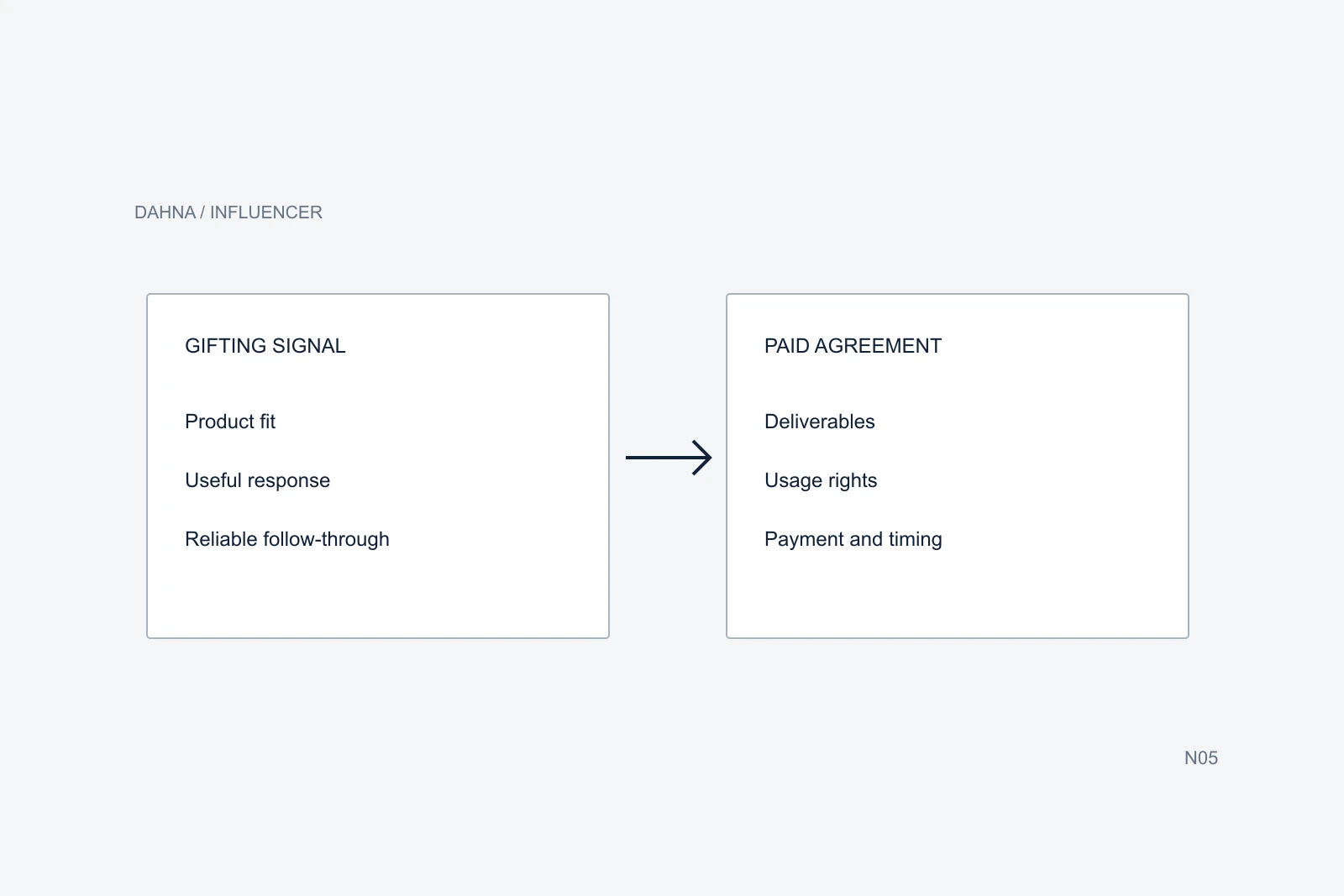
Review the outreach and any agreement before evaluating the result. Was the product offered without obligation, was the creator commissioned to produce something, or was there a platform-specific sample arrangement? Those are different relationships and should not share one expectation.
Budget gifts as product introductions with uncertain output. Keep paid commissions and platform sample arrangements separate, and refer questions about obligations to the actual terms. For accepted TikTok Shop samples, use the dedicated guide linked below.
| Need | Model to consider | What must be clear |
|---|---|---|
| Introduce the product and invite genuine feedback | Voluntary gifting | There is no implied guaranteed post. |
| Secure specific content or publication | An explicit commissioned arrangement | Deliverables, timing, review and permitted uses. |
| Test a continuing relationship | A defined trial with an interested creator | Responsibilities, evidence to review and renewal decision. |
What e.l.f.’s participation brief can teach a gifting program
In December 2021, e.l.f. announced a holiday TikTok film with established creators and community members chosen through duet auditions. Kory Marchisotto explained the campaign’s community focus. The campaign offers an example of a clear invitation to participate, rather than evidence about how often gifted products lead to posts.
The useful application is clarity before participation. A creator should understand whether the brand is offering a gift, inviting feedback, proposing an affiliate relationship or buying a specific contribution. An attractive package cannot substitute for that conversation. If the brand needs a dependable piece of content, the arrangement should acknowledge the work, schedule and rights rather than rely on the recipient feeling obliged.
Keep the invitation proportionate to the relationship. A cold recipient may have little reason to prioritize your launch, while a person already interested in the category may value product access or a well-scoped paid brief. Ask what would make participation worthwhile without presuming the answer. The resulting terms are more useful than a vague promise of future exposure.
Compare the economics of gifts and commissioned output
Imagine a founder choosing between sending another batch of gifts and commissioning a small number of demonstrations. This is a planning exercise, not an e.l.f. result. The gift option has product, packing, shipping and staff costs with uncertain output. The paid option has a fee and agreed deliverables, but still requires review, permissions and a suitable place to use the content.
List what each option is intended to buy. If the purpose is open-ended product discovery and feedback, a gift can be appropriate. If the launch needs a dated video explaining one feature, compare paid proposals for that deliverable. Do not evaluate both options using only cost per package, and do not assume a commissioned video will automatically produce sales.
Use the previous gifting cohort to improve selection. Which recipients asked thoughtful questions? Which had a genuine use for the item? Which encountered a preventable product or shipping problem? A useful review may suggest a smaller, better matched group, a revised product explanation or a paid follow-up with a promising creator. More shipments are only one possible next action.
A simple fictional cost comparison makes the tradeoff visible. Sending 20 gifts at an internal product cost of $20 plus $8 packing and shipping costs $560 before staff time. If four recipients post, shipment cost per observed post is $140. That is a retrospective calculation, not an expected posting rate. If nobody posts, report $560 spent and zero posts; do not invent a cost per post.
Also count what you can actually use. Four public posts are not necessarily four assets your brand may edit, publish or advertise. A commissioned proposal should identify production, publication and reuse rights separately. Compare the total cost of the deliverable you need with the total cost and uncertainty of gifting, rather than comparing a creator fee with the retail value of a free product.
| Arrangement | What can be planned | What remains uncertain |
|---|---|---|
| No-obligation gift | Product and delivery cost; respectful follow-up | Whether the recipient tries, discusses or posts it. |
| Agreed paid demonstration | Defined output, timing and negotiated usage | Audience response and commercial performance. |
| Affiliate relationship | Applicable terms, product access and support | Participation and resulting net orders. |
Let the agreement set your expectations
Clarify
Recover what the original invitation actually promised.
Review
Separate product experience from posting expectations.
Choose
Match the next arrangement to the output required.
Review the experience before sending more
Check whether the creator fits the product, wanted to receive it, received the correct item and had enough information to use it. A poor fit or confusing experience is not solved by increasing sample volume.
Look for feedback as well as posts. A creator may identify a packaging issue or a question the product page should answer. Do not turn that feedback into a public endorsement without permission, and do not pressure someone to express an opinion they do not hold.
What happened after the gift?
Relevant fit
A product the creator can use and evaluate.
Good delivery
The right item arrives in usable condition.
Clear information
Accurate facts and a contact for questions.
Real response
Feedback, voluntary content or no response recorded honestly.
A completed small-brand decision
Imagine a fragrance brand that sent a discovery set to a relevant creator without asking for a deliverable. The package arrived, but there is no post. The first action is a considerate check that the set arrived safely and an invitation to share feedback, not a demand for a video.
For a launch-day demonstration, the next brief would need an agreed video, date and usage rights. That changes both the budget and the conversation before shipping. This fictional example shows the planning difference; it does not predict a posting rate.
| Field | Completed example |
|---|---|
| Original arrangement | A voluntary gift of a fragrance discovery set. |
| Observed outcome | Delivery confirmed; no public content observed at the review date. |
| Immediate action | One appropriate check-in offering help with product questions. |
| Next campaign need | A scheduled product demonstration for a launch. |
| Change | Discuss a commissioned brief and permitted uses before shipping the next package. |
Follow up without inventing an obligation
A simple message can ask whether the product arrived and whether there are questions. If the creator is interested in future work, discuss a brief rather than retroactively attaching conditions to the gift. Decide when to close the attempt so the team does not spend unlimited time chasing an uncertain outcome.
Relevant brand relationships need clear disclosure when content is published. The FTC's guidance includes free products among connections that may need disclosure. Build that discussion into the brief rather than hiding the relationship.
Match the arrangement to the work you need
If the priority is a specific video asset, buy production with an agreed brief and rights. If the priority is access to a creator's audience, discuss the publishing arrangement. If the priority is introducing the product, a well-chosen gifting program may still fit, with uncertainty included in the plan.
Dahna can help with creator selection, product coordination, briefs and follow-up. Ana’s prior creator-program work informs that process. The linked experience record explains the work and the roles in which she did it.
Let the goal choose the model
Product introduction
Use relevant seeding with realistic expectations.
Content asset
Commission the demonstration and agreed uses.
Audience placement
Agree on the publishing deliverable.
Ongoing partner
Review a defined trial before expanding.
Review the last gifting round
Prepare a gifting review that records original terms, confirmed delivery, creator response, useful feedback, follow-up decision and changes to the next brief.
Use the downloadable planning sheet linked below to adapt the examples to your brand. Add the current product information, the person responsible for each task and the check that will show the work is complete. Keep unanswered questions visible for the project discussion.
About the sources
TikTok Shop published the TOPICALS account of its 2024 creator activity, with comments from executives including Sochi Mbadugha. Its growth figures use inconsistent reporting windows and are omitted here. The case does not isolate the effect of a sample follow-up or report a sample-to-post recovery rate.
e.l.f.’s December 2021 announcement describes the holiday film, participants and duet-audition format, with comments from Kory Marchisotto. It does not report the program’s incremental sales, creator economics or a budget suitable for another brand.
Sources & further reading
Plan your next creator outreach
Dahna can review the last gifting round and help plan the next one. Bring the invitation, recipient list and any responses so we can discuss fit, expectations and whether paid production would better meet your needs.
Why consider Dahna for this work?
Dahna brings bilingual Korean and English strategy together with creator, content, and measurement work for brands growing in the US. You can review the people behind the recommendations and the kind of work we propose before starting a conversation.
Founder experience includes prior and contracted roles. Sample deliverables illustrate our approach; they are not client results or a performance promise.
We’ll agree on deliverables, responsibilities and approvals before work begins.