When should a gifted creator become a paid partner?
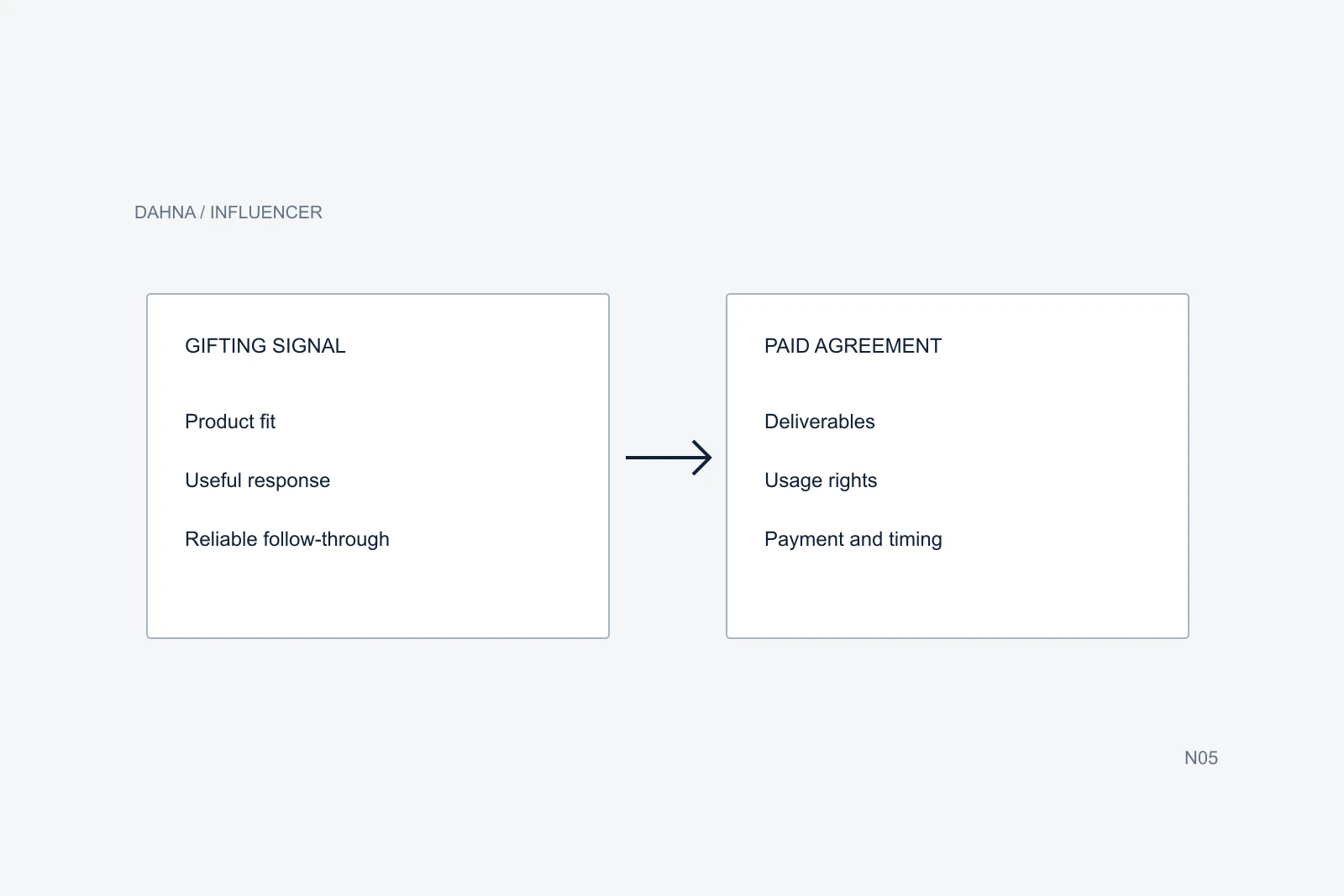
A creator receiving your product is a starting point. A paid partnership becomes useful when you can name the work you want to commission, explain why that person fits it and agree what the payment covers.
Dahna, original planning diagram
In this article
Overview
A creator receiving your product is a starting point. A paid partnership becomes useful when you can name the work you want to commission, explain why that person fits it and agree what the payment covers.
The decision in context
A popular gifted post can provide evidence, but it is not a complete business case. Look at how the creator explained the product, what viewers asked, whether the audience matches your intended customer and whether the next assignment has a clear purpose. Then buy a defined piece of work instead of buying the hope that a viral moment repeats.
Look for a useful explanation you can commission again
Review the actual post before its headline metrics. Did the creator use the correct product, explain it clearly and preserve important context? Did the comments reveal interest in the product or mainly interest in something unrelated to it? A smaller, relevant discussion can be more useful than a large audience responding to a joke that happens to feature your packaging.
For a skincare brand, a promising creator might clearly show where a product fits into a routine. For a device brand, the useful skill might be showing setup without making unsupported promises. Those are specific capabilities you can brief and evaluate in another assignment.
Treat sales evidence carefully. Record the date, offer, available stock and any paid amplification alongside attributed orders. A gifted post supported by a discount and additional distribution is not a clean forecast for a future full-price organic post. The creator may still be a strong partner; the next scope should reflect what the evidence actually shows.
| Observation | Interpretation | Next action |
|---|---|---|
| Clear demonstration with the right product version | Useful explanation skill | Commission a second customer question |
| Comments ask how the two sizes differ | Relevant unresolved buying question | Brief a comparison using approved facts |
| Many views, few identifiable product questions | Commercial fit remains uncertain | Review audience and context before expanding |
| Sales reported during a large promotion | Several factors may explain orders | Record offer and distribution before comparison |
Name what payment buys
Payment can cover different things: making an asset, posting it, participating in a live event, allowing a brand to reuse it, or providing a defined period of exclusivity. List them separately even if you ultimately agree on a bundled fee. Otherwise the brand and creator can leave the same conversation expecting different work.
Be concrete about the deliverable. Specify the product, audience question, format, approximate length where relevant, deadline and required factual elements. Explain the intended destination. A demonstration for the brand’s website may need a different framing and permission scope from a creator-channel post.
Keep room for the creator’s judgment. The reason to work with someone is partly that they understand how to communicate with their audience. Give them the facts, boundaries and objective, then agree which choices remain theirs. Overwriting their voice with a brand script can remove the very quality that made the original post useful.
Turn a promising post into an agreed assignment
Evidence
The creator answered a relevant product question.
Assignment
Commission the next question and deliverable.
Permission
Define posting, reuse, paid use and duration.
Review
Evaluate delivery and the intended response.
A first paid brief for a fictional skincare brand
Imagine a creator received a moisturizer and posted a helpful routine demonstration. Viewers now ask whether the smaller size is the same formula and how much product the container holds. The brand has approved answers and wants a clear follow-up, not a claim about results the creator has not experienced.
A bounded assignment could be one creator-channel video answering those two questions and a clean export for a specifically agreed brand use. The agreement would separately address paid advertising permission, editing, duration and any additional formats. None of those rights should be assumed because the product was originally gifted.
The brand supplies current product facts and the creator proposes the demonstration. Review focuses on accuracy and the agreed deliverable. If the brand later wants a second language, a new offer or extra paid placements, that is additional scope to discuss rather than an invisible extension of the original fee.
| Field | Completed example |
|---|---|
| Customer question | Are the two sizes the same product, and what does each contain? |
| Deliverable | One agreed creator-channel demonstration and one specified export |
| Brand inputs | Current SKU information, approved product statements and destination |
| Creator freedom | Opening, phrasing and demonstration style within the agreed facts |
| Rights discussion | Posting, reuse, editing, paid use, duration and territory listed separately |
| Acceptance | Correct facts, required disclosure, agreed files and posting evidence |
| Review | Relevant questions and observed outcomes with offer/distribution context |
Carry the relationship honestly into the next post
The FTC’s influencer guidance explains that free products and paid relationships can create material connections that need clear disclosure. Changing from gifting to a fee does not turn this into a small administrative detail. Make disclosure part of the brief and the review, in the context where people encounter the endorsement.
A creator should describe their actual experience and avoid claims they cannot support. The brand should provide accurate product information and review required statements before release. For a beauty device or skincare product, do not improvise a medical or performance promise because it sounds stronger in a hook.
Platform settings and applicable disclosure obligations should be checked for the planned placement. TikTok’s commercial content setting is one platform-specific step; it is not a substitute for considering the whole message. Keep the review practical: a viewer should be able to understand the relationship while encountering the content.
Compare the fee with the actual assignment
A higher fee can reflect a larger job, a more valuable audience, broader usage or more demanding production. Ask for the components before concluding that one creator is expensive and another is cheap. The comparison should use similar deliverables and permissions.
Include the brand’s surrounding costs: samples, shipping, coordination, editing and any planned distribution. If performance is part of compensation, define the eligible transactions, adjustments, reporting source and settlement process. A percentage without a clear base is not a complete commercial term.
For a first engagement, limit the commitment to something the team can learn from. That might mean one well-defined assignment with an option to discuss further work after review. It should not mean asking for a broad bundle of rights and indefinite availability in exchange for a vague promise of future opportunities.
Review the partnership without making one post carry the whole business
First check delivery: the asset, facts, files, permissions and publishing obligations. Then inspect the audience response in relation to the brief. A video commissioned to clarify a size difference should be assessed partly on whether that explanation was clear and whether the remaining questions changed.
Use commercial outcomes where they are available, but keep their limits visible. Attributed orders are useful evidence; they do not establish that every sale was caused by the post. Low counts or a stock interruption may leave the sales conclusion uncertain. Record that uncertainty instead of forcing a winner label.
A sensible next decision can be to repeat the creator, revise the brief, buy a different permission scope or stop. Dahna can help connect creator selection, product information and a manageable paid assignment. Bring the original content and the next question you need answered; that is a stronger starting brief than “find us another viral creator.”
Use this guide in your next brief
Download the tables from this guide as a working reference. Keep the example assumptions separate from your own figures, and record the source and date of any numbers you replace.
Sources & further reading
Plan your next influencer marketing decision
Share the creator content that prompted the conversation, the customer question you want answered next and the proposed placements.
Why consider Dahna for this work?
Dahna brings bilingual Korean and English strategy together with creator, content, and measurement work for brands growing in the US. You can review the people behind the recommendations and the kind of work we propose before starting a conversation.
Founder experience includes prior and contracted roles. Sample deliverables illustrate our approach; they are not client results or a performance promise.
External examples are research references, not Dahna client results or promised outcomes.