Does your ecommerce store need a product quiz?
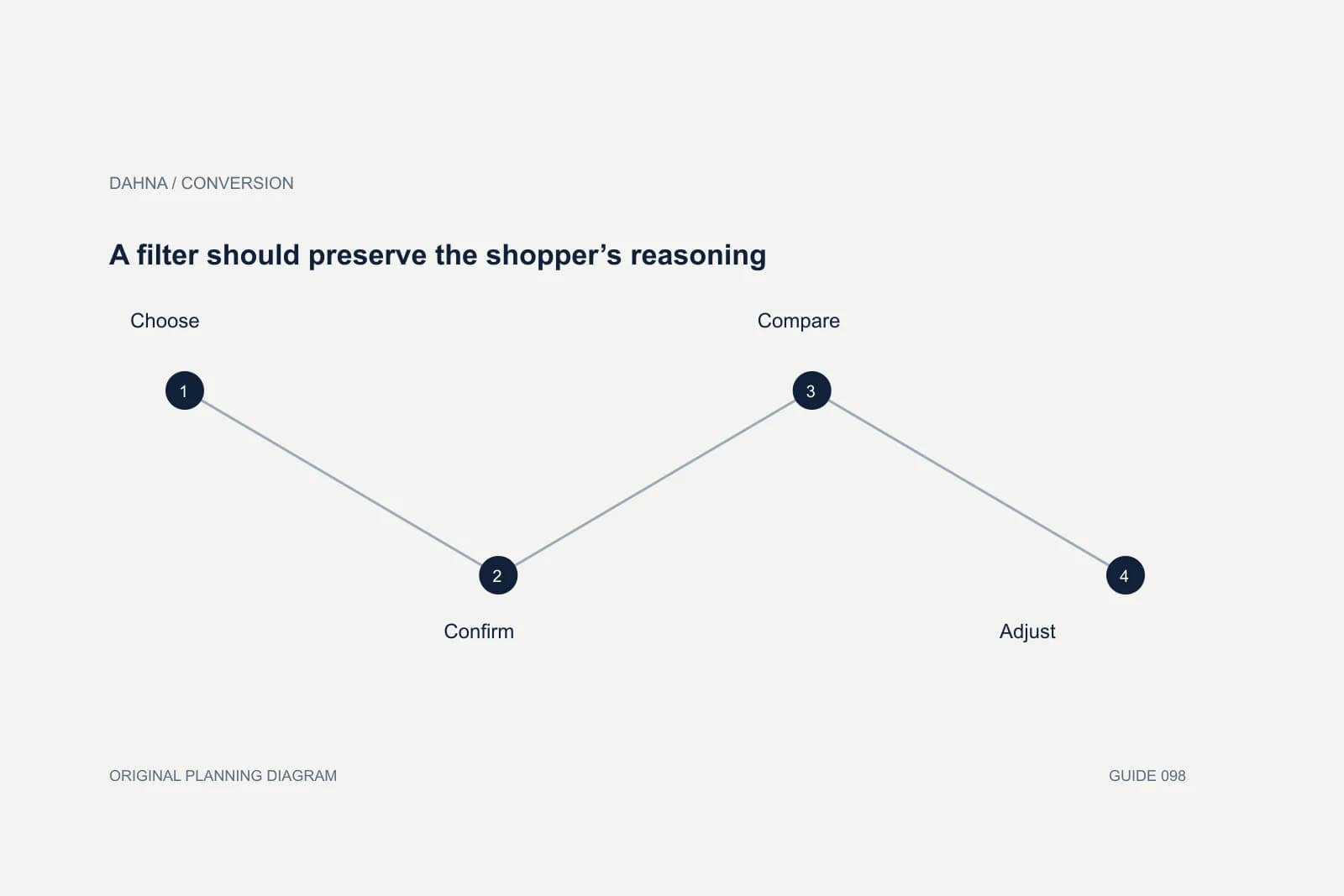
Build a quiz when shoppers need help translating a preference into a product choice and the catalog supports a defensible recommendation. Start with the decision rules and result explanation. If a short comparison or filter solves the same problem, use that simpler path. A quiz should earn its extra steps by making the choice clearer.
Dahna, original planning diagram
In this article
Overview
Build a quiz when shoppers need help translating a preference into a product choice and the catalog supports a defensible recommendation. Start with the decision rules and result explanation. If a short comparison or filter solves the same problem, use that simpler path. A quiz should earn its extra steps by making the choice clearer.
Identify a choice that benefits from guidance
A quiz can be useful when people know what they want to achieve but do not know the brand's product vocabulary. Someone may prefer a light texture and a short routine without knowing which collection corresponds to those preferences. Guided questions can translate that language into a manageable choice if the product facts support the translation.
A quiz is less useful when the catalog contains only a few obvious options or when every answer leads to the same hero product. In that case, a clear product page or comparison may do the job with less effort. Inspect support questions and observed shopping tasks before deciding that an interactive feature is necessary.
Write one success statement in the customer's language. For example: after answering a few relevant questions, a shopper can explain why the suggested moisturizer fits their texture and routine preferences. That is more useful than a project goal to collect more quiz leads. Email collection may be a separate business objective, but it should not obscure the product-choice task.
Clinique provides a real example of guided discovery
Clinique's official site includes a skincare finder quiz and describes it as a short route to products for a routine. That demonstrates a recognizable guided-discovery format within a large beauty range. The public page does not establish a conversion lift, and it does not reveal enough to evaluate every recommendation rule or the business economics behind the feature.
Use the example to frame questions for your own scope. What information does the customer genuinely need to provide? How does each answer change the possible result? What will the result explain? A small brand should be able to answer those questions in a spreadsheet before paying for a complex interface.
Avoid borrowing medical authority from the format. A product-preference quiz is not a diagnosis, and a camera or AI feature does not automatically make its recommendations clinically established. Keep the language and logic within the brand's approved product claims. If a use case requires professional advice, make that boundary clear and involve the appropriate qualified owner.
Write the rules before designing the screens
Create a rule sheet with each question, possible answer, relevant product field and effect on the result. Remove questions that do not change the recommendation or provide necessary context. A long quiz can feel personalized while collecting information that has no role in the decision. Every additional step should have a clear purpose.
Include a no-suitable-match outcome. If the catalog does not fit the person's stated requirements, the quiz should not force a recommendation merely to produce a product card. Explain the limitation and offer a useful next step, such as reviewing the range or contacting support. The same applies when required product facts are missing: resolve the data gap rather than guessing.
Decide how stock affects the result. A sold-out product may remain the best conceptual match, but the experience needs to distinguish that from an available alternative. Do not silently change the recommendation rationale to suit inventory. Record the fallback rule and have the product owner approve it before implementation.
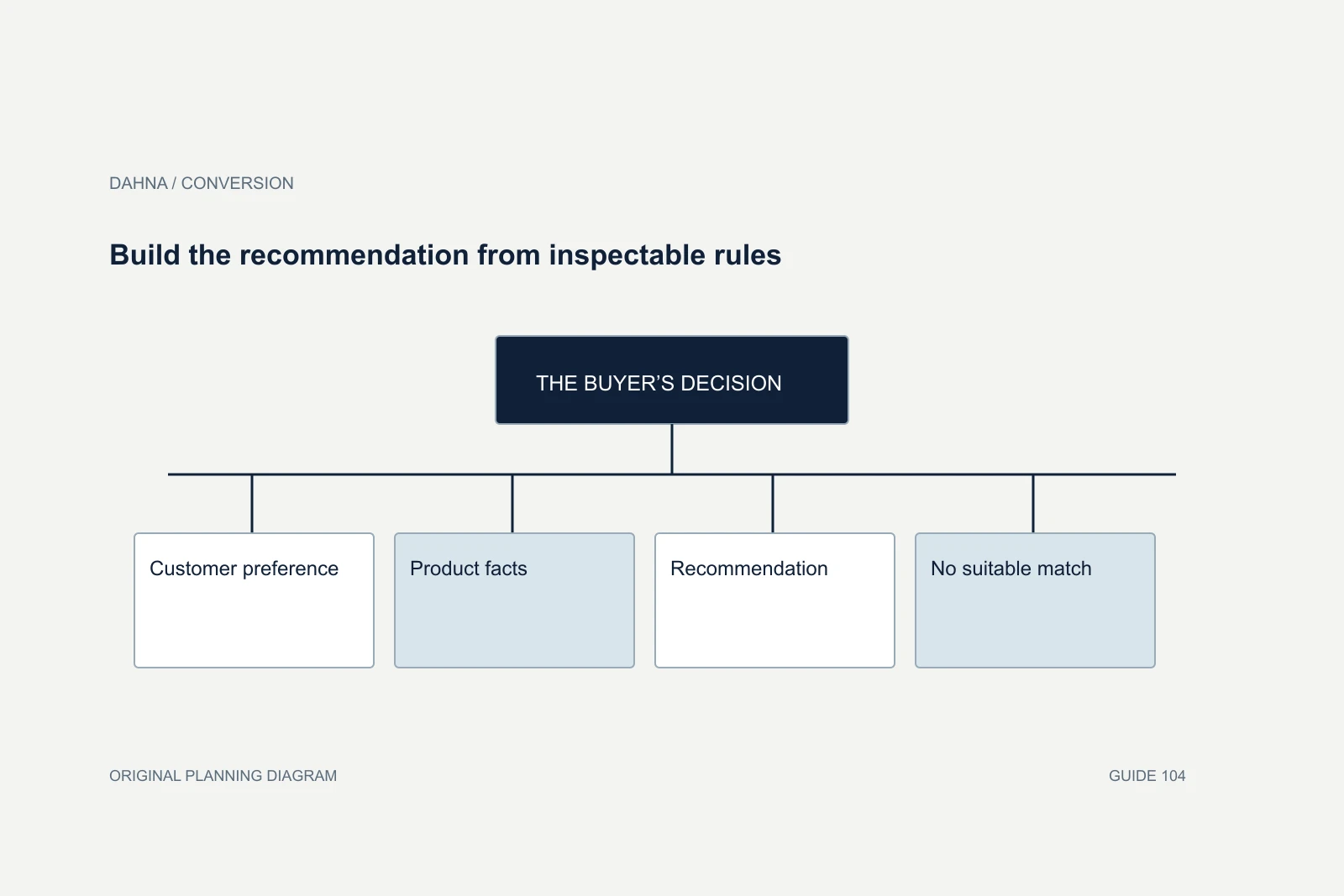
Build the recommendation from inspectable rules
Customer preference
Ask a question that changes the choice
Product facts
Match against approved, maintained attributes
Recommendation
Explain why this product fits the stated preference
No suitable match
Acknowledge the limit and offer a clear next step
A simple fictional moisturizer quiz
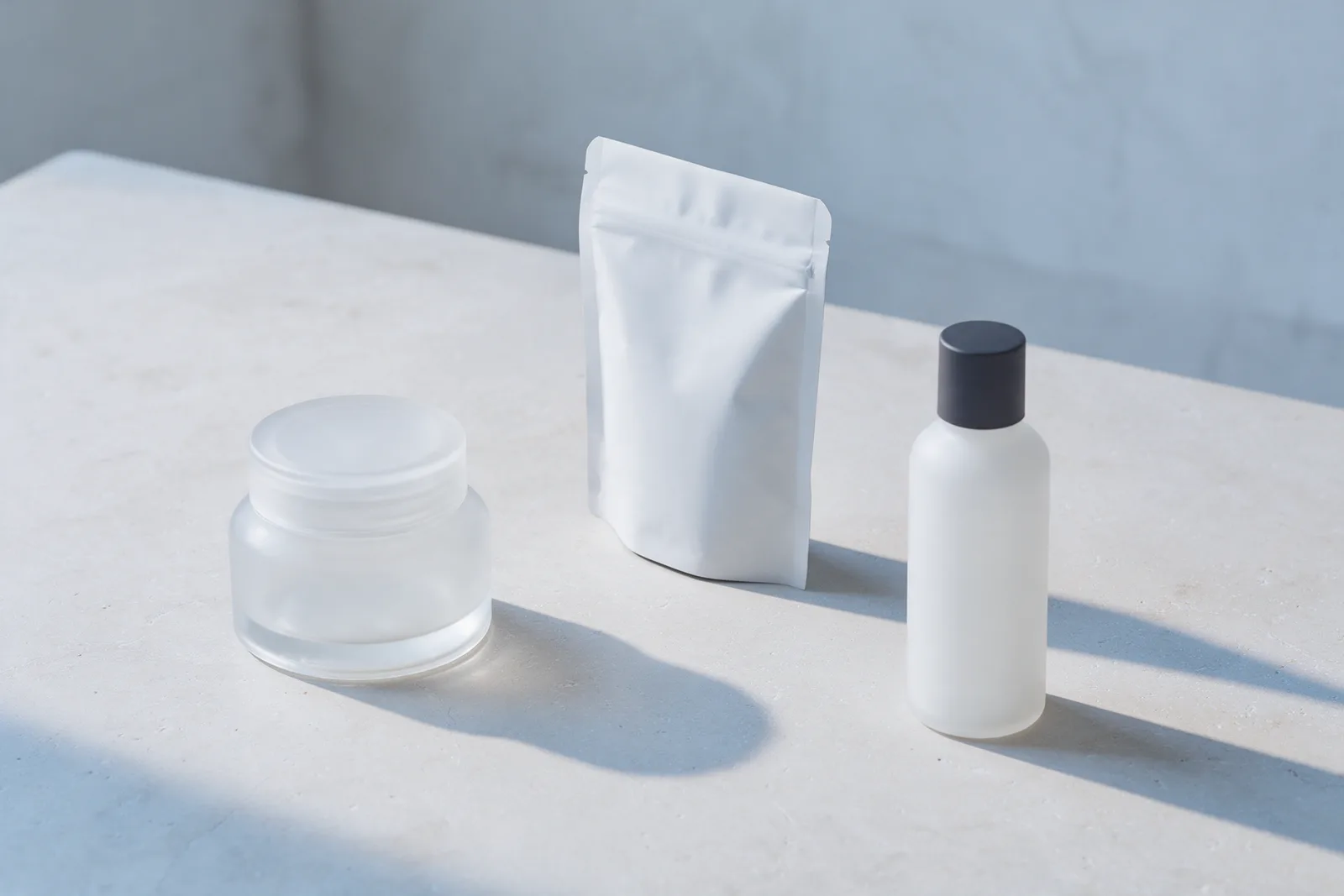
Imagine a fictional range with three moisturizers: a gel, a lotion and a rich cream. The approved product data distinguishes texture, package size and intended use instructions. The proposed quiz asks about preferred texture and desired routine length. It does not ask for a medical history or infer treatment needs from a self-reported condition.
A person who prefers a light gel receives the gel result with an explanation tied to that preference. Someone who says they are unsure sees a short comparison of the textures rather than an arbitrary winner. A routine-length answer changes the amount of supporting education, not the product's claims. The result includes the exact product, relevant facts, price and a route to compare alternatives.
Test contradictory or incomplete answers as well as the neat path. If the person skips a question, changes an earlier response or selects an unavailable option, the result should remain understandable. Write those cases into the brief. A quiz is a small application with states, not just a sequence of attractive question screens.
| Answer or state | Rule | Result explanation |
|---|---|---|
| Prefers gel texture | Match approved gel format | Suggested because you chose a gel texture |
| Unsure about texture | Do not invent a preference | Show a concise texture comparison |
| Short routine preferred | Adjust supporting instructions only | Explain the approved routine simply |
| Preferred item sold out | Show status and labeled alternative | Separate best match from availability |
| Missing required product fact | Hold affected recommendation | Resolve the data before release |
Keep data collection proportionate to the task
List every answer the system stores, where it goes and who can access it. A product quiz does not need to collect sensitive details simply because the form tool allows it. Use a privacy owner to review collection, retention and consent requirements for the actual markets served. The marketing team should understand whether answers become customer-profile fields or remain temporary interface state.
Consider showing the result without making email submission a hidden final condition. If an email is requested to save or send the result, explain that purpose and any separate marketing choice clearly. Measure the product-choice experience separately from contact collection so the team does not optimize a lead count while frustrating shoppers.
Test accessibility and recovery. People should be able to navigate the questions with a keyboard, understand progress, revise an answer and read the result without relying only on color. A back action should not unexpectedly erase the whole session. Include these requirements in the scope before choosing the quiz platform.
Judge the quality of the recommendation
Ask participants to complete a realistic shopping task and explain the result in their own words. Can they identify the product, understand the rationale and recognize the limits? Record cases where they infer a stronger benefit than the product facts support. The rule sheet may need revision even when completion rates are high.
For commercial evaluation, compare eligible visitors with a suitable alternative experience where feasible. Quiz completers are self-selected, so their purchase rate cannot establish that the quiz caused the outcome. Track initiation, completion, result usefulness, product selection, purchases and returns with clear definitions. More completed quizzes can be a poor result if people needlessly pass through them to reach an obvious product.
Dahna can discuss whether a quiz, comparison module or clearer product page is the right scope. Bring the confusing product choice, catalog facts and current customer questions. The first deliverable should be a defensible rule sheet and a tested result concept, followed by implementation only when the feature has a clear job.
Continue with the related decision
Use these guides when the next question goes beyond the scope of this article.
Use the editable decision sheet
Download the completed tables as a CSV, then replace the example inputs and add your evidence, owner and review date. Illustrative figures are teaching examples, not default targets.
Sources & further reading
Bring this decision to Dahna
Use this guide to prepare a focused brief. Tell Dahna what needs to change, which evidence you already have and when you need a decision.
Why consider Dahna for this work?
Dahna brings bilingual Korean and English strategy together with creator, content, and measurement work for brands growing in the US. You can review the people behind the recommendations and the kind of work we propose before starting a conversation.
Founder experience includes prior and contracted roles. Sample deliverables illustrate our approach; they are not client results or a performance promise.