How to test a skincare routine bundle
Test a routine bundle when shoppers need help assembling a sensible product combination and the economics support selling it together. Define the included products, approved use sequence, price and stock rules. Compare contribution across all eligible shoppers, including any single-product sales the bundle replaces. A larger basket alone does not prove the offer is better.
Dahna, original planning diagram
In this article
Overview
Test a routine bundle when shoppers need help assembling a sensible product combination and the economics support selling it together. Define the included products, approved use sequence, price and stock rules. Compare contribution across all eligible shoppers, including any single-product sales the bundle replaces. A larger basket alone does not prove the offer is better.
Name the customer task the bundle solves
A useful routine bundle answers a question such as “What do I need to start with this range?” or “Which of these products are intended to be used together?” It should not be a convenient way to attach slow-moving stock to a hero item. Review support questions, product-page behavior and actual order combinations to identify the task before selecting the contents.
Keep the routine understandable. List the products, quantities and intended sequence using approved product guidance. Explain any relevant choices and exclusions without implying that the same set suits every person. A beauty device bundle may need accessory compatibility and charging details; a skincare routine needs clear product identity and use instructions. The merchandising format should reflect those differences.
Decide whether the bundle is fixed or configurable. A fixed set is easier to explain and fulfill, while a configurable routine can accommodate preferences but creates more combinations to validate. The first project should be as simple as the customer task allows. More options are useful only if they help someone make a better choice.
What The Ordinary’s Daily Set illustrates
The Ordinary presents The Daily Set as a three-product starting routine. Its official page explains the included items and their place in the routine. The useful example is the clarity of the combination: the buyer can investigate a defined set rather than assemble the entire range from scratch. The page does not give us evidence that a similar bundle would raise another brand's conversion rate.
For your brand, write the equivalent explanation before commissioning a bundle landing page. Why are these products together? What remains optional? What should a person already using one component do? If the team cannot answer those questions clearly, a visual bundle card may hide an unresolved merchandising decision.
Use the actual product owner's guidance for sequencing and compatibility. Do not copy another brand's routine or infer that ingredients are compatible because products appear in the same category. The agency's role is to organize and communicate approved information, then test whether shoppers understand the offer. Product suitability and claims need their own responsible owner.
Calculate the bundle’s contribution before choosing its discount
Consider a fictional cleanser-and-moisturizer bundle priced at $58. Assume product cost of $16, packing and fulfillment of $4, payment cost of $2, delivery subsidy of $6 and an expected return-related allowance of $2. Contribution before acquisition spending and fixed overhead is $28. These are illustrative inputs, not beauty-industry benchmarks.
Now compare the alternative purchase. Suppose the average single-product order contributes $18 on the same cost basis. The bundle adds $10 contribution when it replaces one such order, but it could reduce contribution when it replaces two separate orders that would otherwise have occurred. A bundle's value depends on customer behavior as well as its standalone margin.
Keep the cost definition consistent across options. Include any extra carton, insert, assembly work or split-shipment expense created by the bundle. If components have different return rates, document the assumption rather than copying the hero product's allowance. The finance or operations owner should approve the inputs before the agency treats the bundle price as viable.
| Line | Amount | Treatment |
|---|---|---|
| Selling price after discounts | $58 | Revenue input |
| Product cost | $16 | Subtract |
| Packing and fulfillment | $4 | Subtract |
| Payment cost | $2 | Subtract |
| Delivery subsidy | $6 | Subtract |
| Return-related allowance | $2 | Subtract |
| Contribution | $28 | 58 − 16 − 4 − 2 − 6 − 2 |
Compare the whole order mix
Create a test in which eligible shoppers see either the current offer or the current offer plus the proposed bundle. Keep the underlying product prices, traffic allocation and core page information as stable as practical. State the exposure unit and observation window in advance. If shoppers can encounter both versions repeatedly, ask the analyst how assignment will remain consistent.
Use contribution per eligible visitor as a commercial measure, with conversion rate, average order value, component sales and refunds as supporting diagnostics. In a fictional readout with 1,000 visitors per group, the control produces 40 single orders at $18 contribution, or $720. The bundle group produces 25 single orders plus 12 bundles: $450 plus $336, or $786. The difference is $66 before test costs.
That synthetic result does not establish statistical significance. It shows why the full mix matters: single-product orders fell while bundle contribution more than offset the decrease in this example. A real decision needs uncertainty, follow-up costs and operational effects. Do not declare success solely because bundle buyers have a higher average order value than people who chose one item.
| Measure | Existing offer | Offer with bundle |
|---|---|---|
| Eligible visitors | 1,000 | 1,000 |
| Single-product orders | 40 | 25 |
| Bundle orders | 0 | 12 |
| Total contribution | $720 | $786 |
| Contribution per visitor | $0.720 | $0.786 |
Make component availability part of the offer
A bundle is only available when its required components are available in the promised quantities. Decide which inventory system controls the set and how it behaves when one component runs low. A manually maintained bundle count can drift from the component stock and create overselling. Test the update path with the actual fulfillment process before promoting the offer.
Specify substitution rules. If the brand will not substitute a product, say so internally and ensure customer service cannot improvise a different routine after purchase. If a configurable option is supported, verify that its price, image, instructions and inventory all follow the selection. A bundle should arrive as the combination the customer understood at checkout.
Review returns and damaged components with the operations owner. The website summary must reflect the approved process for a partially returned set or an unavailable replacement. These details affect both the customer experience and the economics. They belong in the launch brief even if the public product page presents them through concise links.
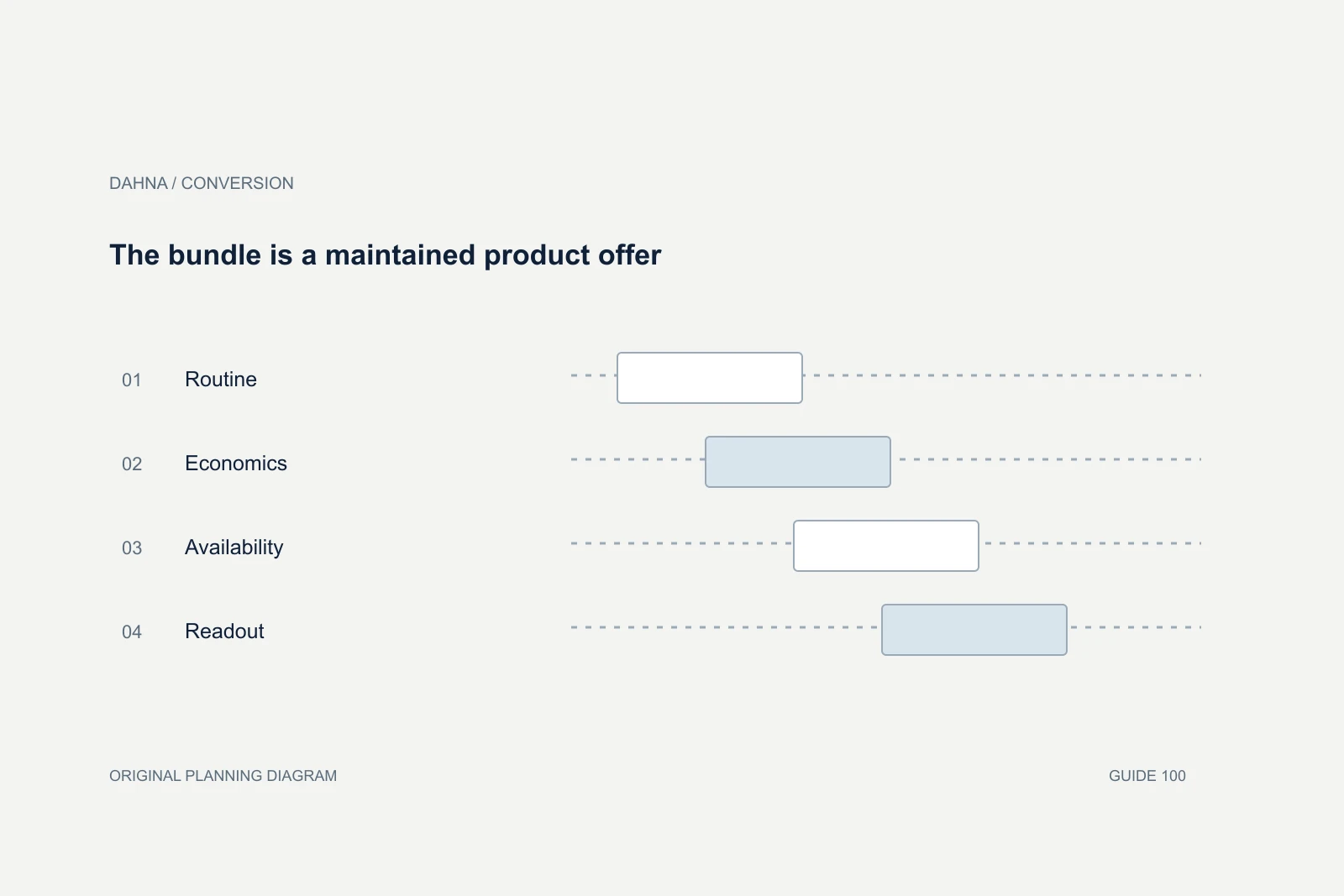
The bundle is a maintained product offer
Routine
Approved products and use sequence
Economics
Contribution with all incremental costs
Availability
Component stock supports the complete set
Readout
Evaluate the full order mix and customer experience
Choose expand, revise or hold
Expand when the offer is understood, the observed economics meet the agreed decision rule and operations can support the volume. Revise when a specific issue is fixable, such as unclear contents or an expensive packaging choice. Hold when the bundle mainly shifts purchases without enough contribution or when the evidence is too uncertain to justify a broader rollout.
The agency brief should include the customer question, approved routine, component economics, inventory behavior, proposed page and test design. Ask for a completed example of the readout before launch. That helps the team agree what would count as a useful result instead of choosing a favorable metric afterward.
Dahna can discuss how merchandising, product content and conversion measurement should fit together. Bring the proposed products and the reason customers might prefer buying them as a set. The first conversation should establish whether the bundle resolves a real choice and whether a focused test can answer the commercial question.
Continue with the related decision
Use these guides when the next question goes beyond the scope of this article.
Use the editable decision sheet
Download the completed tables as a CSV, then replace the example inputs and add your evidence, owner and review date. Illustrative figures are teaching examples, not default targets.
Sources & further reading
Bring this decision to Dahna
Use this guide to prepare a focused brief. Tell Dahna what needs to change, which evidence you already have and when you need a decision.
Why consider Dahna for this work?
Dahna brings bilingual Korean and English strategy together with creator, content, and measurement work for brands growing in the US. You can review the people behind the recommendations and the kind of work we propose before starting a conversation.
Founder experience includes prior and contracted roles. Sample deliverables illustrate our approach; they are not client results or a performance promise.