Should Your Beauty Brand Offer a Paid Mini Size?
Test a paid mini when shoppers hesitate over the initial commitment, the package is ready to sell, and the economics justify a bounded trial. Compare total contribution per eligible visitor, including any displaced full-size orders, before expanding the offer.

In this article
Overview
Test a paid mini when shoppers hesitate over the initial commitment, the package is ready to sell, and the economics justify a bounded trial. Compare total contribution per eligible visitor, including any displaced full-size orders, before expanding the offer.
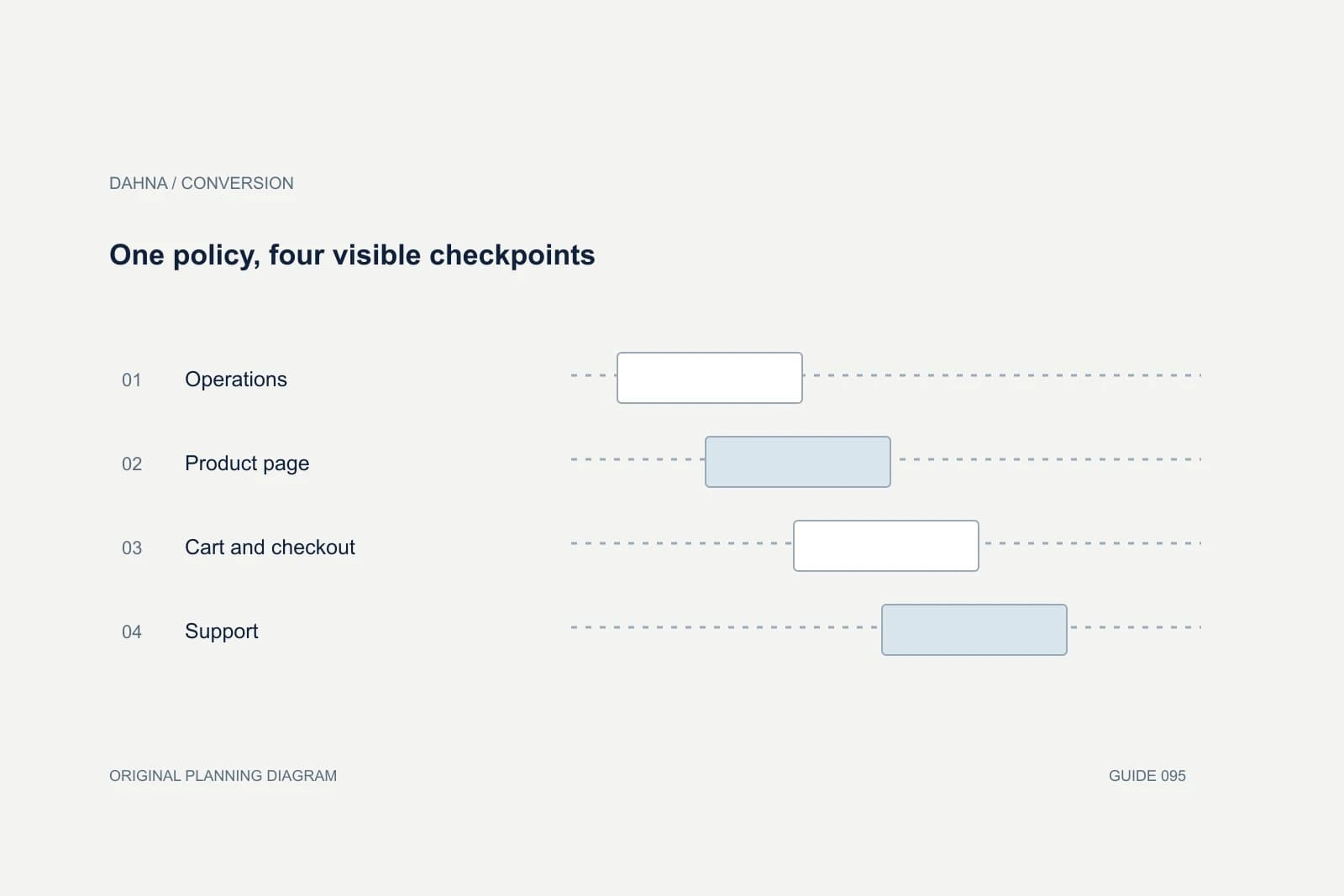
From commitment hesitation to a bounded offer test
- 01
Name the hesitation
Identify the uncertainty that a smaller purchase could resolve.
- 02
Cost the separate order
Include packaging, handling, delivery and displaced full-size contribution.
- 03
Compare complete offers
Evaluate the existing offer against the same offer with a mini choice.
- 04
Limit the next commitment
Introduce, revise or hold using the agreed evidence and inventory ceiling.
What hesitation would a smaller size resolve?
A mini deserves consideration when the obstacle is committing money or product volume before experiencing the formula. Start with a concrete question: would someone interested in this moisturizer buy a smaller amount to assess texture and how it fits their routine? A smaller package will not resolve unclear instructions, missing product facts or an unreliable checkout.
Read a bounded selection of recent support conversations and product questions. Separate requests to try less product from requests for a lower price, a travel format or better explanation. These can look similar in a comment but imply different offers. Record the wording, product and context without claiming that the people who contacted support represent every shopper.
Write the proposed job in one sentence: offer a lower-commitment way to experience the same moisturizer. Keep the existing full size visible. The first decision concerns a purchasable format, not a promise that every mini buyer will later become a full-size customer.
- Consider a mini when shoppers understand the product but hesitate over the initial commitment.
- Improve the explanation first when shoppers cannot tell what the product is or how to use it.
- Investigate price positioning separately when the objection is affordability at any size.
Is the proposed mini ready to sell?
It is ready for a marketing test only after the product owner confirms the package, contents and instructions are suitable for the intended sale. Do not assume that reducing the fill volume is the whole task. Confirm the actual dispensing experience, usable quantity, packaging cost, available stock and relationship to the full-size formula.
FDA guidance describes product identification and net quantity among cosmetic labeling requirements. Send the proposed mini packaging and accompanying information to the qualified regulatory reviewer before photography or production commitments. This is a marketing handoff, not an assessment that a particular label complies.
On the product page, show the mini and full size together with their actual quantities and prices. Explain any packaging differences that affect use. Avoid estimating applications from package volume unless the brand has a defensible basis. A mini should not imply that a short trial establishes long-term efficacy or universal suitability.
- Product owner: confirm formula version, fill quantity, directions and package functionality.
- Operations owner: confirm sellable inventory, picking method and replacement handling.
- Marketing owner: prepare an accurate size comparison and a clear purchase choice.
Can a mini order support its own costs?
Calculate it as a separate order before assuming later purchases will rescue it. The following worksheet is entirely hypothetical, in US dollars, and is not a beauty benchmark. Define contribution here as merchandise revenue plus collected shipping, less product, packing, payment, delivery and expected refund-related costs. Acquisition spending and fixed overhead remain outside this subtotal.
Suppose a mini sells for $12 and collects $4 shipping. Product and packaging cost $3, picking costs $2, payment costs $0.80, delivery costs $5 and an expected refund-related allowance is $0.60. Contribution is $16 minus $11.40, or $4.60. Waiving the shipping charge reduces it to $0.60 if everything else stays unchanged.
A hypothetical $36 full-size order with total variable costs of $17 contributes $19. That difference matters if some shoppers switch from full size to mini. Shopify notes that profit reporting depends on recorded product costs; verify those inputs and add any missing costs needed for this decision.
Acquisition spending and fixed overhead require separate consideration before expansion; the contribution subtotal does not pay for them automatically.
- Record each cost once, including whether inbound freight is already included in product cost.
- Separate one-time mini development costs from recurring order costs.
- Set an acceptable test loss and inventory exposure before buying packaging.
Build a test card around the whole offer
Compare the current full-size offer with the same experience plus a clearly explained mini. Keep the full-size price, shipping policy, core product information and traffic sources as stable as practicable. Otherwise, a simultaneous discount or page redesign can obscure what the smaller size contributed.
Define eligible visitors before launch and assign them consistently if the testing system supports it. State the intended observation window, spending ceiling and stopping conditions. Estimate the traffic needed with an analyst using the store's baseline and the smallest commercially meaningful change; a universal order-count rule would be misleading.
Use total contribution per eligible visitor as the commercial decision measure, with full-size orders, mini orders, refund reasons and support questions as diagnostics. Ask whether the mini opened a useful purchase path or merely redirected an existing one. Dahna's conversion service is a relevant discussion when this offer design, measurement and page coordination need one scoped owner.
- Hypothesis: a paid mini reduces commitment hesitation without an unacceptable decline in total contribution.
- Guardrails: no inaccurate size presentation, stock failures or unexpected shipping charges.
- Review point: evaluate the complete assigned groups, including visitors who buy nothing.
| Field | Example / input to complete |
|---|---|
| Buying hesitation | Commitment before experiencing the formula |
| Mini quantity / price | Quantity: confirm; price: $12 |
| Full-size quantity / price | Quantity: confirm; price: $36 |
| Mini collected revenue | $16 including $4 shipping |
| Recurring mini costs | $11.40 |
| Mini contribution | $4.60 before acquisition and fixed overhead |
| Eligible visitors | Define before assignment |
| Observation window | Set start, end and equal follow-up |
| Acceptable loss | Approve before launch |
| Inventory ceiling | Approve before packaging order |
| Decision owner | Assign before launch |
Read the order mix before celebrating demand
Consider a second hypothetical example with 1,000 eligible visitors in each group. The existing offer produces 30 full-size orders at $19 contribution each: $570, or $0.57 per visitor. The mini offer produces 24 full-size orders and 30 mini orders: $456 plus $138, totaling $594, or $0.594 per visitor.
Orders rise from 30 to 54, but contribution rises by only $24 before test setup costs. The apparent improvement is small and could be uncertain. These synthetic counts do not establish statistical significance. They illustrate why order volume and conversion rate cannot settle the decision alone.
Later full-size purchases can be observed as a secondary outcome using an agreed customer definition and equal follow-up windows. Do not compare a mature mini cohort with a newly acquired control cohort. Avoid treating every subsequent purchase as caused by the mini, and do not count projected upgrades as realized contribution.
- Separate mini-only, full-size-only and mixed baskets when reviewing product choice.
- Check whether returning customers account for most mini demand.
- Record missing follow-up data and unresolved uncertainty beside the result.
Choose introduce, revise or hold
Introduce the mini when the observed economics, operational readiness and customer experience meet the pre-agreed decision rule. Revise when interest is credible but a correctable issue, such as packaging expense or confusing size presentation, prevents acceptance. Hold when the offer mainly displaces stronger orders or the evidence cannot support a larger commitment.
An inconclusive test can still identify a useful next action. Repeated questions about quantity may justify clearer photographs before more traffic. Expensive standalone fulfillment may justify reconsidering the offer, but changing it into an add-on creates a new hypothesis that needs its own evaluation.
For a scoped discussion, bring the product story, hesitation evidence, current size and price, cost worksheet and intended timing. Read Dahna's team background and ask how content, conversion and campaign responsibilities would fit this test. Ask for a defined deliverable covering the offer, decision rule, page requirements and readout.
- Decision owner: approve introduction, revision or a pause in writing.
- Closeout record: retain assumptions, observed costs and reasons for the decision.
- Next commitment: specify inventory and implementation limits before expansion.
Use the blank planning sheet
Download the editable CSV and replace the blank fields with your own evidence, owners and decision dates. The worksheet is a planning aid; the article’s fictional examples are not default targets.
Sources & further reading
Tell us the story behind your trial-size idea
Share your product, the buying obstacle you want a mini to resolve and your timing. Dahna can help identify the shopper question, shape the page or offer test and connect the work to a measurable next action.
Why consider Dahna for this work?
Dahna brings bilingual Korean and English strategy together with creator, content, and measurement work for brands growing in the US. You can review the people behind the recommendations and the kind of work we propose before starting a conversation.
Founder experience includes prior and contracted roles. Sample deliverables illustrate our approach; they are not client results or a performance promise.
Scope depends on product readiness and available data; no conversion improvement is guaranteed.