How to explain shipping and returns on a product page
Put the delivery cost or its calculation rule, a usable timing explanation and the key return conditions close to the purchase decision. Give shoppers direct access to the complete policies. Check the message against the selected product, destination and offer so a reassuring summary never contradicts checkout.
Dahna, original planning diagram
In this article
Overview
Put the delivery cost or its calculation rule, a usable timing explanation and the key return conditions close to the purchase decision. Give shoppers direct access to the complete policies. Check the message against the selected product, destination and offer so a reassuring summary never contradicts checkout.
Start with the policy the store can actually deliver
A product page cannot solve a delivery problem by sounding more confident. Before editing the module, ask the operations owner to confirm handling time, carrier estimates, serviceable destinations, exclusions and the point at which an order qualifies for a particular rate. Write down which values the store can calculate and which still require a destination. The result is a small product-specific brief, not a generic promise copied from the homepage.
Separate dispatch from arrival. “Ships in two business days” describes when the parcel leaves; a shopper planning a gift may read it as the arrival date. If the business cannot calculate an arrival window, explain dispatch and estimated transit separately. State the applicable calendar and cutoff when those details materially change the expectation. A Korean brand shipping from a US warehouse should describe that actual route, rather than using its headquarters location as a delivery clue.
Returns need the same precision. A device, an unopened serum and a promotional set may have different conditions. Record the approved eligibility, request window, return postage treatment and exclusions. The website team should request a decision where policy is unclear, then implement the approved answer. Rewriting a policy without its owner's involvement can create a promise the support team cannot honor.
Why the banner is not enough
Baymard researcher Edward Scott describes shoppers missing shipping information presented only in a sitewide banner. The published examples include Crutchfield and show purchase-area placement at Tesco and Microsoft. The useful observation is about visibility during a task; it is not evidence that your store will achieve a particular revenue lift from moving a sentence.
Use a compact summary near the price, variant choice and purchase button. It should answer the next practical question without becoming another large promotional block. A direct “Shipping and returns” link can open the relevant details, but the key condition should not require opening a long legal document. If a selected product is excluded from an advertised promotion, show that exception at the point where the promotion would otherwise be inferred.
Retain a direct policy destination in the footer as well. People use different routes to verify a purchase, and the small module is not a replacement for a maintained policy page. Keep the summary and full policy connected to the same source of truth. In a multilingual store, assign someone to confirm that translated summaries describe the same commercial terms rather than a more generous local interpretation.
A completed skincare example
Consider a fictional US storefront selling a $38 cleanser. For this exercise, the approved policy is $6 standard delivery below a $60 merchandise subtotal after discounts, free standard delivery at $60, dispatch within two business days, and returns of eligible unopened products requested within 30 days of delivery. These inputs are invented for planning; they are not recommendations for your own policy.
The useful summary is specific enough to prevent the most likely misunderstanding: “Standard delivery is $6; free at $60 after discounts. Dispatches within two business days. Eligible unopened returns within 30 days of delivery.” A detail link explains destination coverage, transit estimates and how to start a return. If the product page cannot know the destination, it should say where the final estimate appears instead of inventing an arrival date.
Now apply a 20% discount to a $64 basket. The merchandise subtotal becomes $51.20, so it no longer qualifies under the fictional rule. A progress message based on the pre-discount subtotal would conflict with checkout. This is an implementation defect, not a copy preference. Record the failing cart state and fix the calculation before testing a more prominent presentation.
| State | What the shopper should see | Acceptance check |
|---|---|---|
| One $38 cleanser | $6 standard shipping; threshold is $60 | Product summary agrees with checkout |
| $64 basket before discount | Free standard shipping if eligible destination | Cart reads the qualifying subtotal |
| $64 basket with 20% off | $51.20 qualifying subtotal; $6 shipping | Promotion does not leave a stale free-shipping message |
| Opened cleanser return question | Approved unopened-product condition | Summary and full policy say the same thing |
Connect merchandising, operations and the website
Give every variable an owner. Merchandising owns the offer and its dates. Operations owns dispatch assumptions and destination restrictions. Customer service owns the practical request process. The website team owns how those approved rules appear and change as a shopper selects a variant or edits the basket. Shared ownership of the entire module usually means no one notices when one input becomes stale.
For a beauty device, add the questions the device actually raises: whether accessories ship together, whether a preorder changes dispatch, and which return conditions apply to the complete kit. Do not borrow a skincare consumable's summary because both products sit in the beauty category. The article about device product education is a useful next step when people also need help understanding what is included and how the product is used.
A simple change log is enough for many small teams. Record the policy version, approving owner, affected market, effective date and pages updated. Schedule the reversal of temporary holiday wording when the promotion is created. Otherwise a seasonal reassurance can survive into a period when the warehouse no longer supports it.
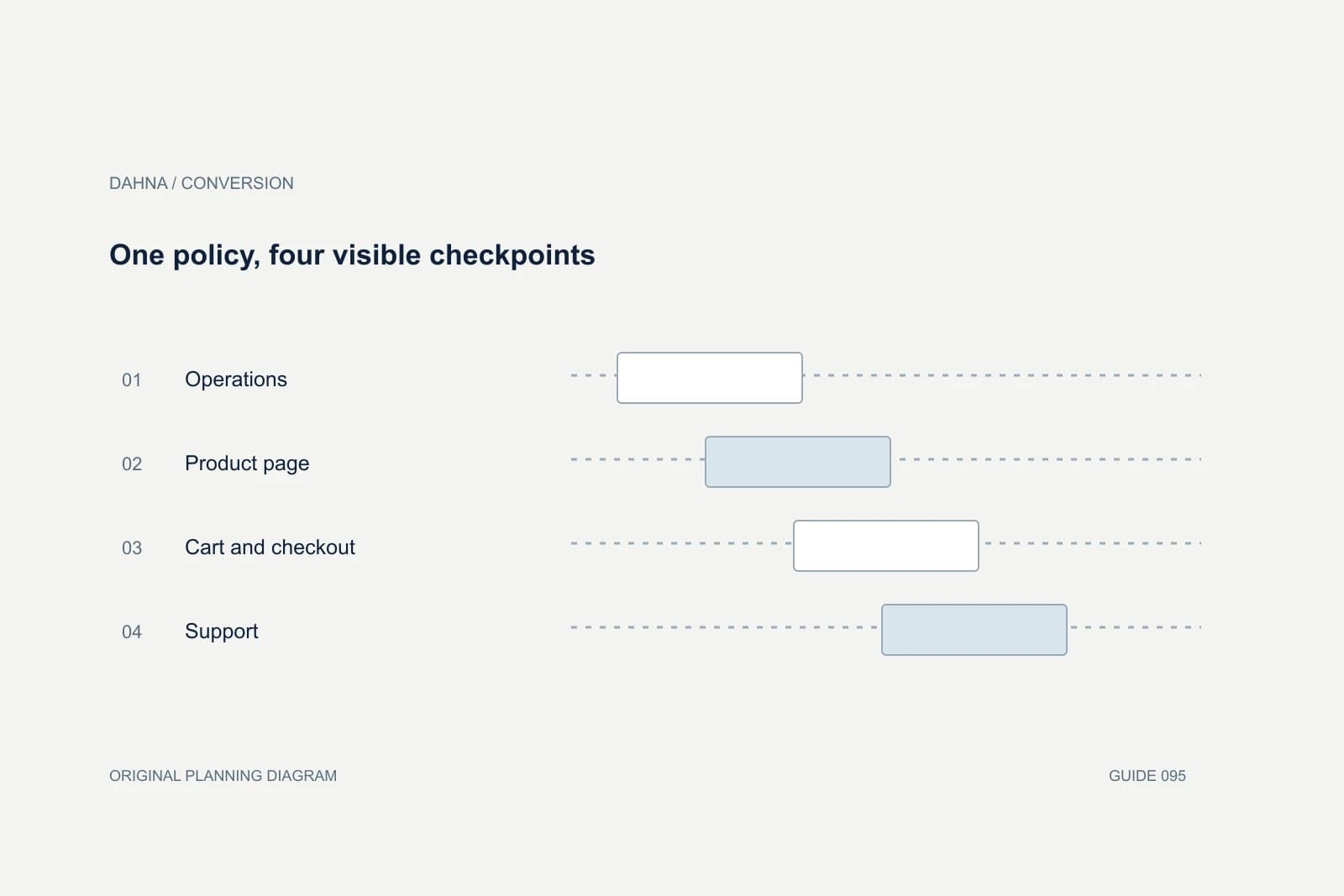
One policy, four visible checkpoints
Operations
Confirms destinations, dispatch and exceptions
Product page
Summarizes the approved terms for this item
Cart and checkout
Recalculates against destination and discounts
Support
Uses the same policy version to answer questions
Test understanding as well as technical accuracy
Create test cases for a normal order, a basket below the threshold, a discounted basket, an excluded destination and an exceptional product. Walk each case from product page to checkout on a phone. Check that the summary survives a variant change, remains readable at larger text sizes and does not cover the purchase controls. Verify links with keyboard navigation and confirm that any expandable details preserve a clear heading and reading order.
Then ask someone unfamiliar with the store to explain the delivery cost and return eligibility in their own words. Give them a concrete task, such as deciding whether the cleanser can arrive for a particular event. A person who finds the policy but misunderstands dispatch as delivery has exposed a content problem. Record that misunderstanding separately from a broken calculator or missing link.
Do not delay a factual correction to preserve a test. An inaccurate policy statement should be fixed. A choice between two accurate placements can be evaluated experimentally when the traffic and implementation support it. Keep the offer and shipping rule unchanged while comparing placement, or the result will combine economics with communication.
What to ask an agency to deliver
A useful scope includes an approved policy matrix, proposed product-page wording, responsive placement, cart consistency checks and an owner for future changes. Ask for examples of accepted and rejected states, not only a polished screenshot. The implementation should be demonstrable with your real variants, discounts and destinations before it is signed off.
For measurement, inspect questions about unexpected delivery charges, policy-link use and checkout progression alongside purchase and refund outcomes. More policy clicks can mean useful discovery or continuing confusion; the number needs context. A lower conversion rate after making a restrictive condition clear may reflect better-informed shoppers rather than a worse interface. Evaluate the commercial result together with avoidable complaints and support work.
Dahna can discuss how the product content, conversion review and website implementation should fit one scope. Bring the current policy, a few recurring customer questions and the affected products. That gives the conversation a concrete starting point and makes it possible to separate a writing task from an operations change.
Continue with the related decision
Use these guides when the next question goes beyond the scope of this article.
Use the editable decision sheet
Download the completed tables as a CSV, then replace the example inputs and add your evidence, owner and review date. Illustrative figures are teaching examples, not default targets.
Sources & further reading
Bring this decision to Dahna
Use this guide to prepare a focused brief. Tell Dahna what needs to change, which evidence you already have and when you need a decision.
Why consider Dahna for this work?
Dahna brings bilingual Korean and English strategy together with creator, content, and measurement work for brands growing in the US. You can review the people behind the recommendations and the kind of work we propose before starting a conversation.
Founder experience includes prior and contracted roles. Sample deliverables illustrate our approach; they are not client results or a performance promise.