How to fix ecommerce searches that return no results
Classify the failed query before changing the search interface. The product may be absent, named differently, missing an attribute or excluded by a filter. Repair the underlying cause and offer an honest next step when the store cannot satisfy the request. A grid of unrelated bestsellers does not resolve the original question.
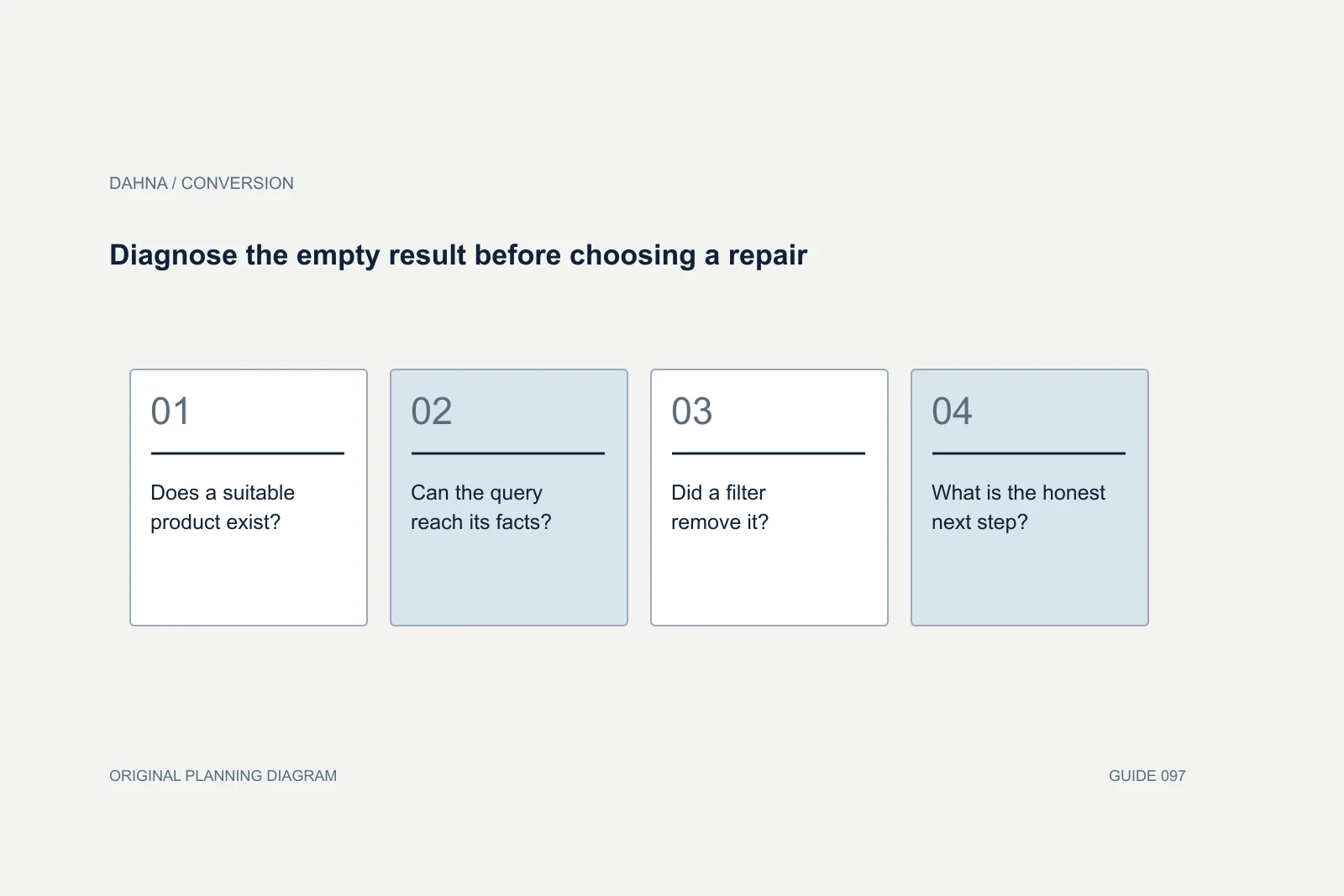
Dahna, original planning diagram
In this article
Overview
Classify the failed query before changing the search interface. The product may be absent, named differently, missing an attribute or excluded by a filter. Repair the underlying cause and offer an honest next step when the store cannot satisfy the request. A grid of unrelated bestsellers does not resolve the original question.
Begin with failed searches, not a search-app shortlist
Collect a recent sample of no-results queries with date, device, market and any applied filters. Preserve the original query alongside a normalized version so spelling, spacing and model numbers remain inspectable. Exclude obvious automated noise and avoid exporting personal information that someone may have typed into the search box. The output should be a reviewable set of customer requests, not a spreadsheet of unexplained strings.
For each query, ask whether the store actually sells a relevant item in that market. If it does, locate the product and identify the field that should connect it to the request. A cleanser described as a face wash might need an approved synonym. A discontinued shade may need a clear explanation and a separately labeled alternative. A product that cannot ship to the selected country is an availability issue, not a spelling problem.
Rank the work by customer consequence and repeated evidence. A rare typo for an important hero product can be worth fixing, while a high-volume query for something the business will never sell may need a clear response rather than new merchandise. Search counts show demand within the people using your store; they do not establish the size of the wider US market.
A failed search should offer a useful way forward
In Baymard's published no-results study, Sonia Sousa describes dead ends and recovery options. Its examples include a stranded search at Tire Rack and generic search advice at Marks & Spencer. The takeaway for a brand team is to provide a relevant route forward rather than expecting shoppers to learn the site's preferred vocabulary. Those examples are research observations, not a current ranking of either retailer.
Preserve the query in the input so the shopper can edit it. Explain what happened in ordinary language and distinguish an exact match from a broader suggestion. If the store substitutes “moisturizer” for “face cream,” show that relationship instead of silently pretending the query was different. If nothing is suitable, a relevant category or support route is more honest than a forced product recommendation.
Be careful with sensitive beauty requests. A search for a medical condition does not authorize the store to claim a product treats that condition. The product and claims owner should approve any synonym or recommendation logic that changes the implication of a query. A useful search experience can explain the catalog's limits without turning every question into a sales promise.
A completed query triage example
Suppose a fictional beauty store sells a cleansing balm, a fragrance-free moisturizer and three lip-tint shades. A small review finds four recurring searches: “makeup remover balm,” “unscented cream,” a discontinued shade name and “LED mask.” The first two may point to existing products, but the team must verify the product terminology before adding mappings. The last two need different treatment because the exact requested item is absent.
For the balm, an approved synonym can connect the phrase to the product without changing its claims. For the moisturizer, “unscented” and “fragrance-free” should not automatically be treated as identical product facts; the product owner needs to approve the wording. For the discontinued shade, explain its status and label any suggested shade as an alternative. For an LED mask the store does not sell, a generic skincare bestseller is not an equivalent result.
Record the chosen repair and expected result for each query. Then test the original phrase, a common misspelling, plural forms and the same search with a filter applied. A fix that works only in the admin preview has not passed the customer task. Keep the original failure in the acceptance sheet so a later catalog update can be checked against it.
| Query | Likely cause | Proposed response |
|---|---|---|
| makeup remover balm | Catalog vocabulary mismatch | Approved synonym to the cleansing balm |
| unscented cream | Potentially ambiguous attribute wording | Verify claim before mapping to fragrance-free |
| Retired shade name | Exact product discontinued | State status; label alternatives separately |
| LED mask | Product category not sold | Honest no-match message and relevant help |
| balm + impossible filter pair | Conflicting applied filters | Expose selected filters and a clear removal route |
Fix data before replacing the entire search system
A search tool can only use the information and rules available to it. Check product titles, descriptions, variant names, searchable attributes and availability before assuming that a different app will solve the problem. A catalog that describes finish in five incompatible ways will continue to produce confusing results until someone defines and maintains those values.
Separate changes into catalog corrections, query rules and interface behavior. Catalog work fixes the underlying product record. Query rules connect approved language to that record. Interface work explains the result and makes recovery possible. This separation makes proposals easier to compare: one agency may be pricing data cleanup while another is pricing a new search subscription and front-end component.
Use a small acceptance set that covers the important failure types, then expand it as new issues appear. Include exact product names and legitimate zero-result searches so the solution does not overcorrect by returning something for every phrase. A search system that always displays products can look successful while reducing relevance. The goal is a useful answer, including an accurate no-match answer.
Diagnose the empty result before choosing a repair
Does a suitable product exist?
Check market, stock and catalog scope
Can the query reach its facts?
Review approved vocabulary and attributes
Did a filter remove it?
Inspect the actual selected constraints
What is the honest next step?
Show a relevant result, correction or clear alternative
Evaluate recovery without rewarding irrelevant clicks
Track no-results exposure and the next meaningful action using a stable event definition. Useful outcomes include a revised query that finds a suitable product, a relevant category visit, a product selection and a completed purchase. Also inspect repeated searches and exits, because someone can click an irrelevant suggestion and still leave frustrated.
Compare similar queries and catalog conditions. A large improvement after restocking a hero product cannot be attributed solely to a redesigned no-results page. Likewise, a lower no-results rate may reflect broad matching that returns weaker results. Read a sample of the actual result pages alongside the aggregate chart. Numbers tell you where to look; they do not replace relevance review.
For a small store, a repeatable query acceptance set and a handful of task sessions may be more useful than an elaborate experiment with very few searches. Ask participants to find a product for a realistic preference, then explain why the result matches. Record unsupported inferences as well as failures. The buyer should understand the result rather than simply reach a product page.
What the agency brief should contain
Bring the failed-query sample, current search configuration, catalog export fields and market restrictions. Ask for a cause classification, proposed data changes, approved synonym list, recovery-page specification and acceptance results. Clarify ongoing responsibility for new product names and discontinued items. Search relevance degrades when no one owns the catalog after the initial cleanup.
A narrowly scoped first project can focus on one collection and its highest-consequence failures. That lets the team validate the process before buying a large platform or rewriting every product record. If a new tool is still needed, the acceptance set becomes a practical way to compare options using your own products and customer language.
Dahna can discuss the connection between catalog content, website implementation and conversion review. The useful question is which failures the project will resolve and how the brand will maintain the result. That is a firmer basis for an agency decision than a promise to make the search experience feel smarter.
Continue with the related decision
Use these guides when the next question goes beyond the scope of this article.
Use the editable decision sheet
Download the completed tables as a CSV, then replace the example inputs and add your evidence, owner and review date. Illustrative figures are teaching examples, not default targets.
Sources & further reading
Bring this decision to Dahna
Use this guide to prepare a focused brief. Tell Dahna what needs to change, which evidence you already have and when you need a decision.
Why consider Dahna for this work?
Dahna brings bilingual Korean and English strategy together with creator, content, and measurement work for brands growing in the US. You can review the people behind the recommendations and the kind of work we propose before starting a conversation.
Founder experience includes prior and contracted roles. Sample deliverables illustrate our approach; they are not client results or a performance promise.