How to catch marketing-data problems before the budget meeting
Monitor the few failures that could change a real decision: missing or duplicated purchase records, implausible values, stale costs, broken campaign classifications, and unexplained shifts after a release. Give every alert an owner and a diagnostic path. A warning nobody investigates is not a control.
Dahna, original planning diagram
In this article
Overview
Monitor the few failures that could change a real decision: missing or duplicated purchase records, implausible values, stale costs, broken campaign classifications, and unexplained shifts after a release. Give every alert an owner and a diagnostic path. A warning nobody investigates is not a control.
Choose checks based on decision risk
A small store does not need hundreds of anomaly rules. Start with the metrics that influence budget, inventory, or campaign evaluation. If purchase events disappear, if order values become implausible, or if a large share of products loses cost coverage, the owner should know before interpreting performance.
Also monitor the collection pipeline itself. A report can look stable because yesterday’s import failed and the dashboard is showing old data. Display freshness, successful import time, and coverage alongside performance. The absence of a data update should not look like an absence of customer activity.
Use a baseline that fits the business rhythm
Compare complete periods and account for ordinary weekday patterns, promotions, stockouts, and small-volume noise. A store with a few daily orders will naturally have large percentage swings. An alert based on a fixed percentage alone can overwhelm the team with false alarms.
Combine absolute and relative context where useful. For example, a drop from two events to one is different from a drop from 2,000 to 1,000 even though both are 50%. The thresholds should be reviewed after observing normal variation and should not be presented as universal ecommerce standards.
| Check | What it can reveal | Owner |
|---|---|---|
| Data freshness | Failed or delayed import | Data or integration owner |
| Purchase events versus store orders | Collection drift requiring investigation | Analytics lead |
| Transaction-ID uniqueness | Potential duplicates or malformed identifiers | Developer |
| Value and currency validity | Incorrect payload or conversion logic | Analytics and commerce owners |
| Product-cost coverage | Incomplete contribution reporting | Finance or catalog owner |
| Campaign-label completeness | Broken or inconsistent acquisition tagging | Marketing operations |
Use debugging tools for investigation, not every conclusion
Google’s DebugView documentation describes inspecting events and parameters in real time under debug conditions. It also notes limits around attribution and collection conditions. That makes it useful for reproducing a suspected implementation problem, while normal reporting and commerce records remain necessary for broader reconciliation.
Google’s ecommerce event documentation provides the expected event structures. A monitoring alert can send the developer back to those definitions when a payload changes. Keep the technical evidence tied to the business symptom so the team does not spend hours fixing an irrelevant warning while purchase values remain wrong.
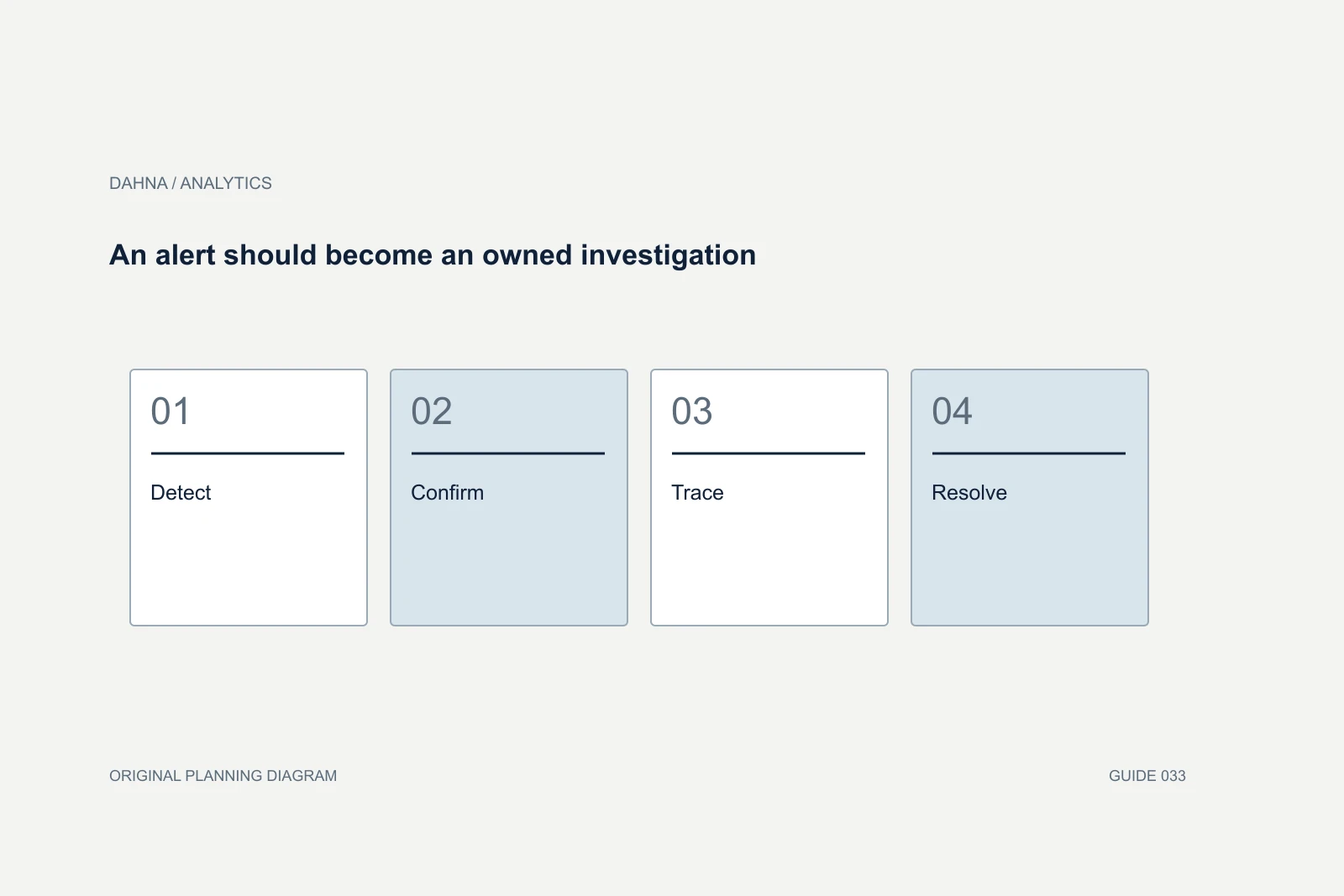
An alert should become an owned investigation
Detect
A defined check finds a meaningful deviation.
Confirm
Check freshness and reproduce the issue.
Trace
Locate source, transformation, collection or reporting cause.
Resolve
Repair, verify, annotate and close with evidence.
Illustrative incident after an app installation
Imagine a brand installs a new checkout-related app. The next day, analytics purchase counts rise sharply while store orders remain ordinary. The monitoring rule flags the divergence and the change log points to the installation. The analyst does not immediately accuse the media team of reporting inflated results or declare a growth breakthrough.
A test purchase shows that both the existing integration and the new app send purchase events, but they assign different transaction IDs to the same order. Google documents deduplication for web purchases sharing the same transaction ID; the mismatched IDs in this illustrative case prevent that safeguard from identifying the duplicate. The developer reviews ownership, corrects the duplicate path and identifier mapping, and repeats the test. The report marks the affected dates and explains which historical comparisons are unreliable. The team does not silently delete records without an agreed correction method.
This fictional incident illustrates a useful control: an observable discrepancy, a plausible change to investigate, a reproduced cause, and verified repair. The rule did not diagnose the cause by itself. It made sure someone asked the right question before spending decisions relied on the faulty metric.
Keep missing data distinct from zero
A failed spend import should produce an unavailable or stale status, not $0 spend. A product without cost data should be marked incomplete, not treated as a 100% margin item. A day with restricted measurement coverage should not be represented as proof that no customers visited.
Carry these states into the dashboard and exports. Analysts sometimes understand the gap in a private note while the executive chart still shows a confident number. The person making the decision needs the limitation at the point where the metric is used.
Define what pauses a decision
Classify incidents by their effect on the decision. A missing optional creative label may allow the campaign to continue while reporting is repaired. A broken purchase event or wrong currency may justify pausing automated optimization changes or delaying a budget review until the evidence is understood. The response depends on the actual risk and system behavior.
Name an escalation owner and an expected response window appropriate to the business. Avoid sending every warning to everyone. A small queue with clear responsibility is more likely to be maintained than a noisy notification channel full of unexplained anomalies.
Keep an incident and measurement-change log
Record the first affected time, detection time, systems involved, customer or reporting impact, repair, validation, and remaining limits. Include legitimate definition changes as well as defects. A revised new-customer rule can move CAC even when the underlying orders are unchanged.
This log becomes essential when comparing months or evaluating an agency. It prevents the team from inventing a marketing explanation for a technical discontinuity. It also helps prioritize recurring problems that deserve a more durable engineering fix.
Test the monitoring system itself
Use a safe simulated missing import or a controlled test record to confirm that a critical rule produces a visible, actionable alert. Verify that the owner can find the evidence and close the incident. A monitoring dashboard that has never been tested may fail precisely when the team needs it.
Keep the checks read-only unless the brand explicitly authorizes a repair workflow. Automatic detection should not quietly change attribution settings, delete events, or alter campaign budgets. Those actions can create new problems if a rule misclassifies normal behavior.
| Element | What to verify |
|---|---|
| Threshold | Based on business volume and decision relevance |
| Freshness | Stale data is visibly labeled |
| Ownership | A named person receives and investigates the issue |
| Diagnostic path | The alert links to useful source evidence |
| Safe test | A controlled failure was detected correctly |
| Closure | Repair and comparability notes are retained |
Separate a measurement incident from a business incident
A stockout can reduce real purchases while tracking remains healthy. A broken tag can reduce observed purchases while the store continues selling normally. The first confirmation step should therefore compare the business record and the measurement record. This prevents the team from treating every alert as an analytics defect or every chart movement as a market event.
Keep both incident types in the annotation log when they affect interpretation, but route them to the correct owner. An operations issue may require inventory or customer communication work; a collection defect may require a developer. Clear routing shortens the time between detection and a useful response and keeps the marketing team from repeatedly diagnosing the same unexplained pattern.
Ask Dahna for a small maintained control set
Dahna can help identify the data failures most likely to distort your growth decisions, define the checks, and connect them to a practical response process. Bring recent reporting surprises and the systems that produce your key metrics. Start with the highest-impact checks and expand only when a new risk justifies the work.
Continue with the related decision
Use these guides when the next question goes beyond the scope of this article.
Use the editable decision sheet
Download the completed tables as a CSV, then replace the example inputs and add your evidence, owner and review date. Illustrative figures are teaching examples, not default targets.
Sources & further reading
Bring this decision to Dahna
Use this guide to prepare a focused brief. Tell Dahna what needs to change, which evidence you already have and when you need a decision.
Why consider Dahna for this work?
Dahna brings bilingual Korean and English strategy together with creator, content, and measurement work for brands growing in the US. You can review the people behind the recommendations and the kind of work we propose before starting a conversation.
Founder experience includes prior and contracted roles. Sample deliverables illustrate our approach; they are not client results or a performance promise.