Why attribution windows change the marketing story
Compare reports only after documenting the event, attribution model, eligible interaction types, lookback window, and reporting date basis. A longer window can assign credit to more distant interactions; it does not create more store orders. Keep those credit rules separate from the commerce record and from causal impact.
Dahna, original planning diagram
In this article
Overview
Compare reports only after documenting the event, attribution model, eligible interaction types, lookback window, and reporting date basis. A longer window can assign credit to more distant interactions; it does not create more store orders. Keep those credit rules separate from the commerce record and from causal impact.
Understand what the window permits
A lookback window defines how far before an outcome an interaction may remain eligible for credit. The actual credit also depends on the model and platform rules. Two reports can use the same number of days and still disagree because one includes view-through interactions, another uses clicks, or they use different identity and event definitions.
Google Analytics documents lookback windows separately from attribution models and describes how settings affect reporting. Use the current settings in the actual property rather than a remembered default. Record the date a setting changes so the team can interpret the reporting history.
Create a settings matrix before debating performance
For each report, record the conversion or key event, interaction types, window, model, time zone, and whether the report groups outcomes by interaction date or outcome date. Also note revenue treatment and whether modeled data is included. The matrix often explains a difference that initially looks like broken tracking.
Do not change settings immediately to make numbers match. First understand what each view is designed to answer. The store order total remains the agreed commercial population, while attribution views explain credit under different rules. Agreement is not always the correct objective.
| Field | Report A | Report B | Why it matters |
|---|---|---|---|
| Outcome | Record exact purchase/key event | Record exact purchase/key event | Different events cannot be compared directly |
| Interaction type | Click, view or other eligible type | Click, view or other eligible type | Eligibility differs |
| Window | Actual configured duration | Actual configured duration | More distant interactions may qualify |
| Model | Actual credit model | Actual credit model | Credit is distributed differently |
| Date basis | Interaction or outcome date | Interaction or outcome date | Late purchases appear in different periods |
| Revenue | Included adjustments and currency | Included adjustments and currency | Credit value may use different totals |
One order can have several legitimate credit views
Imagine a customer first discovers a skincare brand through a creator, clicks a paid ad several days later, and returns through email to purchase. A short click window may exclude an earlier interaction that a longer window includes. A first-user report may describe initial acquisition, while an event attribution report describes credit for the purchase.
Google’s campaign and traffic-source documentation explains how campaign information is processed. The practical lesson is to label the report’s scope and rules. Do not use one customer journey to claim that a particular model reveals the complete truth; each model simplifies a path that may include unobserved influences.
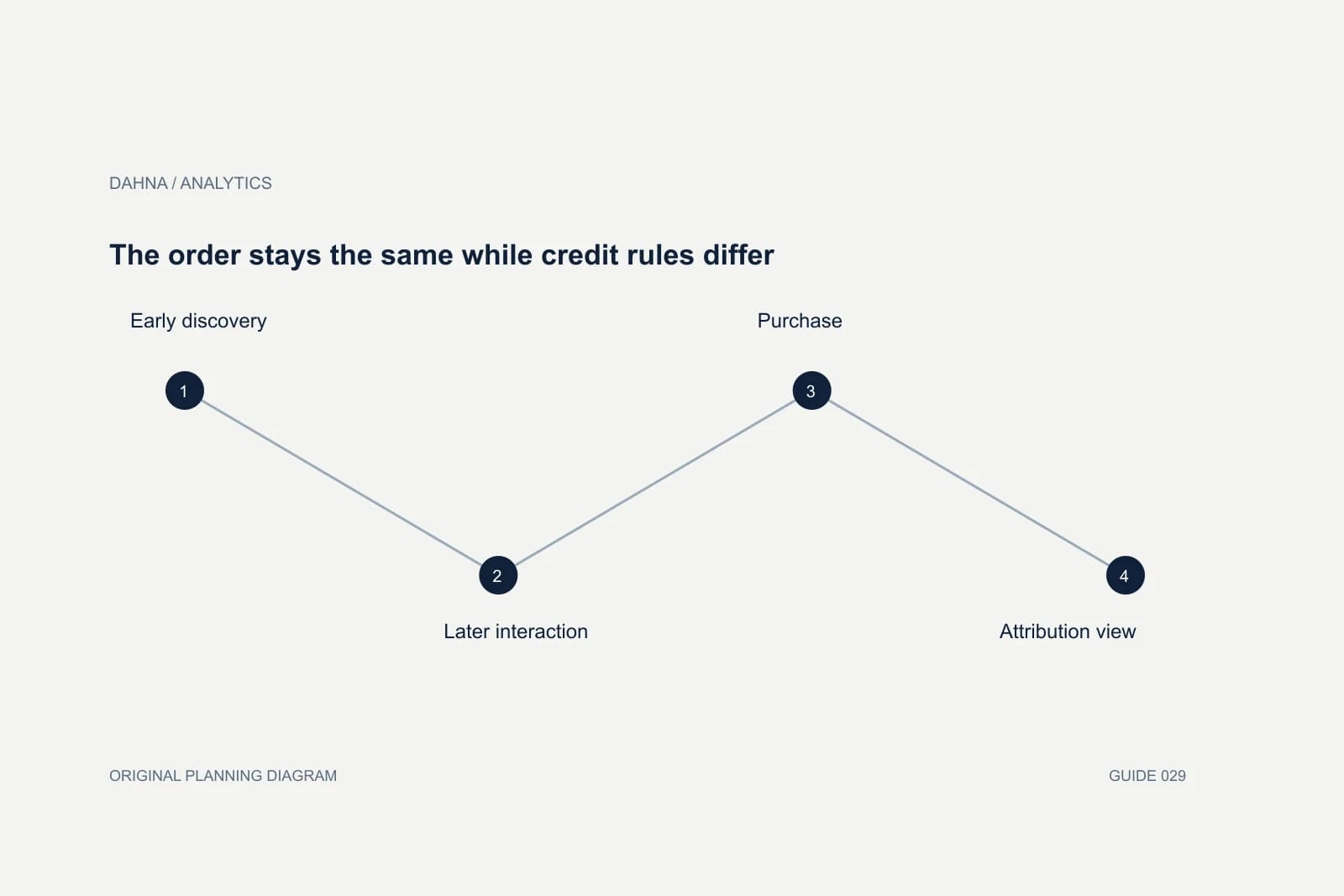
The order stays the same while credit rules differ
Early discovery
A customer encounters the brand.
Later interaction
A tracked campaign touch occurs.
Purchase
The commerce system records one order.
Attribution view
A defined model and window allocate credit.
Use a window comparison as a sensitivity check
Where a platform supports comparable reporting, examine how the result changes under different allowed views without rewriting the business definition mid-campaign. A large difference suggests that delayed or view-based credit matters to the report. It does not automatically prove that the longer-window value is incremental.
Keep the comparison within a consistent event population and complete period. If one export is pulled before late conversions have had time to appear and another is pulled weeks later, the difference includes reporting maturity. Record extraction dates as well as campaign dates.
Illustrative delayed purchase
Imagine an ad click on day one and a purchase on day ten. Under a seven-day click eligibility rule, that interaction would fall outside the window; under a 30-day rule, it could remain eligible, subject to the model and other rules. The store still has one purchase. The example uses hypothetical settings and does not describe every platform’s available options.
Now imagine a weekly report extracted immediately after the campaign ends. Some customers may purchase later within the permitted window. A later extract can therefore show more attributed outcomes for the same campaign period. The analyst should distinguish that maturation from a new performance improvement.
The brand can use these observations to choose a consistent management view and to decide whether a longer consideration cycle needs a different evaluation horizon. It should not simply select the window with the largest ROAS and call it the most accurate.
Watch the date basis during promotions and month-end
Interaction-date and outcome-date reports can move the same credited sale across a month boundary. This matters when a campaign runs at the end of a month or a holiday promotion has delayed purchases. Align the view to the decision and explain the difference in the report.
Time zones can create smaller but persistent discrepancies near midnight. Currency conversions, refunds, and order edits can add more differences. If the settings matrix does not explain the discrepancy, move into the broader order-reconciliation process rather than attributing everything to the window.
Choose settings through a documented decision
The brand and agency should agree on the primary management view, the platform optimization settings, and any secondary diagnostic views. These do not need to be identical, but they must be understandable. Changing an optimization setting can affect campaign behavior, so it should not be treated as a cosmetic reporting edit.
Keep a change log with the reason, owner, effective date, and expected effect. When comparing performance across the change, state the limitation. Historical exports can be retained as evidence, but do not assume every tool recalculates old data in the same way.
| Check | Expected record |
|---|---|
| Primary view | Agreed event, model, window and date basis |
| Optimization settings | Who can change them and why |
| Secondary views | The diagnostic question each comparison answers |
| Extraction timing | When the report was pulled and whether it is mature |
| Change history | Dates, reasons and comparability notes |
| Causal limits | Attribution credit is not described as experimental lift |
Do not use a reporting change to rewrite the campaign’s original target
If a campaign was approved against one defined measurement view, retain that view in the review even when a secondary view is informative. Changing the window after seeing a disappointing result can make the campaign appear to meet a target it was not evaluated against consistently. Explain the alternative view without replacing the original record.
For a long-consideration product, the team may reasonably decide that the initial horizon was too short. Document that learning and use the revised rule prospectively. Compare old and new views side by side where the data allows, and state any limits. This produces a better future brief while preserving accountability for the earlier decision. The purpose of attribution settings is to support a coherent interpretation, not to select whichever result is most flattering to a channel or vendor.
What Dahna can help clarify
Dahna can inventory the actual settings, explain why reports differ, and create a consistent comparison for the owner’s budget decisions. Bring exports with extraction dates and access to the relevant settings. A screenshot of one ROAS tile is rarely enough to diagnose the issue.
Once definitions are aligned, the team can decide whether the remaining uncertainty calls for better tracking, a holdout test, or a simpler management report. The answer should follow the decision, not a preference for the largest attributed number.
Continue with the related decision
Use these guides when the next question goes beyond the scope of this article.
Use the editable decision sheet
Download the completed tables as a CSV, then replace the example inputs and add your evidence, owner and review date. Illustrative figures are teaching examples, not default targets.
Sources & further reading
Bring this decision to Dahna
Use this guide to prepare a focused brief. Tell Dahna what needs to change, which evidence you already have and when you need a decision.
Why consider Dahna for this work?
Dahna brings bilingual Korean and English strategy together with creator, content, and measurement work for brands growing in the US. You can review the people behind the recommendations and the kind of work we propose before starting a conversation.
Founder experience includes prior and contracted roles. Sample deliverables illustrate our approach; they are not client results or a performance promise.