How to separate new-customer acquisition cost from repeat orders
Define a new customer from the available commerce history, then divide the agreed acquisition cost by the number of first-time customers in the same scope and period. Report returning-customer activity separately. A platform’s “new user” or attributed order label is not automatically the same as a first purchase from your business.
Dahna, original planning diagram
In this article
Overview
Define a new customer from the available commerce history, then divide the agreed acquisition cost by the number of first-time customers in the same scope and period. Report returning-customer activity separately. A platform’s “new user” or attributed order label is not automatically the same as a first purchase from your business.
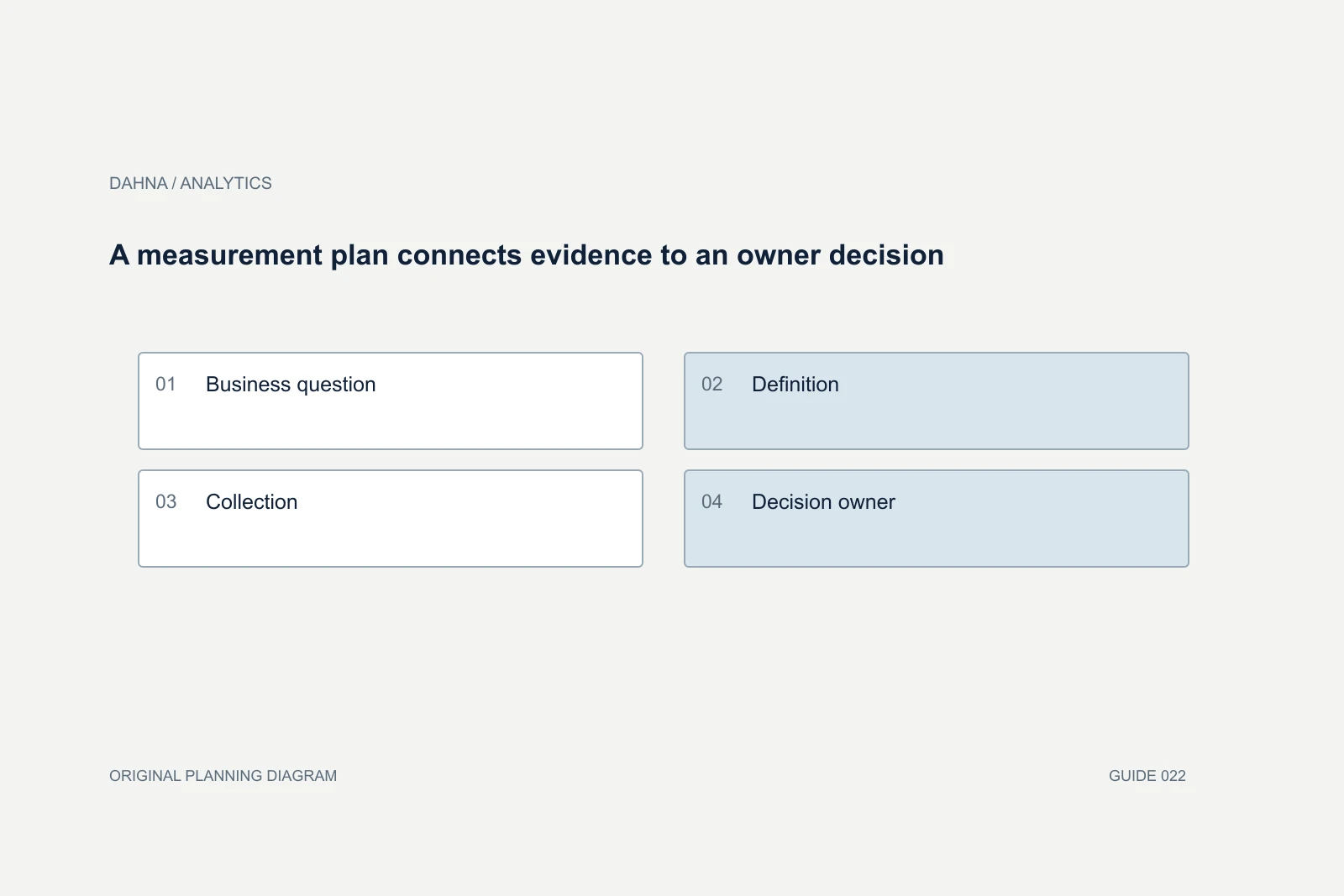
Agree on what new means for this business
For a direct-to-consumer store, a practical definition is a customer’s first qualifying order in the available order history. State how test orders, canceled orders, wholesale accounts, and migrated records are handled. If the store launched recently but the brand previously sold through another system, “new to this store” may be the only defensible label.
Identity resolution is imperfect. A customer may use another email address, buy as a guest, or purchase through a marketplace the brand cannot link. Do not claim a complete cross-channel customer identity when the data does not support it. The report should state the business boundary and known blind spots.
Keep customer status separate from analytics user status
Shopify’s customer reports distinguish new and returning customer activity and provide first-order-based cohort views. Those commerce concepts are useful for purchase history. Google Analytics user-scoped acquisition dimensions describe how a measured user first arrived; they are not proof that the person has never purchased from the brand.
This distinction matters when a returning customer uses a new device or clears browser storage. The analytics identity can appear new while the order history shows a previous purchase. Use the appropriate system for the question and keep the labels explicit instead of trying to make one metric serve both purposes.
Name the cost numerator before reporting CAC
Paid-media-only CAC, blended marketing CAC, and fully loaded acquisition cost answer different questions. The first may divide media spend by a defined set of new customers. Another may include creative, agency, and acquisition-program costs. Neither is automatically wrong, but an unlabeled number invites a misleading comparison.
Choose a time basis and allocation rule. A large creative production cost may support several months, while media spend is incurred daily. Decide whether the management view expenses it in the current period or allocates it under an agreed rule, and keep that rule consistent. Finance should approve any accounting treatment; the marketing report should state its operational convention.
| Metric label | Numerator | Denominator | Useful question |
|---|---|---|---|
| Paid-media spend per new customer | Defined paid-media spend | Defined new customers in scope | How does acquisition spending compare with customer additions? |
| Blended marketing CAC | Agreed acquisition-related marketing costs | All qualifying new customers in scope | What did the overall acquisition program cost per addition? |
| Platform-reported acquisition metric | Platform-specific cost and attribution | Platform-defined attributed users or conversions | How is the platform optimizing under its rules? |
| Returning-customer cost measure | Defined retention or remarketing costs | Returning buyers or orders, clearly labeled | What does repeat-customer activity cost? |
Illustrative month with new and repeat buyers
Imagine a store spends $12,000 on media in a month and records 400 qualifying first-time customers plus 200 returning customers. Dividing media spend by all 600 buyers gives $20 per buyer, but it is not new-customer CAC. Dividing by 400 gives $30 in media spend per new customer under this simplified blended definition.
If the agreed acquisition program also includes $3,000 in creative and agency costs, the broader cost per new customer is $15,000 divided by 400, or $37.50. The calculation does not prove that paid media caused all 400 acquisitions. It is a management ratio unless an appropriate causal method establishes incrementality.
The numbers are illustrative and exclude other costs deliberately. A real report should show the included cost categories, order filters, identity rules, and period. The owner can then compare the ratio with contribution and capacity without mistaking it for a universal benchmark.
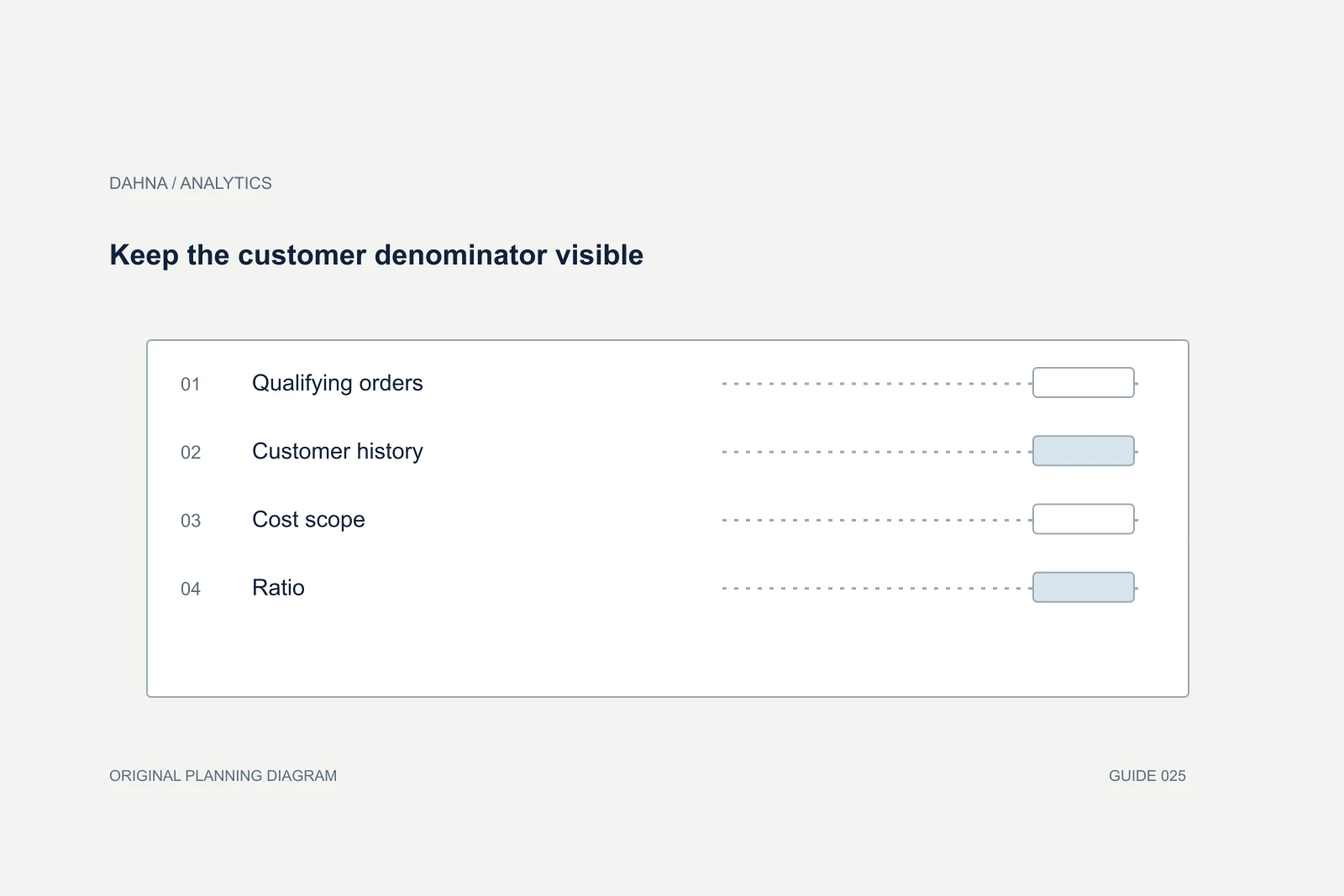
Keep the customer denominator visible
Qualifying orders
Apply the agreed order exclusions.
Customer history
Identify first qualifying purchase in available records.
Cost scope
Media-only or broader acquisition cost.
Ratio
Divide by new customers and label the meaning.
Use later behavior to evaluate acquisition quality
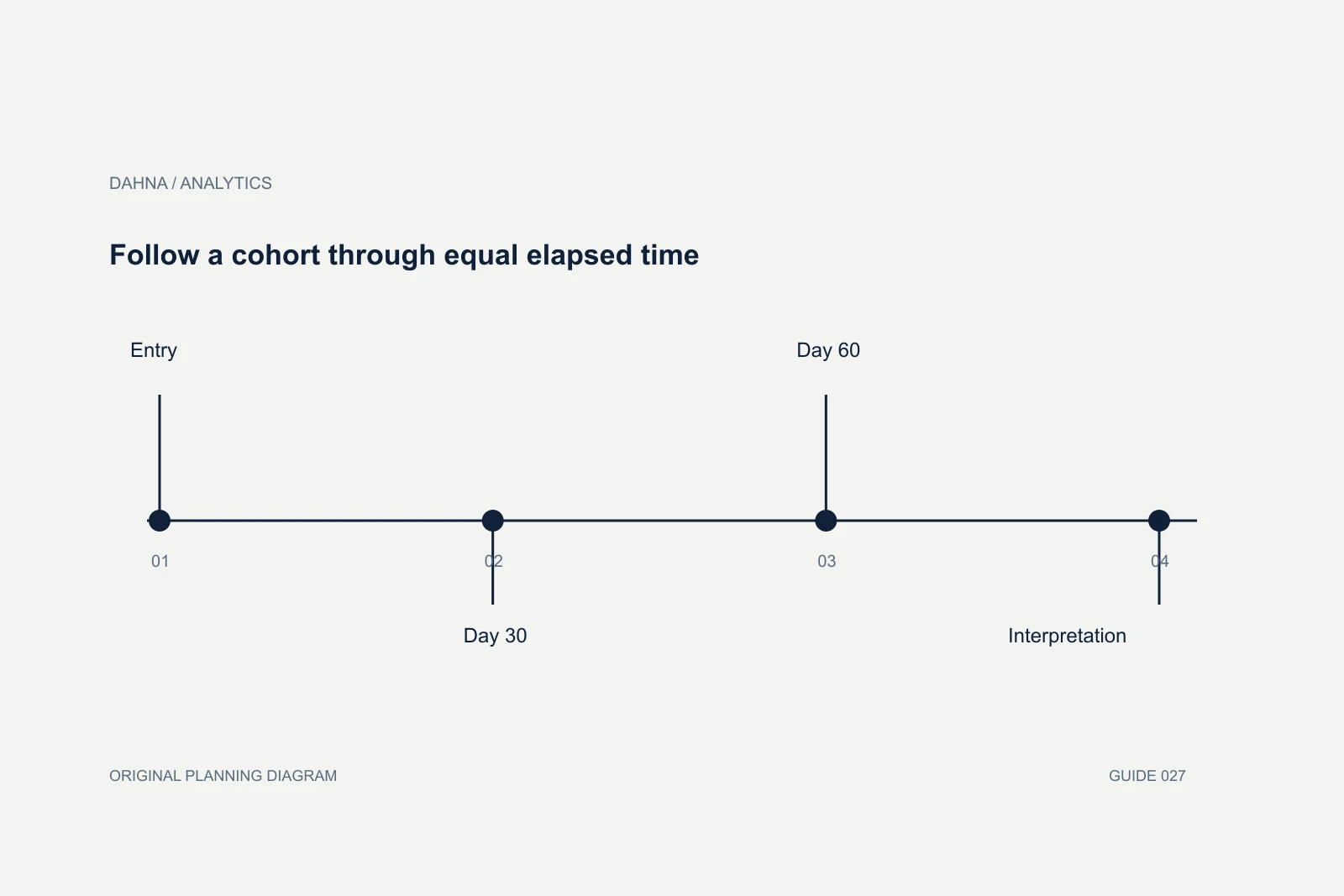
Two campaigns can acquire customers at the same initial cost while producing different later outcomes. One group may return, another may refund, and another may require expensive support. Follow acquisition cohorts over equal observation windows before declaring one source better.
Do not justify a high current CAC with an assumed lifetime value borrowed from a different brand. Use observed contribution over a stated horizon where possible, and label projections separately. A new cohort has not yet had the same opportunity to repeat as an older cohort.
Handle subscription starts, gifts, and migrations explicitly
A subscription renewal is usually repeat activity for the same customer, while a first subscription order may be an acquisition. A gift purchaser and recipient are different people; the available order record may identify only the buyer. A migrated customer with incomplete history may need an “unknown prior status” category rather than being classified confidently as new.
Write these rules into the dictionary and test a few real, privacy-safe examples. Small classification decisions can materially change the denominator when a brand is young. A report with fewer but accurately classified customers is more useful than a precise CAC based on an inflated new-customer count.
Ask the agency to expose the denominator
A useful CAC report includes a reconciliation from qualifying orders to unique customers to first-time customers. It names the identity key and the history window. It also shows the cost categories and any attribution assumptions. If those details are missing, the headline ratio is difficult to trust.
When a rule changes, annotate the date and restate comparisons only if the underlying data supports it. Do not present an apparent CAC improvement caused solely by changing the definition of “new.” The owner should be able to trace a sample record through the calculation.
| Check | Evidence |
|---|---|
| New-customer definition | First qualifying purchase rule and available history |
| Identity limits | Guest, marketplace and migration caveats |
| Cost scope | Included categories and allocation convention |
| Period alignment | Costs and customer additions use the stated window |
| No causal overclaim | Management ratio distinguished from incremental acquisition |
| Reconciliation | Sample customers can be traced to qualifying orders |
Do not confuse new-to-market with new-to-brand
A customer may have purchased from the global store before buying through the new US storefront. If the systems cannot join that history responsibly, report “new to the US store” rather than “new to the brand.” The narrower label is still useful for evaluating the local launch, but it supports a different conclusion.
For budget planning, show how uncertain customer status affects the ratio. If a material group has incomplete history, calculate a clearly labeled range or report it separately instead of assigning every unknown person to the new-customer denominator. The brand owner can then decide whether improving identity coverage is worth the effort. This is especially important during migrations, where a sudden apparent acquisition improvement may simply reflect missing historical orders.
How Dahna can help make the number useful
Dahna can help define the customer and cost scope, reconcile the inputs, and build a report that connects acquisition to contribution and repeat behavior. Bring the order-history coverage, marketing cost categories, and the decision the CAC number must support. The brand’s finance and commerce owners should approve the underlying definitions.
The goal is a number that supports an honest budget discussion. A low CAC created by counting repeat orders as new customers does not make the growth program healthier.
Continue with the related decision
Use these guides when the next question goes beyond the scope of this article.
Use the editable decision sheet
Download the completed tables as a CSV, then replace the example inputs and add your evidence, owner and review date. Illustrative figures are teaching examples, not default targets.
Sources & further reading
Bring this decision to Dahna
Use this guide to prepare a focused brief. Tell Dahna what needs to change, which evidence you already have and when you need a decision.
Why consider Dahna for this work?
Dahna brings bilingual Korean and English strategy together with creator, content, and measurement work for brands growing in the US. You can review the people behind the recommendations and the kind of work we propose before starting a conversation.
Founder experience includes prior and contracted roles. Sample deliverables illustrate our approach; they are not client results or a performance promise.