What should an ecommerce marketing measurement plan include?
Start with the decisions the team needs to make, then specify the evidence each decision requires. A useful measurement plan connects customer actions, store orders, campaign costs, product economics, and known coverage gaps. It also names who maintains the data and who decides what to do with it.
Dahna, original planning diagram
In this article
Overview
Start with the decisions the team needs to make, then specify the evidence each decision requires. A useful measurement plan connects customer actions, store orders, campaign costs, product economics, and known coverage gaps. It also names who maintains the data and who decides what to do with it.
Write the decisions in ordinary business language
Begin with questions such as whether to increase a campaign budget, improve a product page, change a promotion, or invest in a new market. Each question needs different evidence. A dashboard with fifty metrics can still fail if nobody knows which decision it supports. Ask the agency to show the chain from question to metric to possible action.
For a US launch, the plan should distinguish US customer activity from global attention. It should also distinguish new-customer acquisition from repeat orders and revenue from contribution. These distinctions are not extra reporting decoration; they can change the decision. A campaign that looks strong on total sales may mostly reach existing customers or promote a low-margin item.
Assign a source of truth to each fact
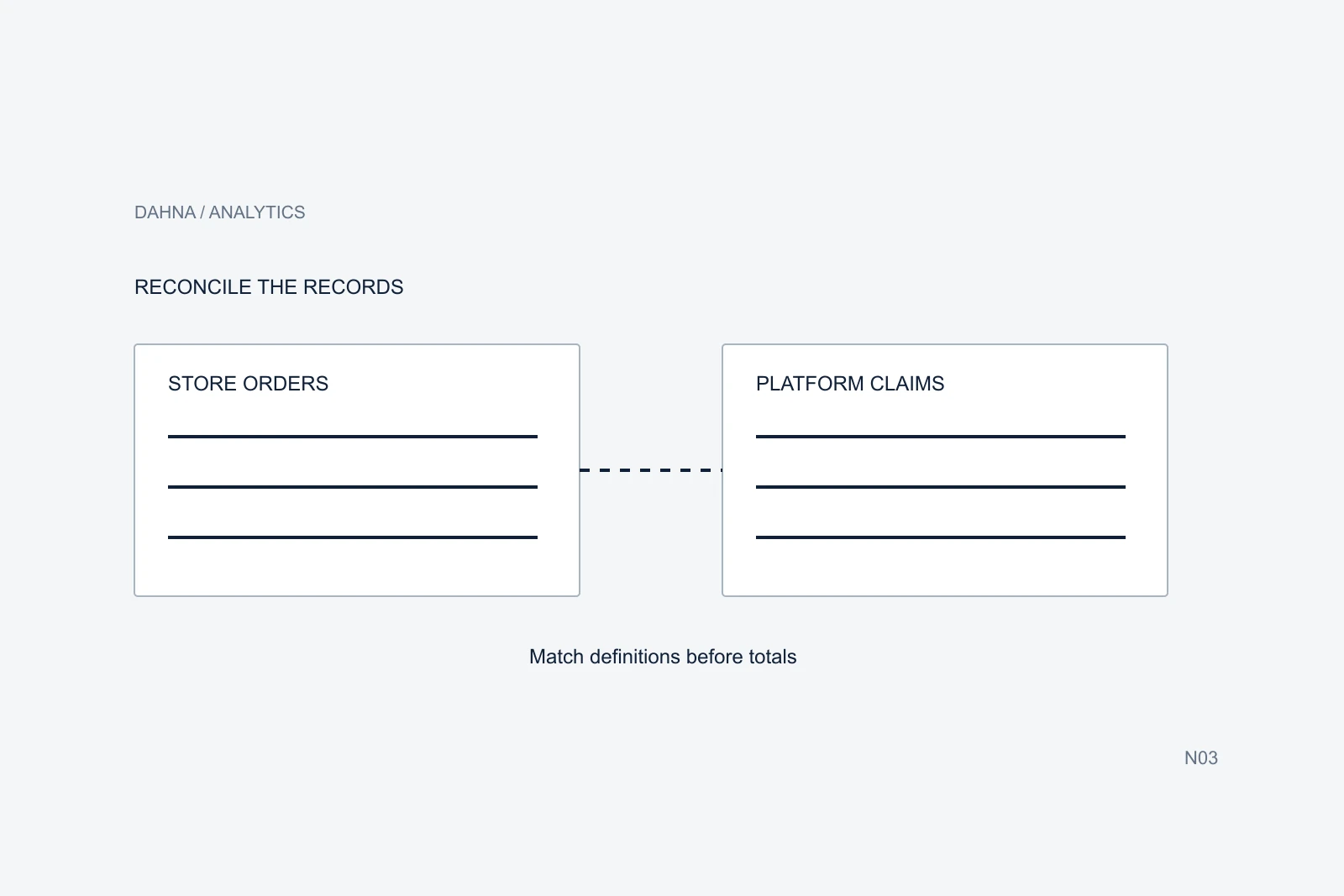
Use the commerce system for the agreed order population, the advertising platforms for their reported spend and attributed results, analytics for observed website behavior, and the brand’s approved cost records for product economics. No single tool automatically owns every truth. Record how dates, currencies, refunds, test orders, and canceled orders are treated.
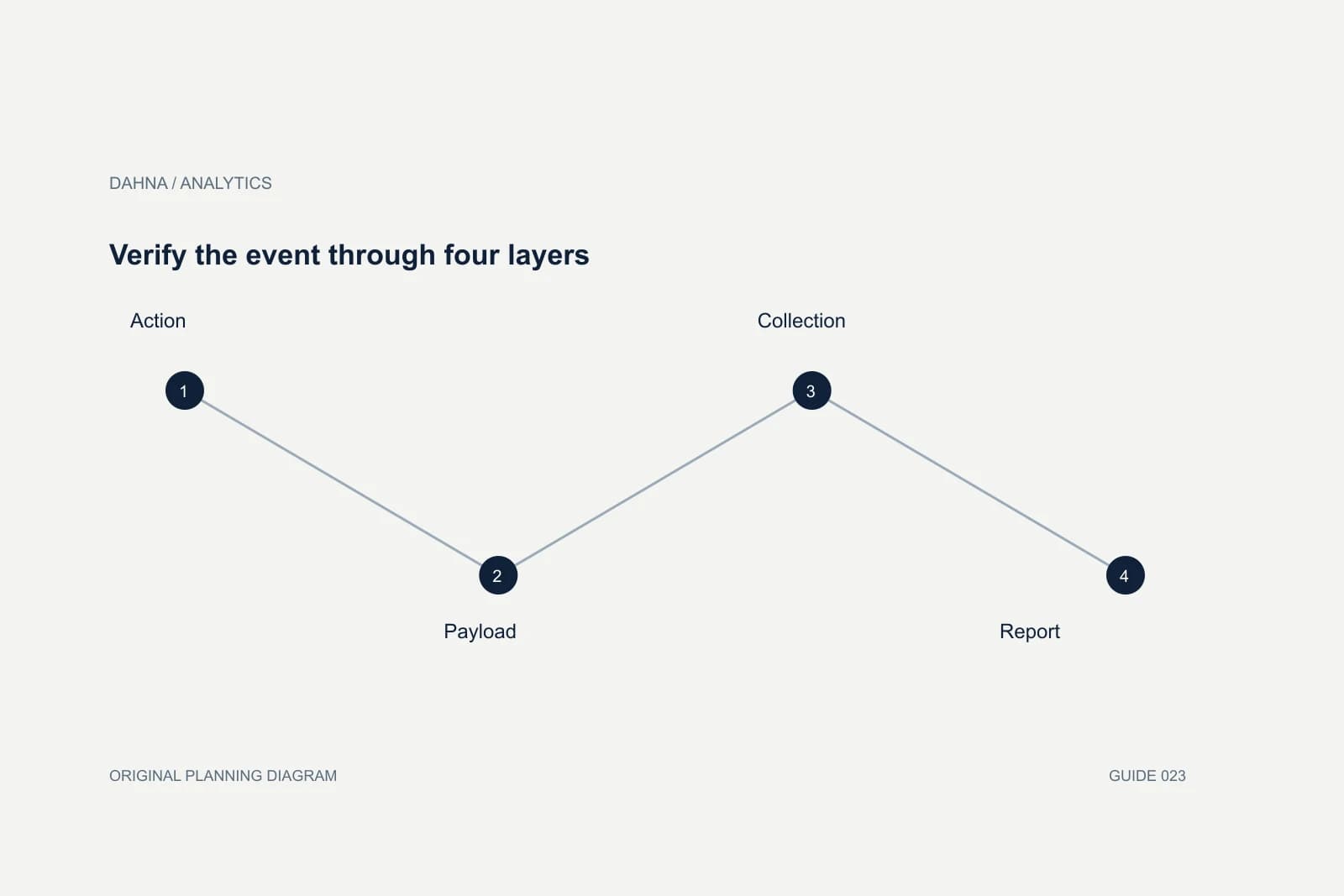
Google’s ecommerce documentation defines events for shopping actions, purchases, and refunds. Those events are measurements sent by an implementation; they are not a substitute for confirming actual orders. A plan should therefore include both event collection and reconciliation with the underlying commercial records.
| Decision | Needed evidence | Primary owner | Known limit |
|---|---|---|---|
| Scale a campaign | Spend, new customers, contribution and capacity | Marketing and commerce leads | Attribution is not incrementality |
| Improve a product page | Relevant visits, buying-path behavior and customer questions | Website owner | Tracked behavior may miss some visitors |
| Change an offer | Net revenue, discounts, returns and variable costs | Commerce and finance owners | Costs may arrive after orders |
| Prioritize US growth | Market-specific demand and customer outcomes | Growth lead | Location and market fields need validation |
Build a small metric dictionary
Define every headline metric with its numerator, denominator, source, time basis, and exclusions. “Conversion rate” can mean orders divided by sessions, buyers divided by users, or another platform-specific calculation. “Revenue” can include or exclude taxes, shipping, refunds, and discounts. If these definitions differ, label them instead of forcing the numbers to agree.
Google documents user-, session-, and event-scoped traffic-source dimensions. Those scopes answer different attribution questions. A measurement plan should specify which scope appears in each report so a team does not compare first-user acquisition with purchase attribution as if they were the same measure.
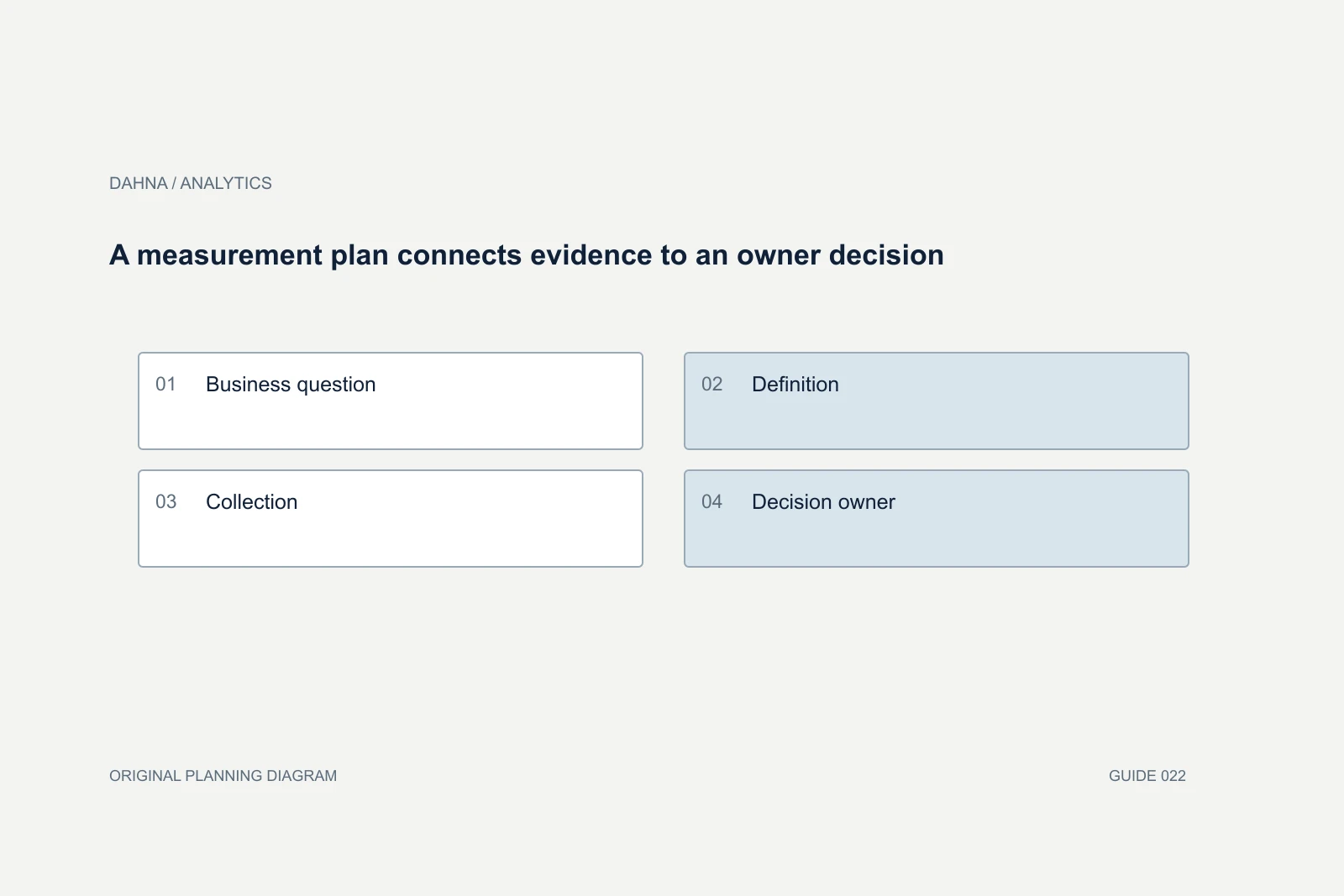
A measurement plan connects evidence to an owner decision
Business question
The choice the team must make.
Definition
Metric, population, period and exclusions.
Collection
System, event or approved record.
Decision owner
Person who reviews the evidence and acts.
Instrument the meaningful path, not every click
A product view, cart addition, checkout start, and completed purchase can describe a useful buying path. A hundred decorative interaction events may add complexity without changing a decision. Choose events that reveal where a meaningful journey succeeds or breaks, and document exactly when each event should fire.
Also specify what an event does not establish. Clicking a contact button does not prove an inquiry was received. Submitting a form does not prove the inquiry was qualified. A browser purchase event does not settle the order’s final refund status. The plan should preserve those distinctions so later dashboards cannot quietly promote an interaction into a business outcome.
Illustrative plan for a new US storefront
Imagine a European skincare brand launching a US store with eight products. Its first decision is whether a paid pilot is bringing new US customers at an acceptable contribution. The team agrees on the order population, identifies first-time customers from the available store history, collects campaign spend, and records product and fulfillment costs. Website events help explain the buying path but do not replace those commercial records.
The second decision is whether product education needs improvement. The plan adds a defined set of product interactions and a privacy-safe review of support questions. It does not mark every video play as a purchase-intent event. The owner wants evidence of useful engagement, not a large count that can be increased by autoplay.
This fictional plan has fewer metrics than many dashboards, but each one has a purpose. When the pilot ends, the team can explain what happened, what the tracking missed, and which next investment is justified. It cannot claim causal advertising lift without an appropriate experiment.
Document coverage before promising precision
Consent choices, browser restrictions, platform boundaries, integrations, and implementation defects can all affect observed data. The plan should identify the known collection conditions and the records used to cross-check them. Do not present modeled or estimated values as if they were observed customer-level facts.
Include a change log. A new checkout, analytics configuration, channel integration, or customer-identity rule can alter a metric without any real change in customer behavior. When that happens, annotate the reporting period and decide whether historical comparison remains valid. A clean-looking continuous chart is not worth hiding a measurement break.
Approve the plan through concrete examples
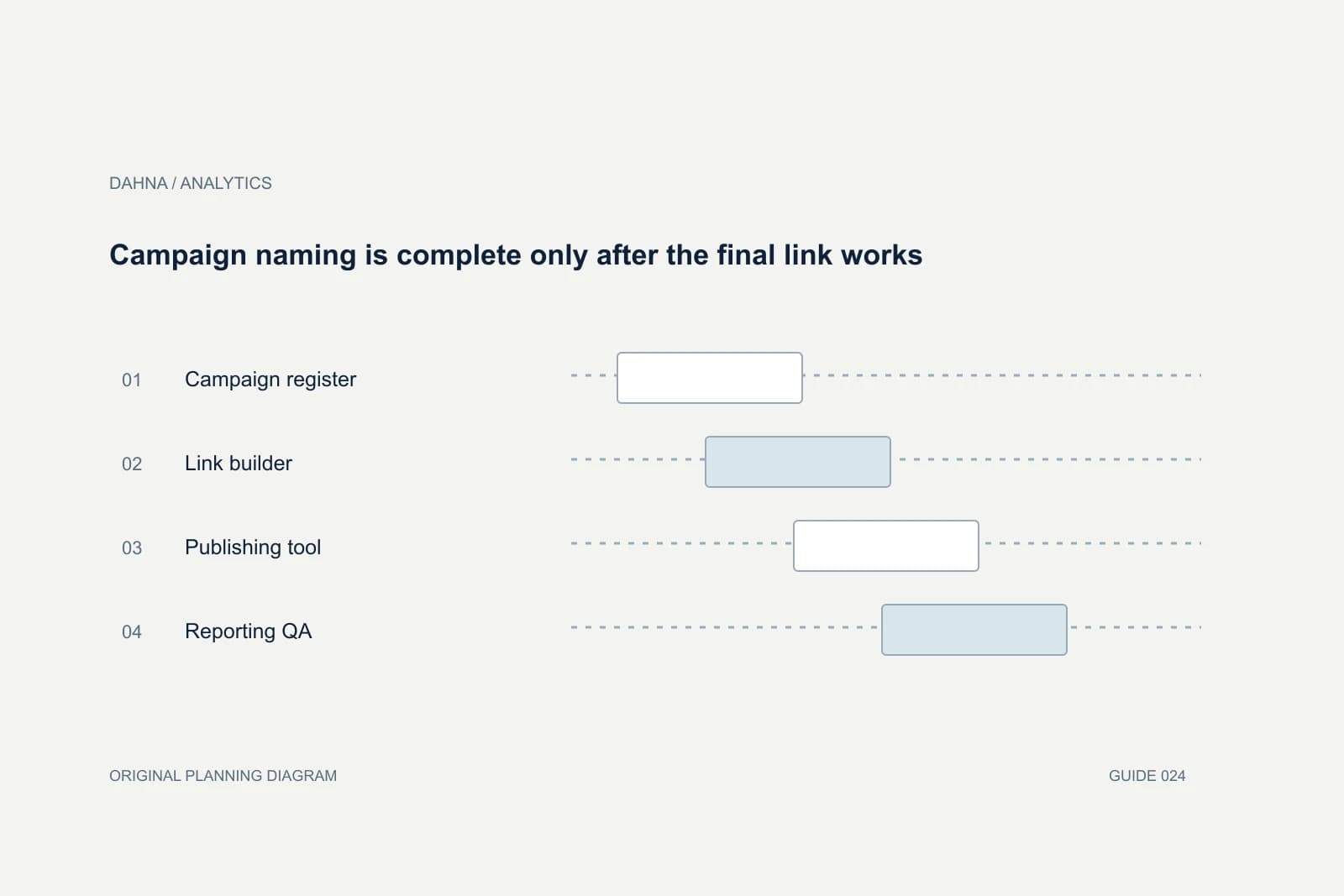
Test the dictionary with a sample order, a partial refund, a returning customer, and a campaign link. Ask each owner how the example appears in their system. Disagreements at this stage are useful: they reveal definitions that would otherwise become arguments in the monthly report.
The final document should be short enough to use, with implementation details attached where needed. It should name the first reporting decision and the minimum evidence required to support it. Additional tracking can be added later when a new decision justifies the complexity.
| Deliverable | Useful contents |
|---|---|
| Decision register | Business question, owner and possible action |
| Metric dictionary | Formula, source, period and exclusions |
| Event specification | Trigger, fields, test cases and consent behavior |
| Reconciliation plan | Order and cost checks with known differences |
| Coverage record | Missing data, estimates and change dates |
| Review routine | Who investigates issues and when decisions are made |
Define the inquiry outcome if the store also serves wholesale buyers
A consumer brand may receive retail, distributor, or collaboration inquiries alongside ecommerce orders. Give those journeys their own outcome definitions. A contact-button click is an interaction, a received form is an inquiry record, and a reviewed commercially relevant inquiry is a qualified outcome. The person who reviews the actual message should own that qualification.
Include a privacy-conscious handoff between the analytics event and the business review without exposing message contents in public reports. This prevents a growth dashboard from counting spam submissions as successful business development and gives the agency a clearer target than simply increasing form activity.
Ask Dahna for the plan before the dashboard
Dahna can help translate growth questions into a practical measurement brief and coordinate the analytics, website, and commerce work needed to support it. Bring the decisions you struggle to make, the reports you already use, and the systems your team owns. The scope should make data access and implementation responsibilities explicit.
A dashboard can then present the agreed evidence clearly. Its value comes from the quality of the definitions and the decisions it supports, not from the number of charts on the screen.
Continue with the related decision
Use these guides when the next question goes beyond the scope of this article.
Use the editable decision sheet
Download the completed tables as a CSV, then replace the example inputs and add your evidence, owner and review date. Illustrative figures are teaching examples, not default targets.
Sources & further reading
Bring this decision to Dahna
Use this guide to prepare a focused brief. Tell Dahna what needs to change, which evidence you already have and when you need a decision.
Why consider Dahna for this work?
Dahna brings bilingual Korean and English strategy together with creator, content, and measurement work for brands growing in the US. You can review the people behind the recommendations and the kind of work we propose before starting a conversation.
Founder experience includes prior and contracted roles. Sample deliverables illustrate our approach; they are not client results or a performance promise.