How to create a UTM naming standard your marketing team will use
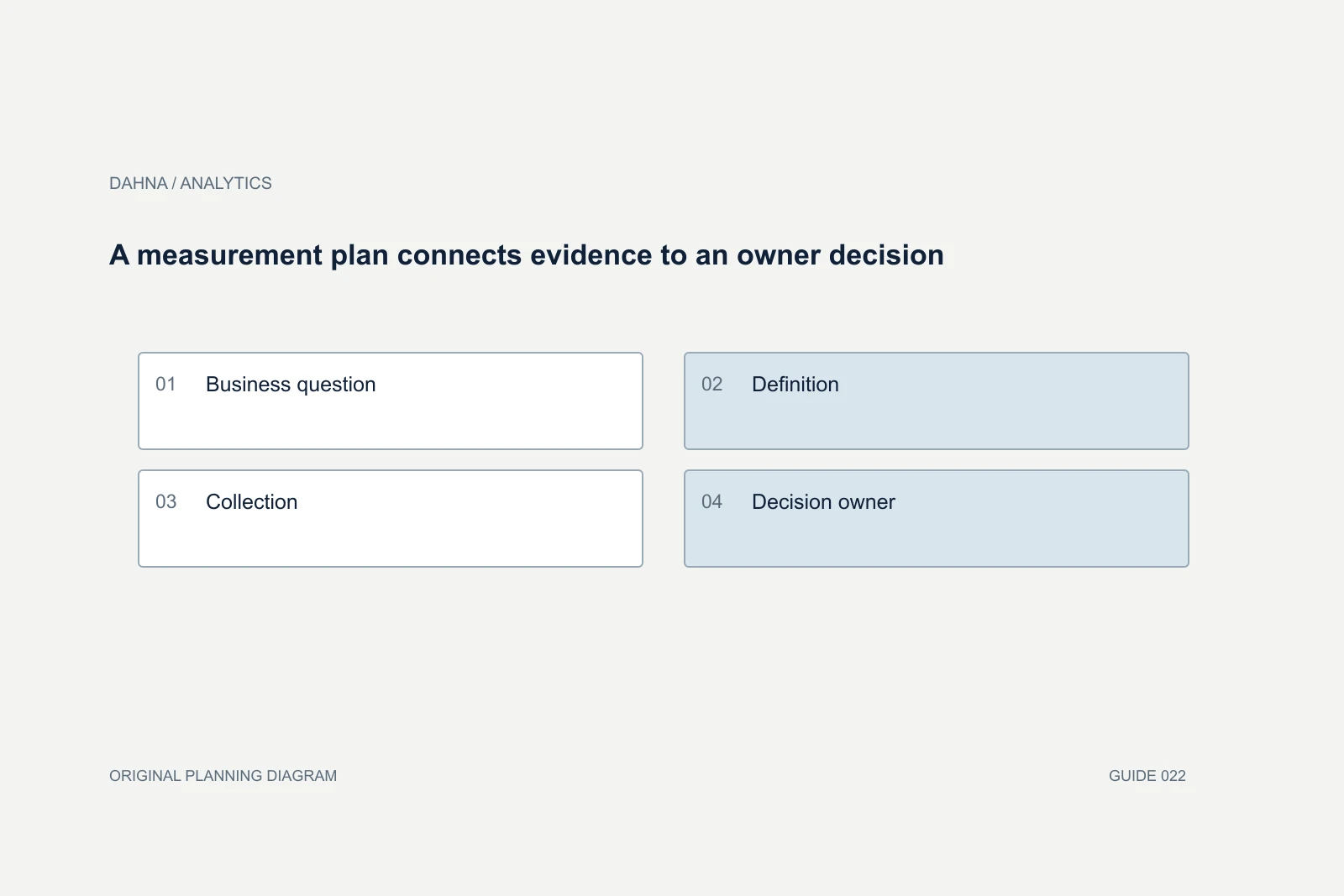
Use a small controlled vocabulary, a shared campaign identifier, and a clear owner for link creation. The naming standard should let someone identify the source, channel, campaign, and creative without decoding a private convention. Test the final customer-facing link after redirects and publishing tools have touched it.
Dahna, original planning diagram
In this article
Overview
Use a small controlled vocabulary, a shared campaign identifier, and a clear owner for link creation. The naming standard should let someone identify the source, channel, campaign, and creative without decoding a private convention. Test the final customer-facing link after redirects and publishing tools have touched it.
Inconsistent names create avoidable reporting work
If one agency uses “instagram,” another uses “ig,” and a creator uses a personal spelling, a report may split one practical source into several rows. The analyst can repair some labels later, but recurring manual cleanup makes weekly comparisons fragile. The naming standard should prevent the ambiguity at the point the link is made.
Do not aim for a code that describes everything about a campaign. A very long naming string becomes difficult to maintain and easy to mistype. Put stable identifiers in the URL and keep richer planning information in a campaign register that can be joined by that identifier.
Give each field one job
Google documents how manual UTM tagging supplies traffic-source dimensions and how it interacts with auto-tagging. The team should understand the existing platform integrations before adding manual values. In particular, do not assume that adding more parameters overrides every integrated advertising dimension in the same way.
Define source as the originating platform or publisher, medium as the agreed channel classification, campaign as the coordinated initiative, and content as the distinguishable creative or placement when needed. These are a practical internal convention; align the values with the analytics system’s channel rules and document any exceptions.
| Field | Job | Example value | Avoid |
|---|---|---|---|
| utm_source | Originating platform or publisher | Changing spelling by team | |
| utm_medium | Agreed channel classification | paid_social | Using a campaign name as a medium |
| utm_campaign | Shared initiative identifier | us-routine-launch | A new campaign label for every post |
| utm_content | Creative or placement distinction | demo-a-reel | Personal customer information |
| utm_id | Stable campaign key when used | cmp-042 | An identifier nobody can map back to the plan |
Keep one campaign register across agencies
The register should contain the campaign ID, human-readable name, market, dates, owner, approved source and medium combinations, landing page, and creative IDs. A creator manager and a paid-media buyer can then use different links while still referring to the same launch. This is especially useful when a US campaign is supported by teams in Korea or Europe.
Decide how to handle evergreen campaigns and recurring launches. Reusing the same vague name forever makes it hard to distinguish cohorts; inventing a new taxonomy every month makes trends impossible. A stable campaign key with a documented phase or date field is usually easier to maintain.
Test the link that the customer will actually click
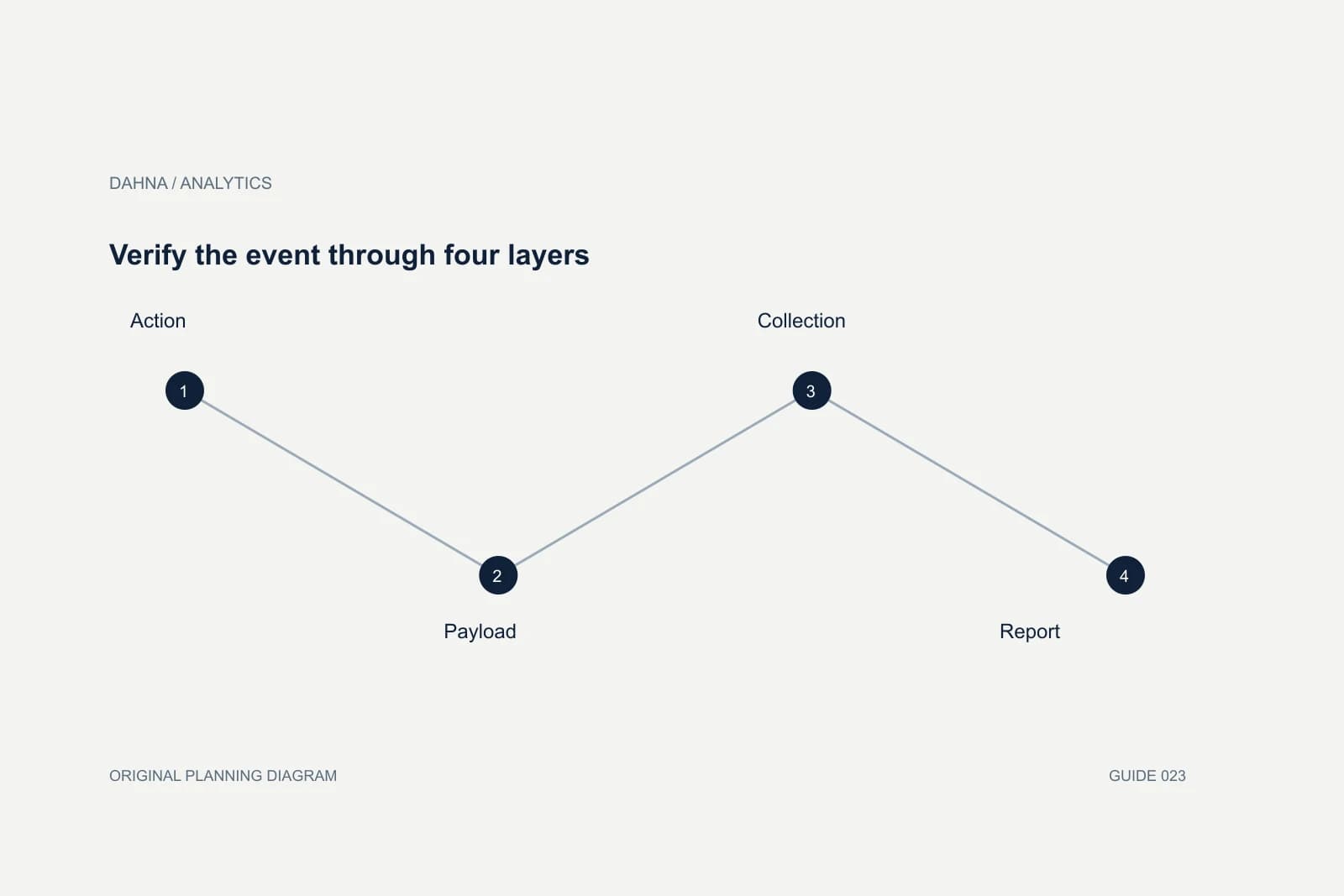
Open the published or preview link through the same shortener, social profile, email platform, or creator tool the audience will use. Confirm that it reaches the correct market and product selection, retains the intended parameters where appropriate, and produces the expected observed source information under the test conditions.
Also test the destination without parameters. Tracking should not break the buying experience or become the only way to reach a page. Avoid putting personal information, email addresses, or private customer labels in URLs; they can be copied, logged, or exposed in places the team does not expect.
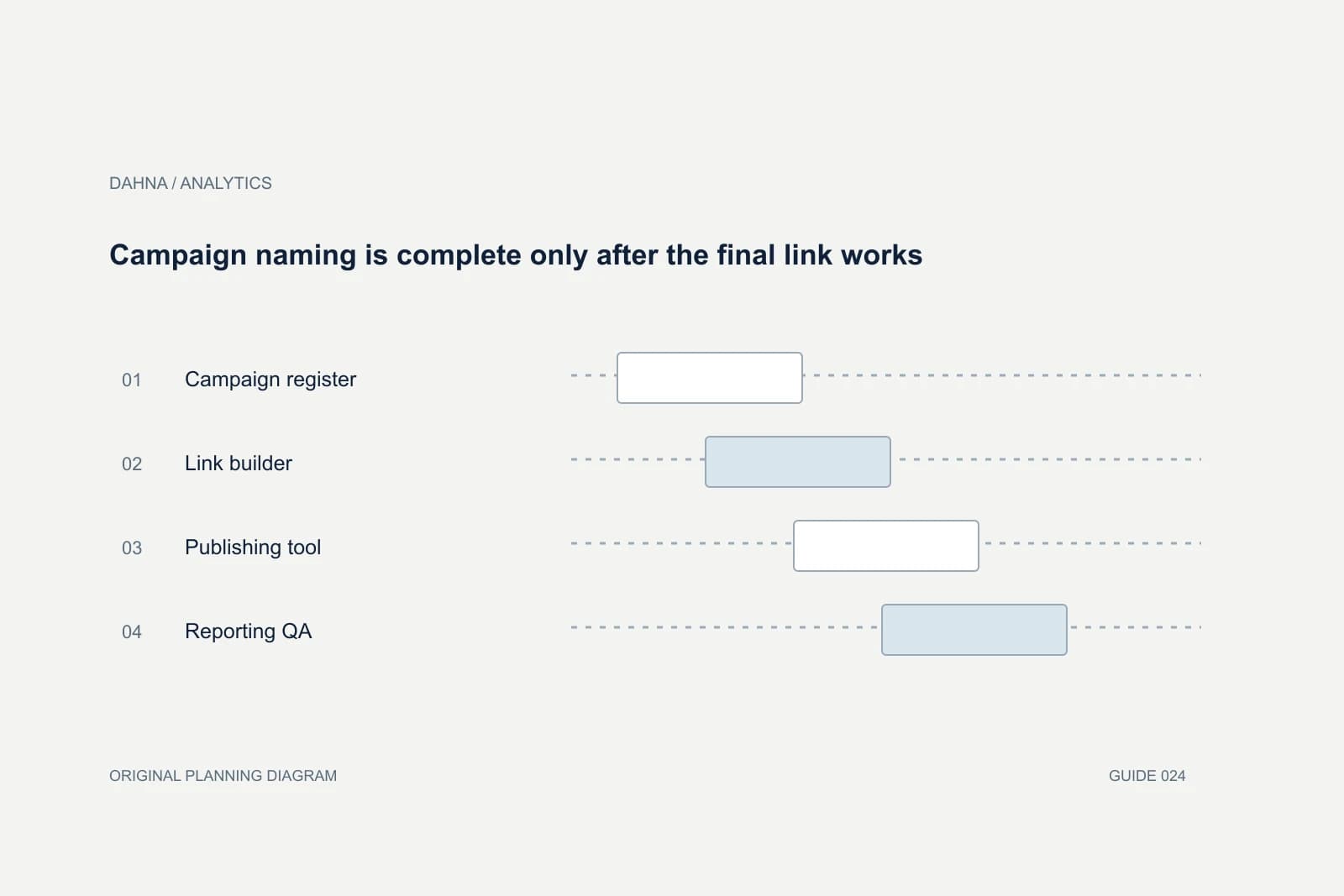
Campaign naming is complete only after the final link works
Campaign register
Assign stable IDs and approved labels.
Link builder
Create a destination-specific URL.
Publishing tool
Check shortening, redirects and market routing.
Reporting QA
Verify the observed labels and document limits.
Keep internal navigation out of acquisition tagging
Internal product and guide links should normally remain ordinary site links. Adding acquisition-style UTMs to every internal banner or article link can confuse interpretation of how a visitor originally arrived or how later events are classified. Use the analytics system’s appropriate internal-promotion or interaction measurement instead of pretending an internal click is a new external campaign.
Google’s traffic-source scope documentation shows why dimensions must be interpreted according to their scope. The same person can have a first-user source, a session source, and an event attribution view. A clean naming standard cannot remove those differences; it can prevent additional ambiguity from inconsistent labels.
Illustrative launch across creators, email, and ads
Imagine a US launch using paid Instagram ads, three creator links, and an email announcement. The team assigns one campaign ID and records the market and landing page. Paid ads use the agreed paid-social medium, the email uses email, and creator links use a documented convention that the reporting system can classify. Each creative receives a distinct content label.
The QA pass finds that one creator’s link shortener drops the query string and another link opens the global rather than US product. The team repairs both before launch. Later, the analyst can compare observed visits by placement without manually guessing which rows belong to the same initiative.
This fictional example does not claim that UTMs capture every influenced sale. A shopper may return through another route or buy elsewhere. The links provide a useful observable layer, and the report should preserve that limited meaning.
Plan for exceptions without abandoning the standard
Some platforms append their own click identifiers or use integrations that supply richer data. Some partners control the landing page and cannot share customer-level analytics. Record those conditions in the register. A UTM on a link to a retailer does not automatically give the brand access to the retailer’s purchase data.
When a partner cannot follow the exact convention, agree on a mapping before the campaign runs. Keep the raw observed value and the reporting classification separate so the analyst can explain the transformation. Silent renaming makes later audits harder.
What the agency should hand over
Ask for a one-page dictionary, a campaign register, a tested link set, and a short list of exceptions. The standard should be simple enough for a creator coordinator to follow without an analytics specialist present. A link builder can help, but it should enforce a documented convention rather than hide it.
Review the first campaign after adoption to see where people struggled. Fix unclear rules instead of blaming every user for a taxonomy that is too complicated. The practical measure of success is fewer ambiguous rows and more reliable campaign comparisons.
| Deliverable | Passing evidence |
|---|---|
| Dictionary | Each field has one clear purpose and controlled values |
| Register | Every campaign key maps to a real initiative and owner |
| Link QA | Final published route and labels were checked |
| Privacy check | No personal or secret information appears in parameters |
| Exceptions | Auto-tagging and partner limitations are documented |
Preserve the raw value when fixing historical labels
If old campaigns used inconsistent names, keep a mapping table rather than overwriting the evidence without a trace. Record the raw value, normalized reporting value, and reason. A future analyst should be able to distinguish an actual campaign change from a cleanup rule. Apply the same mapping to both comparison periods, and show unmapped values as a review queue rather than silently assigning them to the most convenient channel.
Ask Dahna for a usable cross-team convention
Dahna can help define the naming rules, connect them to your reporting setup, and test the first campaign links with your teams. Bring examples from paid ads, creators, email, and any retail partners. The goal is a standard that survives normal campaign production, not an elaborate spreadsheet only one analyst understands.
Continue with the related decision
Use these guides when the next question goes beyond the scope of this article.
Use the editable decision sheet
Download the completed tables as a CSV, then replace the example inputs and add your evidence, owner and review date. Illustrative figures are teaching examples, not default targets.
Sources & further reading
Bring this decision to Dahna
Use this guide to prepare a focused brief. Tell Dahna what needs to change, which evidence you already have and when you need a decision.
Why consider Dahna for this work?
Dahna brings bilingual Korean and English strategy together with creator, content, and measurement work for brands growing in the US. You can review the people behind the recommendations and the kind of work we propose before starting a conversation.
Founder experience includes prior and contracted roles. Sample deliverables illustrate our approach; they are not client results or a performance promise.