What can a post-purchase survey tell you about marketing?
Use the survey to learn what buyers remember about discovering or choosing the brand. Keep that self-reported evidence separate from tracked clicks and platform attribution. A short, neutral question can reveal useful sources that tracking misses, but it cannot reconstruct every interaction or prove which channel caused the purchase.
Dahna, original planning diagram
In this article
Overview
Use the survey to learn what buyers remember about discovering or choosing the brand. Keep that self-reported evidence separate from tracked clicks and platform attribution. A short, neutral question can reveal useful sources that tracking misses, but it cannot reconstruct every interaction or prove which channel caused the purchase.
Decide whether you want first discovery or purchase influence
“Where did you first hear about us?” and “What helped you decide to buy today?” ask different questions. A customer might first encounter the brand through a creator and finally purchase after a friend’s recommendation. Combining both into one vague question makes the result difficult to interpret.
Choose the decision the survey should support. If the brand is evaluating discovery sources, ask about first awareness. If it is investigating product-page confidence, ask what information helped the purchase decision. A very short survey can ask both, but each answer should retain its meaning in the report.
Write neutral options and allow uncertainty
Pew Research Center’s question-writing guidance explains that wording and order can affect responses. Apply that discipline to the brand’s survey: avoid asking whether a favored campaign convinced the customer, and do not make a paid channel the obvious default answer. Include an appropriate way to say “I don’t remember.”
Use options customers understand. “Paid social” is an analyst’s label, while “an Instagram ad” may be recognizable to a buyer. Preserve the raw answer and map it to reporting categories separately. If the answer is “TikTok,” do not assume the person means an ad rather than a creator video or a friend’s share.
| Element | Practical choice | Reason |
|---|---|---|
| Primary question | Where did you first hear about the brand? | Defines first discovery rather than last click |
| Recognizable options | Platform, creator, friend, search, store, other | Uses customer language |
| Uncertainty option | I do not remember | Avoids forcing a guessed channel |
| Optional detail | Name a creator, video, store, or search if you remember | Adds useful specificity without demanding it |
| Reporting label | Self-reported discovery among respondents | Keeps the evidence type explicit |
Keep the survey short enough to answer thoughtfully
A long questionnaire at checkout can distract from the purchase and produce hurried answers. Place the survey in an appropriate post-purchase moment and keep participation voluntary. Ask only what the team will actually use. If the research needs a longer interview, recruit for that separately rather than hiding it inside a routine order flow.
Pew’s analysis of open-ended question nonresponse shows that response burden differs across question types. Our application is to use optional detail carefully: an open field can reveal a specific creator or search phrase, but many buyers will leave it blank. Missing detail should remain missing rather than being filled with an analyst’s guess.
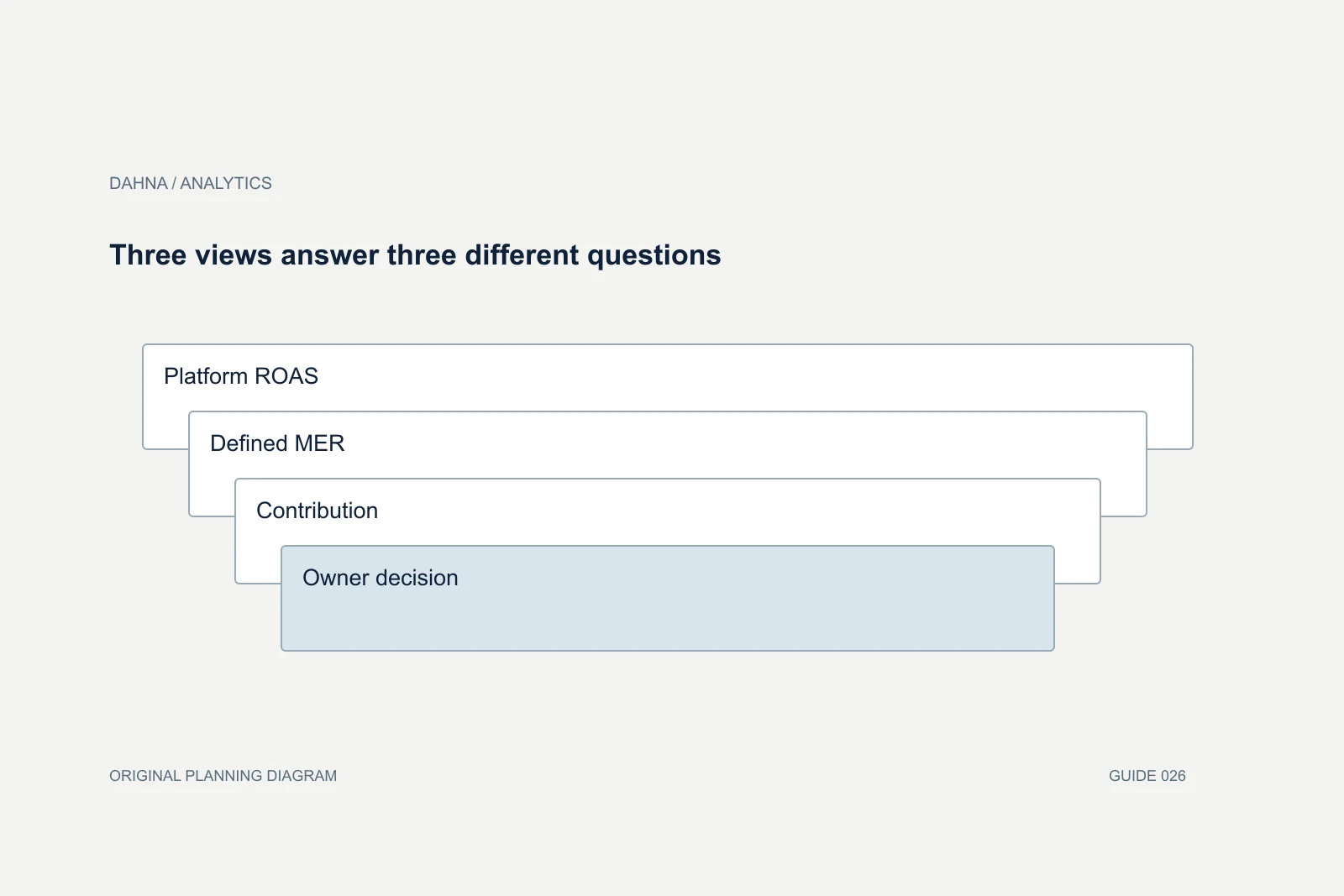
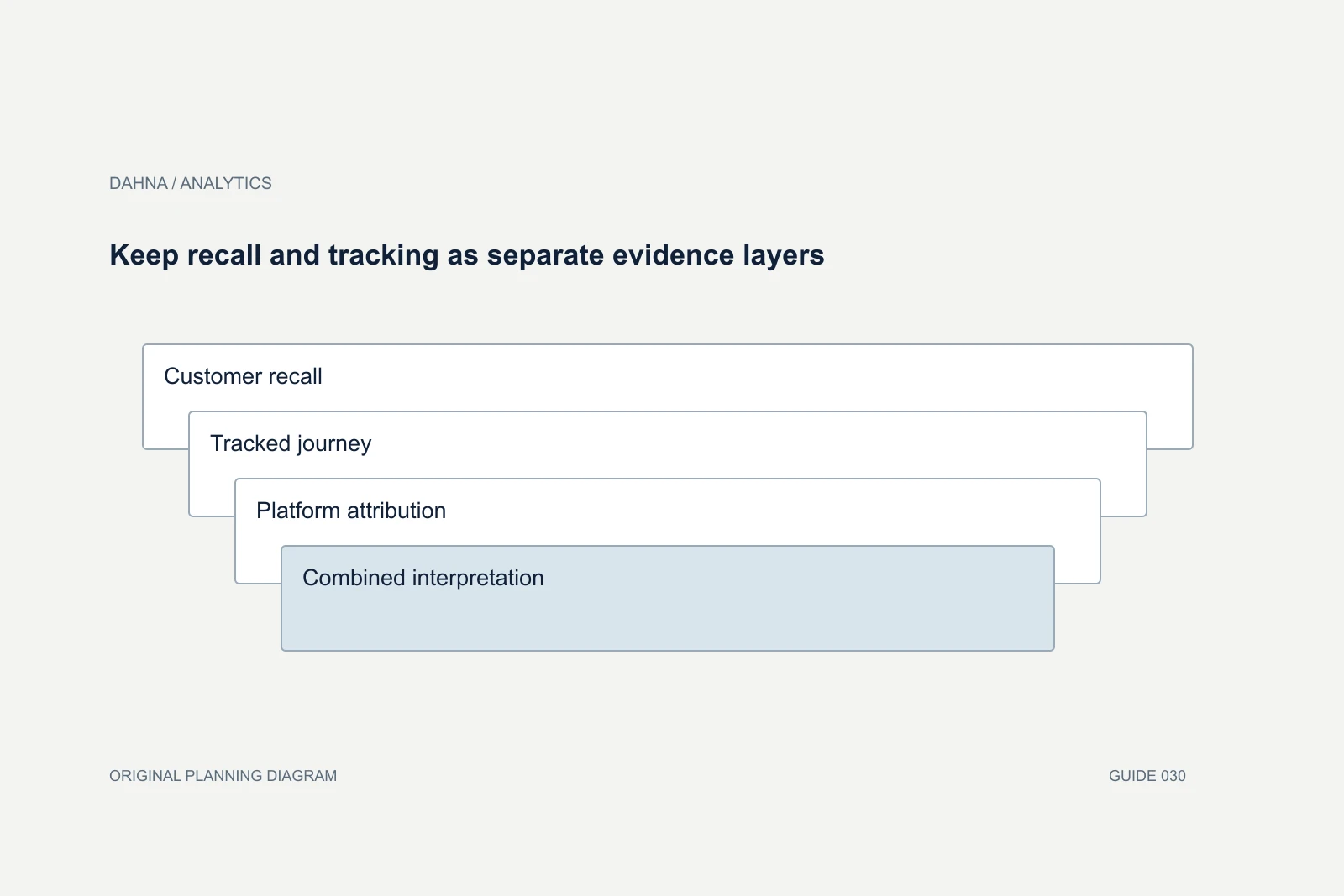
Keep recall and tracking as separate evidence layers
Customer recall
What the respondent remembers.
Tracked journey
What permitted systems observed.
Platform attribution
Credit under each platform’s rules.
Combined interpretation
Look for patterns without forcing agreement.
Report the response rate and the population
Count eligible orders, survey displays where measurable, respondents, and usable answers. A source share among respondents is not necessarily the source share among all customers. People who choose to answer may differ from those who skip the question, and a campaign’s fans may be especially likely to mention it.
If one customer can answer after multiple orders, decide whether the report is order-based or customer-based. A recurring buyer’s response should not silently become a new discovery event every month. State the rule and keep first-time and returning buyers separate when it helps the acquisition question.
Illustrative month with a modest response rate
Imagine 500 qualifying first-time customer orders and 150 survey responses. Sixty respondents say a creator introduced them to the brand, 40 say search, 30 say a friend, and 20 choose another source or do not remember. The correct creator share is 60 of 150 respondents, or 40% of respondents. It is not proof that creators acquired 40% of all 500 customers.
The team compares optional creator names with campaign dates and looks for repeated references. It may find that buyers mention an older video, suggesting a longer discovery path worth investigating. It does not assign every untracked order to that creator or multiply the response share into a precise channel revenue figure.
The numbers are fictional. The survey provides a useful clue about remembered discovery, especially when tracking is incomplete. Its value increases when the team keeps the denominator and limitations visible instead of using the answers to manufacture perfect attribution.
Create a codebook for open answers
Keep the original privacy-safe text, the assigned category, and the reason for ambiguous classifications. “My sister sent me a TikTok” can reflect both a platform and word of mouth; choose a documented coding rule or preserve multiple dimensions rather than forcing a false single cause.
If AI assists with categorization, sample and review the output appropriately and describe the process accurately. Do not infer sensitive personal characteristics from a short answer. The marketing purpose is to understand discovery language and useful channel patterns, not to build an unnecessary personal profile.
Use disagreements to ask better questions
A survey may emphasize creators while analytics shows direct or search traffic. That can be consistent with a person seeing a video and later searching the brand name. It can also reflect recall bias. The disagreement is a reason to investigate the journey, not an instruction to declare one source the truth and discard the others.
Use recurring patterns to design a next test, improve campaign tagging, or ask a more precise follow-up question. Keep the survey wording stable across comparison periods where possible. If the options change, annotate the report because the distribution may change for measurement reasons.
What a useful survey report includes
The report should contain the exact question, answer options, placement, dates, eligible population, response count, coding rules, and examples of useful language. It should separate first discovery from purchase influence and respondents from all customers. A simple table with these details is more credible than a polished pie chart without a denominator.
Assign an owner who can turn the findings into a decision. If nobody will change a brief, a test, or a customer explanation based on the result, reconsider whether the survey is worth the customer’s attention.
| Check | Evidence |
|---|---|
| Question meaning | First discovery or purchase influence is explicit |
| Neutrality | No leading option or forced certainty |
| Population | Eligible customers and response rate are shown |
| Coding | Raw answers and category rules are preserved |
| Comparison | Wording changes and time windows are documented |
| Limits | Recall evidence is not presented as causal attribution |
Keep “other” answers useful without overinterpreting them
Review the uncategorized answers periodically for a genuinely recurring source that deserves its own option. Do not add a new choice after every unusual response; too many options can make the survey harder to answer. When the wording changes, version the questionnaire and keep the earlier responses under their original categories. That preserves comparability while allowing the instrument to improve as the brand’s distribution changes.
How Dahna can help use the answers
Dahna can help write a short survey, create a coding scheme, and connect the findings with campaign and store data. Bring the specific discovery question you want to answer and the checkout or post-purchase tools available. The scope should include implementation ownership and a first review decision.
Continue with the related decision
Use these guides when the next question goes beyond the scope of this article.
Use the editable decision sheet
Download the completed tables as a CSV, then replace the example inputs and add your evidence, owner and review date. Illustrative figures are teaching examples, not default targets.
Sources & further reading
Bring this decision to Dahna
Use this guide to prepare a focused brief. Tell Dahna what needs to change, which evidence you already have and when you need a decision.
Why consider Dahna for this work?
Dahna brings bilingual Korean and English strategy together with creator, content, and measurement work for brands growing in the US. You can review the people behind the recommendations and the kind of work we propose before starting a conversation.
Founder experience includes prior and contracted roles. Sample deliverables illustrate our approach; they are not client results or a performance promise.