How to test an ecommerce free-shipping threshold
Choose a threshold candidate from actual basket values, delivery costs and product margins, then test the total contribution it produces. Include orders that receive a subsidy without changing their behavior. A higher average basket can coexist with lower contribution, and a lower threshold can spend money on customers who would have ordered anyway.
Dahna, original planning diagram
In this article
Overview
Choose a threshold candidate from actual basket values, delivery costs and product margins, then test the total contribution it produces. Include orders that receive a subsidy without changing their behavior. A higher average basket can coexist with lower contribution, and a lower threshold can spend money on customers who would have ordered anyway.
Read the basket distribution before choosing a number
Average order value hides the shape of the business. Export recent completed orders and examine merchandise subtotals after discounts, shipping collected, actual delivery expense, product cost and destination. Separate unusual wholesale, employee and replacement orders from the customer population the proposed policy is meant to serve. Record how refunds and cancellations are treated.
Look for clusters rather than mechanically setting a threshold a percentage above the average. A brand with a $32 hero item and a $12 accessory has different natural basket combinations from one selling a $220 device. A threshold that requires an irrelevant extra product may frustrate shoppers without creating useful demand. Consider which additions genuinely fit the purchase.
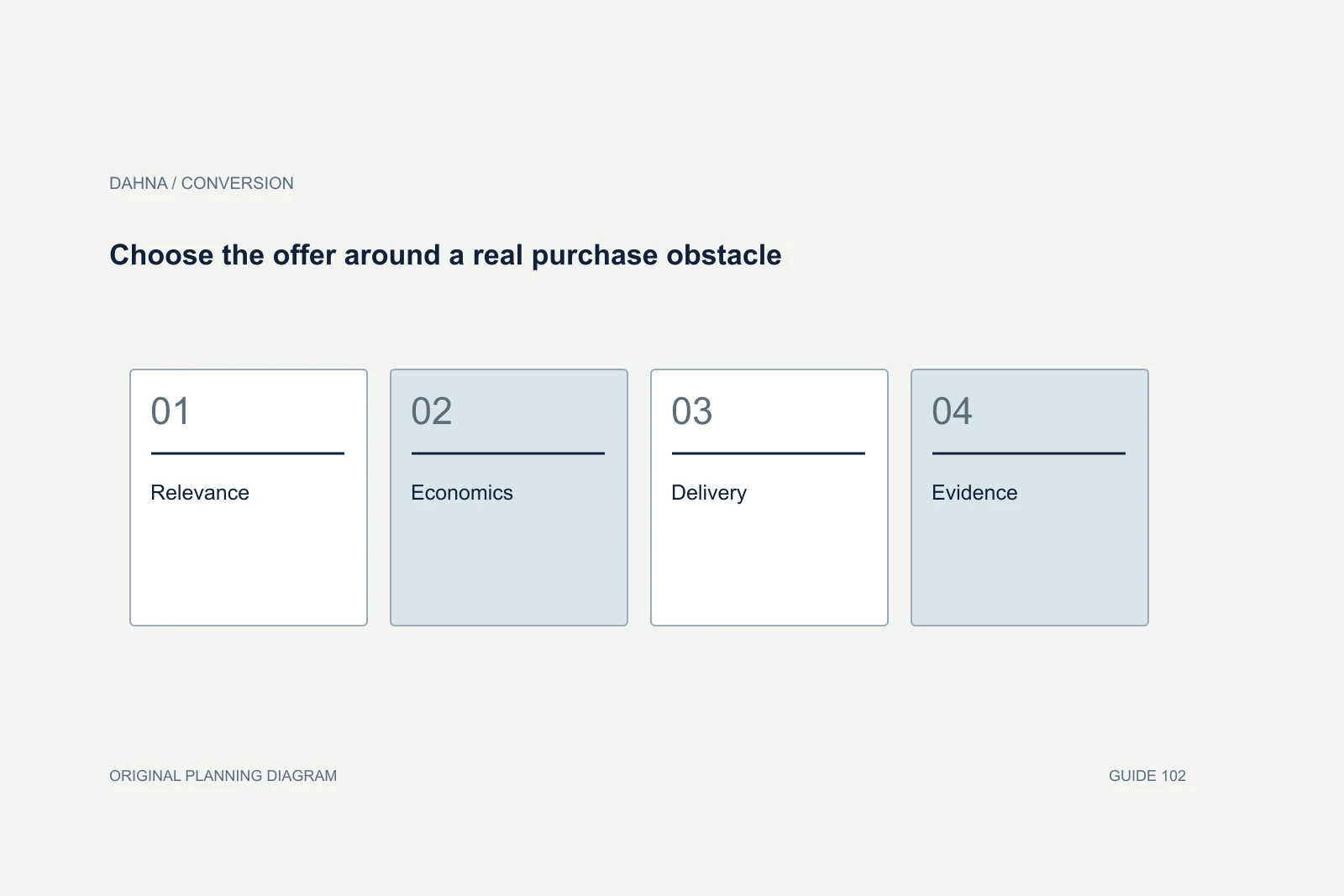
Review the current policy's coverage. How many orders already qualify, how many sit just below it, and how much delivery subsidy is being absorbed? Use destination and parcel weight where they materially change cost. A single national average can conceal expensive regions or heavy bundles. The first worksheet should explain the existing subsidy before projecting a new one.
Define exactly what qualifies
Shopify's shipping-rate documentation describes minimum-order conditions and the interaction of shipping profiles. Its free-shipping discount documentation also allows conditions such as a minimum purchase amount. These are implementation mechanisms, not evidence that a particular threshold improves profit. The brand must choose the commercial rule and test the configuration it actually uses.
Write the threshold definition in one sentence: which subtotal counts, whether discounts reduce it, which products and destinations qualify, and whether the benefit is automatic or code-based. Include the treatment of gift cards, subscriptions or special shipping profiles when relevant. A vague “free over $60” promise can create different interpretations in the product banner, cart and checkout.
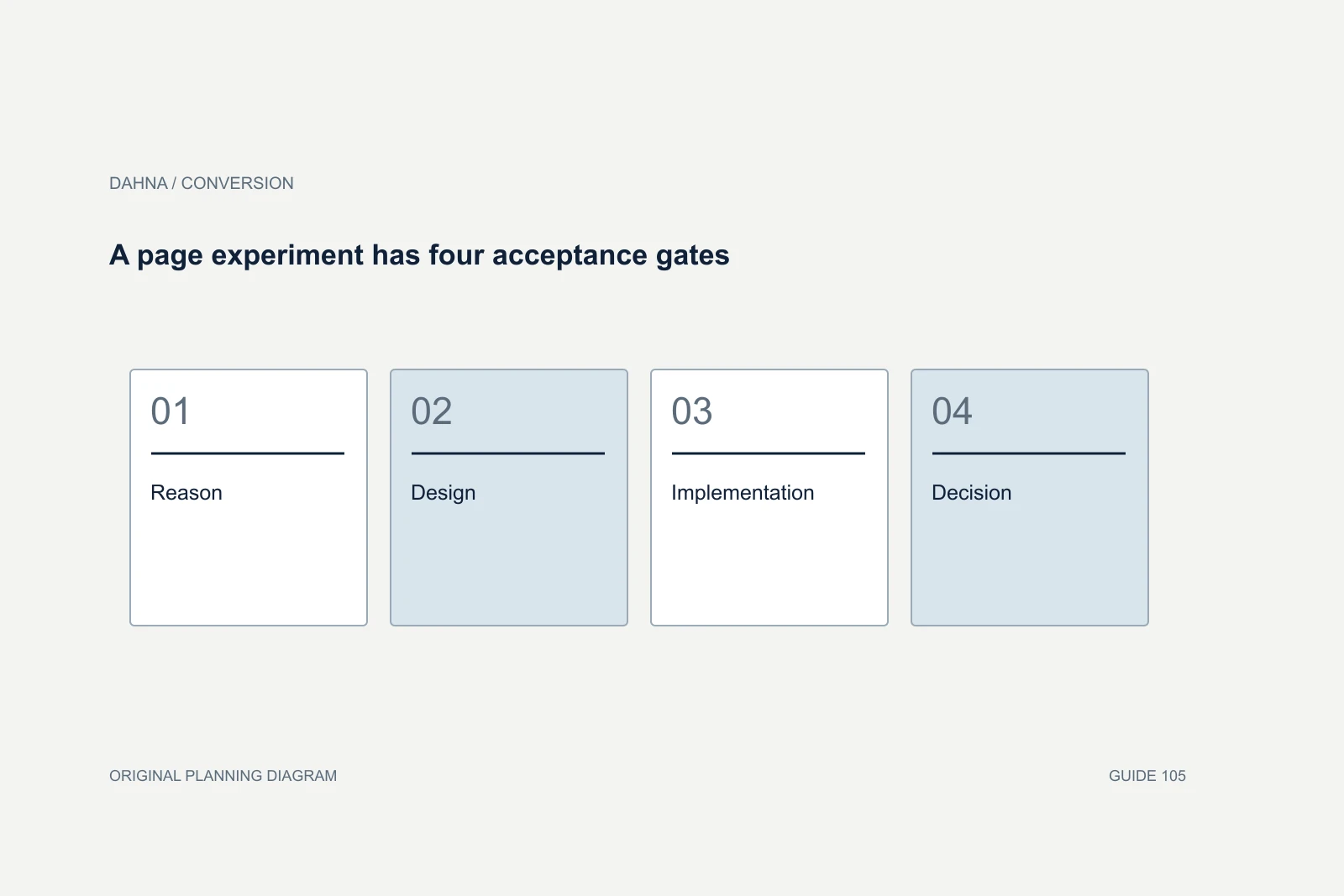
Test the rule with the actual basket states before running an experiment. If the control group has accurate shipping behavior and the treatment has a configuration defect, the result will not answer the threshold question. Separate the economic decision from the calculation's technical acceptance, and give each an owner.
Calculate the value of an extra item and the cost of the subsidy
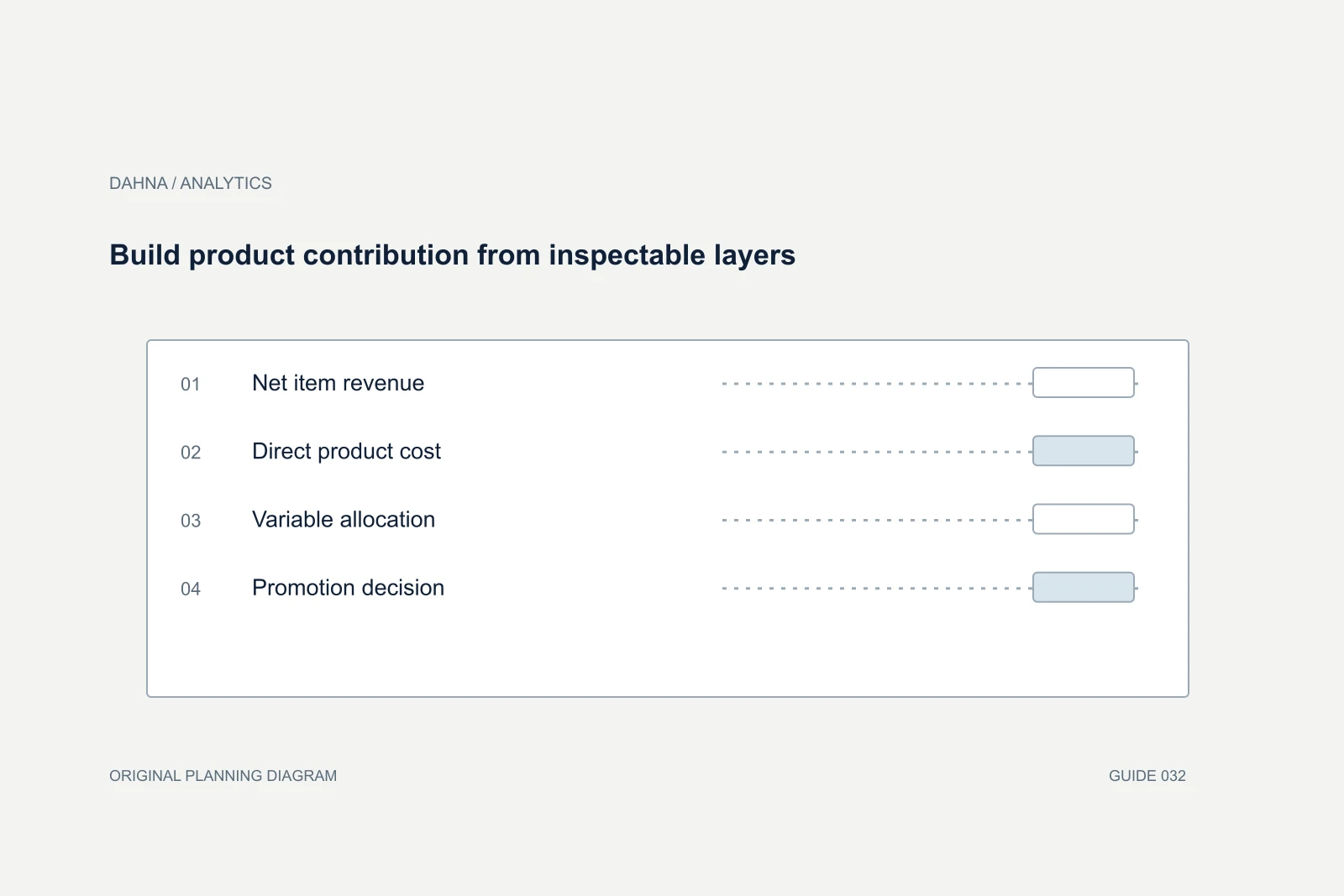
Consider a fictional $40 order that currently collects $6 shipping. Assume product cost of $12, fulfillment of $3, payment cost of $1.50, carrier cost of $6 and a return allowance of $1.50. Contribution before acquisition and overhead is $22: $46 collected less $24 in variable costs. If the same customer receives free delivery without changing the basket, contribution falls to $16.
Now suppose a $12 accessory is added to reach a proposed $50 threshold. Assume the accessory adds $3 product cost, $0.40 payment cost and $0.60 packing cost, with no extra carrier expense. The $52 merchandise order contributes $24: $52 less $28 total variable costs. That is $2 more than the original paid-shipping order, not a $12 improvement.
The example shows why the response mix matters. Some shoppers add a suitable item, some receive a subsidy on an unchanged basket, some decide not to buy and some place orders that would not otherwise occur. The test must account for all those outcomes. The numbers here are illustrative and should be replaced with the brand's actual order-level economics.
| Order state | Customer pays | Variable costs | Contribution |
|---|---|---|---|
| $40 item + $6 shipping | $46 | $24 | $22 |
| Same $40 item, free shipping | $40 | $24 | $16 |
| $40 item + $12 accessory, free shipping | $52 | $28 | $24 |
Make the comparison about eligible visitors
Define the audience before launch. If the question concerns US direct-to-consumer orders, the experiment should not mix in markets with different delivery rules. Assign eligible visitors consistently and keep the threshold explanation, product prices and promotions aligned with the intended comparison. If several shipping policies change together, document that the test evaluates the whole package.
Use contribution per eligible visitor as the main economic measure, with order rate, basket composition, shipping subsidy and refunds as supporting measures. Looking only at buyers excludes people who decide against ordering because of the policy. Looking only at basket size ignores the cost of delivery and the products added to qualify.
A fictional control group with 1,000 visitors and 30 orders averaging $22 contribution produces $660. A treatment with 34 orders averaging $19 produces $646. More orders and possibly a larger basket do not make that treatment better on the stated measure. Those synthetic counts illustrate arithmetic, not statistical significance or a forecast for your brand.
| Measure | Current policy | Candidate threshold |
|---|---|---|
| Eligible visitors | 1,000 | 1,000 |
| Orders | 30 | 34 |
| Average contribution per order | $22 | $19 |
| Total contribution | $660 | $646 |
| Contribution per visitor | $0.660 | $0.646 |
Check the consequences beyond the first order
Monitor whether the threshold encourages unsuitable add-ons, higher return rates or split shipments. An accessory with low acquisition cost can still be expensive if it changes the parcel class or creates picking errors. Ask operations to review actual orders from both groups rather than relying entirely on the checkout subtotal.
Later repeat purchases may matter, but compare cohorts with equal follow-up and a clear customer definition. Do not count projected repeat revenue as realized contribution or assume every later purchase was caused by free shipping. A first-order decision can be made with a stated limit while longer-term outcomes continue to mature.
Inspect support questions about eligibility and unexpected charges. A commercially promising threshold can still need clearer communication. The shipping-and-returns article covers that information design separately. Fix incorrect statements immediately; do not preserve a misleading message merely because a test is running.
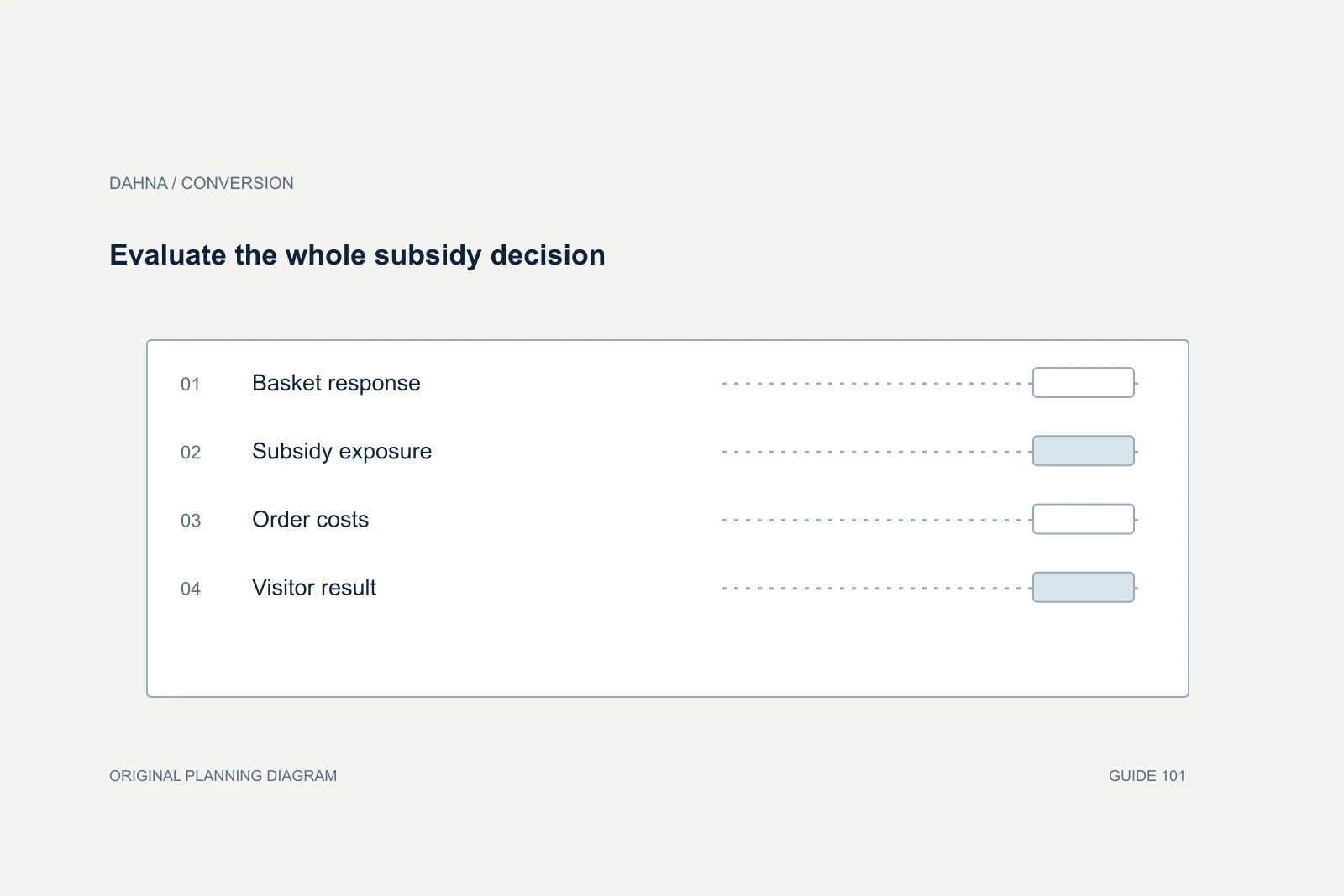
Evaluate the whole subsidy decision
Basket response
What did the shopper add or remove?
Subsidy exposure
Which orders receive free delivery?
Order costs
What did those actual parcels cost to fulfill?
Visitor result
What contribution did the eligible audience produce?
What a useful threshold project delivers
Ask for a baseline order analysis, a small set of plausible threshold candidates, an implementation acceptance sheet and a test plan with a decision rule. The agency should explain why a candidate fits the catalog and which assumptions could reverse the conclusion. A recommendation based only on a competitor's threshold is missing the economics of your business.
The readout should include uncertainty and operational findings. An inconclusive result may justify retaining the current policy while correcting communication, or testing a different offer with a clearer rationale. It should not be turned into a success story by selecting whichever secondary metric increased.
Dahna can discuss the conversion, content and measurement work needed for a scoped test. Bring recent order economics, shipping profiles and the customer behavior you hope to change. The goal is to find an offer the brand can afford and shoppers can understand, with a result that supports a real decision.
Continue with the related decision
Use these guides when the next question goes beyond the scope of this article.
Use the editable decision sheet
Download the completed tables as a CSV, then replace the example inputs and add your evidence, owner and review date. Illustrative figures are teaching examples, not default targets.
Sources & further reading
Bring this decision to Dahna
Use this guide to prepare a focused brief. Tell Dahna what needs to change, which evidence you already have and when you need a decision.
Why consider Dahna for this work?
Dahna brings bilingual Korean and English strategy together with creator, content, and measurement work for brands growing in the US. You can review the people behind the recommendations and the kind of work we propose before starting a conversation.
Founder experience includes prior and contracted roles. Sample deliverables illustrate our approach; they are not client results or a performance promise.