Should your ecommerce brand test a discount or a value offer?
Choose the offer that addresses the shopper’s actual hesitation and can be delivered at acceptable cost. Compare a price reduction with a clearly defined benefit on contribution per eligible visitor, not redemption or average order value alone. Include the cost of giving either offer to people who would have purchased without it.
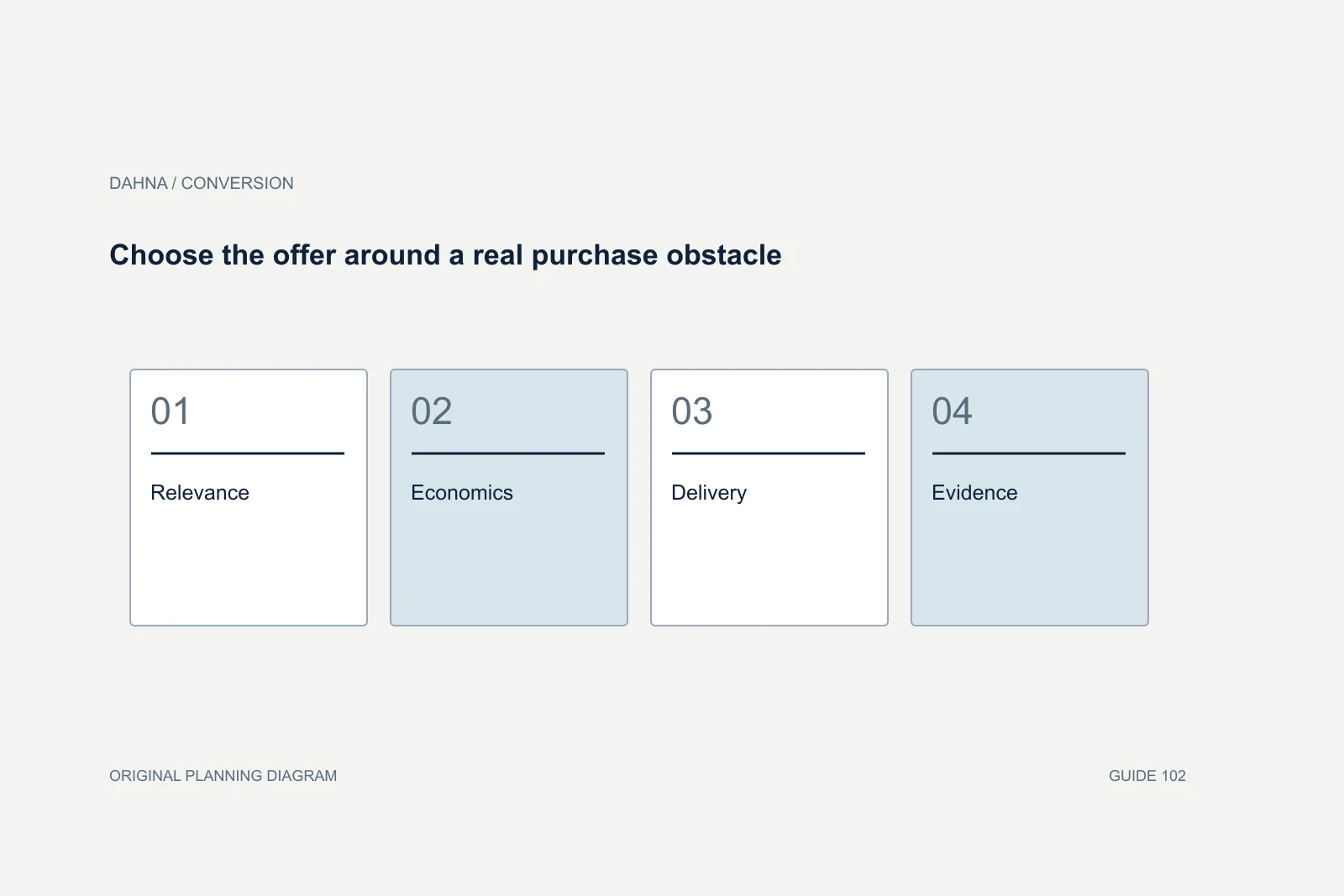
Dahna, original planning diagram
In this article
Overview
Choose the offer that addresses the shopper’s actual hesitation and can be delivered at acceptable cost. Compare a price reduction with a clearly defined benefit on contribution per eligible visitor, not redemption or average order value alone. Include the cost of giving either offer to people who would have purchased without it.
Start with the reason someone is hesitating
A discount is relevant when price is the obstacle, but not every unfinished purchase is a price objection. A shopper may be unsure about shade, product quantity, delivery timing or how a device fits their routine. Reducing the price can leave that uncertainty intact. Review customer questions and task evidence before turning a promotion into the default response.
An added-value offer should solve something useful. A compatible travel case, a relevant sample or a clearly delivered consultation may fit a particular purchase. An unrelated gift can add operational cost while making the offer harder to explain. Define the benefit in the customer's terms and verify that the business can fulfill it reliably.
Keep factual education separate from an incentive. Clear instructions and accurate product information belong in the standard purchase experience; they should not be withheld to make a promotional package feel more valuable. The test concerns an additional commercial benefit, not whether shoppers receive the information needed to make an informed decision.
What Sephora’s rewards example can and cannot teach
Sephora's 2020 announcement about its Beauty Insider program described samples, rewards and experiences as forms of customer value. That is a useful reminder that beauty offers can extend beyond a percentage reduction. It does not show that a small brand should copy Sephora's program, nor does it provide a causal estimate for the value of a particular gift.
Translate the principle into a manageable choice. A brand selling one hero moisturizer may test a relevant sample of a complementary product against a modest discount. A device brand might investigate whether an accessory is actually useful to buyers before including it. The customer task should determine the offer, with the product owner confirming compatibility and claims.
Avoid assigning a large retail value to a gift merely to make the comparison appear attractive. Use an accurate description and support any stated price comparison. The internal cost and the customer's perceived value are different quantities; both matter, but neither should be fabricated to justify the promotion.
Compare the offer economics on the same basis
Use a fictional $60 order with $25 in variable costs before any promotion. Baseline contribution is $35 before acquisition and fixed overhead. A 15% discount reduces revenue by $9, leaving $26 contribution if costs stay unchanged. A gift costing $4 plus $1 incremental packing leaves $30 contribution if it creates no additional shipping or payment cost in this simplified example.
That does not make the gift automatically better. The discount might persuade more eligible shoppers, while the gift might be irrelevant or create returns. The calculation tells you the contribution per order under stated assumptions; the test tells you how many and which orders occur. Recalculate if the offer changes parcel weight, payment fees or customer service work.
Also consider orders that would have happened anyway. Giving a benefit to an existing buyer can be appropriate, but it is still a cost. A high redemption rate is not a measure of incremental demand. The agency should show the full eligible audience and the alternative outcome being estimated, rather than labeling every redeemed order as new revenue.
| Offer | Revenue | Variable costs | Contribution |
|---|---|---|---|
| No incentive | $60 | $25 | $35 |
| 15% discount | $51 | $25 | $26 |
| Relevant gift | $60 | $30 | $30 |
Keep the test interpretable
Compare a limited set of offers that the store can explain and fulfill consistently. Define whether the test includes a no-incentive control, how visitors are assigned and which products qualify. If the store has limited traffic, testing too many variants can leave every comparison inconclusive. Ask an analyst to estimate the traffic and observation window needed for the smallest commercially meaningful difference.
Keep the surrounding presentation comparable. A beautifully produced gift page against a poorly written discount page tests more than the offer mechanic. Both versions should clearly state eligibility, timing and the actual benefit. If a gift runs out, pause or record the affected exposure rather than silently substituting something that changes the treatment.
Use contribution per eligible visitor as a primary commercial measure, with order rate, returns, support contacts and benefit usage as diagnostics. Predefine how cancellations and partial refunds enter the calculation. Do not choose the winner halfway through because one version briefly leads on clicks. The decision rule should exist before anyone sees results.
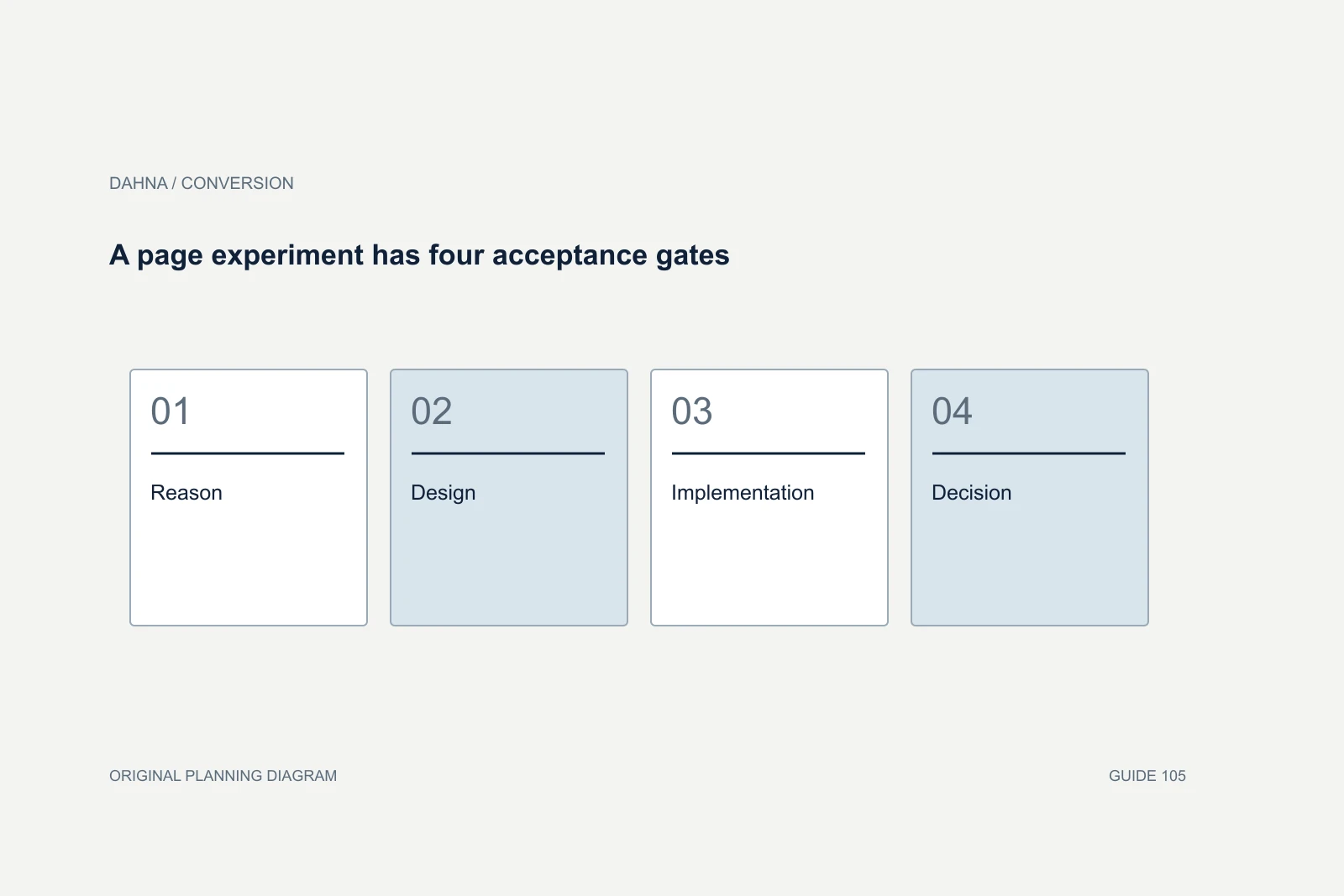
Choose the offer around a real purchase obstacle
Relevance
Does the benefit address the hesitation?
Economics
What does each redeemed order contribute?
Delivery
Can the brand fulfill the promise consistently?
Evidence
Does the eligible audience produce a better result?
A readout that can say no
Imagine 2,000 eligible visitors in each group. The discount version produces 70 orders at $26 contribution, totaling $1,820. The gift version produces 62 orders at $30, totaling $1,860. The gift produces fewer orders but $40 more contribution in this synthetic example. The difference may be too small or uncertain to justify changing the offer once setup and operational costs are considered.
A no-incentive group would answer another important question: whether either promotion improves the business compared with the existing experience. Without it, the test can compare the two offers but cannot establish that a promotion is necessary. State that boundary in the readout rather than treating a relative winner as proof of incremental profit.
Look at qualitative feedback as well. If customers misunderstood the gift size or expected a full-size product, the communication needs correction even if the short-term numbers look attractive. If discount buyers cancel more often, investigate the reason before assuming the offer brought better demand. The outcome is a business decision with customer consequences, not a contest between promotional labels.
| Measure | 15% discount | Gift |
|---|---|---|
| Eligible visitors | 2,000 | 2,000 |
| Orders | 70 | 62 |
| Contribution per order | $26 | $30 |
| Total contribution | $1,820 | $1,860 |
| Contribution per visitor | $0.910 | $0.930 |
Ask for a decision brief and an operational handoff
A useful scope contains the hesitation evidence, offer definitions, approved product claims, cost model, eligibility rules and test plan. Include inventory and customer-service instructions for the benefit. The agency should identify dependencies before launch, especially when a gift needs assembly, a code must combine with another promotion or an appointment must be delivered by a separate team.
The final recommendation can be retain, revise or stop. Retain an offer when the evidence and operations support it. Revise a clearly identified weakness, then evaluate the revised proposition as a new decision. Stop when the cost is not justified or the offer confuses the product's value. There is no requirement to keep a promotion merely because work went into it.
Dahna can help connect the offer, creative explanation and conversion measurement. Bring the current purchase hesitation, candidate benefits and realistic costs. That makes it possible to discuss a test that answers a useful commercial question rather than adding another discount to the calendar.
Continue with the related decision
Use these guides when the next question goes beyond the scope of this article.
Use the editable decision sheet
Download the completed tables as a CSV, then replace the example inputs and add your evidence, owner and review date. Illustrative figures are teaching examples, not default targets.
Sources & further reading
Bring this decision to Dahna
Use this guide to prepare a focused brief. Tell Dahna what needs to change, which evidence you already have and when you need a decision.
Why consider Dahna for this work?
Dahna brings bilingual Korean and English strategy together with creator, content, and measurement work for brands growing in the US. You can review the people behind the recommendations and the kind of work we propose before starting a conversation.
Founder experience includes prior and contracted roles. Sample deliverables illustrate our approach; they are not client results or a performance promise.