How indie fragrance brands can turn sampling into online sales
Build a fragrance sampling journey that connects creator content, discovery sets and full-size purchases, with clear costs and measurement limits.
How can fragrance samples lead to full-size online purchases?
An indie fragrance brand can connect creator discovery to online sales by making the next trial step clear: help people choose a sample, use it, compare their experience and find the corresponding full-size product. Evaluate sampling cohorts after their purchase window, including sample costs and discounts. A shipment or a popular unboxing is not the same as a converted customer.
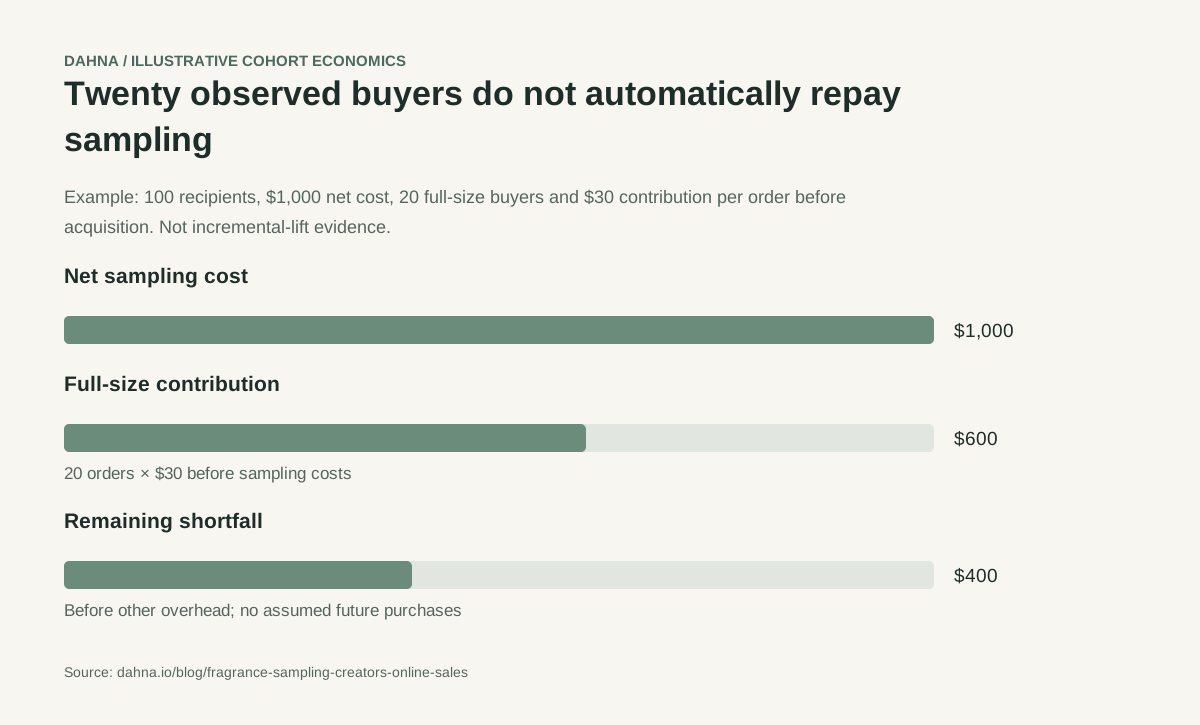
Twenty observed buyers do not automatically repay sampling
- Net sampling cost$1,000
- Full-size contribution20 orders × $30 before sampling costs$600
- Remaining shortfallBefore other overhead; no assumed future purchases$400
Design around what a video cannot communicate
A viewer can see a bottle and hear a creator describe a fragrance, but cannot smell it through the screen. The content's job is to help the right person decide whether trying it is worthwhile. Use recognizable scent descriptions, the intended occasion and an honest explanation of the creator's own preference.
Avoid making the creator's reaction a universal prediction. Personal descriptions such as soft, sharp or comforting need context. A helpful brief asks what the person notices and how they would choose among the samples; it does not dictate that everybody must call one scent their favorite.
Start with the problem the brand needs to solve. If customers struggle to choose between scents, a clearly explained discovery set may help. If people buy samples but cannot find the full-size product afterward, the immediate issue is the journey rather than the amount of creator content.
What should happen between receiving a fragrance sample and buying full size?
Choose whether the campaign is designed to sell a discovery set, distribute a limited sample or invite someone to an in-person experience. Those offers have different costs and customer expectations. Put the price, contents and any redemption terms beside the offer, and make the full-size destination easy to find later.
A sample needs an understandable identity outside the original packaging. Use a legible scent name and a simple route back to the relevant product page. Do not make a recipient remember which creator or post introduced the set in order to buy it again.
| Step | Customer question | Useful brand response |
|---|---|---|
| StepCreator discovery | Customer questionDoes this sound like something I would enjoy? | Useful brand responseA specific, honest scent description and sample destination |
| StepChoosing a sample | Customer questionWhich option should I try? | Useful brand responseClear set contents, price and differences |
| StepTrying it | Customer questionWhich scent did I prefer? | Useful brand responseLegible names and room for a personal assessment |
| StepBuying full size | Customer questionWhere is the exact one I liked? | Useful brand responseDirect product route and clear offer terms |
| StepReturning later | Customer questionCan I find it again? | Useful brand responseConsistent names, availability and customer support |
Brief creators for useful comparison
Give creators the product information they need, the campaign objective and the agreed deliverables. Ask them to explain their own preference and the context in which they tried the scent. A demonstration of how they compare the discovery set can be more useful to a hesitant buyer than a rapid bottle reveal.
Let the role determine the creator choice. A fragrance-focused collaborator may explain differences precisely. A creator whose audience shares a relevant occasion or gifting need may introduce a different buyer. Review the audience and the actual work before assuming either group will produce more sales.
Agree on publication, reuse and paid permissions separately. The FTC's endorsement guidance covers material connections including gifts; communicate the disclosure requirement alongside the brief. Payment or product should not depend on a favorable review.
How do you calculate the cost of a fragrance sampling campaign?
Calculate net sampling cost from sample product, packaging, assembly, shipping, fees, creator work and any brand-funded full-size discount, less sample revenue where applicable. Divide that cost by observed full-size buyers to calculate cost per observed buyer. Use the same definitions and maturity window across cohorts; this does not establish incremental sales.
Consider a hypothetical cohort of 100 sample recipients. If the net campaign cost after sample revenue is $1,000 and 20 recipients later buy full size, the cost is $50 per observed full-size buyer. That is $1,000 divided by 20, not an industry benchmark. At $30 contribution per full-size order before this acquisition cost, the 20 orders contribute $600, leaving a $400 shortfall before other overhead.
This calculation describes the observed cohort economics. It does not prove that all 20 purchases were caused by sampling. Some recipients might have bought anyway, and other buyers may return outside the measurement window. Record that uncertainty instead of presenting the cohort rate as an incremental lift.
When should you evaluate a fragrance sampling cohort?
Evaluate a fragrance sampling cohort after the purchase window chosen before the campaign, using the brand's observed buying cycle and offer. Compare groups with similar time to mature. A cohort shipped last week should not be judged against one that has had a month to buy.
Use campaign links and clearly defined offers where practical, then reconcile orders, cancellations and returns. Keep discovery-set purchases separate from full-size purchases and existing customers separate from new customers where possible. A single customer may encounter creators, a physical event and a direct site visit; avoid adding each channel's claimed conversion as a separate sale.
If sample demand is strong but full-size buying is weak, inspect preference fit, price, offer clarity and the return path. If samples are not moving, inspect the audience, explanation and initial offer. More sampling is a reasonable next step only when the existing journey and its costs support it.
Connect fragrance discovery to a clear purchase journey
Dahna can help scope the product story, creator briefs, campaign content and measurement for a fragrance launch. Sampling production and fulfillment responsibilities should be assigned explicitly with the appropriate partners.
Why consider Dahna for this work?
Dahna brings bilingual Korean and English strategy together with creator, content, and measurement work for beauty brands. You can review the people behind the recommendations and the kind of work we propose before starting a conversation.
Founder experience includes prior and contracted roles. Sample deliverables illustrate our approach; they are not client results or a performance promise.