How to get your beauty products into wellness events: partnerships and product seeding
Find wellness-event partners, pitch a relevant product-seeding offer, agree on placement and logistics, and measure what happens after samples reach guests.
How can a beauty brand get its products into a wellness event?
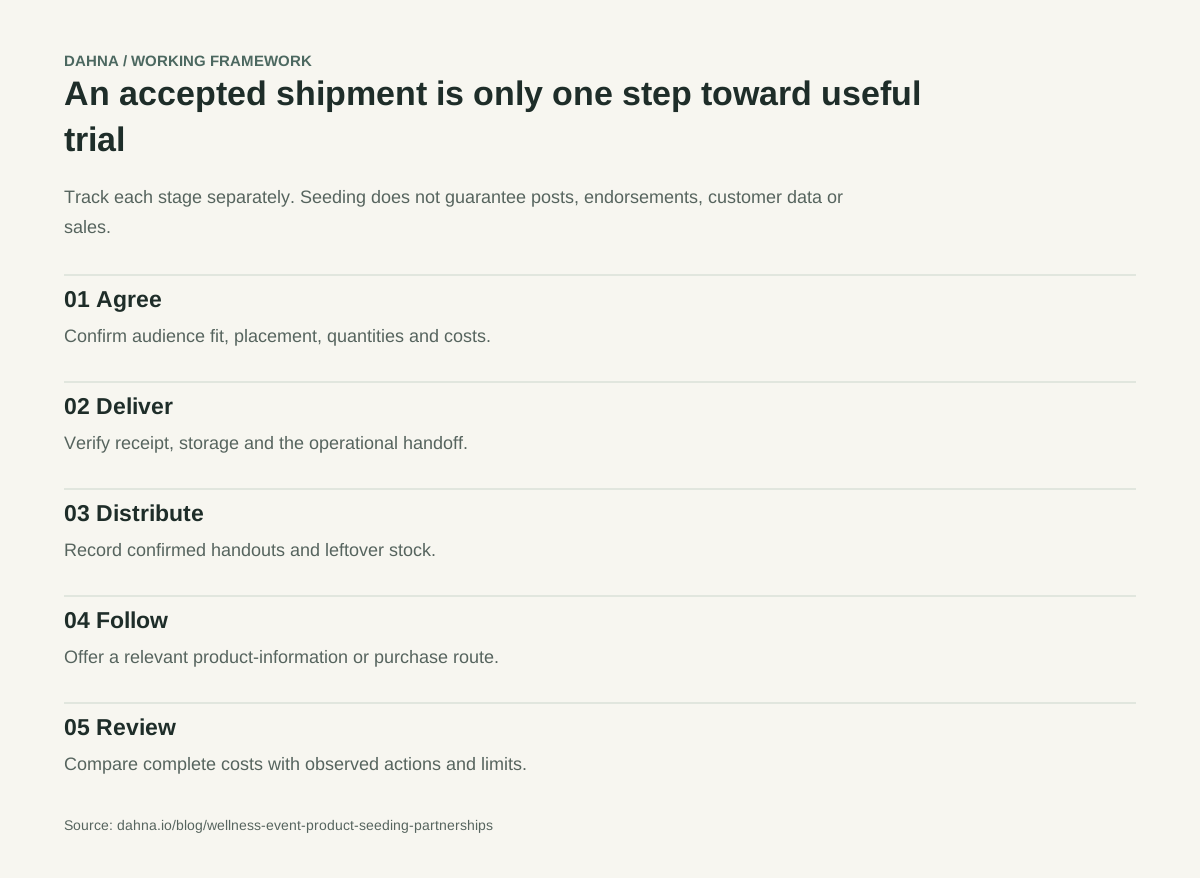
To get a beauty product into a wellness event, approach the organizer with a clear audience fit, a useful role for the product and an operationally complete sampling offer. Agree on the placement, quantities, deadlines, costs and evidence of delivery before shipping. Product seeding buys or contributes an opportunity to try something; it does not automatically include endorsements, attendee data or future sales.
An accepted shipment is only one step toward useful trial
Agree
Confirm audience fit, placement, quantities and costs.
Deliver
Verify receipt, storage and the operational handoff.
Distribute
Record confirmed handouts and leftover stock.
Follow
Offer a relevant product-information or purchase route.
Review
Compare complete costs with observed actions and limits.
How do you find wellness events that fit your product?
Find wellness-event partners by matching the product's customer and use occasion to an organizer's actual community, then checking recent events and the published partnership process. A studio gathering, running-club recovery event and retreat serve different needs. A fashionable venue alone does not establish customer fit.
Build a shortlist of actual organizers, studios and community operators. Review their recent events, audience description, locations, partnership pages and contact process. Distinguish an organizer's published audience claims from independently verified attendance. Ask for the evidence needed for your decision rather than assuming a social following equals event attendance.
There are public routes into these relationships. ClassPass describes product sampling among its brand-partnership options. BLOOM by Callie describes product features and gift-bag participation within its own gatherings. These are examples of partnership formats to investigate, not endorsements, confirmed openings for your brand or relationships Dahna claims to hold.
Does product seeding include promotion or endorsements?
Product seeding includes only the placement and deliverables agreed with the organizer; it does not automatically include promotion, endorsements or attendee data. A sealed take-home sample, a staffed demonstration and an integrated product moment create different obligations. Confirm where the product appears, who explains it and what happens to unused stock.
Separate a product contribution from a paid sponsorship. A gifting invitation may include no guaranteed promotion, while a paid package may specify placements or content. Put the actual deliverables into the agreement; the word ‘partner’ does not define them. If endorsements or creator posts are included, discuss disclosures and permissions explicitly.
| Format | Useful role | Confirm before committing |
|---|---|---|
| FormatGift-bag inclusion | Useful roleA take-home trial | Confirm before committingBag assembly, quantity, identification and leftovers |
| FormatStaffed sampling table | Useful roleProduct explanation and questions | Confirm before committingStaffing, venue permission and safe handling |
| FormatIntegrated experience | Useful roleA relevant moment within the program | Confirm before committingHost approval, timing and supported product statements |
| FormatPaid sponsorship | Useful roleSpecified visibility or participation | Confirm before committingExact deliverables, fees and reporting |
What should a wellness-event partnership pitch include?
Lead with why the product fits the organizer's guests and what the contribution would look like. Identify the product, sample format, available quantity, delivery location, lead time and any constraints. Include a concise product sheet and the person responsible for logistics. Ask which format fits the event instead of demanding a list of promotional benefits before understanding it.
A proposal should make it easy to decide whether the discussion is worth continuing. Avoid unsupported claims about the audience or promises that a product will improve a guest's health. Offer the information the organizer needs to assess the fit, then agree the details before spending on custom packaging or shipping.
Illustrative pitch structure: ‘We make [product] for [customer/use]. Your [event] appears relevant because [specific reason]. We can propose [quantity and sample format] for [placement], with [delivery timing and responsible contact]. Would this fit your program, and what placement, fees and reporting would apply?’ This is a drafting template; no outreach has been sent on your behalf.
Make the handoff explicit before shipping
Confirm the receiving contact, address, delivery window, storage conditions and the date the organizer needs the products in hand. Use packaging and instructions suitable for the approved use. For on-site application, assign qualified owners to review hygiene, product suitability and venue requirements. For sealed take-home samples, make the product identity and use information legible after the event.
Record the shipment, receipt, quantity placed, quantity handed out and leftovers separately. A delivery confirmation proves the shipment reached a destination; it does not prove guests received the product. Agree what evidence the organizer can reasonably provide without collecting or sharing personal information the brand is not entitled to receive.
Settle photo and content permissions in advance. Receiving a photograph does not necessarily grant unlimited advertising rights to the people or brands shown in it. Request the permitted uses and credit requirements. Keep product placement evidence separate from evidence that attendees liked, used or purchased the product.
How do you measure an event product-seeding partnership?
Choose a useful next step such as a product-information page, a sample-specific offer or a relevant discovery-set destination. Use an event-specific link where appropriate, then report visits and orders with clear time windows. A scan is not a purchase, and an untracked return visit may not retain the event source.
Calculate the full cost: product, packaging, shipping, fees, staffing, creative and any discount funded by the brand. Divide by the denominator you actually observed. In an illustrative pilot costing $800, 160 confirmed handouts imply $5 per handout. If eight purchases are recorded within the chosen window, the same cost is $100 per observed purchase. Neither calculation establishes incremental sales or a market benchmark.
Review whether the audience fit, product explanation and logistics were worth repeating. If distribution was confirmed but few guests took the next step, investigate product relevance and the offer. If the organizer could not verify placement, fix the agreement before sending a larger batch. A useful small partnership can be repeated without producing a whole event yourself.
Know when you need partnership support
Outside support can help a brand identify suitable communities, prepare a coherent offer and connect the sampling moment to its content and measurement plan. Confirm who actually owns organizer outreach, negotiation, freight, staffing and reporting in the proposed scope. Event access is not guaranteed simply because an agency has relevant marketing experience.
If you need to create a dedicated brand environment or control the entire visitor journey, use the pop-up planning guide instead. This article addresses entry into another organizer's event, with their audience, program and operational boundaries.
Find an event partnership that fits your brand
Tell us your product, the community you want to reach and what you want the sampling moment to achieve. Dahna can help scope the product story, partnership brief, campaign content and measurement, with execution responsibilities agreed explicitly.
Why consider Dahna for this work?
Dahna brings bilingual Korean and English strategy together with creator, content, and measurement work for beauty brands. You can review the people behind the recommendations and the kind of work we propose before starting a conversation.
Founder experience includes prior and contracted roles. Sample deliverables illustrate our approach; they are not client results or a performance promise.