Your first retail shipment, from order to payment
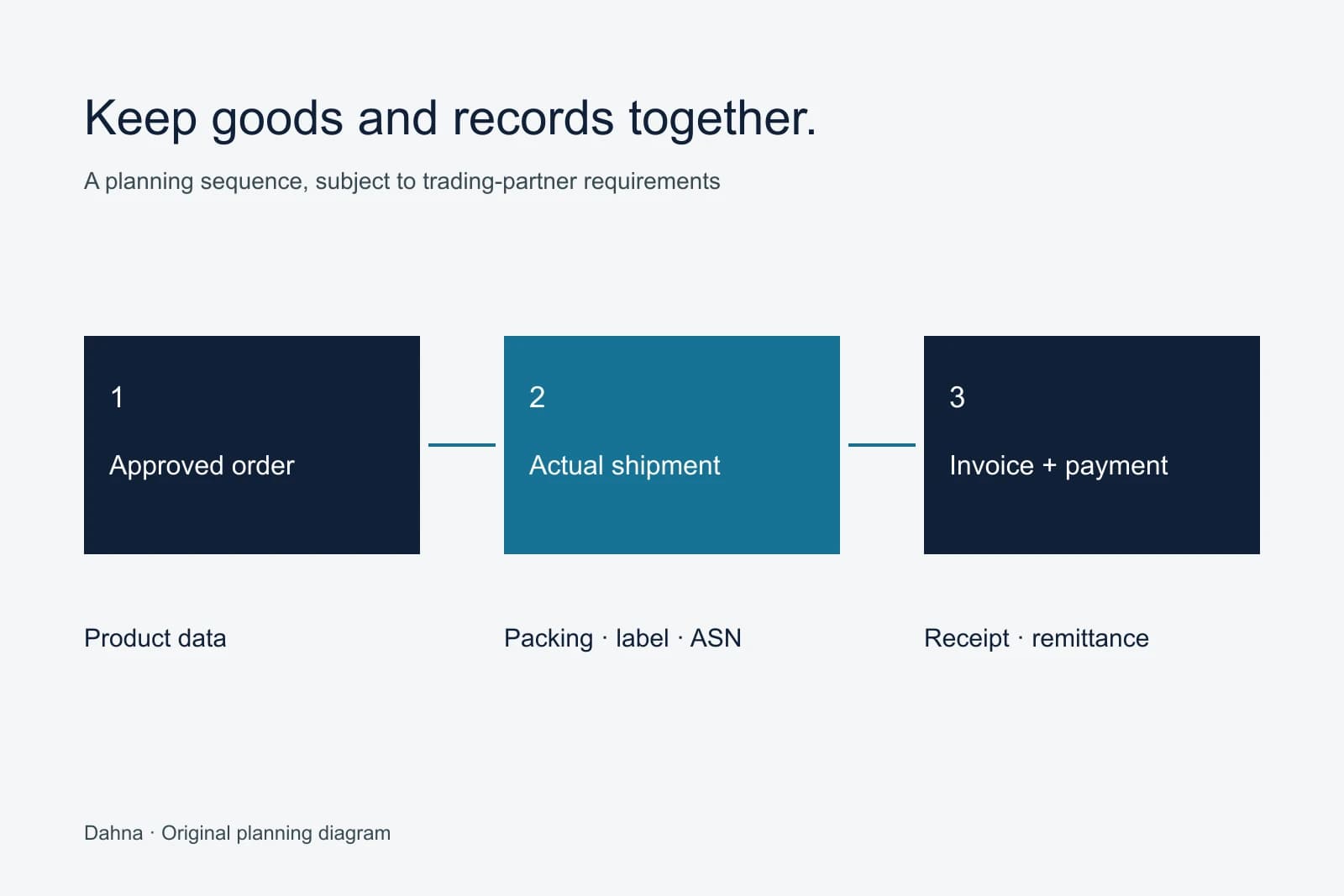
A shipment is ready when the order, physical goods and required electronic records agree. Rehearse those handoffs with your retailer, EDI provider and warehouse before the first live order. Software setup alone does not prove the operating process works.
Dahna, original planning diagram
In this article
Overview
A shipment is ready when the order, physical goods and required electronic records agree. Rehearse those handoffs with your retailer, EDI provider and warehouse before the first live order. Software setup alone does not prove the operating process works.
The older system you may be thinking of is EDI
EDI means electronic data interchange: structured business documents exchanged between trading partners. The tools around it may include an EDI service, retailer portal, warehouse system and label-validation service. They do different jobs. Recognizing the portal name is less useful than knowing which system creates, sends, checks and stores each record.
In common X12 retail workflows, 850 identifies a purchase order, 855 an order acknowledgment, 856 a shipment notice and 810 an invoice. A 997 functional acknowledgment concerns the received transaction; it is not a promise to pay or proof that the goods were accepted. X12 describes the overall sequence as an illustrative flow with options, not one mandatory process for every retailer.
Target’s public supplier page requires the ability to receive purchase orders using EDI. It does not publish a complete transaction, mapping or testing specification on that page. Obtain the current requirements for your trading relationship before configuring a system or appointing a provider.
Resolve the order before the warehouse picks
Give one brand-side operations owner responsibility for comparing the purchase order with the accepted assortment and terms. Check item identifiers, units versus cases, quantities, prices, destination and required shipment or arrival dates. Record exceptions through the buyer’s approved change process; do not ask the warehouse to silently substitute a product or quantity.
Give the EDI provider the correct trading-partner specifications and ask what testing proves. Does it cover only document transmission, or also the mapping and business rules you need? Agree who watches failures and who is available when an order arrives. A completed test for one partner is not proof of readiness for another.
| Handoff | Accountable owner | Evidence to retain |
|---|---|---|
| Accept or resolve the order | Brand commercial and operations leads | Approved PO and documented changes |
| Send required transactions | Brand EDI owner with provider | Test results, transmission and error records |
| Pick, pack and label | Warehouse or 3PL lead | Actual pack details and label checks |
| Arrange and release shipment | Logistics lead | Routing instructions, appointment and dispatch record |
| Invoice and reconcile | Brand finance lead | Invoice, receipt evidence and remittance |
Make the cartons match the shipment notice
An advance ship notice, usually shortened to ASN, describes a shipment electronically. A logistics label identifies the physical unit. GS1 explains that an SSCC identifies a logistics unit such as a pallet or carton, linking it to shipment information. GS1-128 is a barcode format that can carry logistics data; it is not simply the consumer item’s checkout barcode.
Use actual packing information, not the original forecast, to create the required shipment record. If the warehouse repacks a carton after the data is prepared, decide which records must be updated before release. Confirm the retailer’s label layout, placement, data, timing and validation requirements with the responsible specialists.
Scanning a barcode is one check. Confirming that the label identifies the correct physical contents and agrees with the transmitted record is another. Neither check by itself verifies every retailer requirement. Save the evidence needed to investigate a mismatch later.
Rehearse one order with a deliberate exception
In this fictional rehearsal, a retailer orders 120 units packed as 12 cartons of 10. During packing, one damaged unit is removed. The warehouse must not leave the record saying 120 units while shipping 119. Operations first follows the retailer’s exception process and obtains the required instruction; the warehouse and EDI owner then reconcile the approved shipment, packing data and applicable notice.
The team also tests a rejected electronic document and a late pickup. For each event, write down who sees it, how they are alerted, who can authorize a correction and what proves the correction reached the right system. Use the provider’s or retailer’s designated test process. Do not send fictional transactions into a production trading relationship.
This rehearsal is an original planning exercise, not a prescribed retailer test case. Its purpose is to expose missing ownership while there is still time to fix it.
Keep delivery and payment visible after dispatch
Confirm the current routing and appointment instructions before release. Keep the carrier reference, dispatch record and available delivery evidence together with the order. A signed carrier document may be relevant evidence, but it does not automatically settle every dispute about what the retailer received.
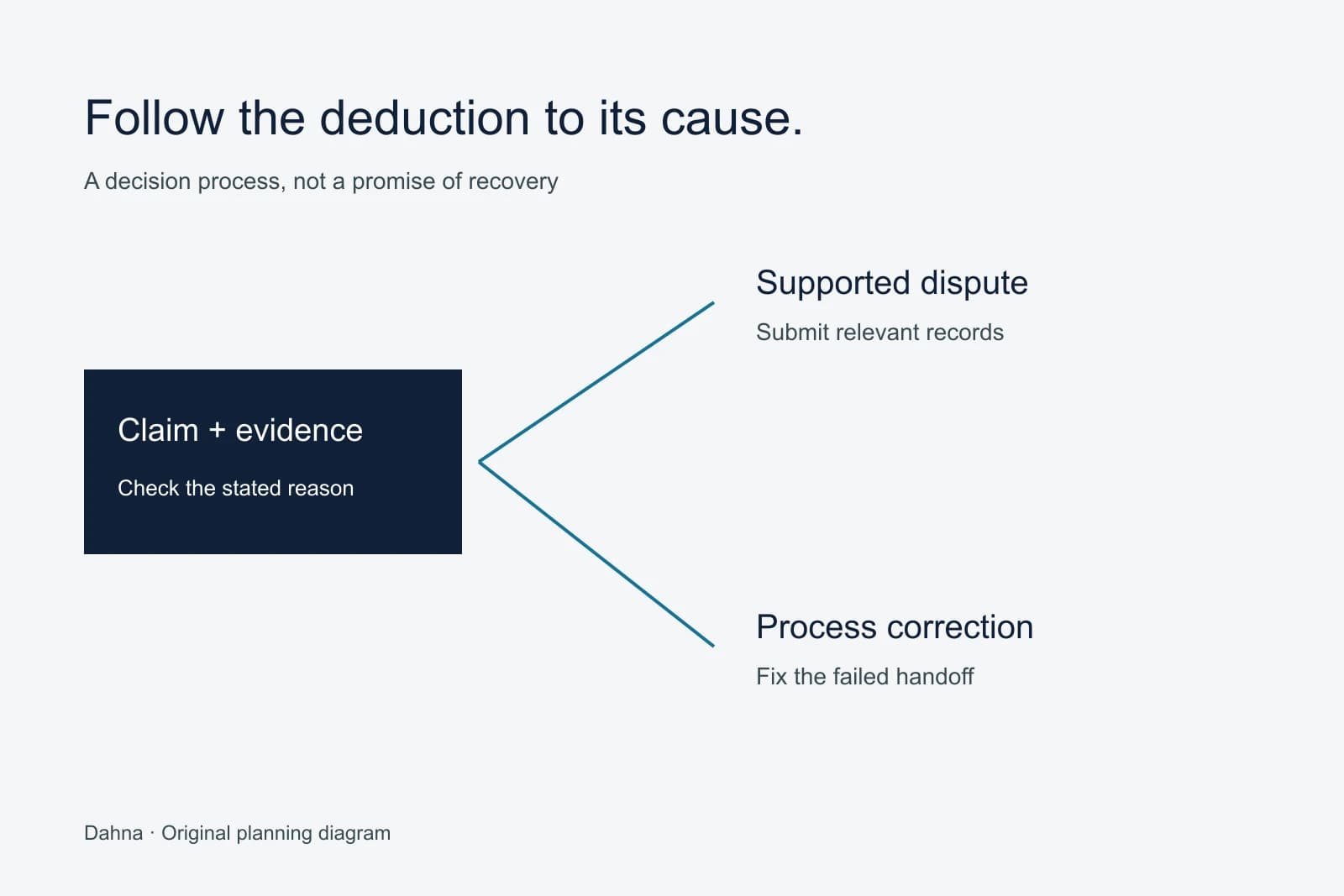
Finance should check the invoice against the approved order and actual shipment, then reconcile the payment and any deductions. Separate a transmission failure from a pricing disagreement, shortage allegation or agreed allowance. Each needs different evidence and an appropriate owner.
Marketing also needs a handoff: do not announce availability at a store until the responsible commercial or retail contact confirms it. Prepare product education and launch assets in parallel, while the operations team owns shipment approval.
Sources & further reading
Connect retail plans to the marketing work
We can prepare the product explanations, approved imagery and launch assets that accompany a confirmed retail introduction. Your operations, EDI and logistics partners own the shipment and compliance work.
Why consider Dahna for this work?
Dahna brings bilingual Korean and English strategy together with creator, content, and measurement work for brands growing in the US. You can review the people behind the recommendations and the kind of work we propose before starting a conversation.
Founder experience includes prior and contracted roles. Sample deliverables illustrate our approach; they are not client results or a performance promise.
Dahna provides marketing support. Retail placement, buyer representation, accounting, EDI integration and warehouse compliance require the appropriate commercial and operational partners.