Retail chargebacks: find the process behind the deduction
Start with the deduction’s stated reason and the governing documents. Build an evidence trail before deciding whether to dispute an error, accept a supported charge or fix the process that caused it. A dispute submission is not recovered cash.
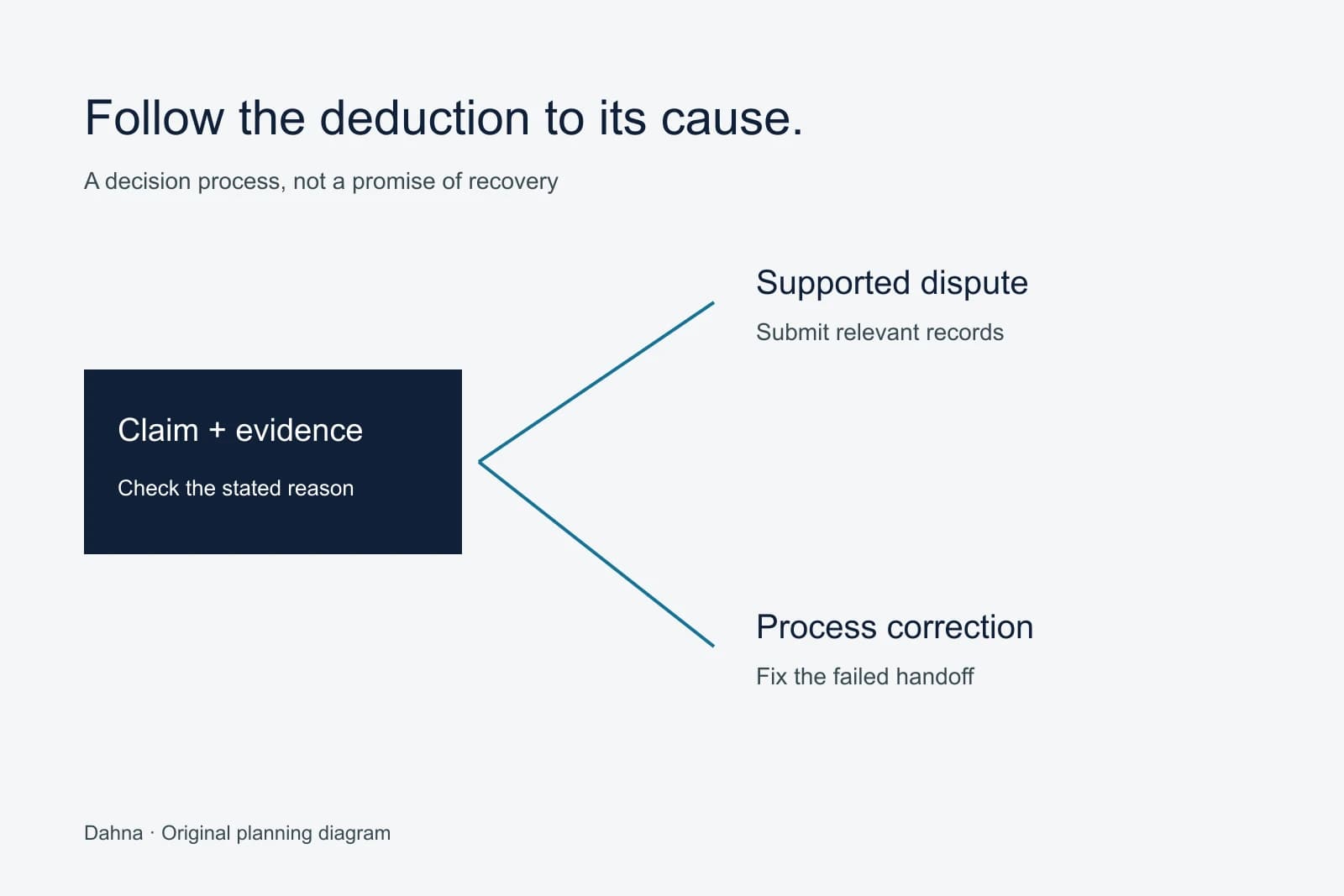
Dahna, original planning diagram
In this article
Overview
Start with the deduction’s stated reason and the governing documents. Build an evidence trail before deciding whether to dispute an error, accept a supported charge or fix the process that caused it. A dispute submission is not recovered cash.
First, identify what was deducted
Here, a retail chargeback means a supplier-facing deduction or compliance charge associated with a trading relationship. It is different from a shopper disputing a card payment. Retailer terminology varies, and not every deduction represents a warehouse mistake: a pricing difference, agreed allowance, return or alleged shortage may require a different investigation.
Start from the retailer’s actual claim or remittance record. Preserve the claim number, stated reason, amount, invoice and purchase-order references, any shipment reference and the date you received it. Find the current agreement or supplier policy that the charge cites. Do not infer the rule or deadline from another retailer’s guide.
For a concrete example of a documented workflow, Direct Commerce’s UNFI help page describes a portal where Natural Supplier users can review deductions, attach supporting documents, submit disputes and track progress. This is evidence of that portal’s function, not a universal retail process or a Target fee schedule.
Route the reason to the evidence owner
Assign a single investigation owner, usually in the brand’s finance or operations team, then ask the relevant specialist for records. A warehouse should not have to guess what a commercial allowance means, and finance should not have to reconstruct a carton from a marketing spreadsheet.
Use the following as a triage map. These are possible evidence paths, not a definitive list of deduction codes. The actual reason and governing documents decide which records matter. Keep originals and timestamps; a reconstructed explanation should be identified as such.
| Stated issue | Start with | Ask this owner |
|---|---|---|
| Quantity or shortage | Order changes, pack record, dispatch and receiving evidence | Warehouse and logistics |
| Label or ASN mismatch | Actual label data, packing record and transmission status | Warehouse and EDI owner |
| Routing or delivery timing | Instructions, booking, pickup and appointment records | Logistics |
| Price or allowance | Accepted terms, approved changes and invoice | Commercial and finance |
| Unclear or duplicate claim | Claim history, remittance and prior resolution | Finance |
A fictional carton mismatch, investigated in order
A fictional brand receives a $240 deduction described as a shipment-data mismatch. That amount is invented for the example; it is not a quoted retailer penalty. The investigator collects the claim and its policy reference, then compares the approved order, final packing record, label identifiers and the record sent to the buyer.
The warehouse log shows that two cartons were repacked after the original electronic record was prepared. If the transmitted record still describes the earlier configuration, the brand has found a plausible internal failure. It should follow the applicable correction process and verify the charge basis before deciding its response. Merely demonstrating that the carrier delivered something would not resolve that mismatch.
Alternatively, if the final pack, labels and acknowledged record agree and the stated charge appears inconsistent with the applicable terms, the owner can prepare a supported dispute through the required channel. Attach the records that answer the stated reason, explain the sequence concisely and keep the submission receipt. No outcome is assumed in either branch.
Run the dispute and the process correction separately
For the financial claim, record the applicable submission route, confirmed deadline, evidence sent, status and next action. Escalate an unclear contract interpretation or accounting treatment to the appropriate specialist. Do not mark an open claim as recovered merely because a portal accepted the submission or a reviewer requested more information.
For prevention, identify the earliest handoff where the mismatch could have been caught. In the fictional example, the change is a named repack check: the warehouse flags the change, the EDI owner updates the required data, and operations confirms the records agree before release. Agree this control with the actual trading requirements; avoid creating a correction that introduces a new timing error.
A provider can help transmit documents, validate records or manage dispute work, but those capabilities do not remove the brand’s need for current requirements and named owners. Ask the provider to demonstrate a relevant exception using an authorized test environment, and clarify which work remains with your team.
Track resolution without turning it into a vanity metric
Keep distinct states for investigating, submitted, awaiting information, accepted, rejected and cash reconciled. If the retailer confirms a credit, reconcile it to the account rather than assuming it has already been paid. Record accepted charges and unresolved claims too; hiding them would make the operating picture misleading.
Review repeated reasons and the steps you can change. A useful monthly discussion asks whether the same failure happened again after the correction and whether the evidence was available when needed. Lower deduction totals alone do not establish improvement if shipment volume also fell.
Use the worksheet’s completed fictional record as an example, then add your own claims using the retailer’s exact terminology. Marketing should receive only the resulting availability or launch constraint it needs, while sensitive contracts and financial records remain with the authorized team.
Sources & further reading
Connect retail plans to the marketing work
We can adjust product education and launch content around confirmed availability and approved product facts. Your finance, commercial and operations specialists handle deductions, disputes and compliance.
Why consider Dahna for this work?
Dahna brings bilingual Korean and English strategy together with creator, content, and measurement work for brands growing in the US. You can review the people behind the recommendations and the kind of work we propose before starting a conversation.
Founder experience includes prior and contracted roles. Sample deliverables illustrate our approach; they are not client results or a performance promise.
Dahna provides marketing support. Retail placement, buyer representation, accounting, EDI integration and warehouse compliance require the appropriate commercial and operational partners.