Why ecommerce paid ads can feel harder—and what to check first
Paid ads feel harder when the cost of acquiring an order rises faster than the money that order leaves behind. The reason may be auction prices, a weaker creative response, a less persuasive offer, a broken buying journey or a change in measurement. Those problems need different actions.
Dahna, original planning diagram
In this article
Overview
Paid ads feel harder when the cost of acquiring an order rises faster than the money that order leaves behind. The reason may be auction prices, a weaker creative response, a less persuasive offer, a broken buying journey or a change in measurement. Those problems need different actions.
The decision in context
Before replacing an agency or doubling creative output, separate the moving parts. This guide shows how to turn “ads aren’t working anymore” into a diagnosis your team can test. It does not assume every platform has become more expensive for every brand.
There is evidence of price pressure, but it is not your account diagnosis
Meta reported that its average price per ad rose 9% for full-year 2025. That is a dated aggregate across its Family of Apps, not a US beauty CPM benchmark and not a prediction of what a particular advertiser should pay in 2026. It provides context for the discussion without explaining your own cost change.
Compare your account on consistent terms: market, objective, placement mix, attribution settings and reporting period. A campaign reaching different people or buying a different outcome may have a different cost even when the auction environment is unchanged. Discounts, promotions and stock levels also affect the result after the click.
Avoid turning a market trend into an excuse to skip account review. A brand may have real external pressure and a fixable internal problem at the same time. The purpose of the analysis is to find the next controllable decision, not to prove that one factor explains everything.
Break acquisition cost into understandable parts
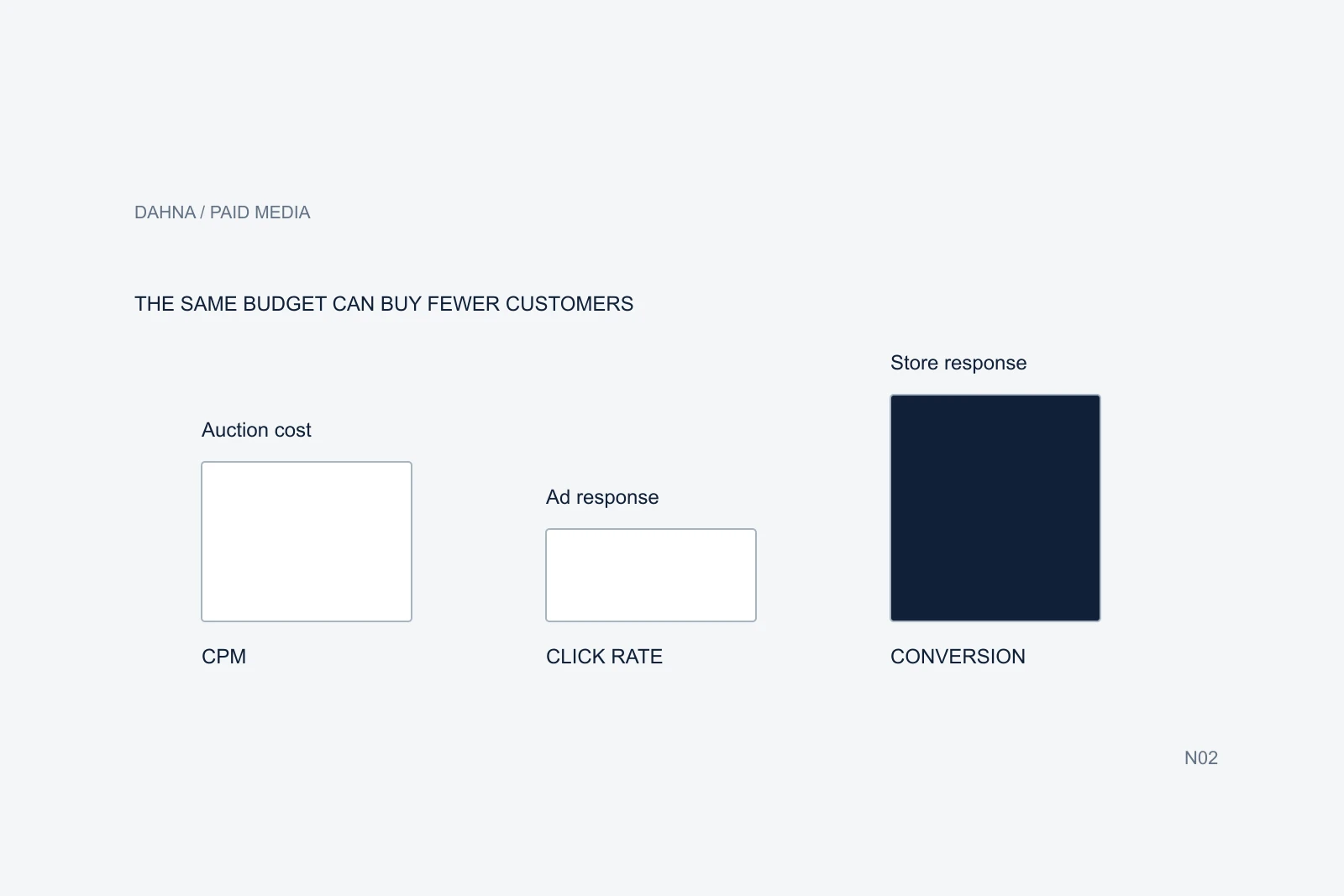
A simple planning model connects impression cost, click response and purchase conversion. At an $18 CPM, 1,000 impressions cost $18. If 1.5% produce clicks, there are 15 clicks and the cost per click is $1.20. If 3% of those clicks produce orders, modeled acquisition cost is $40.
Raise the CPM to $24 while keeping the other assumptions unchanged, and acquisition cost becomes about $53.33. If purchase conversion also falls to 2%, it becomes $80. That does not mean a platform caused the conversion decline. It shows why several modest changes can create a large commercial problem together.
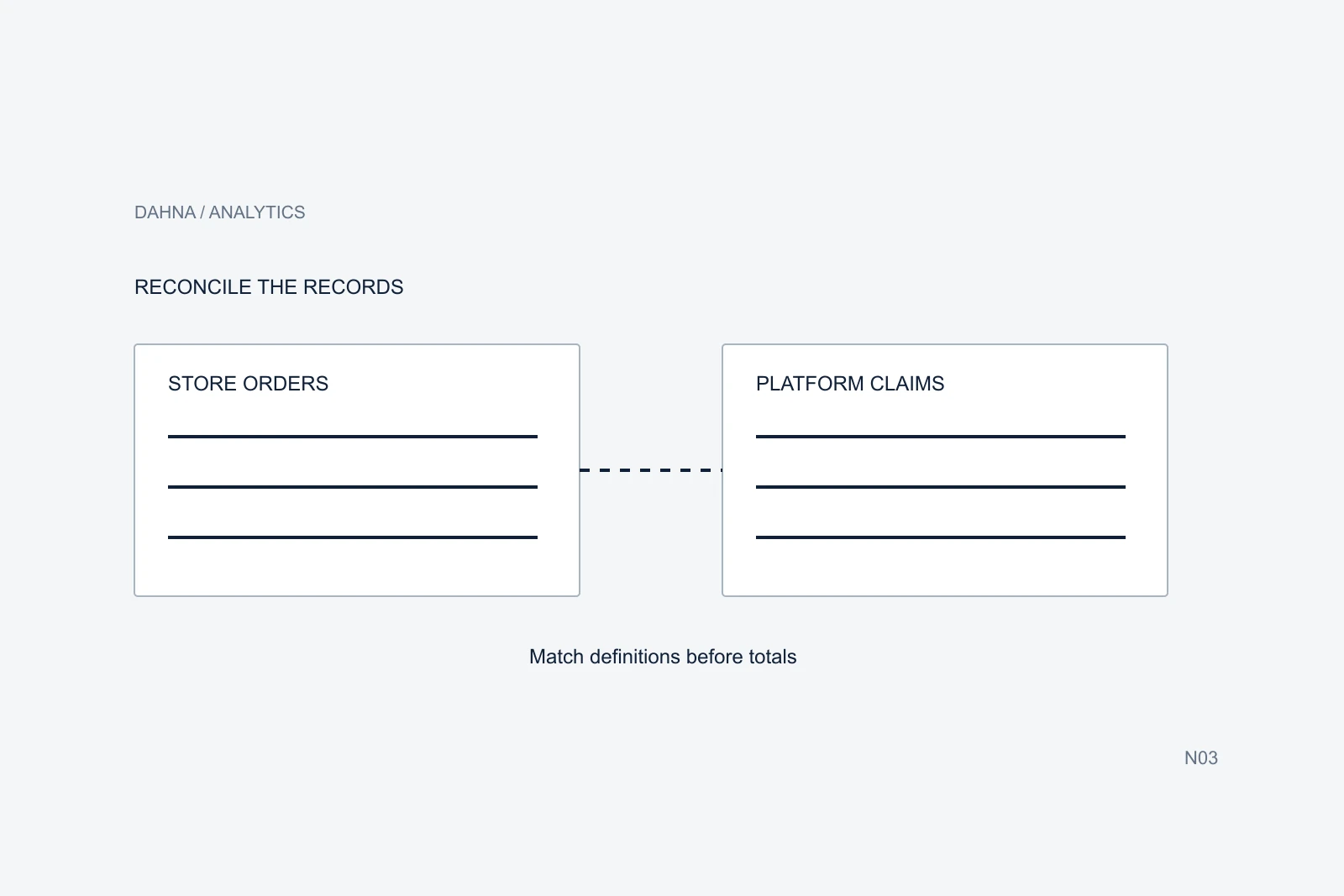
This is a fictional arithmetic model. It treats each counted click as a comparable opportunity and uses one consistent conversion definition. Real dashboards can count link clicks, landing-page views, sessions and attributed purchases differently. Reconcile the definitions before applying this relationship to an account.
| Scenario | CPM | Click-through rate | Orders per click | Modeled cost per order |
|---|---|---|---|---|
| Starting assumptions | $18 | 1.5% | 3% | $40.00 |
| Higher impression cost | $24 | 1.5% | 3% | $53.33 |
| Better click response offsets price | $24 | 2.0% | 3% | $40.00 |
| Higher price plus weaker purchase conversion | $24 | 1.5% | 2% | $80.00 |
Illustrative sensitivity
The same funnel can produce very different acquisition costs
Review what the ad promises and what the product can support
A creative can attract attention without attracting an appropriate buyer. Read the actual question it answers. Does the viewer understand the product, who it is for and why it is relevant? If the ad uses a striking demonstration, can the product page substantiate the same explanation without adding unsupported claims?
TikTok’s Queen Cosmetics case describes using customer-requested color-combination videos in paid distribution. The useful lesson is the connection between a real audience question, a visible demonstration and a shoppable product. The historical campaign’s ad formats and reported results are not a current setup recipe or a promise for another brand.
Build a test around one uncertainty. A skincare brand might compare an ingredient-led explanation with a routine-led explanation while keeping the offer and destination consistent. Choose a change because it might resolve a buying problem, not because a creative calendar needs another variation.
Inspect the promise through the whole purchase path
Ad
What question brings the right person in?
Page
Can the person verify the promise and choose a product?
Checkout
Can the person complete the purchase under clear terms?
Order
Does the completed order leave enough contribution?
Check whether the reported result changed definition
A reporting change can make performance appear better or worse without an equivalent change in the business. Inspect attribution windows, conversion events, duplicate purchase signals, refund treatment and whether a campaign report includes orders from other sources. A comparison is only useful when the definitions are sufficiently consistent.
TikTok’s current Product GMV Max documentation says its dashboard attributes promoted-product orders including organic and affiliate orders. That makes the report useful within its stated rules, but it cannot be read as a clean measure of sales caused only by paid impressions. Keep the store’s order record beside the platform view.
If an agency claims an efficiency improvement, ask whether the measurement settings or campaign type changed during the period. The answer may still be positive, but the evidence needs to explain what was compared. A larger reported return should not silently replace the question of actual contribution.
Why a reported sale is not always an additional sale
Thomas Blake, Chris Nosko and Steven Tadelis studied paid-search effectiveness using experiments at eBay. The research is a useful reminder that people who click an ad may already intend to buy. It does not establish that paid search is ineffective for every emerging brand or that a skincare business should copy eBay’s decision.
Separate attribution from incrementality in your own brief. Attribution assigns observed outcomes under a reporting rule. Incrementality asks what would have happened without the activity. A suitable experiment can help answer the second question, but a small store may not have enough traffic for a precise estimate quickly.
When a strong causal test is impractical, say so. Use consistent reports, customer research, repeatable creative comparisons and conservative budget limits to make the next decision. The honest alternative to perfect attribution is a documented limitation—not a claim that the dashboard reveals the whole customer journey.
Turn the diagnosis into a bounded test
Write one line for the observed constraint, one for the proposed change and one for the evidence that would alter the decision. For example: mobile shoppers reach the correct product but repeatedly ask which size to buy; add a clear size comparison; inspect task completion and subsequent product selection while monitoring commercial results.
Set a maximum test spend your economics can support. Include production cost and the work needed on the destination, not only the platform budget. Name the person who can stop a broken campaign, approve new claims and resolve an inventory issue.
Agree how long the test needs to run under comparable conditions, without pretending that an arbitrary number of days guarantees certainty. Avoid making daily changes in response to every fluctuation. Record major interventions so the team can understand what happened when it reviews the result.
| Observed constraint | First evidence to inspect | Possible first scope |
|---|---|---|
| Higher cost before the click | Comparable auction and delivery reports | Creative/placement review with a defined hypothesis |
| Clicks without relevant shopping behavior | Ad promise, audience response and landing task | Message and product-explanation test |
| Checkout failures or confusion | Observed task failures and support questions | Targeted website repair |
| Good dashboard return, poor cash contribution | Order costs, refunds and attribution definitions | Measurement and contribution reconciliation |
What to ask Dahna to take responsibility for
Ask for a paid-media scope that connects campaign setup, creative, the landing experience and the commercial review. A useful partner can tell you which part it will own, which part your team must supply and what result is still uncertain. More channels are not automatically the next step.
Bring the product economics, recent account changes, creative examples and a complete store-order period. Dahna can help turn those inputs into a testable brief and coordinate the appropriate creative, paid-media or website work. The standard for progress is a better-supported decision, followed by profitable growth where the evidence and operating conditions support it.
Use this guide in your next brief
Download the tables from this guide as a working reference. Keep the example assumptions separate from your own figures, and record the source and date of any numbers you replace.
Sources & further reading
Plan your next paid media decision
Share recent campaigns, your product contribution assumptions and the point where performance appears to have worsened. Include any changes to attribution, offers or landing pages.
Why consider Dahna for this work?
Dahna brings bilingual Korean and English strategy together with creator, content, and measurement work for brands growing in the US. You can review the people behind the recommendations and the kind of work we propose before starting a conversation.
Founder experience includes prior and contracted roles. Sample deliverables illustrate our approach; they are not client results or a performance promise.
External examples are research references, not Dahna client results or promised outcomes.