Which TikTok Shop creators should receive your samples?
Send samples where there is a credible match between the product, the creator’s content and the customer who can buy it. A large sales figure or follower count should start a review, not finish it. Build a cohort that can answer a defined product or selling question, cap the total cost and reserve enough stock and team time to support the creators you select.
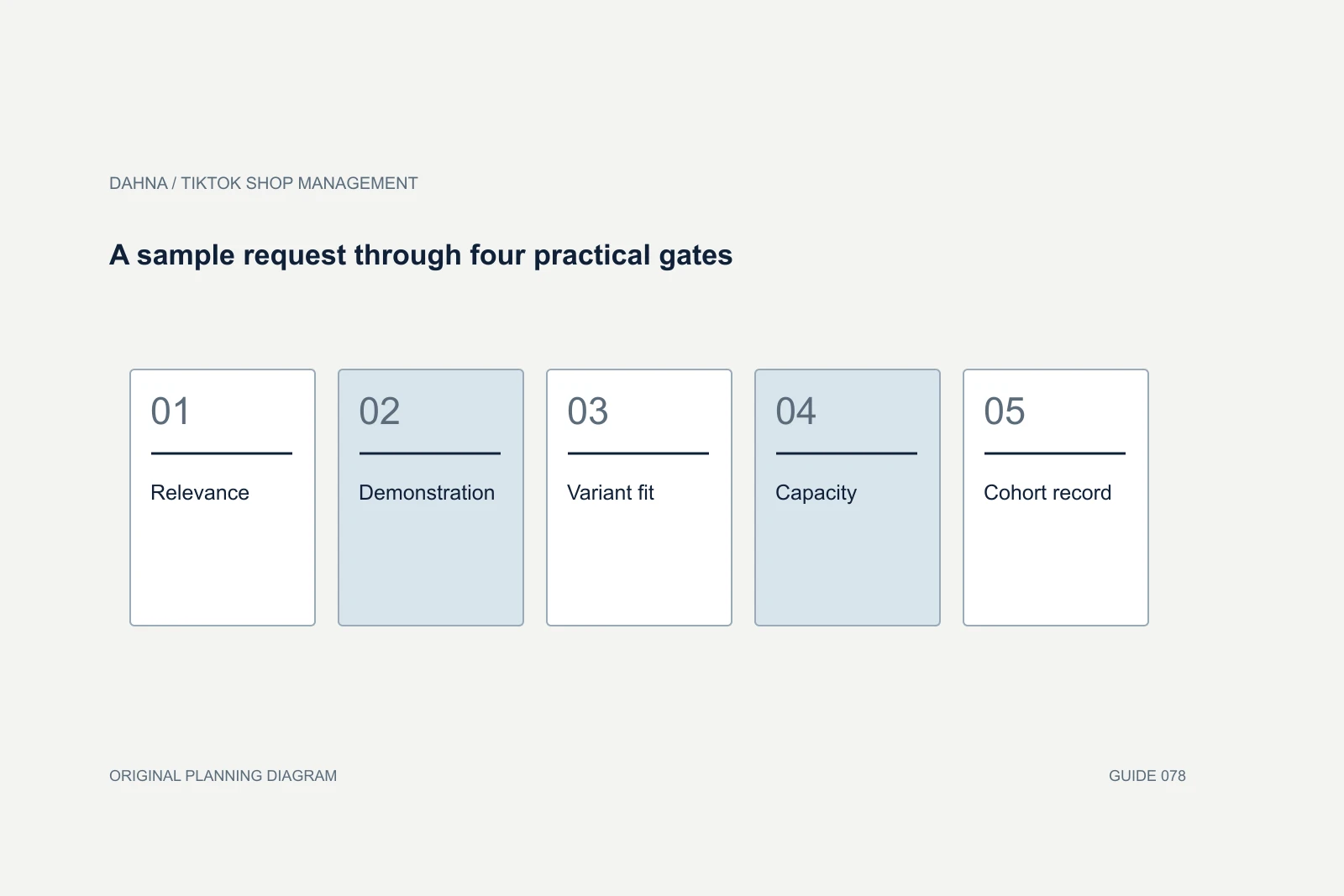
Dahna, original planning diagram
In this article
Overview
Send samples where there is a credible match between the product, the creator’s content and the customer who can buy it. A large sales figure or follower count should start a review, not finish it. Build a cohort that can answer a defined product or selling question, cap the total cost and reserve enough stock and team time to support the creators you select.
Choose the learning question before approving requests
A sample program can test whether a product is easy to demonstrate, discover creators who explain it well or support a known affiliate relationship. Those purposes require different selection criteria. A brand that wants to understand shade selection should not send all its samples to creators who use the same shade and answer the same customer question.
Write the cohort’s question in the approval sheet. For example: can creators explain a two-step cleansing routine without implying that both products are included in a single-item listing? The team can then review content quality, product fit and the linked offer together. Sending the maximum available number of samples is not a strategy if nobody knows what the cohort is meant to teach.
| Question | Creator evidence to inspect | Product choice |
|---|---|---|
| Can shoppers understand a routine? | Clear step-by-step demonstrations | The exact routine products in the brief |
| Does a texture need closer explanation? | Useful close-ups and honest sensory language | Relevant formula and packaging |
| Can a shade range be represented fairly? | Experience explaining undertone and shade limits | Appropriate available shade |
| Can an existing partner repeat useful work? | Specific prior content and fulfilled-order context | Same product or a justified adjacent item |
Look at the content behind the sales figure
TikTok Shop’s Find Creators guidance describes access to sample videos and recent sales, units, views and engagement information. Use those fields to locate evidence, then inspect what was actually being sold. A creator’s past revenue may depend on a different category, price, promotion or audience. It does not automatically predict how they will explain your product.
Review several recent relevant posts and the questions viewers ask. Note whether the creator shows the product clearly, distinguishes personal experience from broad claims and makes the buying step understandable. Check US audience and delivery relevance where the available information supports it. Do not infer a person’s location, purchasing power or suitability from appearance or accent.
Match the sample to the creator and the stock plan
A useful creator can still receive the wrong product. Confirm the variant, size, shade and any necessary accessories before approval. TikTok’s SKU-level sample guidance explains that product-level sample eligibility can apply across Open and Target collaborations. Coordinate those settings with the actual cohort so a broad sample option does not consume scarce variants intended for the launch.
Keep a separate reserve for replacements, damaged parcels and legitimate selection mistakes. Do not quietly substitute a different variant after the creator accepts the offer. Ask whether the alternative still fits the proposed content and allow the creator to decline. The cost of a respectful correction is easier to understand than the cost of an inaccurate demonstration circulating after launch.
A sample request through four practical gates
Relevance
The creator serves a useful buying question.
Demonstration
Recent content can explain this product honestly.
Variant fit
The selected SKU suits the planned content.
Capacity
Stock, cost and support are available.
Cohort record
Approval has a purpose and a review date.
A fictional forty-sample allowance
A fictional skincare brand can support 40 sample packages at a fully loaded cost of $16 each, or $640. It allocates 20 to creators who already explain cleansing routines well, 12 to a smaller discovery cohort with relevant audiences and eight to replacements or carefully reviewed follow-up requests. The split is an illustrative operating choice, not a recommended universal ratio.
Each approved creator receives the product that matches the content question, with the same accurate product facts. The brand records why the creator was selected and what it expects to learn. If the team can only review and support ten relationships a week, shipping all 40 on one day would exceed its capacity. The cohort can be staged without changing the total allowance.
| Allocation | Packages | Cost at $16 each | Purpose |
|---|---|---|---|
| Established fit | 20 | $320 | Repeatable routine explanation |
| Discovery cohort | 12 | $192 | Test adjacent creators and questions |
| Reserve | 8 | $128 | Replacements and justified follow-up |
| Total allowance | 40 | $640 | Maximum planned sample exposure |
What a cross-market beauty program can illustrate
TikTok’s Visionary Seed case describes differentiated strategies for Korean beauty brands in Malaysia, using affiliates and Shop advertising formats. The example supports looking at the brand and product situation rather than assuming one creator approach fits every business. It does not supply a US sample-response benchmark.
For a Korean brand entering the US, keep that distinction practical. A creator who can translate a familiar product category into clear local buying language may be useful even without the largest headline sales figure. At the same time, do not ask creators to invent US-specific claims or product information. The brand must provide approved facts and a purchasable US offer before judging how well the creator explains them.
How to avoid selecting only familiar-looking creators
A selection process can become narrow when reviewers equate personal taste with product fit. Define the useful evidence before reviewing profiles: the buying question, the demonstration skill and the audience or market information actually available. A creator with a different presentation style may explain the product well to a relevant customer. Do not reject them simply because the work does not resemble the brand’s existing feed.
At the same time, keep the sample’s purpose specific. A discovery cohort can intentionally explore new styles or customer situations, while another group tests repeatable product explanation. Label those purposes so the review does not penalize exploratory work for failing to match the established group. The brand is buying information as well as possible sales, and it should know which part of the allowance serves each job.
Review the approval pattern after the cohort is selected. If every creator addresses the same question or needs the same limited shade, the sample plan may have a hidden coverage problem. Adjust before shipping, while changes are still inexpensive. The resulting roster should be explainable through the product and customer decisions it covers, rather than a score that rewards follower count, visual similarity or a single past viral post.
Measure the cohort without rewriting its purpose
Track approval, shipment, receipt, content and fulfilled-order outcomes as separate stages. A delivered package is not published content, and published content is not necessarily a profitable order. Keep the sample selection rationale so the review can identify whether the problem was fit, operations, the offer or the original hypothesis. Do not label a creator unsuccessful merely because an unpromised deliverable did not appear.
Bring Dahna your available SKUs, sample allowance and the questions the cohort should answer. We can help create a selection and review process that respects both the creator relationship and the brand’s economics. The next cohort should be shaped by specific observations: which demonstrations were useful, which product choices caused confusion and which partnerships merit a different paid or commission arrangement.
Continue with the related decision
Use these guides when the next question goes beyond the scope of this article.
Use the editable decision sheet
Download the completed tables as a CSV, then replace the example inputs and add your evidence, owner and review date. Illustrative figures are teaching examples, not default targets.
Sources & further reading
Bring this decision to Dahna
Use this guide to prepare a focused brief. Tell Dahna what needs to change, which evidence you already have and when you need a decision.
Why consider Dahna for this work?
Dahna brings bilingual Korean and English strategy together with creator, content, and measurement work for brands growing in the US. You can review the people behind the recommendations and the kind of work we propose before starting a conversation.
Founder experience includes prior and contracted roles. Sample deliverables illustrate our approach; they are not client results or a performance promise.