How much affiliate commission can your TikTok Shop afford?
Set affiliate commission from the contribution an order can support, then compare that allowance with the work and opportunity you are asking a creator to take on. There is no useful universal percentage for every beauty product. Price, seller-funded discounts, fulfillment, returns, platform charges and paid support all change the room available. Model the actual commission base and current program terms before publishing an attractive rate.
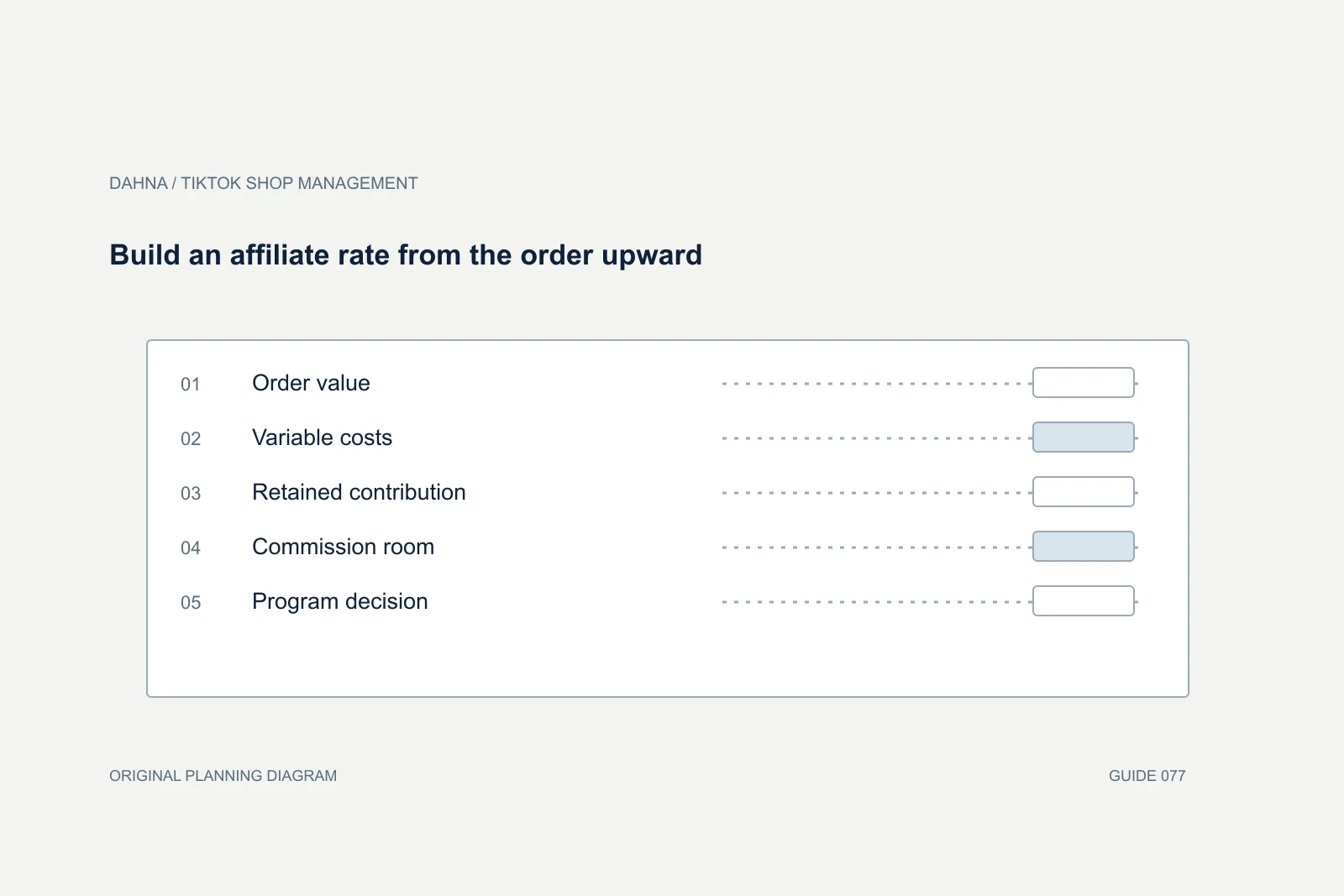
Dahna, original planning diagram
In this article
Overview
Set affiliate commission from the contribution an order can support, then compare that allowance with the work and opportunity you are asking a creator to take on. There is no useful universal percentage for every beauty product. Price, seller-funded discounts, fulfillment, returns, platform charges and paid support all change the room available. Model the actual commission base and current program terms before publishing an attractive rate.
Confirm what the percentage applies to
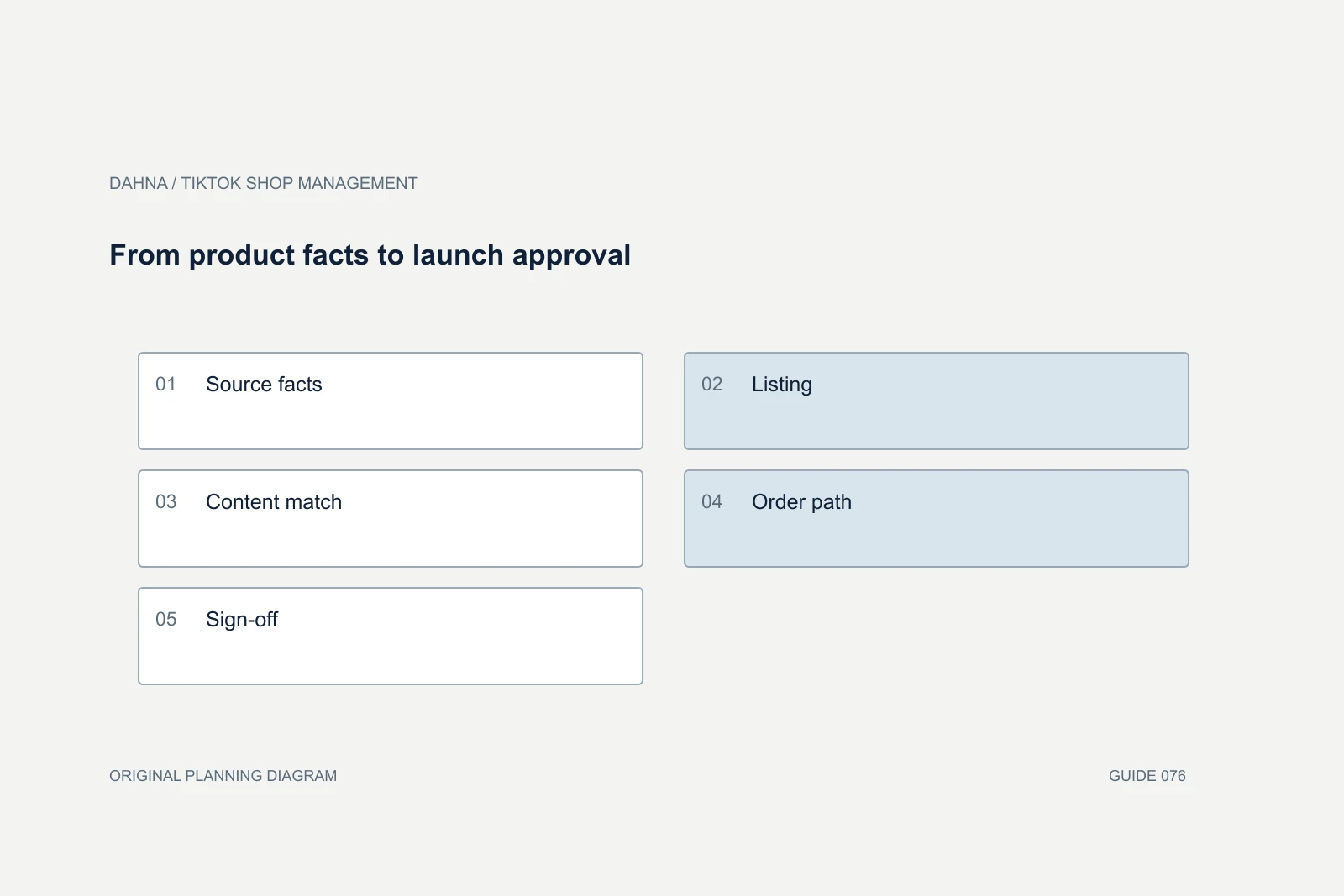
A commission percentage is incomplete without its calculation base. Check how the current collaboration treats discounts, refunds, taxes, shipping and any separate ads commission. Record the exact product, plan and effective dates. The visible headline rate should not be treated as the entire creator cost if a flat fee, sample or paid-media commitment is also involved.
TikTok Shop’s collaboration guidance distinguishes Open and Target arrangements and describes how their rates interact. Because program rules and available settings change, use the current account record for the offer you are making. Do not assume that lowering a setting instantly changes every creator’s existing terms. The budget sheet should show effective dates and any continuing obligations alongside the proposed new rate.
| Input | Use the brand’s own value | Common mistake |
|---|---|---|
| Commission base | Eligible order value under the actual plan | Applying the rate to gross headline GMV |
| Seller-funded offer | Discount and shipping subsidy | Treating every platform coupon as seller cost |
| Variable costs | Product, fulfillment and expected returns | Using gross margin alone |
| Creator support | Samples, fees and administration | Calling commission the whole program cost |
| Paid amplification | Media and applicable additional fees | Ignoring costs attached to promoted content |
Work backward from the contribution you need to retain
Start with the expected order revenue retained by the seller before commission, using the actual definition for your model. Subtract product cost, fulfillment, payment or platform charges, seller-funded shipping and an evidence-based return allowance. Then subtract the contribution the business needs to keep. What remains is the maximum commission amount under those assumptions, not necessarily the rate a creator will accept.
Divide that amount by the actual commission base to estimate a ceiling percentage. If the ceiling is too low to attract the relevant creators, the answer may be a different product, a better bundle, a separate paid deliverable or a smaller test. Raising the rate without changing the economics does not solve the mismatch; it moves the loss into every additional order.
Build an affiliate rate from the order upward
Order value
Start with the actual commission and revenue definitions.
Variable costs
Account for product, fulfillment, charges and returns.
Retained contribution
Choose the amount the business needs to keep.
Commission room
Calculate the remaining affordable creator payment.
Program decision
Compare the offer with creator needs and test costs.
A fictional $40 item at four commission rates
Assume a fictional beauty product has a $40 commission base and $20 of other variable costs, leaving $20 before creator commission. The brand wants at least $10 per order before fixed program costs. At a 15% commission, the creator payment is $6 and $14 remains. At 20%, $8 is paid and $12 remains. At 25%, $10 remains, reaching the chosen floor. At 30%, the $12 commission leaves $8, below the chosen floor.
These percentages are illustrative, not current TikTok defaults or recommended market rates. If a seller-funded discount reduces retained revenue by $4 while the applicable commission base remains $40, the room changes materially. If the base also changes, recalculate both sides. The point is to use the actual terms rather than assuming every promotion affects commission in the same way.
| Commission rate | Payment on $40 base | Remaining after $20 other costs | Against $10 floor |
|---|---|---|---|
| 15% | $6 | $14 | $4 above |
| 20% | $8 | $12 | $2 above |
| 25% | $10 | $10 | At floor |
| 30% | $12 | $8 | $2 below |
Samples make early effective commission look higher
Suppose the same fictional program sends 30 samples at a fully loaded cost of $14 each. That is $420 before any attributed order. If the cohort later generates 100 eligible fulfilled orders, the sample allocation is $4.20 per order; at 300 orders it is $1.40. Add that cost to the commission and any fixed creator fee when reviewing the program. Do not pretend an unsold sample becomes free because it was recorded in a marketing budget.
TikTok’s Magnifiscience case includes ongoing sampling and affiliate content. It does not establish a universal sample return. Your cohort needs its own cost record and observation window.
Make the creator proposition clear and credible
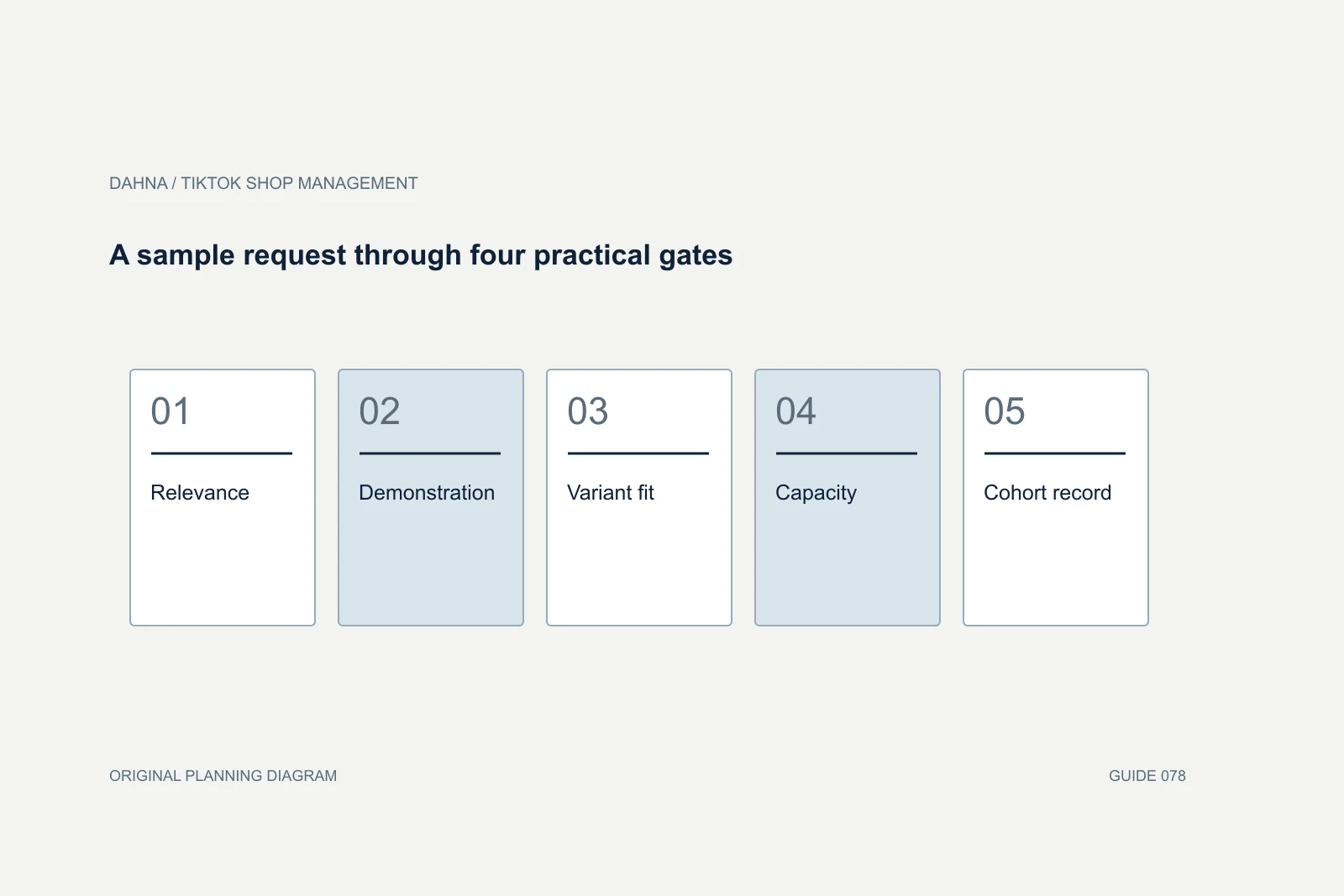
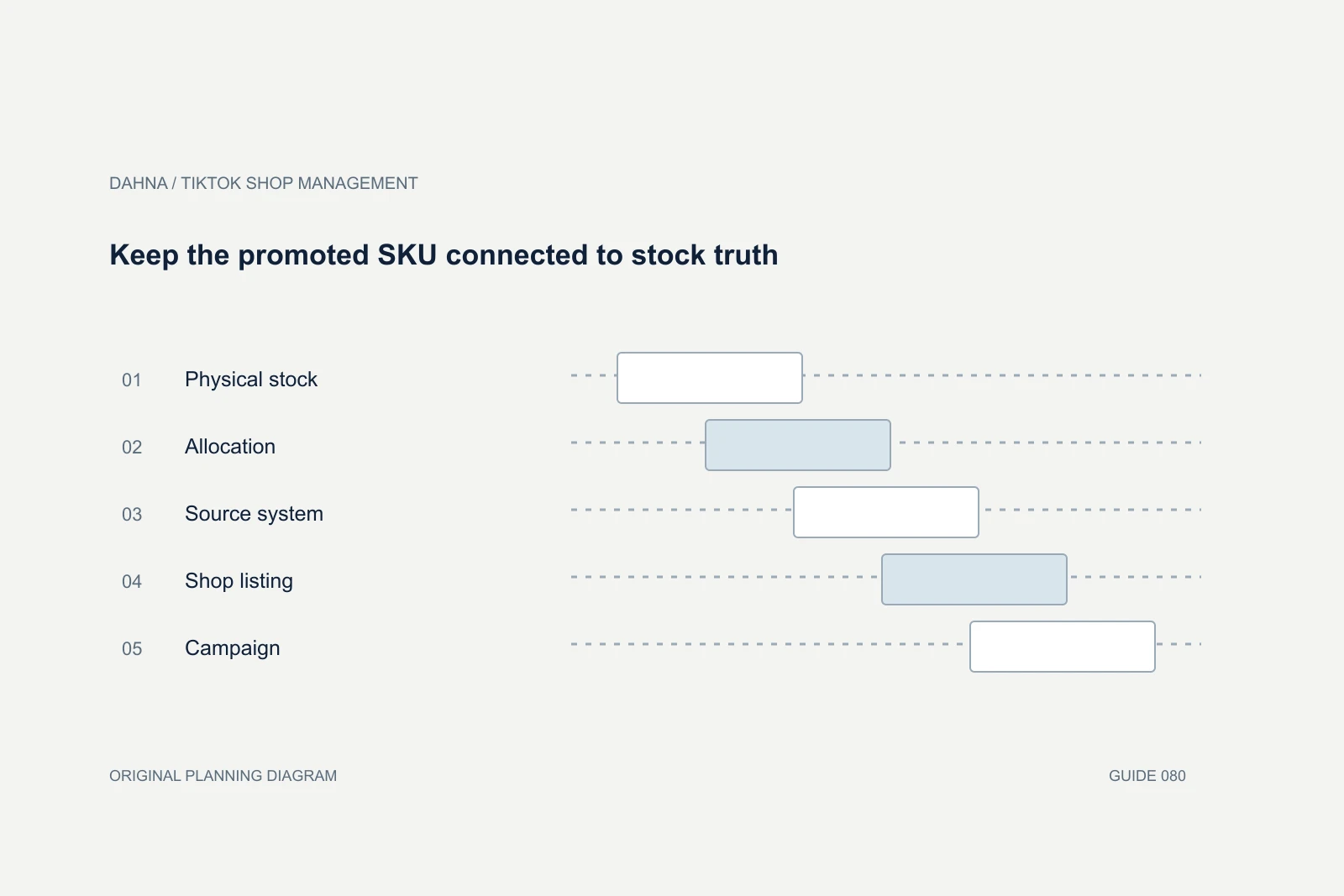
Creators evaluate more than a percentage. The product’s relevance, selling price, availability, customer response, content workload and the brand’s reliability all affect the opportunity. A high rate on an unclear listing with unstable stock may be less attractive than a lower rate on a product the creator can explain confidently. Improve those inputs before assuming the rate is the only obstacle.
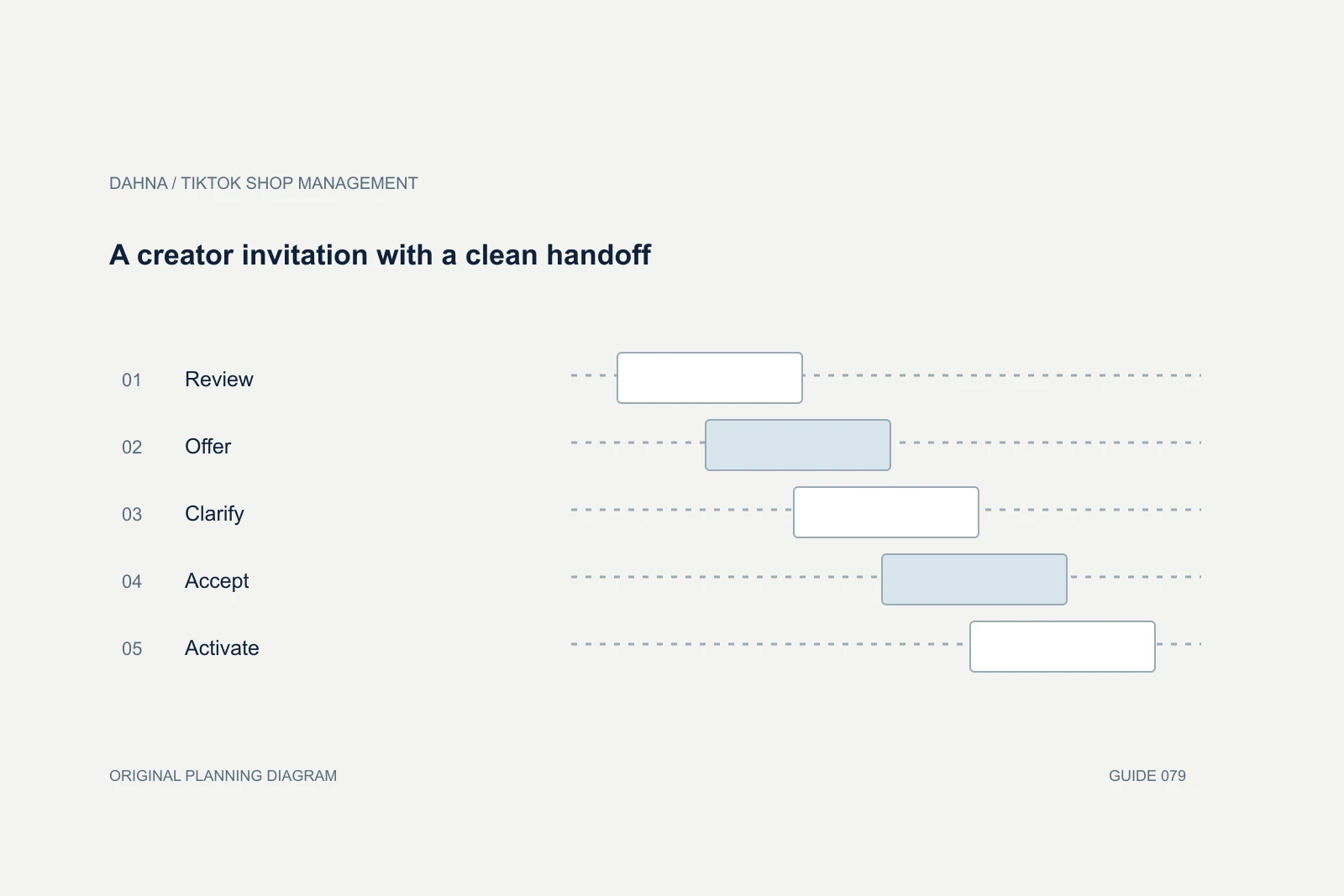
Separate a performance partnership from a guaranteed production assignment. If the brand needs a specific video by a fixed date, discuss the appropriate paid deliverable rather than relying on commission alone to imply that commitment. TikTok supports flat-fee collaboration workflows, but the exact available terms should be reviewed for the intended program. The offer should say what is guaranteed, what depends on sales and what remains optional.
What if creators do not respond to an affordable rate?
A small US ecommerce brand asked on Reddit how to find suitable affiliates, choose a commission and assess creators before sending samples. That public question is useful evidence of the buying problem, not a source for a universal rate. The replies contain claims that should not be adopted as verified benchmarks. A brand needs to diagnose its own invitation and product proposition before raising compensation.
Start by checking whether the creator can understand the offer and imagine useful content. Is the product relevant to their recent work? Does the listing explain the item clearly? Is the sample arrangement practical? If the invitation asks for substantial custom production on commission alone, the mismatch may be the commercial model rather than the percentage. A separately priced first assignment can answer a different question from an open affiliate offer, provided its cost and rights are explicit.
If the product cannot support the compensation needed for the intended partners, revise the economics or scope. A bundle might create more contribution but also more explanation and fulfillment cost. A lower-cost sample might reduce exposure but fail to represent the actual product experience. Model those tradeoffs rather than treating commission as an isolated dial. The final decision can be to test a different product or postpone the program when the offer does not yet make sense.
Review by product and cohort before expanding
Track the commission terms, sample cost, fulfilled orders, refunds and contribution for each meaningful cohort. Include the time the brand spent approving, shipping and supporting the work. Avoid changing the success definition after seeing which number looks strongest. An early cohort may be useful for learning product explanation even when its short-term economics do not justify expansion; label that purpose honestly.
Bring Dahna your products, current Shop terms and target retained contribution. We can help build a commission budget that fits the creator brief and the operating workload. The decision should identify which products can support an affiliate program, which offer needs revision and what evidence would justify the next rate or sample allocation.
Continue with the related decision
Use these guides when the next question goes beyond the scope of this article.
Use the editable decision sheet
Download the completed tables as a CSV, then replace the example inputs and add your evidence, owner and review date. Illustrative figures are teaching examples, not default targets.
Sources & further reading
Bring this decision to Dahna
Use this guide to prepare a focused brief. Tell Dahna what needs to change, which evidence you already have and when you need a decision.
Why consider Dahna for this work?
Dahna brings bilingual Korean and English strategy together with creator, content, and measurement work for brands growing in the US. You can review the people behind the recommendations and the kind of work we propose before starting a conversation.
Founder experience includes prior and contracted roles. Sample deliverables illustrate our approach; they are not client results or a performance promise.