How much stock should you reserve for a TikTok Shop campaign?
Reserve stock from a realistic demand range and the time needed to replenish, while protecting existing orders and other commitments. Do not use a hoped-for viral sales number as the only forecast. Connect the product being promoted to the inventory system, sample allocation and campaign pause decision so the team can respond when demand is either much lower or much higher than expected.
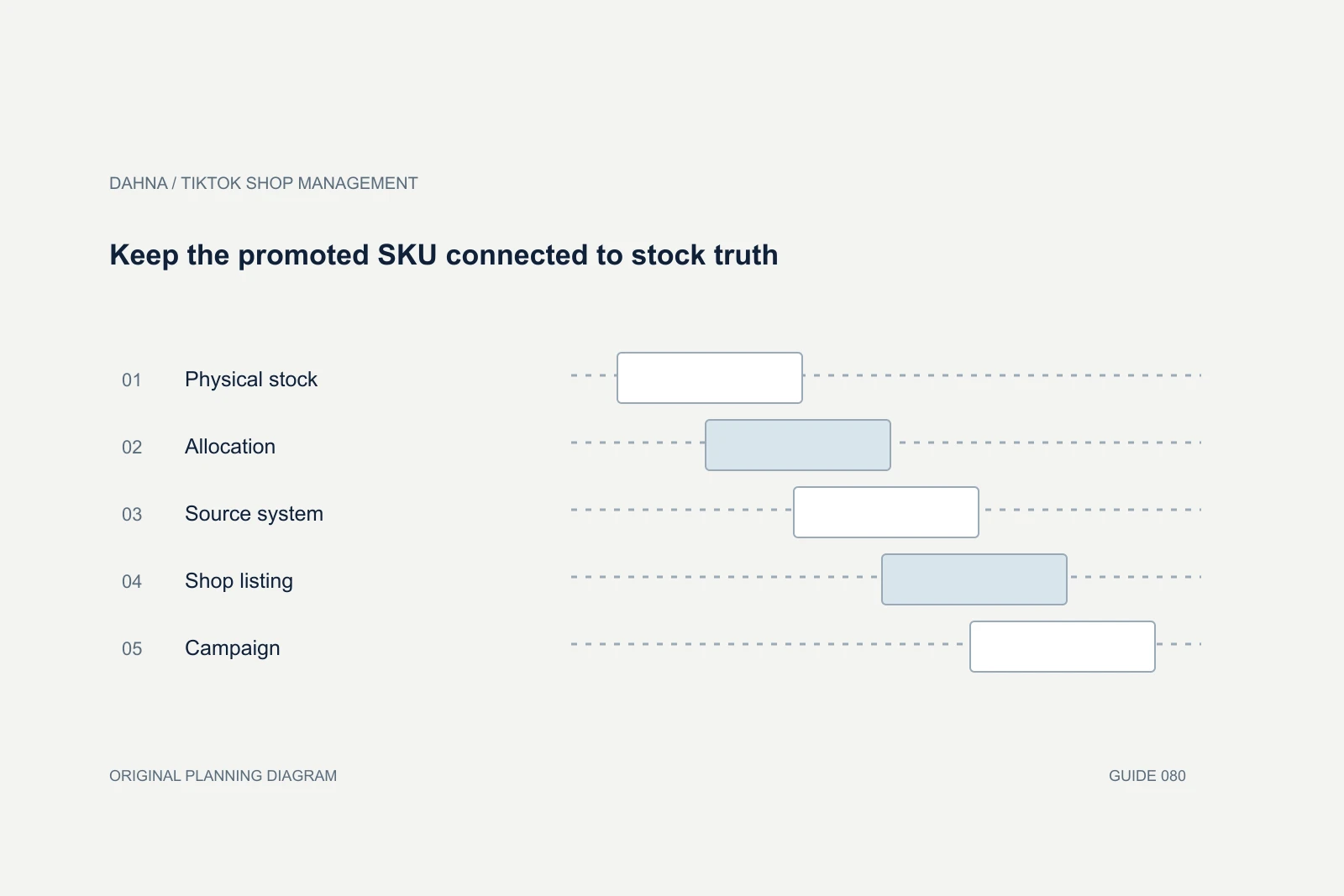
Dahna, original planning diagram
In this article
Overview
Reserve stock from a realistic demand range and the time needed to replenish, while protecting existing orders and other commitments. Do not use a hoped-for viral sales number as the only forecast. Connect the product being promoted to the inventory system, sample allocation and campaign pause decision so the team can respond when demand is either much lower or much higher than expected.
Available stock is smaller than the warehouse count
Start with units that are actually sellable in the intended US operation. Subtract committed orders, quality holds, damaged stock, samples and any quantity already reserved for another channel. For a bundle, count the components needed to fulfill the whole set. A warehouse total can look comfortable while one component limits the campaign to a much smaller number of orders.
Record the date and source of each number. If a spreadsheet is updated once a day while the store sells continuously, it is an estimate with a timing gap. The campaign team needs to know that gap rather than treating the export as a live promise. International replenishment also needs an operational estimate that includes receiving and readiness, not merely the date goods leave the origin warehouse.
| Line | Units | Meaning |
|---|---|---|
| Sellable physical stock | 900 | Confirmed usable inventory |
| Existing commitments | −180 | Orders and agreed allocations |
| Creator samples | −40 | Reserved marketing packages |
| Operating buffer | −80 | Chosen protection against uncertainty |
| Available campaign allowance | 600 | Before new demand from other channels |
Know which system controls the quantity
TikTok’s Shopify integration guidance describes inventory synchronization and a threshold setting that can provide a buffer. It also explains that when synchronization is active, changes should be made through the designated source. The practical task is to verify the actual connector and settings your store uses; a generic integration diagram does not prove the current feed is healthy.
Test a controlled stock change and inspect how it reaches the Shop listing. Confirm the mapping for each variant and bundle, then record who responds to a sync failure. Avoid correcting the displayed Shop quantity manually if the next source update will overwrite it. The marketing agency needs visibility into the issue and authority to pause promotion, while the inventory owner remains responsible for the stock truth.
Keep the promoted SKU connected to stock truth
Physical stock
Confirm sellable units and holds.
Allocation
Reserve commitments, samples and buffers.
Source system
Update the authoritative SKU quantity.
Shop listing
Verify the synchronized available offer.
Campaign
Adjust promotion before the promise becomes false.
Build low, middle and high scenarios
Use the brand’s relevant history where it exists: fulfilled orders per comparable content period, event demand, returns and the share of traffic that reached the linked item. Explain the differences between that history and the new campaign. A different creator, price or discount can change demand enough that last month’s average is an unreliable single-point forecast.
When there is little history, treat the launch as a bounded learning exercise. Choose an order allowance the operation can support, then plan how to respond if demand accelerates. Do not call the high case a prediction or use it to justify an irreversible inventory commitment without further commercial review. The table should make uncertainty visible so the brand can choose its exposure deliberately.
| Scenario | Campaign units/day | Seven-day demand | Against 600-unit allowance |
|---|---|---|---|
| Low | 25 | 175 | 425 units remain |
| Middle | 60 | 420 | 180 units remain |
| High | 100 | 700 | 100-unit shortfall before other changes |
A seasonal beauty case includes more than media
TikTok’s Magnifiscience case includes logistics and customer-operation improvements alongside campaign activity. It provides an operating example, not a stock-planning formula or a forecast for another brand.
For a smaller US launch, keep the application concrete. If a creator demonstrates a hydration bundle, inspect the limiting component before scheduling more promotion. If the campaign depends on a particular size, do not assume another size is an interchangeable substitute. The inventory plan should preserve what the customer was promised, even when an alternative product would be easier to ship.
Decide what happens before the buffer is gone
Using the fictional 600-unit allowance, the high scenario exceeds the available quantity. The team can reduce campaign exposure, stagger creator activity, choose a different approved assortment or delay the event. A pause trigger should account for reporting and operational delay: waiting until the displayed quantity reaches zero may leave no time to stop ads or update a LIVE run of show.
Assign a person who can act during US selling hours. Define the message to hosts and creators, the listing change owner and the customer-service response if an existing order is affected. Avoid making an improvised delivery promise in a comment just to preserve a sale. If a backorder or preorder option is considered, the brand must verify that the exact product and account can use it under current rules.
Bundles need a component-level stop rule
A campaign can run out of a bundle even when its parent product still appears available. Suppose each set contains one cleanser and one moisturizer, with 300 cleansers and 180 moisturizers genuinely available for the campaign. The maximum complete sets are 180 before any additional reserve. Adding the two quantities and calling the total “480 units available” would badly overstate what the promotion can deliver.
Check how the commerce system calculates bundle availability and whether the connector preserves that behavior. If the bundle is assembled manually, identify who reduces the available quantity when a component is allocated elsewhere. The campaign team needs a clear signal when the limiting component reaches its buffer. A substitute should be a newly approved offer with accurate content, not an unannounced change inside the parcel.
Include creator samples in the component calculation as well. Sending a complete set uses both items, while a single-product sample may use only one. A campaign with several bundles sharing the same moisturizer can draw on the same constrained stock from different directions. A simple component map makes that competition visible and helps the brand decide which offer to prioritize before media and creators create overlapping demand.
Turn the event into a better stock decision
After the campaign, reconcile ordered, canceled, fulfilled and returned units separately. Compare actual demand with the scenario range and identify which assumption was wrong. A missed forecast may come from content reach, conversion, price, stock availability or the timing of another channel’s promotion. Preserve that explanation instead of simply replacing the forecast with the final sales count.
Bring Dahna your campaign calendar, SKU inventory, sample plan and replenishment constraints. We can coordinate the marketing allowance, listing checks and pause rules with your operations team. This is a marketing-and-operations handoff, not a promise that Dahna will warehouse or fulfill the orders. The useful result is a campaign that can respond to demand without losing control of the purchase promise.
Continue with the related decision
Use these guides when the next question goes beyond the scope of this article.
Use the editable decision sheet
Download the completed tables as a CSV, then replace the example inputs and add your evidence, owner and review date. Illustrative figures are teaching examples, not default targets.
Sources & further reading
Bring this decision to Dahna
Use this guide to prepare a focused brief. Tell Dahna what needs to change, which evidence you already have and when you need a decision.
Why consider Dahna for this work?
Dahna brings bilingual Korean and English strategy together with creator, content, and measurement work for brands growing in the US. You can review the people behind the recommendations and the kind of work we propose before starting a conversation.
Founder experience includes prior and contracted roles. Sample deliverables illustrate our approach; they are not client results or a performance promise.