Why does TikTok Shop payout differ from reported sales?
Reported sales and a bank payout describe different stages of the transaction. Reconcile them by order and settlement period, separating unsettled orders, refunds, seller discounts, fees, shipping and adjustments. Then add the costs that sit outside the platform report, such as product cost, samples, production and agency work. A payout mismatch is a question to investigate, not immediate proof that either the platform or the marketing report is wrong.
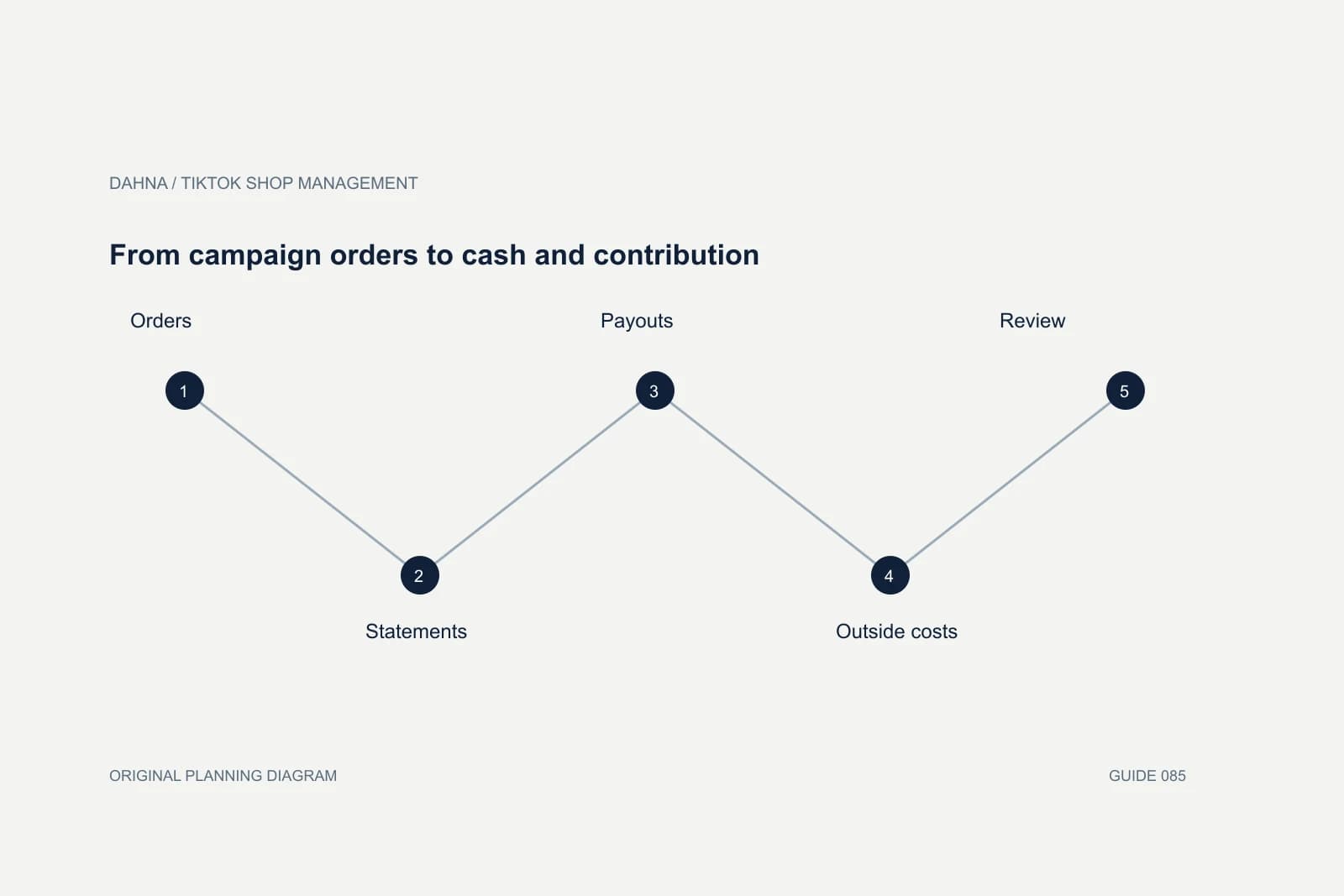
Dahna, original planning diagram
In this article
Overview
Reported sales and a bank payout describe different stages of the transaction. Reconcile them by order and settlement period, separating unsettled orders, refunds, seller discounts, fees, shipping and adjustments. Then add the costs that sit outside the platform report, such as product cost, samples, production and agency work. A payout mismatch is a question to investigate, not immediate proof that either the platform or the marketing report is wrong.
Keep three clocks visible
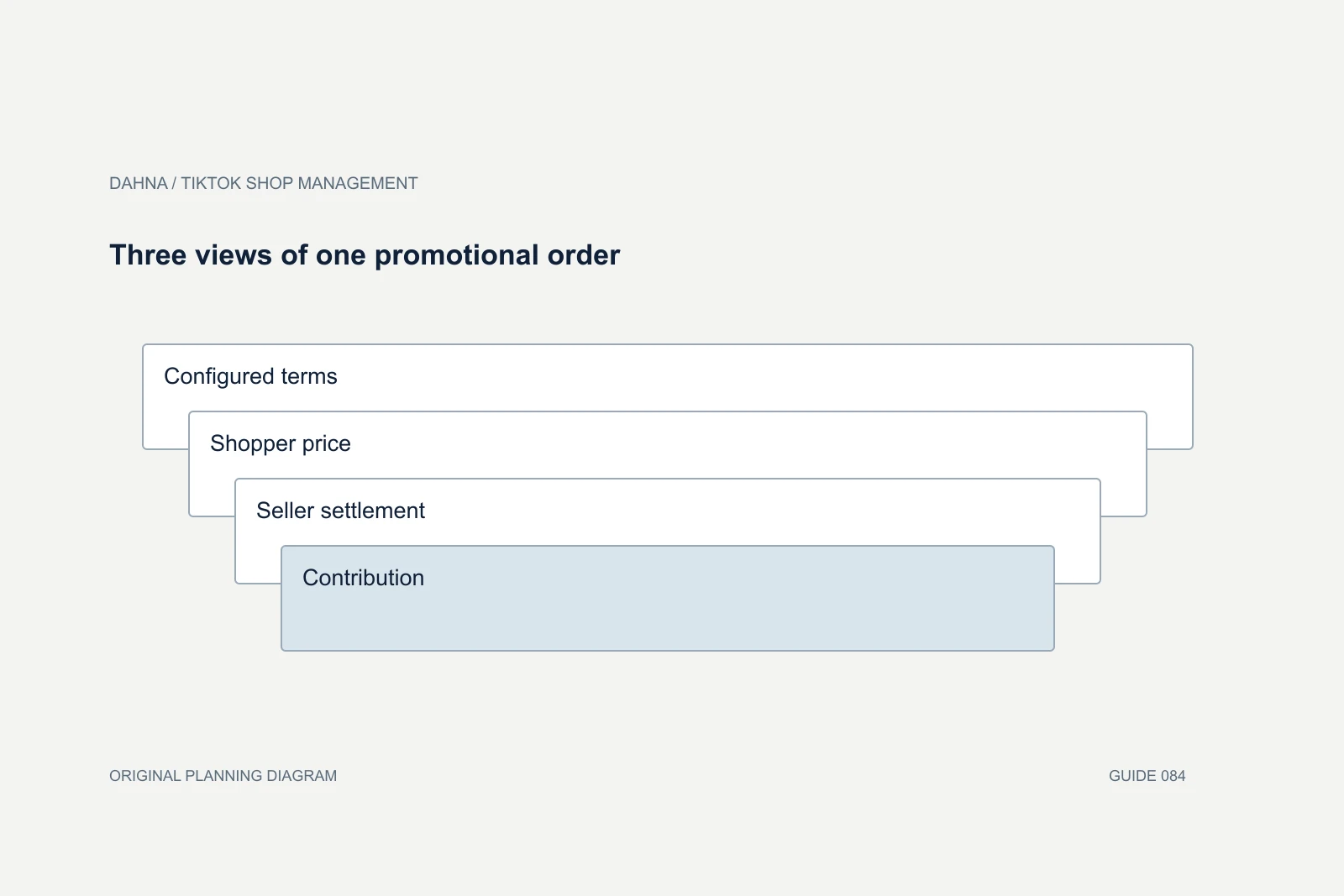
An order has a creation date, a settlement date and a payout date. A campaign dashboard can group activity by the first while a finance export uses the second and the bank reflects the third. Comparing the totals for the same calendar week without understanding those clocks can create an apparent missing-money problem.
TikTok Shop’s settlement-report guidance explicitly describes a settlement-based view and provides order, SKU, statement and payment identifiers. Use those identifiers to connect records instead of trying to make two headline totals match by hand. Preserve the time zone and export range. The person reviewing the campaign needs to know which orders are still outside the settled population.
| View | Primary question | Why the total can differ |
|---|---|---|
| Order creation | What was purchased during the campaign? | Some orders may cancel or settle later |
| Settlement statement | What became payable in this period? | Includes deductions and adjustments for eligible orders |
| Bank payout | What cash arrived? | Can aggregate statements or occur on a later date |
| Campaign contribution | What value remained after all relevant costs? | Includes costs outside the platform statement |
Build a repeatable reconciliation sheet
Import the relevant order and settlement exports without changing their original fields. Create a working table keyed by the platform’s order and SKU identifiers, with statement and payment references where available. Keep raw exports read-only and use a separate calculation layer so a reviewer can trace any number back to its source.
Classify the differences before investigating individual cases: timing, cancellation/refund, promotion funding, fee, shipping, adjustment or unresolved. An unexplained remainder should stay visible. Do not force it into a miscellaneous cost line simply to make the sheet balance. The purpose is to reveal a question that has an owner and a next action, not to produce a cosmetically perfect total.
From campaign orders to cash and contribution
Orders
Identify the campaign’s transaction population.
Statements
Match settled rows and recorded deductions.
Payouts
Connect statement/payment IDs to cash movement.
Outside costs
Add product, sample, content and operating costs.
Review
Explain differences and retain unresolved items.
A fictional bridge from $10,000 in orders
Suppose a fictional campaign records $10,000 in merchandise orders. At the review date, $1,000 is canceled or refunded and $2,000 remains unsettled. The settled gross population is therefore $7,000 in this simplified illustration. Assume $700 in seller discounts, $900 in fees and commissions, $400 in net shipping deductions and a $100 positive adjustment. The resulting settlement amount is $5,100.
That does not establish campaign profit. Product cost, samples, media and production may still sit outside the statement. It also does not mean the remaining $2,000 will all become cash; later cancellations or adjustments can change it. The bridge makes timing and deductions visible so the owner can review the right population rather than comparing $10,000 directly with a $5,100 payment.
| Line | Amount | Explanation |
|---|---|---|
| Created merchandise orders | $10,000 | Starting campaign population |
| Canceled/refunded population | −$1,000 | Removed under simplified assumptions |
| Still unsettled | −$2,000 | Timing difference at review date |
| Settled gross population | $7,000 | Basis of this example |
| Seller discounts | −$700 | Seller-funded reduction |
| Fees and commissions | −$900 | Assumed recorded charges |
| Net shipping deductions | −$400 | Assumed shipping balance |
| Adjustment | +$100 | Requires its own explanation |
| Settlement amount | $5,100 | Before outside costs and bank timing |
Topicals illustrates a different measurement boundary
TikTok’s Topicals case discusses measuring activity across Shop, Amazon and the direct store with Fospha. That is a marketing-effectiveness question. It should not be confused with reconciling a Shop settlement statement, where the first task is to explain actual transactions and deductions.
Both views can be useful, but they answer different questions. A model can estimate a broader marketing effect without changing the cash received for a particular order. A settlement report can accurately describe cash-related activity without establishing which channel caused the customer to buy. Keep those responsibilities separate so a sophisticated attribution discussion does not obscure a basic unexplained payout difference.
Leave room for the order to change
Choose a preliminary review and a later mature review that fit the product’s return pattern and the platform’s process. Label which costs are recorded and which remain estimates. A beauty device, a shade-sensitive cosmetic and a replenishment product may have different return reasons and timing. Use the brand’s evidence rather than a universal reserve percentage borrowed from another seller.
If a refund changes commission or fee treatment, verify the actual statement entry under the current rules. Do not assume every cost is reversed in the same way. Keep returned product disposition and any replacement shipping with the operations owner, then include the relevant business cost in the campaign view using the finance team’s agreed definitions.
Use unresolved items to improve the operation
Common useful investigations include an order linked to the wrong SKU, a promotion funded differently from the forecast, a shipping charge that needs clarification or a payout that covers several statements. Assign each item a responsible person, supporting record and review date. Repeated differences should lead to a process correction rather than repeated manual adjustments.
Avoid sharing customer information unnecessarily in an agency reporting deck. Order-level work may require restricted operational access, while the marketing review usually needs aggregated findings and a small number of redacted examples. The brand’s finance or accounting owner should approve the financial definitions; the agency can help explain how campaign activity and commercial offers connect to those records.
Reconcile a partial refund without losing the original order
A multi-item order can settle and later receive a partial refund. Preserve the original order identity and link the later adjustment instead of replacing the first record with an unexplained lower total. The campaign review should be able to show which item changed and whether associated shipping, fees or commission changed under the actual rules.
This matters when one bundle component causes repeated dissatisfaction. A campaign-level total may remain acceptable while the same SKU produces a pattern of adjustments. Bring that finding to the product and content owners: the problem may involve packing, quality or an unclear expectation created before purchase. The reconciliation sheet should make the pattern visible without deciding the cause prematurely. A small set of well-explained exceptions can improve the next campaign more than a perfectly formatted payout chart that hides what customers actually experienced.
Ask for a report that can be followed backward
Bring Dahna the campaign identifiers, order exports, settlement statements and the costs paid outside TikTok Shop. We can help organize the marketing review and coordinate questions with the appropriate operating owners. The deliverable should show the bridge, the unresolved items and the decisions they affect, with no claim that raw GMV or payout alone is profit.
A useful next decision might be to change a coupon, adjust an affiliate rate, repair a SKU mapping or delay expansion until the cash timing is understood. The reconciliation is successful when the owner can trace the result and act on it. It should make the next campaign easier to price and review, rather than adding another unexplained dashboard to the business.
Continue with the related decision
Use these guides when the next question goes beyond the scope of this article.
Use the editable decision sheet
Download the completed tables as a CSV, then replace the example inputs and add your evidence, owner and review date. Illustrative figures are teaching examples, not default targets.
Sources & further reading
Bring this decision to Dahna
Use this guide to prepare a focused brief. Tell Dahna what needs to change, which evidence you already have and when you need a decision.
Why consider Dahna for this work?
Dahna brings bilingual Korean and English strategy together with creator, content, and measurement work for brands growing in the US. You can review the people behind the recommendations and the kind of work we propose before starting a conversation.
Founder experience includes prior and contracted roles. Sample deliverables illustrate our approach; they are not client results or a performance promise.