Will your TikTok Shop discount still leave a profit?
Check who funds each part of a TikTok Shop promotion and how the active offers interact before approving the customer-facing price. A large discount on screen is not necessarily the seller’s entire cost, and a platform-funded incentive should not be treated as permanent margin support. Model the exact order, inspect the available promotion tools and verify the settled result after launch.
Dahna, original planning diagram
In this article
Overview
Check who funds each part of a TikTok Shop promotion and how the active offers interact before approving the customer-facing price. A large discount on screen is not necessarily the seller’s entire cost, and a platform-funded incentive should not be treated as permanent margin support. Model the exact order, inspect the available promotion tools and verify the settled result after launch.
Separate shopper savings from seller cost
List the product markdown, seller coupon, shipping discount, platform incentive and any co-funded campaign contribution as separate lines. The customer sees a final price, but the seller’s economic effect depends on the funding and current program terms. A promotion summary that combines everything into “30% off” hides the information the owner needs to approve it.
Confirm whether any campaign participation or other program charge applies to the order. Do not infer the current fee from another seller’s screenshot or an old creator video. Use the account’s actual offer and settlement definitions, saving a dated record. The model should also show what happens if a temporary subsidy ends while the seller-funded discount remains active.
| Input | Question to answer | Evidence |
|---|---|---|
| Product discount | How much does the seller give up? | Configured product offer |
| Coupon | Who funds it and who can redeem it? | Current coupon terms |
| Shipping support | What portion does the seller bear? | Shipping program and order view |
| Platform incentive | Is it temporary or conditional? | Campaign-specific notice |
| Other charges | Which fees change with participation? | Current account terms and report definitions |
Use the platform’s forecast without treating it as a guarantee
TikTok Shop’s Price Watch documentation describes tools for forecasting shopper prices, simulating promotion interactions and monitoring pricing risk. It also explains that safety monitoring does not block every type of discount. Review the actual active combination rather than assuming that setting a safety price automatically protects every order.
Keep a distinction between a configured offer, a forecasted customer price and a settled financial outcome. Each is useful at a different stage. A forecast can reveal an unexpected stacking combination before launch, while settlement shows the actual deductions and adjustments afterward. If the tool’s result differs from the brand’s model, resolve the definition or configuration gap before increasing exposure.
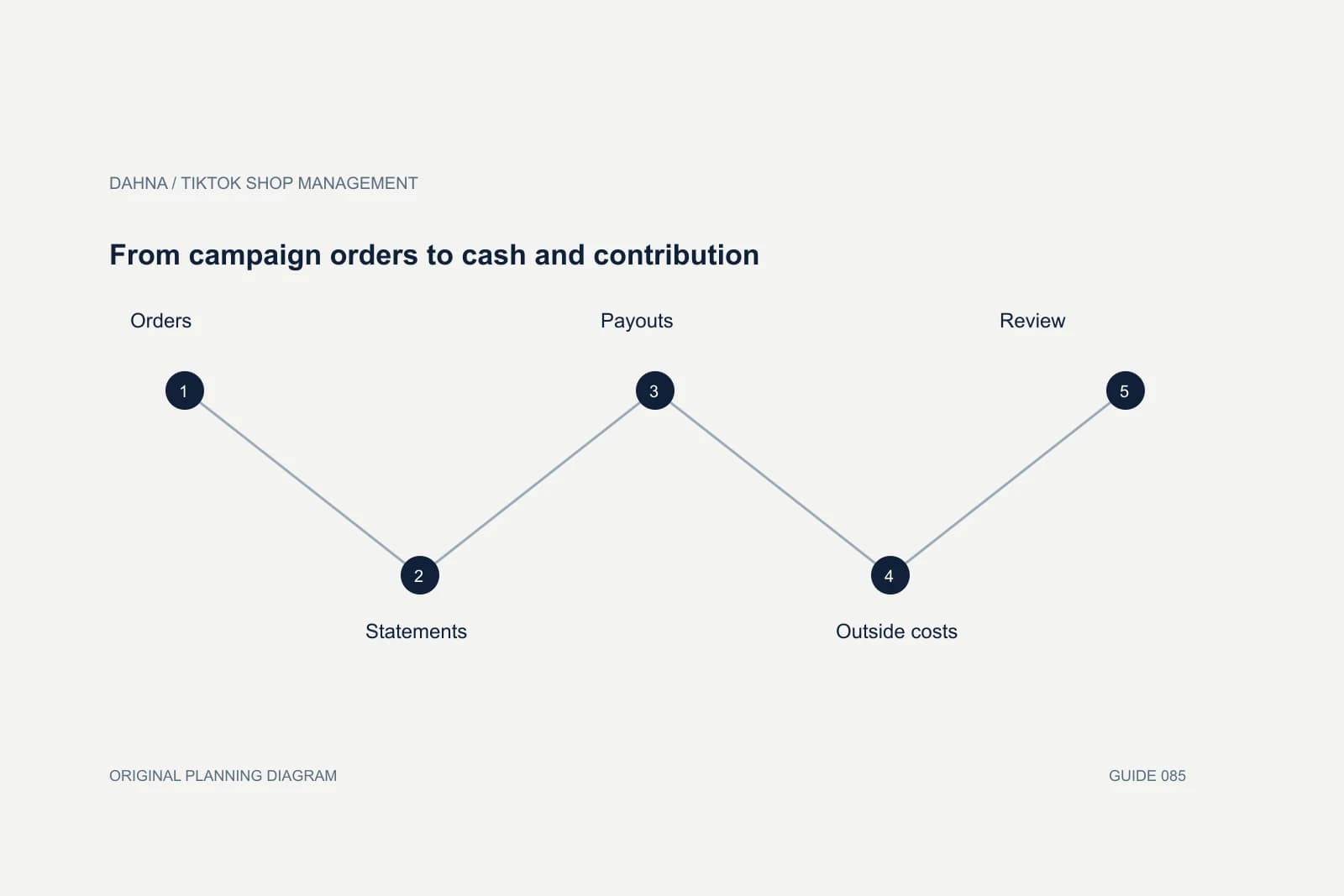
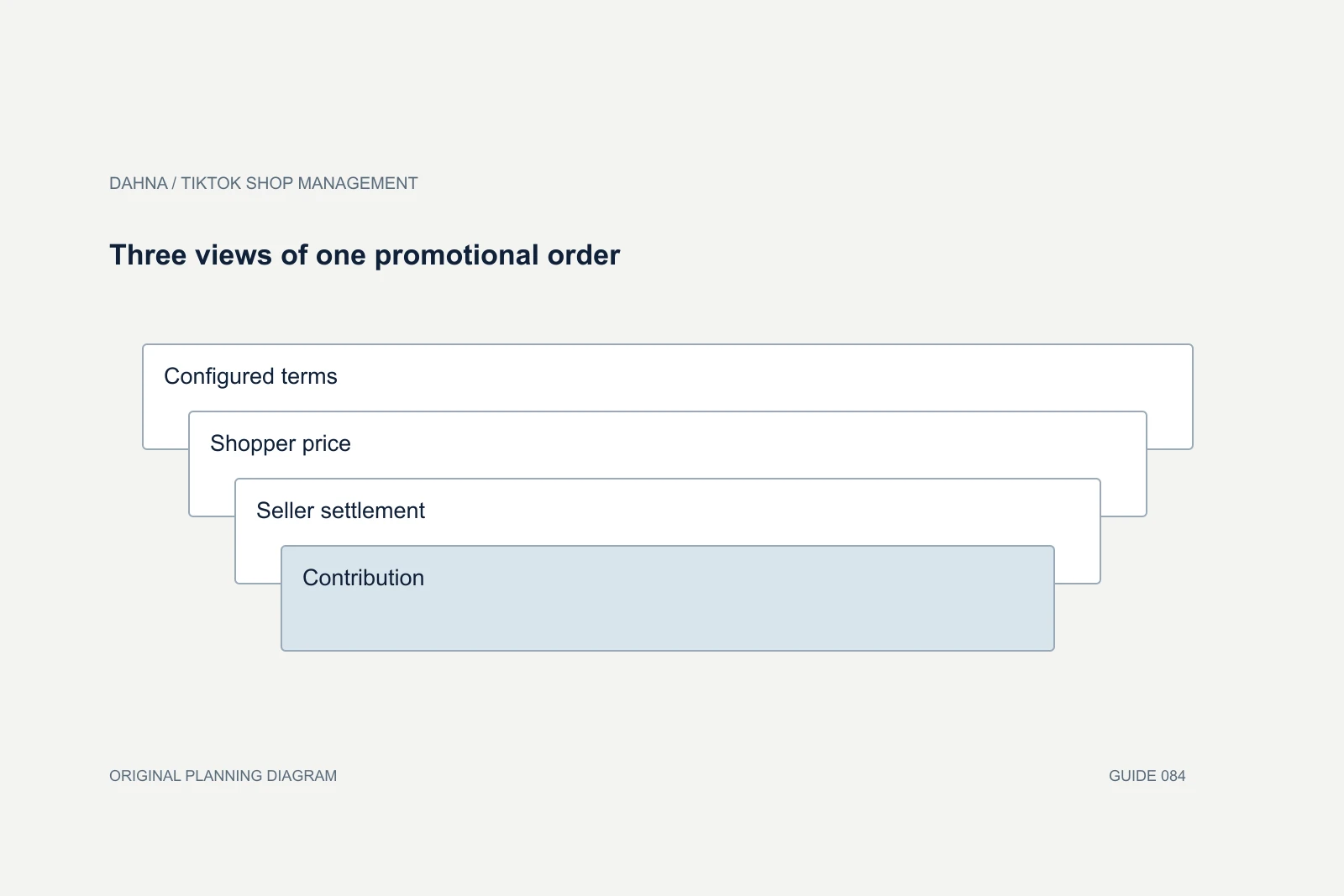
Three views of one promotional order
Configured terms
The offers and funding the brand approved.
Shopper price
The combination a particular eligible buyer sees.
Seller settlement
The recorded revenue, fees and adjustments.
Contribution
The remaining amount after product and operating costs.
A fictional $50 product with two seller-funded incentives
Assume a fictional product lists at $50. A $5 seller markdown and a further $5 seller-funded coupon reduce retained merchandise revenue to $40 under this simplified example. Product cost is $12, fulfillment and seller shipping cost $7, other order charges $3 and an expected return allowance $2. That leaves $16 before affiliate commission and advertising. Assume an applicable $8 creator payment; $8 remains before media and fixed costs.
The arithmetic is deliberately simplified and does not describe a universal TikTok calculation base. Replace every line with the actual order and program definition. If the brand had approved the promotion using the original $50 as revenue, it would overstate the room for marketing by $10 per order. At 500 orders, that mistaken assumption would create a $5,000 difference in the plan.
| Line | Amount | Running remainder |
|---|---|---|
| List price | $50 | $50 |
| Seller markdown | −$5 | $45 |
| Seller-funded coupon | −$5 | $40 |
| Product cost | −$12 | $28 |
| Fulfillment and seller shipping | −$7 | $21 |
| Other charges and return allowance | −$5 | $16 |
| Assumed creator payment | −$8 | $8 before ads and fixed costs |
A holiday campaign result does not reveal your discount economics
TikTok’s Space NK Black Friday case reports a comparison of automated and manual campaign setups. It demonstrates a retailer using a seasonal advertising window, but it does not provide the order-level margin or promotion-funding detail needed to price another brand’s offer.
That boundary matters when an agency presents a seasonal success story beside a proposed discount. Ask for the bridge from your product costs to your actual offer. A well-known retailer’s revenue or ROAS headline cannot establish that a small skincare brand can afford the same apparent price reduction, particularly when its fulfillment costs, average order value and repeat behavior differ.
Test the expensive and unusual baskets too
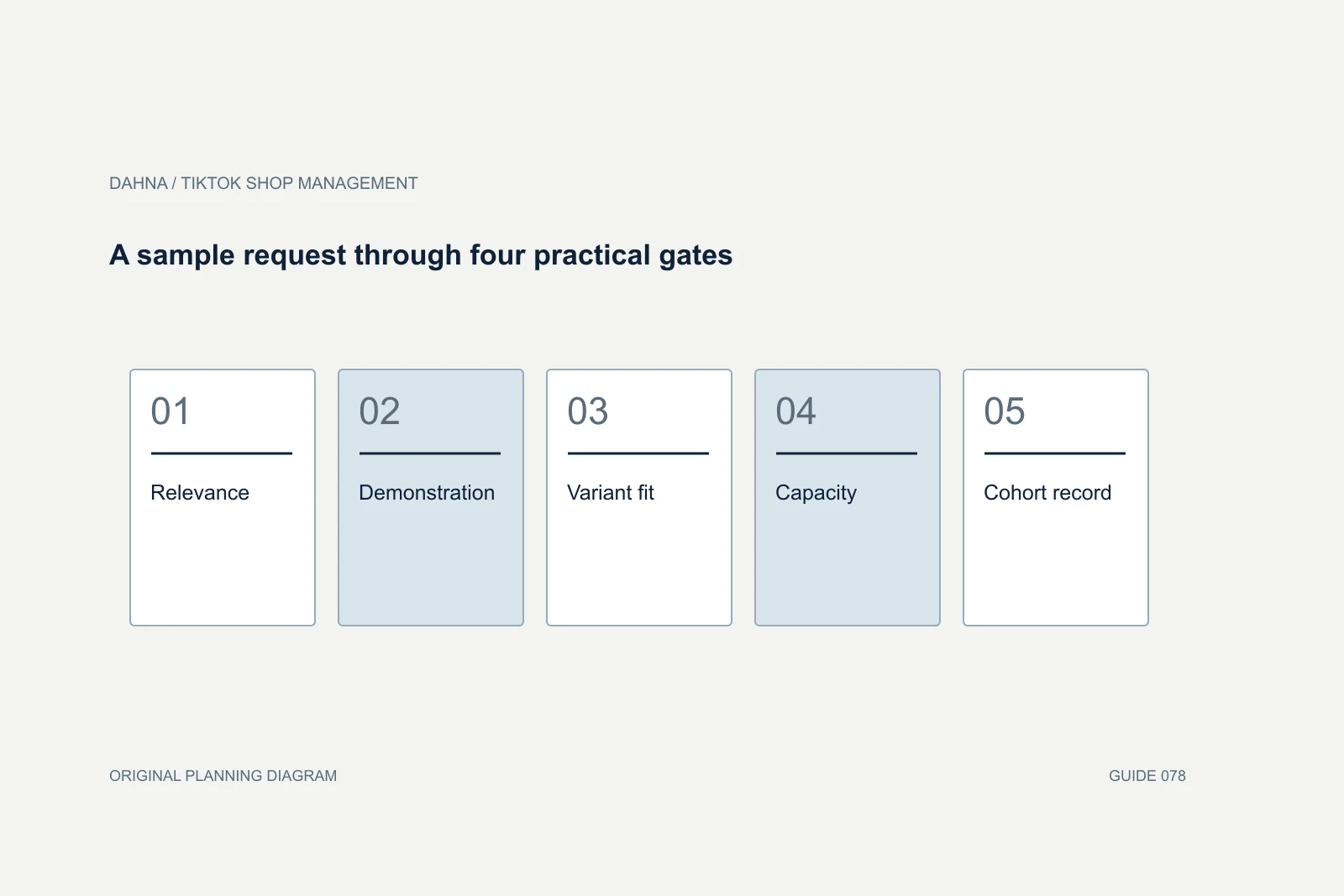
A single hero-product calculation can miss a losing variant or bundle. Review the highest-cost shade or size, the lowest-priced eligible item, a multi-item cart and any threshold near the shipping offer. Confirm what happens when a buyer uses an available coupon after the product discount. The acceptance sheet should include the combinations most likely to break the intended contribution floor.
Check gifts as real costs. A gift may require product, packing and shipping capacity even when it has no sale price in the cart. If the gift runs out, the brand needs a truthful end state and a customer-service procedure for affected orders. Do not leave an old video or LIVE script promising a benefit the operation no longer supplies.
Give every incentive an end and an owner
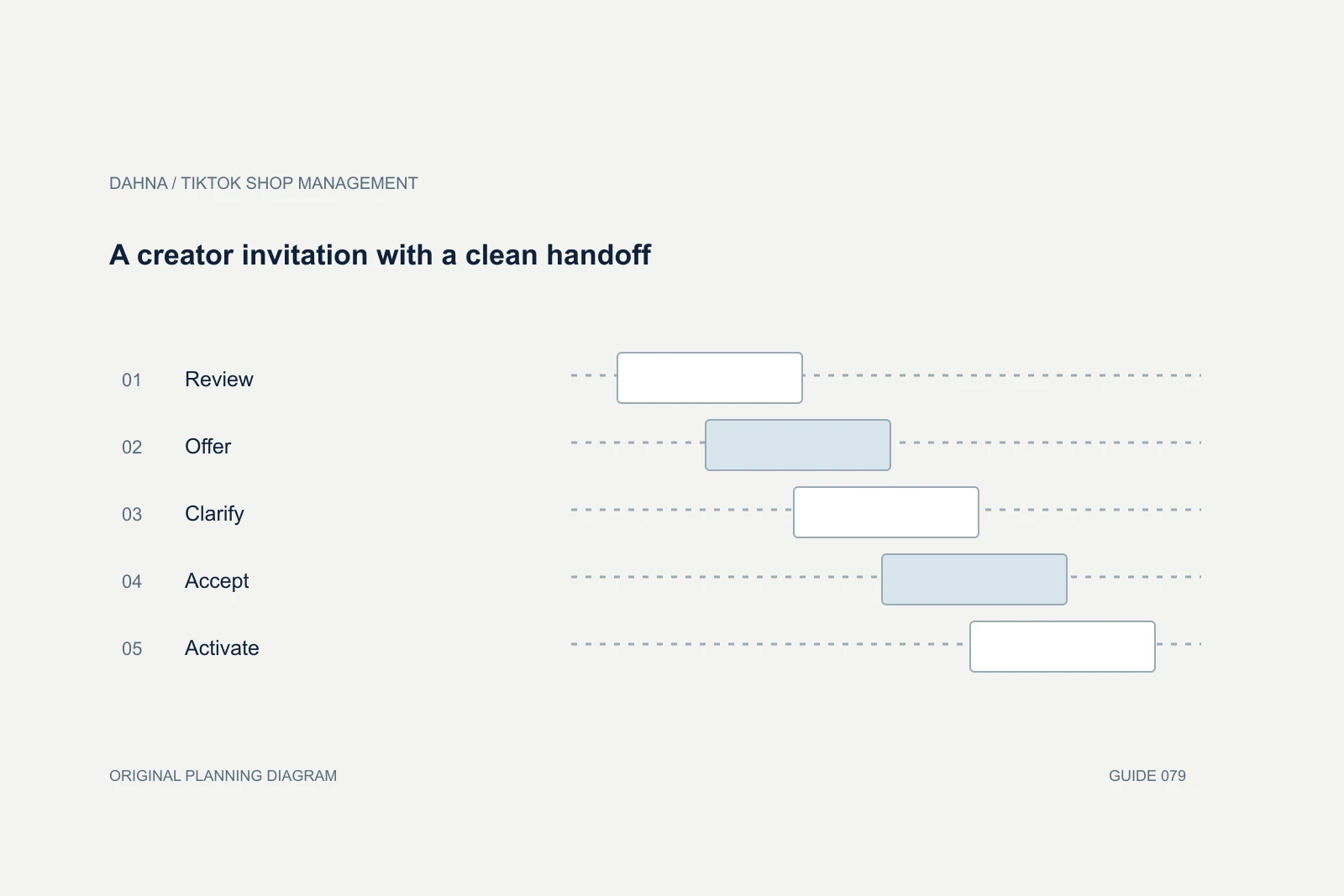
Record the start and end time, time zone and person responsible for each offer. Overlapping promotions can create a problem when one expires and another continues, especially if the creative still describes the original combination. A Korean or European headquarters should be able to see the US schedule in an unambiguous time reference and identify the on-call decision maker.
After launch, inspect real orders and compare them with the forecast. Investigate differences in eligibility, funding, fees or returns rather than assuming the model was close enough because sales increased. Keep the review at SKU and offer level where possible; a profitable average can hide a specific product that should be removed from the next promotion.
Check the offer when the subsidy disappears
Model one version of the promotion without any temporary platform support. If the product becomes unprofitable immediately, the brand needs a clear end date or a different post-campaign offer. Do not allow an automated campaign to continue spending against an economics sheet that still assumes an expired incentive. Assign the owner who will update both the model and the customer-facing message.
Also distinguish a price floor from a contribution floor. Two orders at the same final product price can leave different amounts if shipping, creator compensation or returns differ. The approval sheet should identify which floor is being protected and which costs are outside it. That makes a later exception easier to investigate: the price may have stayed within the chosen limit while another cost made the order unattractive. The next decision should address that actual cause rather than tightening the wrong setting.
What to bring to an offer review
Bring Dahna the proposed products, cost assumptions, current promotion terms and target contribution floor. We can help coordinate the customer message, listing checks and campaign decision with your finance and operations owners. The work should produce a completed offer model and launch checklist, not a generic instruction to discount more aggressively.
Approve the offer only when the brand understands the downside scenario and the operating end state. If the economics do not work, consider a different assortment, quantity, benefit or test size. A smaller promotion that the business can sustain is more informative than a large sales event whose true costs appear only when the payout arrives.
Continue with the related decision
Use these guides when the next question goes beyond the scope of this article.
Use the editable decision sheet
Download the completed tables as a CSV, then replace the example inputs and add your evidence, owner and review date. Illustrative figures are teaching examples, not default targets.
Sources & further reading
Bring this decision to Dahna
Use this guide to prepare a focused brief. Tell Dahna what needs to change, which evidence you already have and when you need a decision.
Why consider Dahna for this work?
Dahna brings bilingual Korean and English strategy together with creator, content, and measurement work for brands growing in the US. You can review the people behind the recommendations and the kind of work we propose before starting a conversation.
Founder experience includes prior and contracted roles. Sample deliverables illustrate our approach; they are not client results or a performance promise.