What should your brand give journalists and reviewers for AI-search visibility?
Give independent writers something they can verify and use: clear product facts, a meaningful story, access to appropriate people or products, and the evidence behind consequential claims. Coverage can broaden the public information available about a brand, but paying for mentions or repeating a press release does not guarantee AI citations.
Dahna, original planning diagram
In this article
Overview
Give independent writers something they can verify and use: clear product facts, a meaningful story, access to appropriate people or products, and the evidence behind consequential claims. Coverage can broaden the public information available about a brand, but paying for mentions or repeating a press release does not guarantee AI citations.
Why third-party evidence deserves attention
Mahe Chen, Xiaoxuan Wang, Kaiwen Chen, and Nick Koudas studied differences between AI search and conventional search in a 2025 preprint. Their experiments found substantial use of earned-media sources and differences across systems, languages, and phrasing. That is a reason to inspect the sources appearing around your category, not proof that a particular publication will produce a predictable ranking benefit.
The study’s scope and tested systems matter. A current brand program should verify its own observed answers and customer sources rather than turn a research finding into a universal media-buying rule. The useful question is what independent evidence is missing from the public conversation about the product.
Give the writer a reason to care beyond a launch date
A product launch can be newsworthy, but “another serum exists” may not help a writer serve their audience. Explain the customer problem, the meaningful product distinction, and the evidence that allows the writer to evaluate it. A founder’s specific design decision or an original test can be more useful than a list of promotional adjectives.
Be clear about what the brand can and cannot support. If there is no comparative trial, do not imply measured superiority over named competitors. If a founder has manufacturing experience, describe the actual role and dates rather than inflating the credential. A strong evidence pack makes limitations easier to understand as well as strengths.
Build the pack around verifiable questions
Organize the material so a journalist or reviewer can find the exact product identity, US availability, approved images, source documents, and a person who can answer follow-up questions. Keep a separate section for the brand’s interpretation. This prevents opinion from being mistaken for a measured fact.
For beauty devices or skincare claims, route substantive scientific or regulatory questions to the appropriate qualified owner. The marketing agency can coordinate the evidence but should not imply an independent clinical review simply because the pack has polished charts.
| Component | What it should contain | What to avoid |
|---|---|---|
| Product facts | Exact model, market, quantity and current offer source | A generic family name that hides variants |
| Claim support | Specific evidence with methods and limitations | A percentage without a denominator or test context |
| Original story | A documented decision, process or customer problem | Unverifiable “first” or “best” language |
| Review access | Clear product access and contact route | A requirement for positive coverage |
| Assets | Accurate images with usage information | Old packaging or unclear rights |
| Relationships | Transparent sponsorship or gifting context | Paid placement presented as independent reporting |
Respect the difference between coverage and advertising
The FTC’s endorsement and review guidance discusses honest representation and disclosure of material relationships. For this planning task, the practical rule is to make sponsorship, payment, or gifted access clear and avoid manufacturing the appearance of independent praise. Specific compliance questions should go to the brand’s appropriate adviser.
A reviewer may reach a mixed or negative conclusion. That possibility is part of independent evaluation. An agency should not promise a fixed number of favorable “earned” articles while controlling the conclusion behind the scenes. Define the work as research, preparation, outreach where authorized, and accurate follow-up; define paid placements separately.
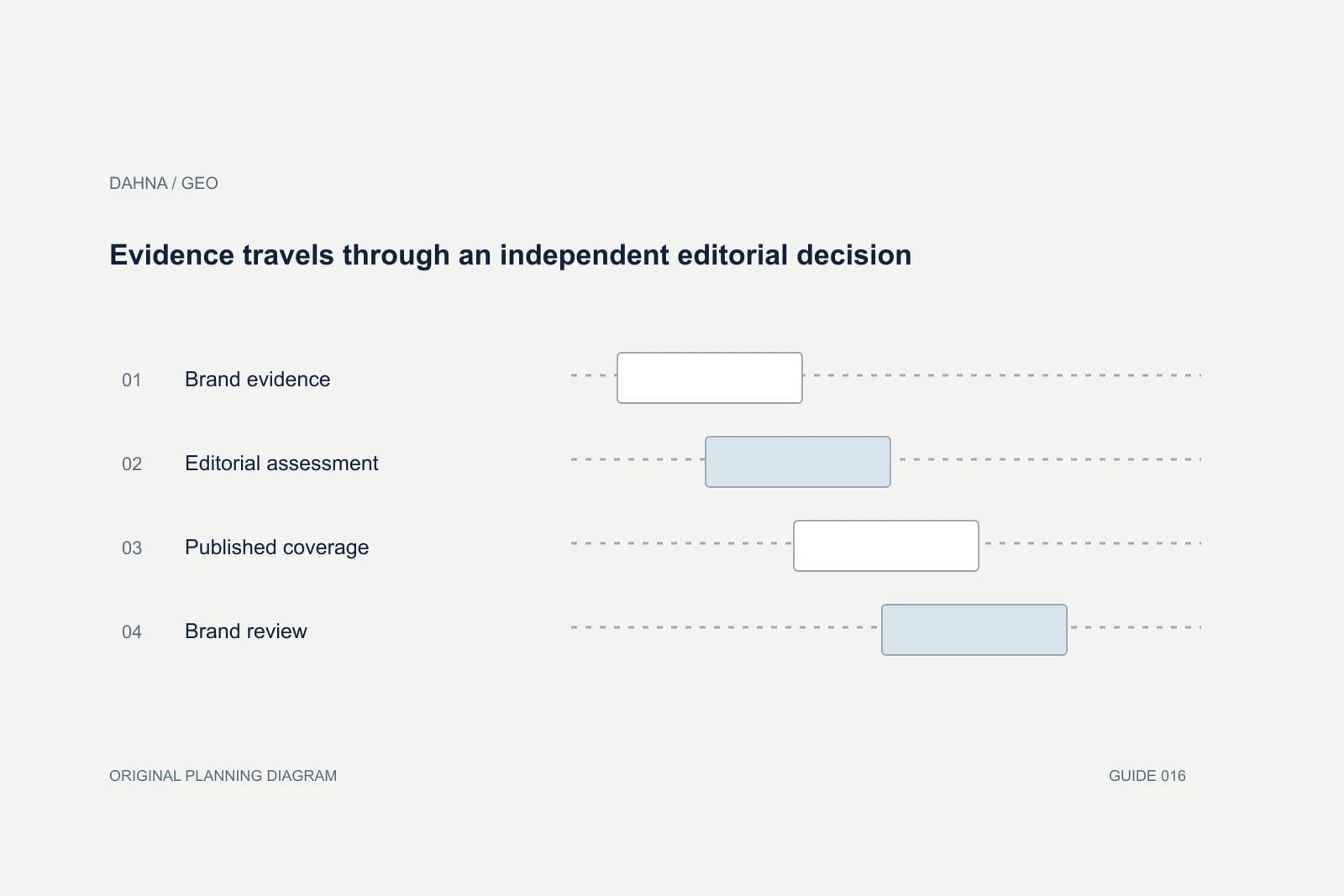
Evidence travels through an independent editorial decision
Brand evidence
Verified facts, methods and access.
Editorial assessment
The publisher chooses what is relevant.
Published coverage
The actual claims and sources are visible.
Brand review
Check factual accuracy without demanding praise.
Illustrative pitch for a refillable product
Imagine a skincare brand with a refill system. Instead of claiming it is “the most sustainable choice,” the evidence pack shows the package components, compatible refills, measured material quantities under a stated method, and limitations of the comparison. The founder explains why the refill mechanism changed after early user testing, supported by dated design records.
A writer can now investigate a concrete question: what does the refill change for the customer, and what does the evidence actually support? The brand provides a sample without requiring a positive verdict and discloses the arrangement. The example is fictional and does not establish an environmental claim for any real product.
After publication, the team checks whether the story identifies the right product and market. If an error appears, it sends a narrow correction with evidence. If the review is accurate but unfavorable, the team records the feedback rather than trying to recast it as a factual error.
Evaluate coverage by substance and relevance
Count whether the piece reaches a relevant audience, accurately describes the item, adds independent analysis, and gives readers useful evidence. A large number of low-substance mentions can be less valuable than one careful review. Also separate referral activity, observed citations, and commercial outcomes; they are not interchangeable.
Keep the coverage source in the AI observation record if it is later cited. A citation is an observation about that answer, not proof that the media program caused a sale. This distinction lets the brand learn from the work without overstating what the data can show.
| Question | Why it matters |
|---|---|
| Does the audience overlap with our buyers? | Relevance matters more than a raw mention count |
| Are product and market facts correct? | Coverage should reduce confusion |
| Is there original assessment? | Independent value is different from copied promotional text |
| Are relationships clear? | Readers need to understand the source context |
| Can we observe useful customer activity? | Connect exposure to business learning without inventing attribution |
Prepare for a reviewer to ask the uncomfortable question
A useful evidence pack anticipates reasonable criticism. Why does the product cost more? What did the study not measure? Which customer should choose another option? What changed between the current and previous model? A brand that can answer these questions precisely gives a writer more useful material than one that supplies only positive talking points.
Create a short unresolved-questions list before outreach. Some questions may need a product owner’s response, a new demonstration, or specialist interpretation. If the answer is unknown, say so. Do not place a confident placeholder in a media fact sheet with the intention of checking it later; that document may be copied quickly into public coverage.
Also prepare a correction process. Name the person who can verify a factual error, provide the supporting document, and approve a concise request. The request should identify the specific statement and the correct fact. It should not bundle a legitimate correction with a demand to improve the review’s opinion of the product.
This preparation has value even if a publisher declines the story. The same verified answers can improve retailer briefs, creator onboarding, and product pages. Evaluate the project partly by that reusable evidence quality rather than treating every hour as wasted unless it produces an immediate mention. Distribution matters, but the brand first needs information worth distributing.
Ask Dahna for evidence preparation before a mention quota
Dahna can help organize product facts, identify the story worth testing, and prepare a reviewer-friendly brief connected to your broader content program. Bring the strongest original evidence and the questions you cannot yet answer. The proposal should distinguish preparation, approved outreach, creator partnerships, and paid media.
If the evidence is weak, the next step may be better product documentation or original research. Buying more distribution for an unsupported claim does not make it more credible.
Continue with the related decision
Use these guides when the next question goes beyond the scope of this article.
Use the editable decision sheet
Download the completed tables as a CSV, then replace the example inputs and add your evidence, owner and review date. Illustrative figures are teaching examples, not default targets.
Sources & further reading
Bring this decision to Dahna
Use this guide to prepare a focused brief. Tell Dahna what needs to change, which evidence you already have and when you need a decision.
Why consider Dahna for this work?
Dahna brings bilingual Korean and English strategy together with creator, content, and measurement work for brands growing in the US. You can review the people behind the recommendations and the kind of work we propose before starting a conversation.
Founder experience includes prior and contracted roles. Sample deliverables illustrate our approach; they are not client results or a performance promise.