What product facts should an AI shopping answer be able to verify?
Publish the facts a buyer would need to distinguish the exact item and decide whether to investigate it further: product name, model or variant, market, quantity, compatibility, usage boundaries, and the source of important claims. Put those facts on a useful product page rather than creating a separate page for every possible AI prompt.
Dahna, original planning diagram
In this article
Overview
Publish the facts a buyer would need to distinguish the exact item and decide whether to investigate it further: product name, model or variant, market, quantity, compatibility, usage boundaries, and the source of important claims. Put those facts on a useful product page rather than creating a separate page for every possible AI prompt.
Begin with the confusion a buyer could reasonably have
A beauty device can be confused with an earlier model. A serum may have different bottle sizes or regional versions. A refill can fit one package and not another. These are concrete information problems, and they are more useful starting points than asking an agency to “make the page AI-friendly.”
List the distinctions that would change the purchase. If the brand cannot verify a detail internally, the page should not state it confidently. Product teams, support staff, and the relevant claims owner should resolve the underlying fact before the content team turns it into an answer. Clear formatting cannot repair uncertain evidence.
CurrentBody makes model distinctions a visible product task
CurrentBody’s US LED mask page identifies a Series 2 model and publishes product specifications, including its stated LED count. The useful lesson is the presence of a named version and item-specific details. Those distinctions help a reader avoid treating every mask sold by the brand as the same device.
This is an observation of a manufacturer’s product page, not an independent evaluation of effectiveness or a recommendation to buy the device. A brand applying the lesson should decide which specifications matter to its own customers and verify them through the appropriate internal source. More specifications are not automatically more useful; the page needs to explain the decision each one supports.
Separate identity, offer, instructions, and evidence
Identity facts describe what the item is. Offer facts describe the current purchase conditions. Instructions describe its intended use. Evidence supports claims made about performance or suitability. Mixing these categories can lead to a promotional sentence being repeated as if it were a tested specification.
Keep a source and owner for consequential statements. A pack quantity might come from the approved catalog. A compatibility statement might come from product engineering. A performance claim might require a specific study with conditions and limitations. An agency can organize these inputs, but should not invent the missing substantiation.
| Fact group | Example field | Source owner | Public treatment |
|---|---|---|---|
| Identity | Model, variant, quantity, market | Catalog team | Plain language beside the product |
| Offer | Current price and availability | Commerce system | Live purchase information |
| Use | Setup, routine, compatibility | Product and support team | Accessible instructions with boundaries |
| Evidence | What a test actually measured | Approved research or claims owner | Specific claim with linked support |
| Change history | Version or packaging transition | Product owner | Explanation where confusion is likely |
Make the answer usable without flattening the product story
A concise fact panel can sit beside the richer story, imagery, and demonstrations. Use meaningful headings, short explanations, and tables where comparison helps. Keep essential details in accessible text; a specification hidden only inside an image or video is harder for many people to verify.
Google’s current generative-AI optimization guidance emphasizes useful content and foundational search practices. It does not turn a special “AI fact page” into a requirement. Our recommendation is to improve the real product destination so it serves buyers well and can be understood accurately, rather than publishing an isolated page whose only purpose is to repeat keywords.
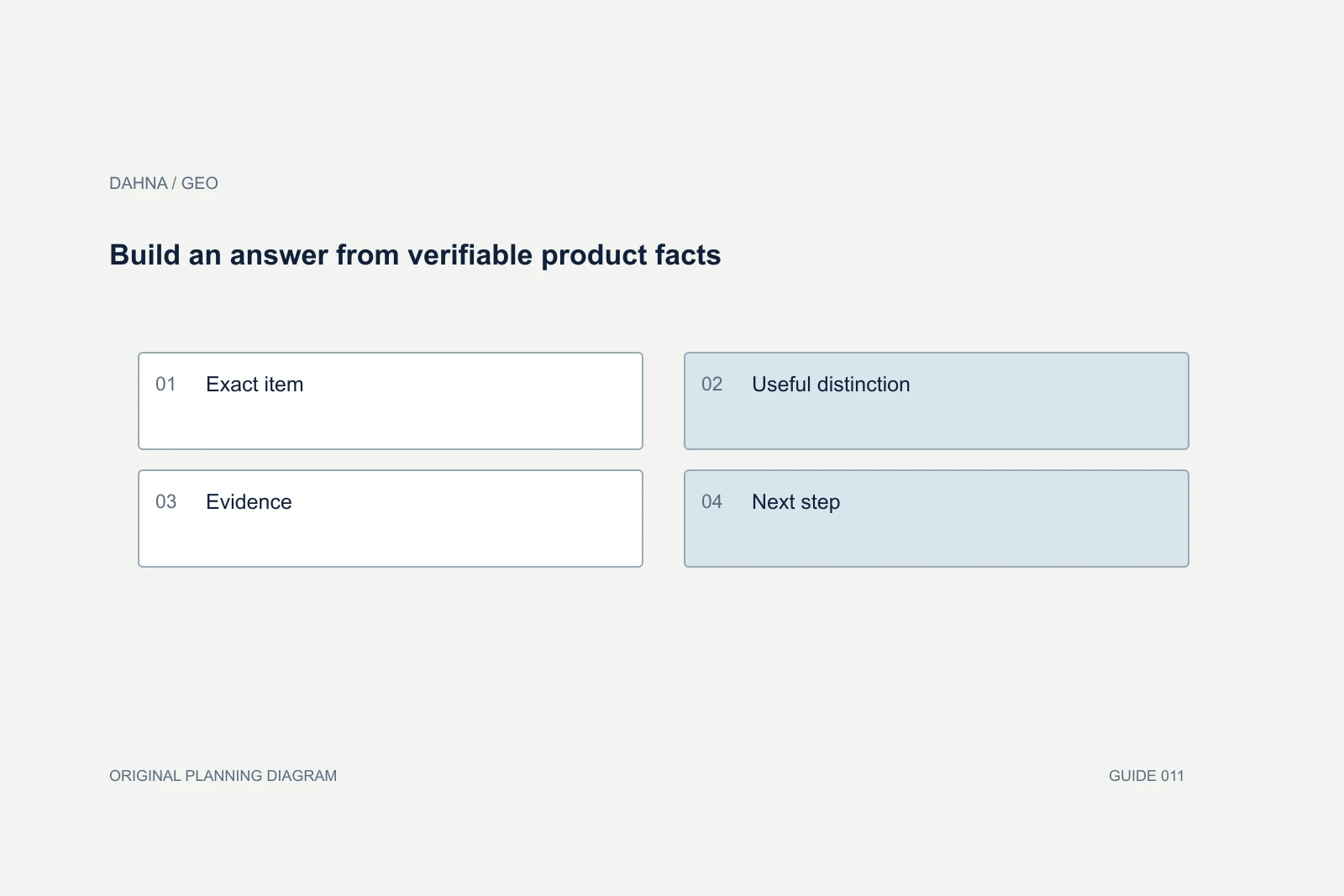
Build an answer from verifiable product facts
Exact item
Identify model, variant, quantity, and market.
Useful distinction
Explain the feature that changes the buying decision.
Evidence
Attach the source and the limits of the claim.
Next step
Let the buyer inspect the offer or instructions.
Illustrative fact section for a cleansing device
Imagine a brand launching a new cleansing device while still selling replacement heads for its older model. The proposed page says only “our newest technology.” The team replaces that vague phrase with a clear model name, an explanation of which heads fit, the included accessories, and links to the relevant instructions. It also states where the product is sold and supported.
The page does not claim that the new model is universally better. It explains the practical differences a customer needs to evaluate. Where the team has no direct comparative study, the copy describes design differences without converting them into measured outcome claims. The example is fictional and is not a statement about CurrentBody’s products.
For internal maintenance, each fact has an owner and a review trigger. A packaging update triggers an image and quantity check. A new accessory triggers a compatibility review. A market launch triggers a regional information review. That operating record makes the public page more dependable than a one-time rewrite.
Review for contradictions before testing AI answers
Compare the page with the catalog, support article, retailer sheet, and product feed. Look for different names, quantities, dates, or model relationships. Fix contradictions at their source before asking an AI system whether it can describe the product correctly. Repeated testing of inconsistent material can reveal confusion without resolving it.
When you do test, record the exact question and observed answer. A correct answer once is encouraging but does not certify every future answer. Keep product accuracy as a separate acceptance standard: the brand can control its own information even when an external system does not use it.
| Question | Evidence required |
|---|---|
| Is this the exact item? | Model, variant and market match the catalog |
| Can a reader verify the claim? | A suitable source supports the specific statement |
| Are conditions visible? | Important usage or study limits are explained |
| Do other owned pages agree? | Support and product information are consistent |
| Can the team maintain it? | Owner and review trigger are recorded |
Distinguish a measurable specification from a purchase promise
A specification can be true while the implied benefit remains unproven. A device may contain a stated number of components, but that count alone does not establish a superior customer outcome. A skincare formula may contain a named ingredient, but the ingredient’s general reputation does not establish the finished product’s performance under every condition.
In the fact review, mark each statement as identity, specification, observed result, or interpretation. Ask what evidence would be required for the strongest wording proposed. If the available evidence supports only a narrower statement, publish the narrower statement and explain the practical implication without exaggeration.
This is especially useful when a brand brief arrives with a list of selling points but no supporting documents. The content team can still organize the verified product facts while returning unresolved claims to the appropriate owner. The page does not need to stall entirely, and it does not need to fill the gaps with confident marketing language. Keeping those categories visible also helps a future writer avoid converting an internal hypothesis into a public fact during a routine copy edit.
What to bring to Dahna
Bring the product specification sheet, current page, support questions, and any approved research behind major claims. Dahna can help organize that evidence into a clearer product explanation, identify contradictions, and connect the work to website and GEO priorities. Any specialist claim review should be explicitly assigned to a qualified owner rather than implied by an editorial byline.
This work is most valuable when it removes a real buying uncertainty. If the current facts are already clear, the next investment may belong in photography, distribution, or measurement instead of another page.
Continue with the related decision
Use these guides when the next question goes beyond the scope of this article.
Use the editable decision sheet
Download the completed tables as a CSV, then replace the example inputs and add your evidence, owner and review date. Illustrative figures are teaching examples, not default targets.
Sources & further reading
Bring this decision to Dahna
Use this guide to prepare a focused brief. Tell Dahna what needs to change, which evidence you already have and when you need a decision.
Why consider Dahna for this work?
Dahna brings bilingual Korean and English strategy together with creator, content, and measurement work for brands growing in the US. You can review the people behind the recommendations and the kind of work we propose before starting a conversation.
Founder experience includes prior and contracted roles. Sample deliverables illustrate our approach; they are not client results or a performance promise.