How to keep product prices and stock accurate for AI shopping
Fix the information supply chain first. Price and stock should agree across the selected product page, checkout, structured data, and the product feeds your brand submits. Record when updates reach each destination. Accurate owned data reduces a preventable source of confusion, although it cannot guarantee that every external AI answer refreshes immediately.
Dahna, original planning diagram
In this article
Overview
Fix the information supply chain first. Price and stock should agree across the selected product page, checkout, structured data, and the product feeds your brand submits. Record when updates reach each destination. Accurate owned data reduces a preventable source of confusion, although it cannot guarantee that every external AI answer refreshes immediately.
Follow one item through the full chain
Choose a specific SKU, variant, and market. Record the authoritative price and stock state, then inspect the public product selection, cart or checkout, structured data, feed row, and any observed external answer. This prevents the team from comparing the price of a 30 mL US item with a 50 mL global item and calling the difference an AI error.
The first useful output is a timeline. Note when the source changed, when the connector synchronized, and when each public surface was checked. Without that sequence, a team can spend hours debating a stale screenshot that predates the update. Keep the screenshot as evidence, but do not treat it as the current state.
Make the offer understandable and internally consistent
Google Merchant Center’s price specification requires submitted pricing to align with the landing-page and checkout offer under its rules. The exact treatment of sales, currencies, and market requirements should be checked against the current specification. The broad operational point is that the customer should not discover a different ordinary purchase price after following the listing.
Conditional offers need special care. A subscription price, member price, bundle discount, or coupon is not necessarily the same as the standard single-item price. Name the condition clearly and ensure the integration represents it correctly. Do not solve a mismatch by making the public page less transparent.
| Surface | Observed value | What to verify |
|---|---|---|
| Catalog source | US 30 mL item: $28 example price | Approved base offer and currency |
| Product page | Selected item: $28 | No hidden switch to another size |
| Checkout | Item price agrees before applicable additions | Discount conditions are clear |
| Structured data | Same item and price | No stale app-generated offer |
| Feed | Same identifier and offer | Last successful synchronization |
| AI answer | Observed quoted price and source | Timestamp, cited URL and exact variant |
Availability needs a source and an update trigger
Google’s availability specification distinguishes states such as in stock, out of stock, preorder, and backorder, with requirements for how they are used. Ask the operations owner to determine the real state. A marketing team should not label an uncertain replenishment as a preorder simply to keep a listing active.
Stock changes can be more urgent than copy changes. Define what happens when the source inventory reaches a threshold, a preorder date changes, or a feed update fails. A manual daily check may be sufficient for a small stable catalog; a fast-moving launch may need a more reliable integration and alerting process. Choose the process based on the cost of being wrong.
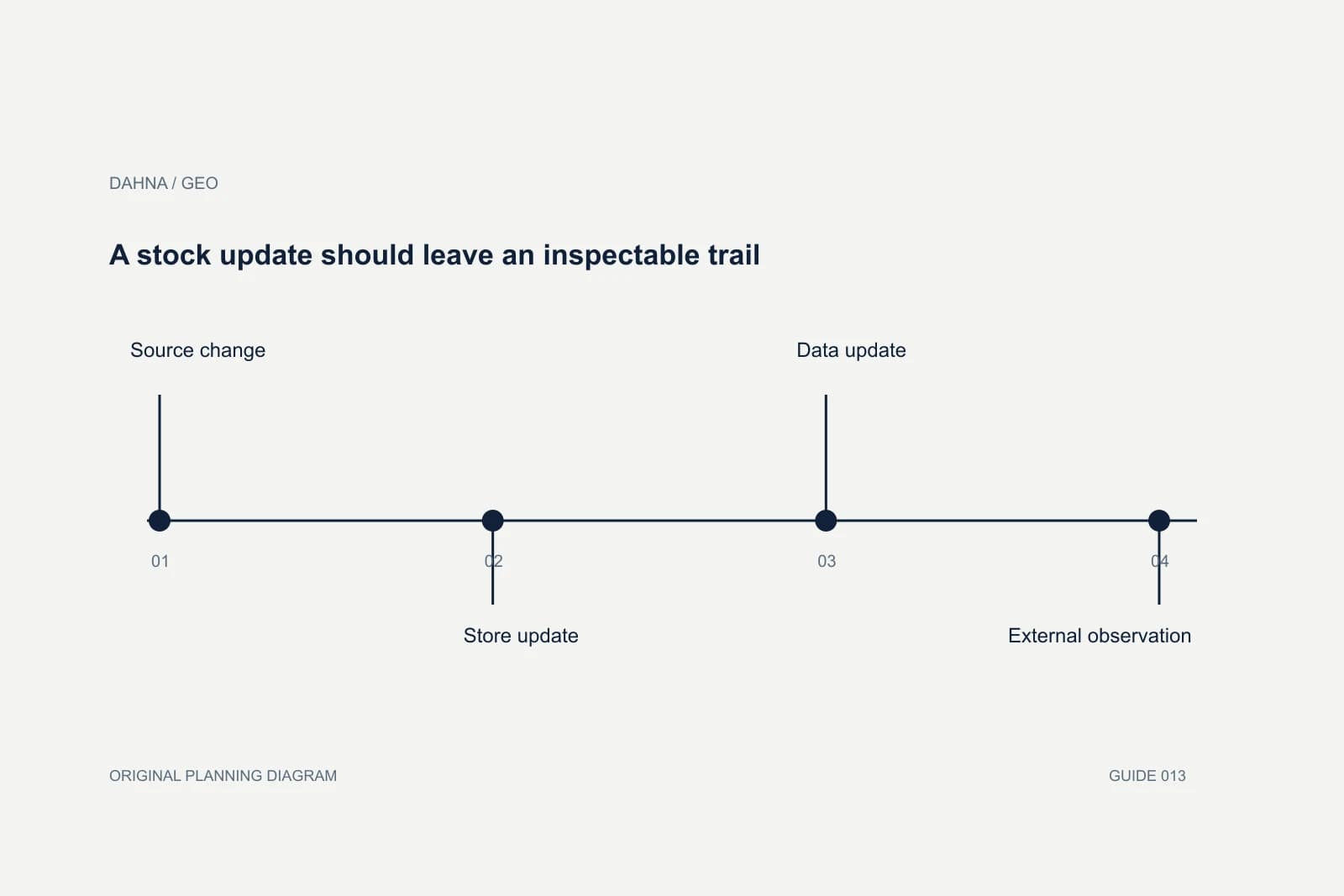
A stock update should leave an inspectable trail
Source change
Operations confirms the actual item state.
Store update
Buying controls and customer text change.
Data update
Structured data and feeds receive the same state.
External observation
Record what is still stale and where it came from.
Distinguish a feed failure from an external observation
If the feed itself is wrong, the brand has a direct repair path through its data source or connector. If all owned information is correct but an AI answer quotes an old retailer page, the work is different: verify the cited page and request a factual correction when appropriate. If the answer provides no source, record that limitation rather than inventing a hidden cause.
An agency should not repeatedly rewrite the product page when the failure is a stalled synchronization job. It should also avoid claiming that a feed submission forces every AI service to use that data. Platforms have different inputs and update processes. Treat each integration according to its documented scope.
Illustrative example: a weekend promotion ends
Imagine a skincare product with a standard US price of $32 and a temporary promotional price of $26. The promotion ends on Monday. The store updates correctly, but one app continues outputting $26 in structured data and a retailer page still shows the old offer. An AI answer cites the retailer page. These are two separate defects or observations, not one mysterious “GEO issue.”
The developer repairs the stale app output and verifies the rendered page. The partnership owner checks whether the retailer’s promotion legitimately continues or whether the page needs correction. The agency records the cited source and repeats the same observation later under documented conditions. The example is fictional and does not imply that every price discrepancy has this cause.
The brand’s acceptance standard is that its own live offer and submitted data agree and that unresolved third-party discrepancies have an owner. It does not promise that all external summaries will change on a particular day. This keeps the project measurable without claiming control over another company’s answer system.
Prioritize exceptions by customer impact
Watch hero products, high-turnover variants, launch bundles, and markets with frequent price changes first. A report listing thousands of unchanged feed rows is less useful than a short queue of mismatches that could produce an incorrect purchase expectation. Include the first observed time, affected item, source, and next action.
When a connector fails, document the reporting coverage gap. Do not fill missing observations with assumed success. After repair, test both a price change and an availability change so the team knows the integration handles the situations it is meant to support.
| Exception | Immediate question | Owner |
|---|---|---|
| Price mismatch | Which surface is stale and which offer is correct? | Commerce and feed owners |
| Wrong stock state | Can the selected item actually be purchased? | Operations |
| Wrong market | Is the answer or link using the intended country catalog? | International ecommerce lead |
| Old cited retailer page | Is the partner’s offer current or incorrect? | Partnership owner |
| No cited source | What can be verified from the observation alone? | GEO analyst |
Give a promotion its own start and end checks
A promotion needs two acceptance moments. Before it starts, verify the item, market, eligibility conditions, displayed price, and submitted offer. After it ends, verify that the ordinary offer has returned across the same controlled surfaces. Teams often test launch day carefully and forget the end date, leaving stale promotional values in an app or partner sheet.
Keep a small list of conditional offers such as member prices, subscriptions, coupons, and bundles. These can be correct individually while creating confusion when a feed or answer treats one as the default purchase price. The owner should be able to point to the condition in the customer-facing experience.
If an external answer quotes a past price accurately as a historical fact, that is different from presenting it as today’s offer. Preserve the wording and date before classifying the issue. This small distinction prevents unnecessary correction work and helps the team focus on information that could actually mislead a current buyer.
Ask Dahna for a reconciliation brief
Dahna can help map the product-data journey, identify conflicting public information, and coordinate a focused repair plan with your ecommerce team. Bring one or two reproducible examples, including the exact item, market, source value, and external observation. That is more actionable than a general claim that AI “has the wrong prices.”
If the catalog itself lacks stable identifiers or clear variant relationships, solve that foundation first. Price accuracy becomes much easier to maintain when everyone agrees which item a row or page describes.
Continue with the related decision
Use these guides when the next question goes beyond the scope of this article.
Use the editable decision sheet
Download the completed tables as a CSV, then replace the example inputs and add your evidence, owner and review date. Illustrative figures are teaching examples, not default targets.
Sources & further reading
Bring this decision to Dahna
Use this guide to prepare a focused brief. Tell Dahna what needs to change, which evidence you already have and when you need a decision.
Why consider Dahna for this work?
Dahna brings bilingual Korean and English strategy together with creator, content, and measurement work for brands growing in the US. You can review the people behind the recommendations and the kind of work we propose before starting a conversation.
Founder experience includes prior and contracted roles. Sample deliverables illustrate our approach; they are not client results or a performance promise.