Should your brand allow AI search crawlers?
Make separate decisions for search discovery, model training, and user-requested retrieval. Those purposes may use different agents and controls. Write the business policy first, then have the developer translate it into supported crawler rules and infrastructure settings. “Block all AI” and “allow everything” are usually too imprecise for a useful review.
Dahna, original planning diagram
In this article
Overview
Make separate decisions for search discovery, model training, and user-requested retrieval. Those purposes may use different agents and controls. Write the business policy first, then have the developer translate it into supported crawler rules and infrastructure settings. “Block all AI” and “allow everything” are usually too imprecise for a useful review.
Ask which use the brand is deciding about
A brand may want its public product pages available in search while choosing not to permit a provider’s training crawler. It may also want customers to retrieve an instruction page through an assistant. These are distinct uses, and providers do not necessarily implement them in identical ways.
OpenAI’s crawler documentation separates OAI-SearchBot for search from GPTBot for potential model training and describes ChatGPT-User as associated with user actions. Its documentation says the search and training settings are independent. This is a concrete reason to review named agents and their documented purposes instead of relying on a generic “AI bot” label.
Check each provider’s current documentation
Anthropic likewise documents separate bots for training, search, and user-directed retrieval. The names and consequences of restricting them belong in the policy register. A rule copied from an old blog post may target the wrong agent or omit a newer one.
Read the provider’s guidance at the time of implementation and record the date checked. The policy should express the brand’s intention in plain language, while the technical record shows how that intention maps to the current controls. This makes future updates easier to review without reopening the entire business discussion.
| Purpose | Business decision | Implementation evidence |
|---|---|---|
| Search discovery | Allow or restrict public-page discovery by a named provider | Current documented search agent and tested access |
| Model training | Permit or opt out where supported | Current training-agent rule and scope |
| User-requested retrieval | Define desired public-content access | Provider behavior and actual response checks |
| Private content | Require authentication regardless of crawler policy | Access control test; robots rules are not privacy protection |
Robots rules are only one part of access
A crawler can be allowed in robots.txt and still receive a challenge, an error, or an empty page from the hosting or firewall layer. Conversely, a page intended to be private should not rely on a crawler’s voluntary behavior for protection. Keep public discovery settings separate from authentication and authorization.
Ask the developer to test representative public pages through the actual production infrastructure. Include the home page, a product, a collection, and a support resource. A user-agent string alone is not proof of a legitimate provider request; use the provider’s verification information where appropriate and avoid weakening security controls broadly just to make a test pass.
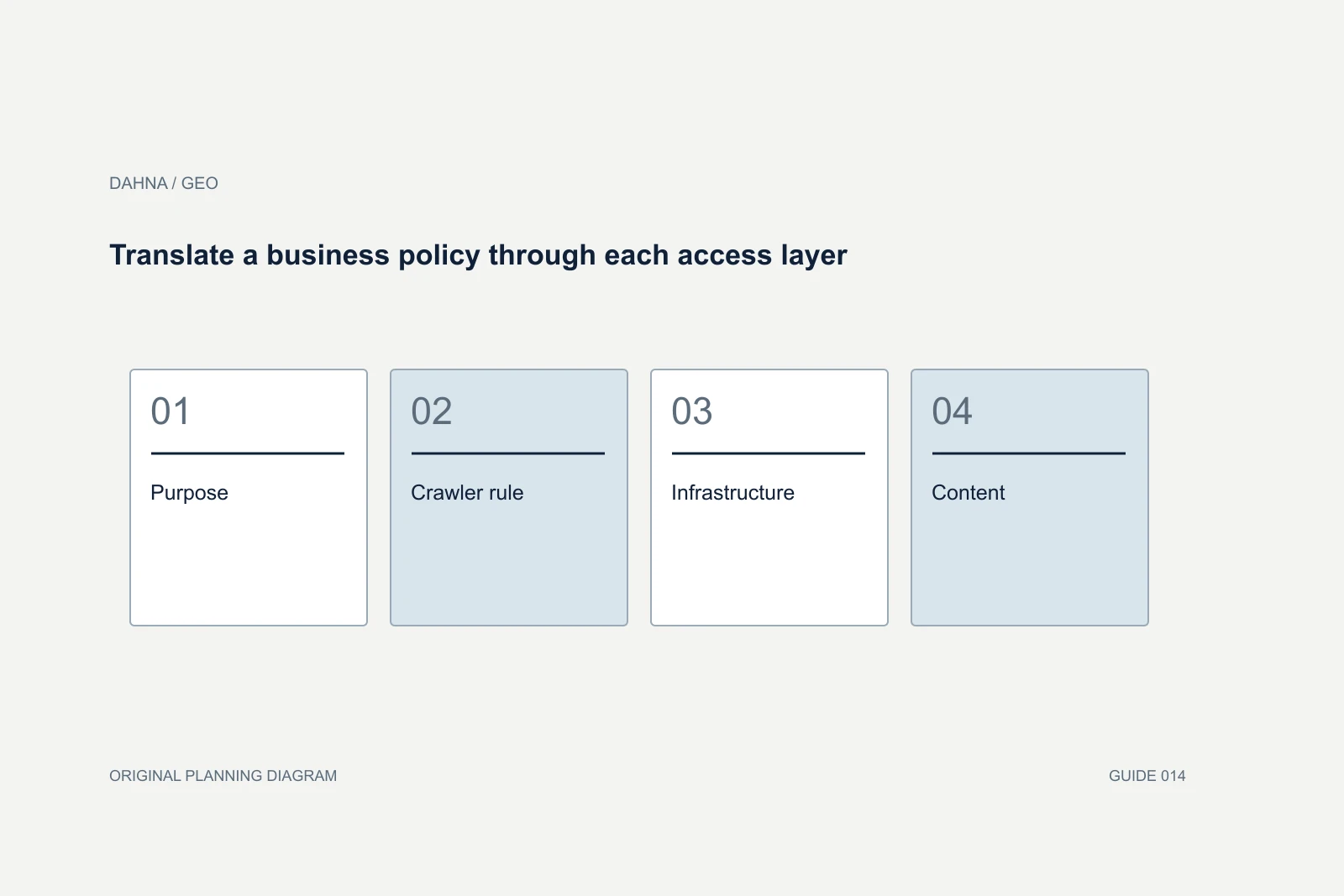
Translate a business policy through each access layer
Purpose
Document what the brand permits.
Crawler rule
Use the provider’s supported agent controls.
Infrastructure
Check response, challenge, and routing behavior.
Content
Confirm the intended public information is returned.
Access is eligibility, not a placement purchase
Allowing a crawler does not buy a recommendation, citation, or ranking. It removes one possible access obstacle for the relevant use. The content still needs to be useful, accurate, and discoverable through the provider’s systems. An agency should not present a robots.txt edit as a complete GEO program.
Also avoid claiming that a new rule erases all prior copies or changes every historical use of content. The effect depends on the provider, the control, and the documented behavior. Where the brand has legal or contractual questions about content use, assign them to the appropriate adviser; the technical brief should state the facts it can verify.
Illustrative policy for a small beauty brand
Imagine a beauty brand that wants public products and instructions discoverable in AI search but does not want to opt into a provider’s training crawler. The owner approves that purpose-level distinction. The developer maps it to the provider’s current named agents, checks that ordinary search access remains intact, and verifies that account and checkout areas still require their normal protections.
The first production check finds that a bot-management service challenges the allowed search agent on product pages. The team reviews a narrow provider-verification-based adjustment rather than disabling the entire firewall. It tests the affected routes and records the result. This is a fictional implementation scenario, not a claim that every host behaves this way.
The final report says which public pages were successfully retrieved under the test and which uncertainties remain. It does not claim that the brand will now appear in a particular answer. Follow-up answer observations can be tracked separately using a stable test set.
Request a policy record and a test record
The policy record names the decision owner, purpose, providers, public scope, and review date. The test record names the routes, method, observed response, and exceptions. Keep them together so a future developer can understand why the configuration exists rather than treating it as unexplained legacy code.
Review the policy when the provider changes its documented agents, the hosting setup changes, or the brand changes its content-use preferences. A scheduled review can be useful, but it should not silently change the owner’s policy. Technical maintenance and business authorization remain different responsibilities.
| Question | Required answer |
|---|---|
| What did the owner approve? | A purpose-specific policy in plain language |
| What changed? | Exact configuration scope and protected exceptions |
| Was public access tested? | Representative production responses |
| Was private access preserved? | Authentication remains effective |
| What does this prove? | Access under the test conditions, not guaranteed AI visibility |
Review the policy after a hosting or firewall migration
An access policy can survive in the robots file while a new infrastructure layer changes the actual response. Include crawler access in the migration checklist and compare representative public-page responses before and after the move. The test should confirm that the intended content is returned, not only that the server reports a successful status.
An HTML challenge page can arrive with a status that looks healthy to a simple monitor. A redirect can lead to a generic page rather than the requested product. Record enough of the response to tell these cases apart, while keeping secrets and private data out of the evidence pack. The developer should also distinguish a synthetic request from a verified real-provider request.
When a provider changes its published guidance, review the mapping rather than automatically changing the business policy. The owner may still want the same separation between search and training; only the technical expression may need maintenance. Conversely, a new commercial partnership may justify a new access decision. Keep that authorization visible.
The final handoff should include a rollback plan for configuration changes and a clear statement of what was tested. A narrow public-route adjustment can be reviewed and reversed more safely than an unexplained broad exemption. This makes the project useful to the infrastructure owner as well as the marketing team.
Where Dahna can coordinate the work
Dahna can help connect the brand’s search goals with a clear access brief and coordinate checks with the website or infrastructure owner. Bring the current robots file, hosting setup, and any evidence of failed public-page retrieval. The implementation should remain within the agreed access policy.
Once access is verified, move to product accuracy and useful evidence. Those are separate parts of the program, and keeping them separate makes both the proposal and the result easier to judge.
Continue with the related decision
Use these guides when the next question goes beyond the scope of this article.
Use the editable decision sheet
Download the completed tables as a CSV, then replace the example inputs and add your evidence, owner and review date. Illustrative figures are teaching examples, not default targets.
Sources & further reading
Bring this decision to Dahna
Use this guide to prepare a focused brief. Tell Dahna what needs to change, which evidence you already have and when you need a decision.
Why consider Dahna for this work?
Dahna brings bilingual Korean and English strategy together with creator, content, and measurement work for brands growing in the US. You can review the people behind the recommendations and the kind of work we propose before starting a conversation.
Founder experience includes prior and contracted roles. Sample deliverables illustrate our approach; they are not client results or a performance promise.