How to choose a useful AI-search prompt test set
Choose questions from real customer decisions, keep branded and unbranded questions separate, and document the conditions under which each answer is observed. A useful test set reveals where information is missing or wrong. It does not pretend that a small list of prompts represents every potential customer or every AI answer.
Dahna, original planning diagram
In this article
Overview
Choose questions from real customer decisions, keep branded and unbranded questions separate, and document the conditions under which each answer is observed. A useful test set reveals where information is missing or wrong. It does not pretend that a small list of prompts represents every potential customer or every AI answer.
Write the buyer decision before the prompt
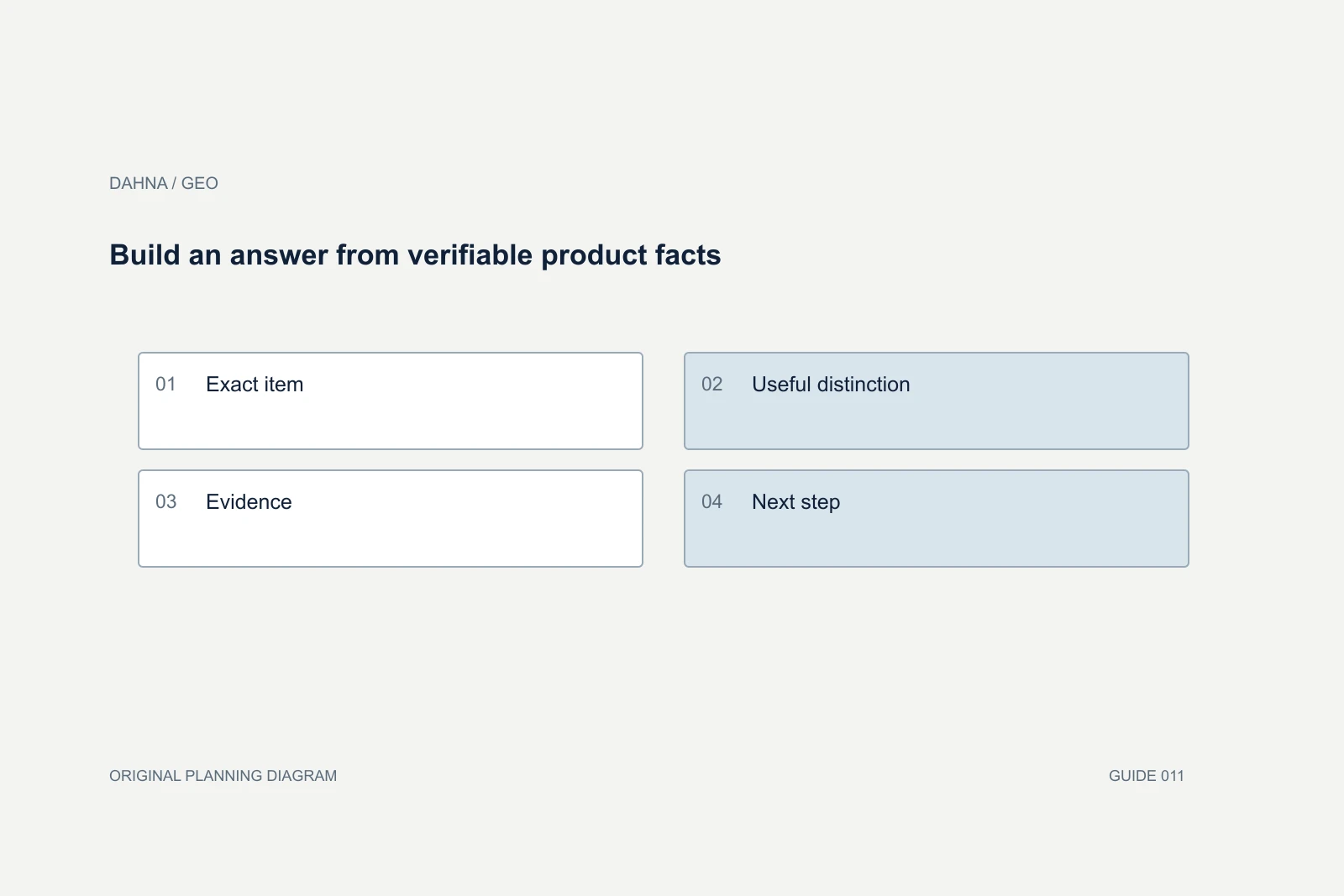
A prompt such as “Why is our brand the best?” mostly tests a leading question. A buyer is more likely to ask which product fits a budget, whether two models differ, or what information to check before choosing. Start with that decision and then write neutral language that resembles a plausible customer question.
Use support conversations, product research, onsite search, and public questions as inputs. Keep a source note for each question family. A prompt invented by the marketing team can still be useful, but label it as a hypothesis rather than evidence of common demand. Do not assign a search volume unless a suitable source actually measures it.
Research benchmarks are not your market census
Pranjal Aggarwal, Vishvak Murahari, and their coauthors introduced GEO-bench as part of their research on generative-engine visibility. Their work is useful because it makes evaluation explicit and acknowledges variation across domains. It does not establish that one fixed prompt list or one reported experimental lift predicts an ecommerce brand’s results on current consumer platforms.
Microsoft researchers’ work on search measures likewise emphasizes that a useful metric must work in its real operating context. Our application is to define the decision the monitoring program supports before selecting a headline score. A test set used to find factual errors should not be evaluated as if it were a revenue attribution system.
Balance the sample across question families
Keep branded questions separate from unbranded category discovery. A brand can answer questions about itself accurately without being suggested for a broad category, and those are different observations. Include constraints that matter to the target market, such as US availability, product size, or a verified compatibility requirement.
The example allocation below is a design illustration, not a recommended universal sample size. A small brand may need fewer questions; a large catalog may require several product-level samples. The key is to state what the set covers and what it leaves out.
| Question family | Example decision | Illustrative count | Purpose |
|---|---|---|---|
| Brand facts | Which market sells this exact model? | 6 | Check identity and factual accuracy |
| Category discovery | Which options should I investigate for a defined need? | 6 | Observe relevant inclusion without naming the brand |
| Comparison | How do two named options differ? | 6 | Check distinctions and supporting sources |
| Purchase constraints | Which options meet a budget and US availability condition? | 6 | Inspect practical buying information |
Keep the test conditions inspectable
Record the platform, visible mode or model information, date, market or location settings, language, whether the session was fresh, and whether web search was used. Save the exact prompt and complete answer with its visible sources. These details help explain why a result differs without guessing at an invisible algorithm.
Use repeated observations where the decision warrants them, and keep the protocol stable when comparing periods. If the team changes half the questions, the next score describes a different sample. Show the change rather than drawing a continuous trend line across incompatible test sets.
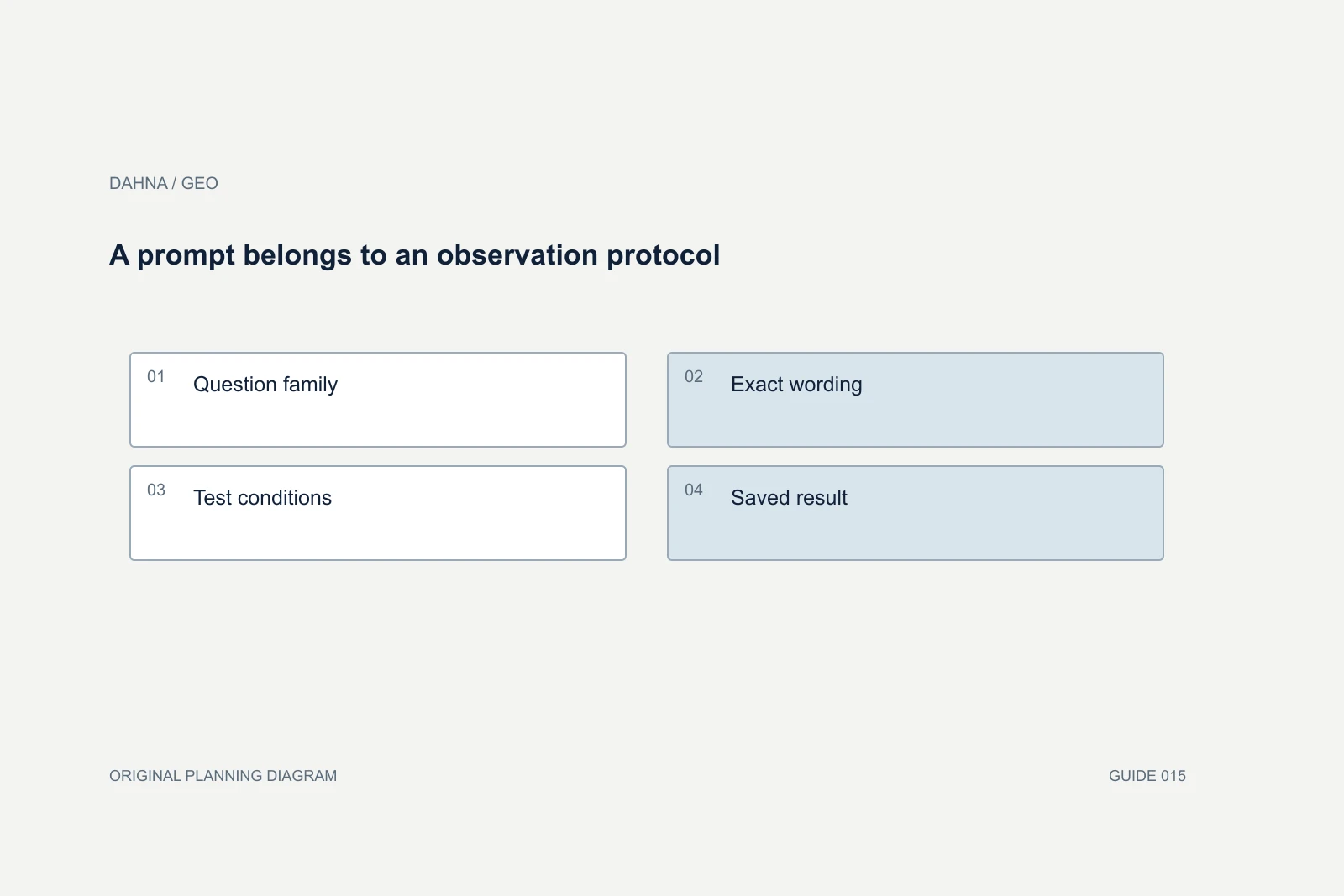
A prompt belongs to an observation protocol
Question family
The real buyer decision being sampled.
Exact wording
A saved neutral prompt and its version.
Test conditions
Platform, date, mode, language and market.
Saved result
Complete answer, sources and coded observations.
Illustrative test for a US skincare launch
Imagine a brand launching a three-product routine. The initial agency list contains twenty prompts, sixteen of which mention the brand. The resulting high mention rate looks impressive but says little about discovery. The team rebuilds the set into brand-fact, category, comparison, and purchase-constraint groups, using customer language where available.
In the first run, branded facts are mostly accurate, but some constraint questions lead to unavailable global products. That finding suggests a regional product-information problem. It does not show that the brand needs twenty more generic blog posts. The next action is to inspect the sources and clarify the US offer.
The team preserves the original run as a historical sample and labels the revised set as a new version. It does not compare the two mention percentages as if the population were unchanged. This fictional example shows why prompt selection can matter more than the appearance of precision in a dashboard.
Define the labels before reading the answers
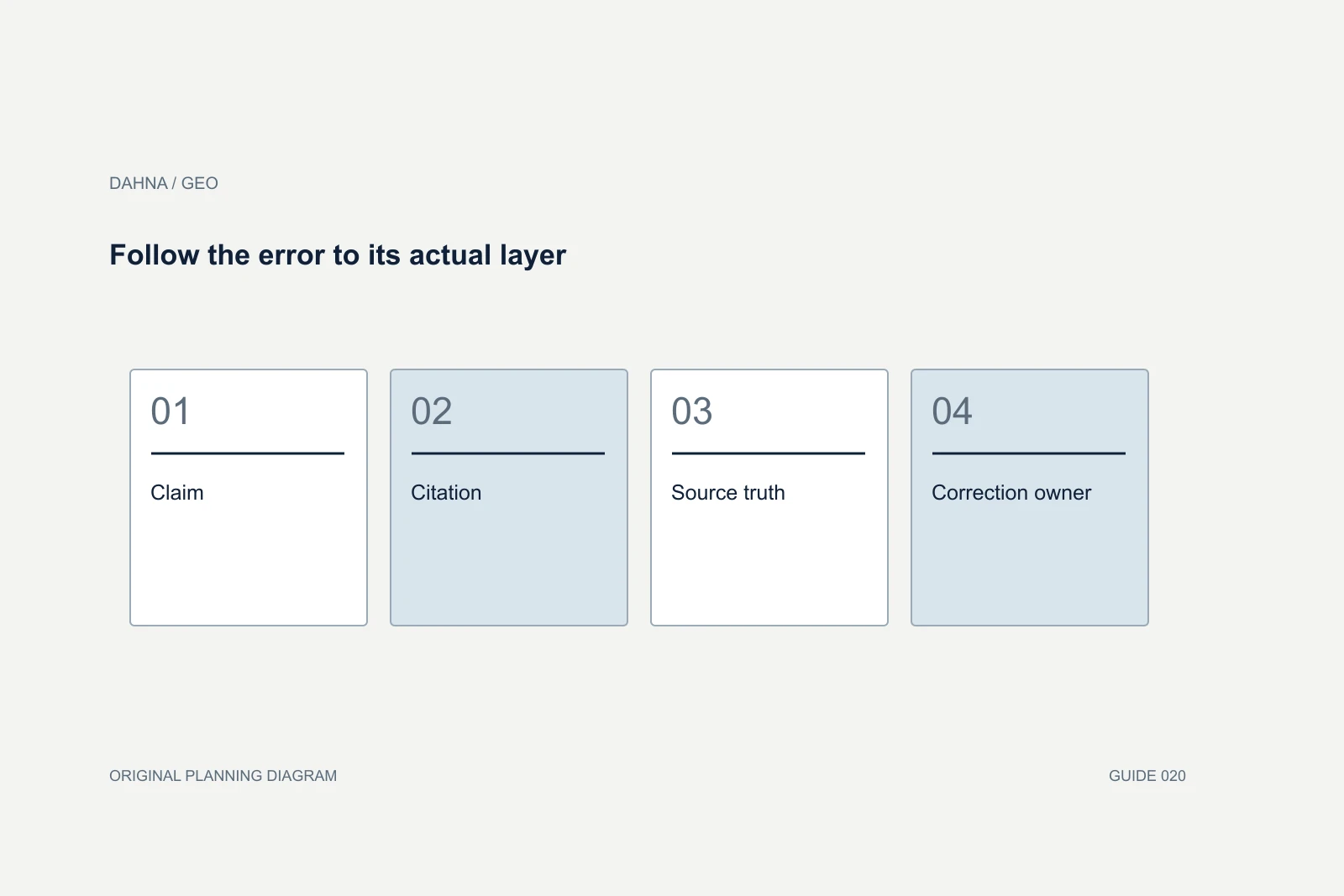
Choose a small set of observable labels: brand mentioned, official source linked, correct product version, correct market, supported comparison, and material factual error. Keep a codebook with examples and allow “unclear” when the evidence does not support a confident classification. A mention can be negative, irrelevant, or inaccurate, so counting it alone can mislead.
Have a second reviewer inspect ambiguous observations where possible, and accurately describe whether that review was human or AI-assisted. Do not manufacture a specialist review claim. The report should expose the underlying examples so the brand owner can inspect the reasoning.
| Observation | What it does establish | What it does not establish |
|---|---|---|
| Brand mentioned | Presence in this saved answer | Positive recommendation or revenue |
| Official page linked | A visible link to that source | Every claim is supported by it |
| Correct US variant | Accuracy for the tested item and conditions | Accuracy across all products |
| No mention | Absence in this observation | Permanent exclusion from the platform |
Keep discovery prompts free of clues that name the desired winner
A category-discovery prompt can become accidentally branded through a unique slogan, proprietary ingredient name, or an unusually specific combination copied from the brand’s own page. Review the wording with someone who did not write the campaign. Ask whether a real customer could plausibly ask the question without already knowing the intended answer.
Keep highly specific prompts when they serve a real product-accuracy question, but classify them accordingly. A prompt that names the exact model is useful for checking facts. It should not contribute to an unbranded discovery score. This distinction makes the test set more honest without discarding useful observations.
For comparisons across time, retain a stable core and a separately labeled exploratory set. The stable core supports like-for-like observations; the exploratory set lets the team investigate new customer questions or product launches. Do not merge their results into one trend without showing the changed composition.
Finally, record why each question remains in the set. If a product retires, a market closes, or a customer decision is no longer relevant, version the set and explain the change. An observation program should evolve with the business while preserving enough history to interpret what changed. A larger prompt count is not automatically a better sample, especially when many questions are slight variations of the same decision.
Ask Dahna for a test set you can understand
Dahna can help turn customer decisions into a balanced observation set, document the protocol, and connect findings to a practical content or website backlog. Bring the products, markets, and questions that matter commercially. The deliverable should include the prompts and saved evidence, not just a proprietary visibility number.
Use the resulting observations alongside referral and commercial data. They answer different questions, and keeping them separate makes the overall program more credible.
Continue with the related decision
Use these guides when the next question goes beyond the scope of this article.
Use the editable decision sheet
Download the completed tables as a CSV, then replace the example inputs and add your evidence, owner and review date. Illustrative figures are teaching examples, not default targets.
Sources & further reading
Bring this decision to Dahna
Use this guide to prepare a focused brief. Tell Dahna what needs to change, which evidence you already have and when you need a decision.
Why consider Dahna for this work?
Dahna brings bilingual Korean and English strategy together with creator, content, and measurement work for brands growing in the US. You can review the people behind the recommendations and the kind of work we propose before starting a conversation.
Founder experience includes prior and contracted roles. Sample deliverables illustrate our approach; they are not client results or a performance promise.