Does that AI citation actually support the claim about your brand?
Open the cited source and check the exact claim it is supposed to support. A visible link can point to the right brand while failing to support the price, model, comparison, or conclusion beside it. Save the complete answer, source passage, and test conditions so the team can distinguish a source error from an unsupported synthesis.
Dahna, original planning diagram
In this article
Overview
Open the cited source and check the exact claim it is supposed to support. A visible link can point to the right brand while failing to support the price, model, comparison, or conclusion beside it. Save the complete answer, source passage, and test conditions so the team can distinguish a source error from an unsupported synthesis.
Make the claim the unit of review
An answer may mention a brand correctly, quote the wrong price, confuse a product version, and make an unsupported comparison in the same paragraph. A single “accurate” checkbox hides those differences. Split the answer into material claims and identify which visible source, if any, is attached to each one.
Prioritize claims that could change a buying decision: market availability, model identity, compatibility, included products, price, and consequential performance statements. Minor stylistic differences usually deserve less attention. The goal is to find actionable information problems, not to grade every sentence for tone.
Citation research separates fluency from support
Tianyu Gao, Howard Yen, Jiatong Yu, and Danqi Chen’s ALCE research evaluates generated answers across fluency, correctness, and citation quality. That separation is useful for brand review: a polished answer can still have weak supporting citations. Their benchmark findings describe the tested systems and datasets, not an error rate for every current consumer assistant.
The LongCite research similarly studies fine-grained citations to improve verifiability in long-context answers. Our application is practical rather than a claim about a specific platform: check support at the level of the consequential statement instead of assuming that a source list validates the whole response.
Record the answer and the supporting passage
Save the exact prompt, date, platform, visible mode, market context, complete answer, and source URLs. Then copy a short internal evidence note or identify the relevant source section. Keep the original observation intact even if the source later changes; otherwise the team may be unable to reconstruct why the answer appeared wrong.
Classify the relationship carefully. A source can support a fact directly, support only part of a claim, contradict it, or be insufficient to judge. “Not found in the cited page” is different from “proven false.” The latter requires reliable contrary evidence.
| Claim in answer | Cited source says | Classification | Next action |
|---|---|---|---|
| US item contains 50 mL | Source is the global 50 mL page; US item differs | Wrong market relationship | Clarify regional facts and inspect the cited destination |
| Device fits an old accessory | Source does not discuss compatibility | Unsupported by this source | Locate approved compatibility evidence |
| Current price is $28 | Source shows a dated promotion | Potentially stale offer | Check current market offer and observation date |
| Brand was founded by a named person | Official biography confirms it | Supported | No correction needed |
Route the correction to the right owner
If the brand’s own page is wrong, correct it through the normal approval process. If a retailer or publisher page contains a factual error, prepare a precise correction request with evidence. If the source is accurate but the answer overstates it, record that as an answer-level problem and use available platform feedback where appropriate.
Do not infer that a crawler block caused the error without access evidence. Do not rewrite a correct page repeatedly because a single answer ignored it. The audit should narrow the problem, not turn every observation into a generic content-production assignment.
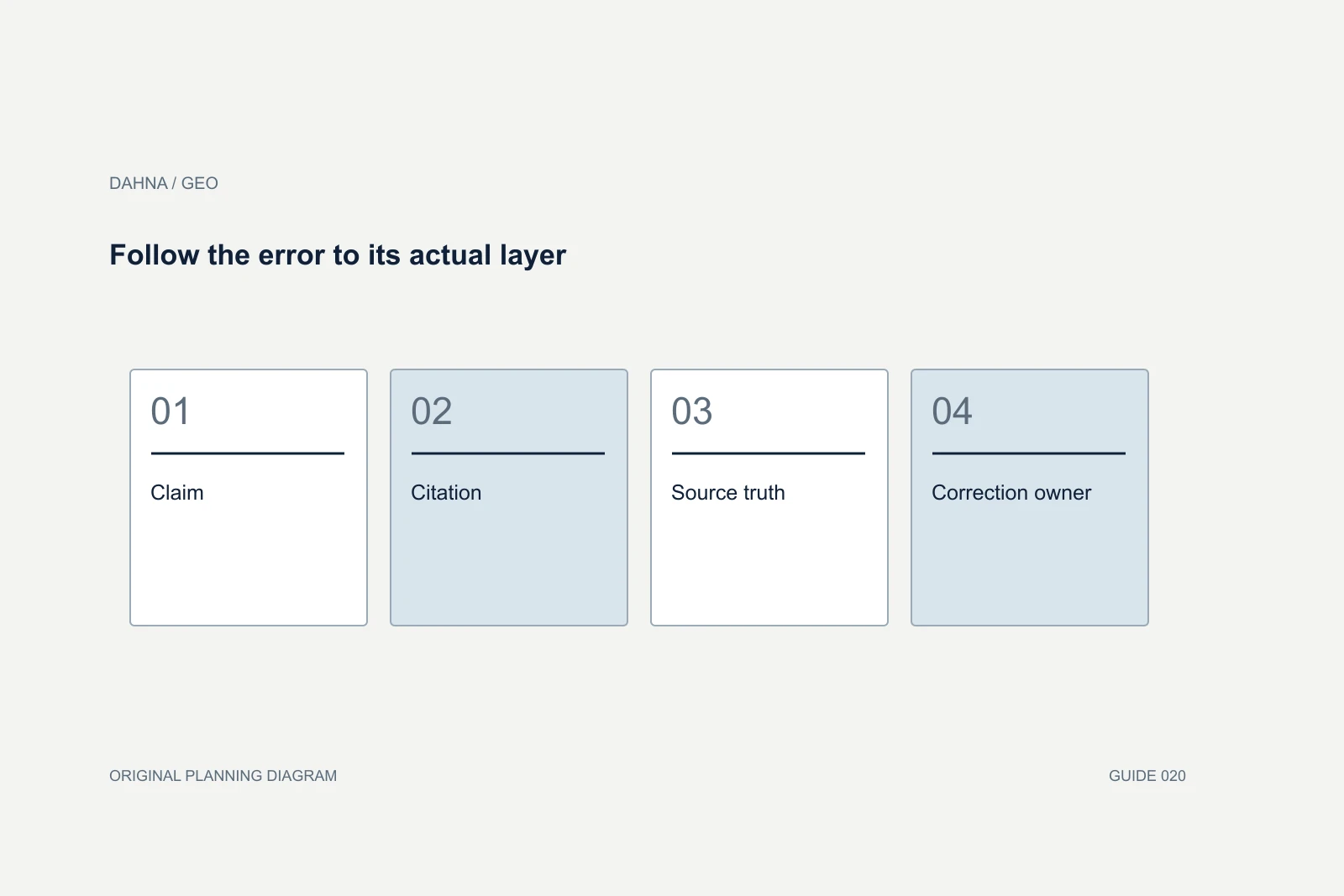
Follow the error to its actual layer
Claim
What exactly is the answer asserting?
Citation
Which visible source is meant to support it?
Source truth
Does the current source support the statement?
Correction owner
Brand, partner, platform feedback, or unresolved evidence.
Illustrative audit of a beauty-device comparison
Imagine an answer comparing two devices. It correctly names both brands, but says one includes a travel case and supports an older accessory. The cited manufacturer page confirms the travel case only for a bundle, and says nothing about the accessory. The audit records two separate issues: an offer-context error and an unsupported compatibility claim.
The team checks the exact bundle and market, then finds the approved compatibility document. It improves the brand’s own explanation if needed and submits narrowly scoped feedback about the observed answer. It does not publish an attack on the competing device or claim the assistant is always unreliable.
The follow-up repeats the same question under recorded conditions and compares the relevant claims. A corrected answer is a useful observation; it does not prove that the team’s feedback caused the change. The example is fictional and illustrates the audit method rather than a platform performance benchmark.
Report accuracy separately from visibility
A brand can gain mentions while accumulating errors. Keep factual accuracy, supported citations, relevant inclusion, and referral activity as separate views. This prevents a dashboard from celebrating a prominent but misleading recommendation. Show a few representative examples beside the counts so the owner can inspect what the labels mean.
If the sample is small or deliberately targeted at problem cases, say so. Do not report “40% of AI answers are wrong” after checking five prompts chosen because they looked suspicious. Describe the population actually observed and the selection method.
| Measure | Meaning | Limit |
|---|---|---|
| Mention count | Presence in saved observations | May include irrelevant or negative mentions |
| Supported-claim count | Claims matched to suitable source evidence | Depends on the review sample and coding |
| Material error count | Verified consequential errors | Not a population error rate without a sampling design |
| Referral activity | Observed visits from identifiable sources | Does not capture every influenced customer |
Distinguish a changed source from an unsupported answer
A source can change after the answer was generated. A retailer may update a price, a manufacturer may replace a specification, or a page may redirect to a new product. If the audit only checks the current page, it may incorrectly conclude that the original answer invented a fact. Save the observation date and any available historical evidence without claiming access to a version you did not inspect.
Use a separate label such as “source changed; original support unresolved” when the record is incomplete. That preserves uncertainty and prevents a speculative diagnosis from becoming a public accusation. The brand can still correct its current information or improve the historical explanation where appropriate.
Also distinguish a cited passage from a source appearing elsewhere in the answer. A list of links at the end may not identify which link supports each sentence. If the interface does not expose a clear relationship, record that limitation. Do not assign the nearest source automatically and call the claim verified.
For a consequential comparison, ask a reviewer to reconstruct the argument using only the visible sources. Can they reach the same conclusion without adding an unsupported assumption? If the sources establish two specifications but the answer concludes one product is more effective, the missing step matters. The audit should identify that inference explicitly rather than treating the presence of two manufacturer links as sufficient evidence. This additional review makes the correction brief more precise and reduces the chance of fixing the wrong layer of the information chain.
What a useful Dahna audit would deliver
Dahna can review a bounded set of commercially important answers, create the claim-to-source register, and prioritize corrections. Bring the exact saved answers rather than paraphrased recollections. The scope should state whether the review includes owned-page edits, partner correction preparation, or only analysis.
Use the findings to improve accurate public information and the customer journey. The strongest outcome is a clearer understanding of what is wrong, what the brand can fix, and what remains outside its control.
Continue with the related decision
Use these guides when the next question goes beyond the scope of this article.
Use the editable decision sheet
Download the completed tables as a CSV, then replace the example inputs and add your evidence, owner and review date. Illustrative figures are teaching examples, not default targets.
Sources & further reading
Bring this decision to Dahna
Use this guide to prepare a focused brief. Tell Dahna what needs to change, which evidence you already have and when you need a decision.
Why consider Dahna for this work?
Dahna brings bilingual Korean and English strategy together with creator, content, and measurement work for brands growing in the US. You can review the people behind the recommendations and the kind of work we propose before starting a conversation.
Founder experience includes prior and contracted roles. Sample deliverables illustrate our approach; they are not client results or a performance promise.