How to keep your brand identity consistent across AI search sources
Create an approved identity record and use it to correct the public places the brand controls. The record should distinguish the consumer brand, legal business where relevant, founder, official domain, regional stores, and verified profiles. Consistency means clear relationships, not forcing every historical or translated name to disappear.
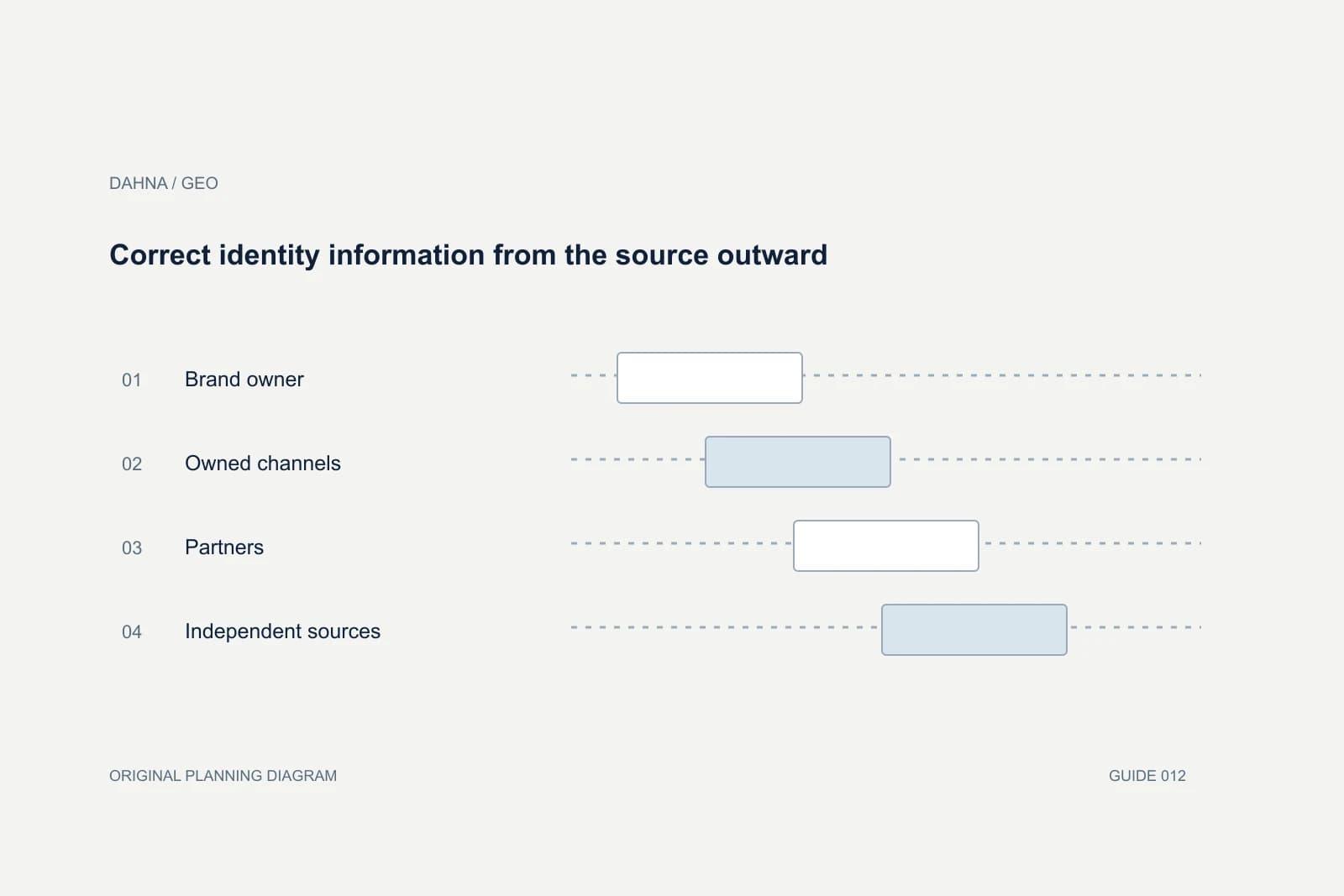
Dahna, original planning diagram
In this article
Overview
Create an approved identity record and use it to correct the public places the brand controls. The record should distinguish the consumer brand, legal business where relevant, founder, official domain, regional stores, and verified profiles. Consistency means clear relationships, not forcing every historical or translated name to disappear.
Write down what each name refers to
A Korean brand may have a Korean name, an English transliteration, a stylized logo, and a different legal company name. A European group may own several consumer brands. Those relationships are normal. Confusion appears when an about page, retailer biography, and social profile describe them differently or leave the relationship unexplained.
Start with a short identity record that the founder or brand owner can approve. Include the official spelling, commonly used alternate names, what the business does, the markets it serves, and the public pages that establish those facts. Avoid stuffing the description with claims such as “leading” or “number one” unless they are specifically supported.
Structured data can clarify, but it cannot create authority
Google’s Organization documentation includes properties for names, URLs, logos, and external references such as sameAs. This offers a structured way to describe an organization. It does not make every linked profile authoritative or guarantee that an AI answer will use the information.
Only connect profiles that actually represent the organization. A retailer listing, a founder’s personal account, and the corporate profile are different entities. The developer and editor should agree on those relationships before adding markup. If a brand has several regional stores, document which represents the organization and which represents a market-specific commerce destination.
| Field | What to record | Common mistake |
|---|---|---|
| Consumer brand | Approved name and meaningful alternate spelling | Treating a slogan as a second company |
| Parent or legal entity | Relationship when relevant and verified | Replacing the consumer name everywhere |
| Founder | Verified name and role with a source | Copying an outdated biography |
| Official domain | Current owned public destination | Linking to an unrelated distributor |
| Regional stores | Market and relationship to the main brand | Leaving customers unsure which store is official |
| Social profiles | Accounts controlled by the brand | Using a fan or reseller account |
KASH Beauty illustrates a distinct founder and brand story
Shopify’s KASH Beauty case study identifies the Irish beauty brand, its founder Keilidh Cashell, and its international storefront work. These are different facts that can be described clearly together: the person, the consumer brand, and the commerce operation. The lesson is not that a founder name is an SEO shortcut; it is that accurate relationships make a public story easier to understand.
Treat vendor and media biographies as sources to check, not as the brand’s only source of truth. If a role changes, the brand should update the places it controls and request corrections elsewhere when appropriate. This article does not imply that KASH Beauty has an identity problem or that it is a Dahna client.
Audit in order of control and importance
Begin with the official website, organization markup, social bios, product documentation, and retailer materials the team supplies. Then review important third-party pages that customers actually encounter. Keep the original wording, the correct fact, the source supporting the correction, and the owner who can act.
Do not send a broad campaign demanding that every website use identical marketing copy. Independent writers may describe a brand differently while remaining accurate. Prioritize factual errors: the wrong founder, an unofficial store presented as official, a retired domain, or a market relationship that could mislead a customer.
Correct identity information from the source outward
Brand owner
Approves the identity record and relationships.
Owned channels
Publish consistent factual information.
Partners
Receive the current approved facts.
Independent sources
Request specific factual corrections when justified.
Illustrative US launch with two brand spellings
Imagine a Korean skincare brand whose English name appears with and without a space. Both spellings are used legitimately, but a new US retailer biography identifies the distributor as the founder. The team records the two spellings as alternate brand names, clarifies the distributor relationship on its own about page, and sends the retailer a specific correction supported by the founder biography.
The team also discovers an old social profile linking to a retired global store. It updates that owned link and adds a clear route to the US store. It does not erase accurate historical coverage or publish ten “about” pages repeating the same biography. The useful work is resolving the few relationships that could confuse a buyer.
After corrections are live, the agency records the dates and checks whether relevant public pages now agree. Any AI-answer observations remain a separate record. An external answer may take time to change or may cite another source, so completion of the correction project is not defined solely by one chatbot response.
What a completed identity review looks like
A finished review provides an approved identity record, a list of corrected owned pages, a queue of justified third-party requests, and unresolved questions. It should distinguish an actual factual conflict from harmless stylistic variation. That distinction saves the team from chasing cosmetic consistency while important errors remain.
Include maintenance triggers such as a new market, founder role change, acquisition, domain change, or product-line rename. The identity record should be useful to PR, creators, retail partners, and the website team. When it becomes part of normal briefing, fewer conflicting descriptions are created in the first place.
| Issue | Priority reason | Practical action |
|---|---|---|
| Wrong official store | Could misdirect a purchase | Correct owned references and notify the publisher |
| Incorrect founder attribution | Material factual error | Supply a precise sourced correction |
| Different but accurate brand description | May be harmless editorial choice | Review for meaning; do not demand uniform copy |
| Historic spelling | May remain useful context | Explain the relationship where necessary |
Handle a distributor relationship without erasing local context
An authorized US distributor may operate a customer-service channel or a local store while the global brand owns the product identity. Explain that relationship where it matters to a buyer. The public record should help someone determine who sells the item, who supports it, and which site represents the brand in the relevant market.
Avoid solving the problem by replacing every distributor reference with the global company name. That can make the record less accurate. Instead, distinguish roles and verify which organization controls each domain or profile. If a partnership ends, agree on how old public materials will explain the transition rather than assuming every historical mention can be removed.
Include these role distinctions in the retailer and creator briefing materials. A short approved factual paragraph can prevent a partner from introducing a distributor as the founder or presenting an unofficial storefront as the manufacturer. The agency’s role is to make the relationship understandable and maintainable. It should not promise that every independent source will adopt the same wording or that an identity correction will produce a particular AI-search placement.
How Dahna can help organize the work
Dahna can build the identity inventory, compare public descriptions, and prepare a focused correction brief for the channels your team controls. The brand owner should approve the underlying facts, and any external outreach should be explicitly included in the agreed scope. The work should not be sold as guaranteed placement in a knowledge panel or AI answer.
If product names are the main source of confusion, add a product fact review. If the organization is accurately represented but absent from relevant conversations, distribution and evidence may be the next question rather than more identity markup.
Continue with the related decision
Use these guides when the next question goes beyond the scope of this article.
Use the editable decision sheet
Download the completed tables as a CSV, then replace the example inputs and add your evidence, owner and review date. Illustrative figures are teaching examples, not default targets.
Sources & further reading
Bring this decision to Dahna
Use this guide to prepare a focused brief. Tell Dahna what needs to change, which evidence you already have and when you need a decision.
Why consider Dahna for this work?
Dahna brings bilingual Korean and English strategy together with creator, content, and measurement work for brands growing in the US. You can review the people behind the recommendations and the kind of work we propose before starting a conversation.
Founder experience includes prior and contracted roles. Sample deliverables illustrate our approach; they are not client results or a performance promise.