How should product variants work in ecommerce SEO?
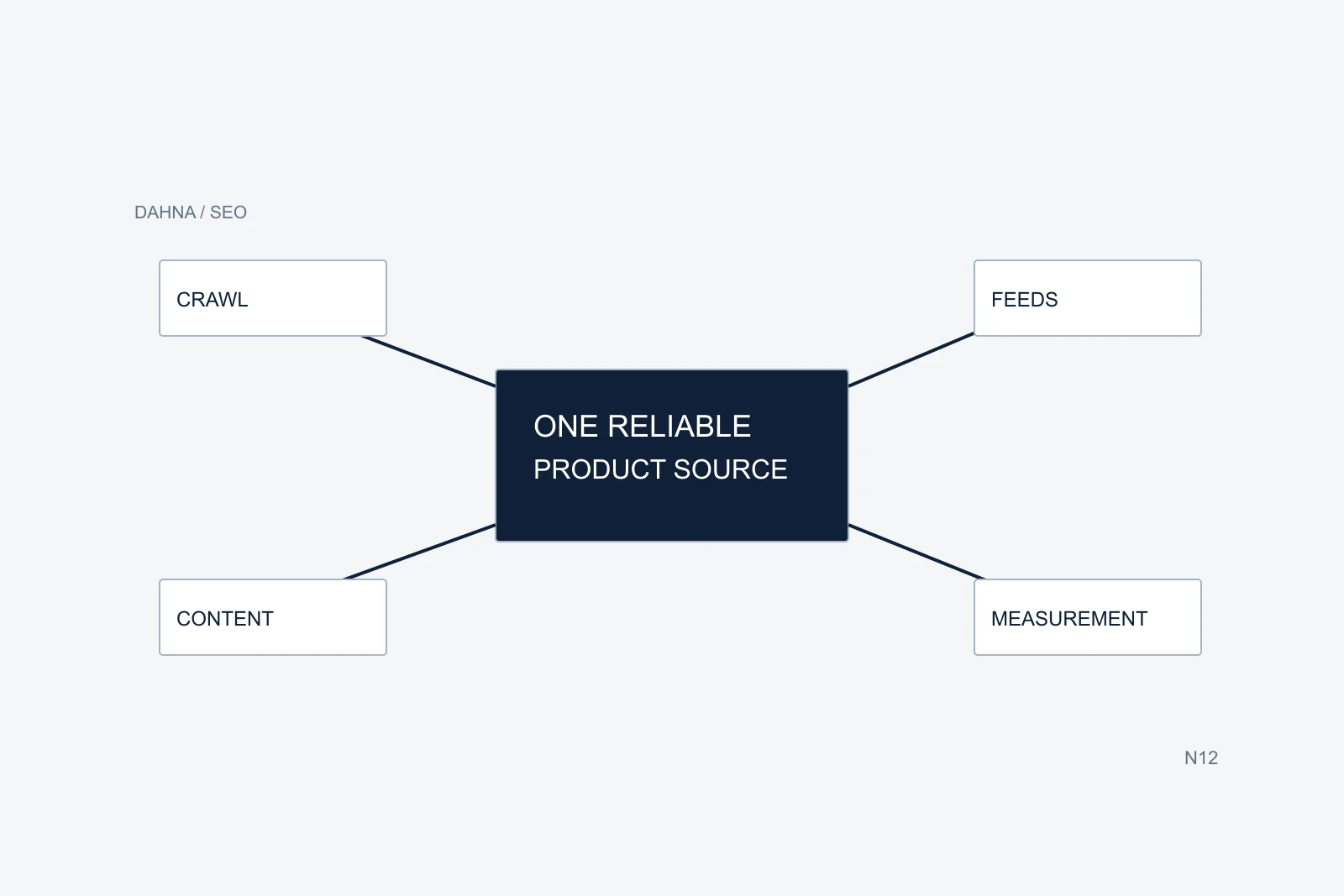
Treat each purchasable variant as a precise item within a clearly defined product family. A visitor should be able to open the relevant size or shade directly, see matching information, and buy that selection. The URL, visible page, feed, and structured data should describe the same choice.
Dahna, original planning diagram
In this article
Overview
Treat each purchasable variant as a precise item within a clearly defined product family. A visitor should be able to open the relevant size or shade directly, see matching information, and buy that selection. The URL, visible page, feed, and structured data should describe the same choice.
Separate the product family from the purchasable item
A moisturizer can have one consumer-facing name and several sellable sizes. A makeup line can contain dozens of shades, each with its own identifier and inventory. Confusion appears when a site treats the family title, the selected variant, and the sellable SKU as interchangeable. A beautiful page can then send a shopper to the wrong item or publish the wrong price in a feed.
Google’s ProductGroup documentation supports describing shared product properties and the attributes by which variants differ. It uses properties including variesBy, hasVariant, and productGroupID. Those fields help express a relationship; they do not correct an inaccurate catalog. The product team must first agree on which items belong together and which are genuinely different products.
Make a variant matrix before editing schema
The matrix is a collaboration tool for the merchandiser, developer, feed owner, and SEO lead. Give each sellable item a row. Include stable identifiers, the attribute values, its direct URL, image, price, currency, and stock state. A bundle should not casually inherit a single component’s identifier, and a market-specific formula should not be treated as a cosmetic variation without review.
For a small catalog, a spreadsheet is enough to expose disagreements. The point is consistency, not buying a product-information system prematurely. Once the matrix is correct, the team can decide which system will maintain each field and which exports need to consume it.
| Family | Variant | Direct selection | Item-level information |
|---|---|---|---|
| Daily moisturizer | 30 mL | URL opens the 30 mL choice | SKU, image, $24 example price, stock |
| Daily moisturizer | 50 mL | URL opens the 50 mL choice | Different SKU, image, $34 example price, stock |
| Tinted moisturizer | Shade 03 | URL opens Shade 03 | Shade-specific image and identifier |
| Routine bundle | Three named products | Bundle URL opens the complete set | Bundle identity and included quantities |
A direct link should preserve the selection
Google’s ecommerce URL guidance recommends that variants can be identified by separate URLs, using a path or a query parameter. Fragment-only selections are not equivalent for indexing. The appropriate canonical setup depends on the store’s page architecture; do not turn a simple parameter-based product page into many competing pages without understanding the platform.
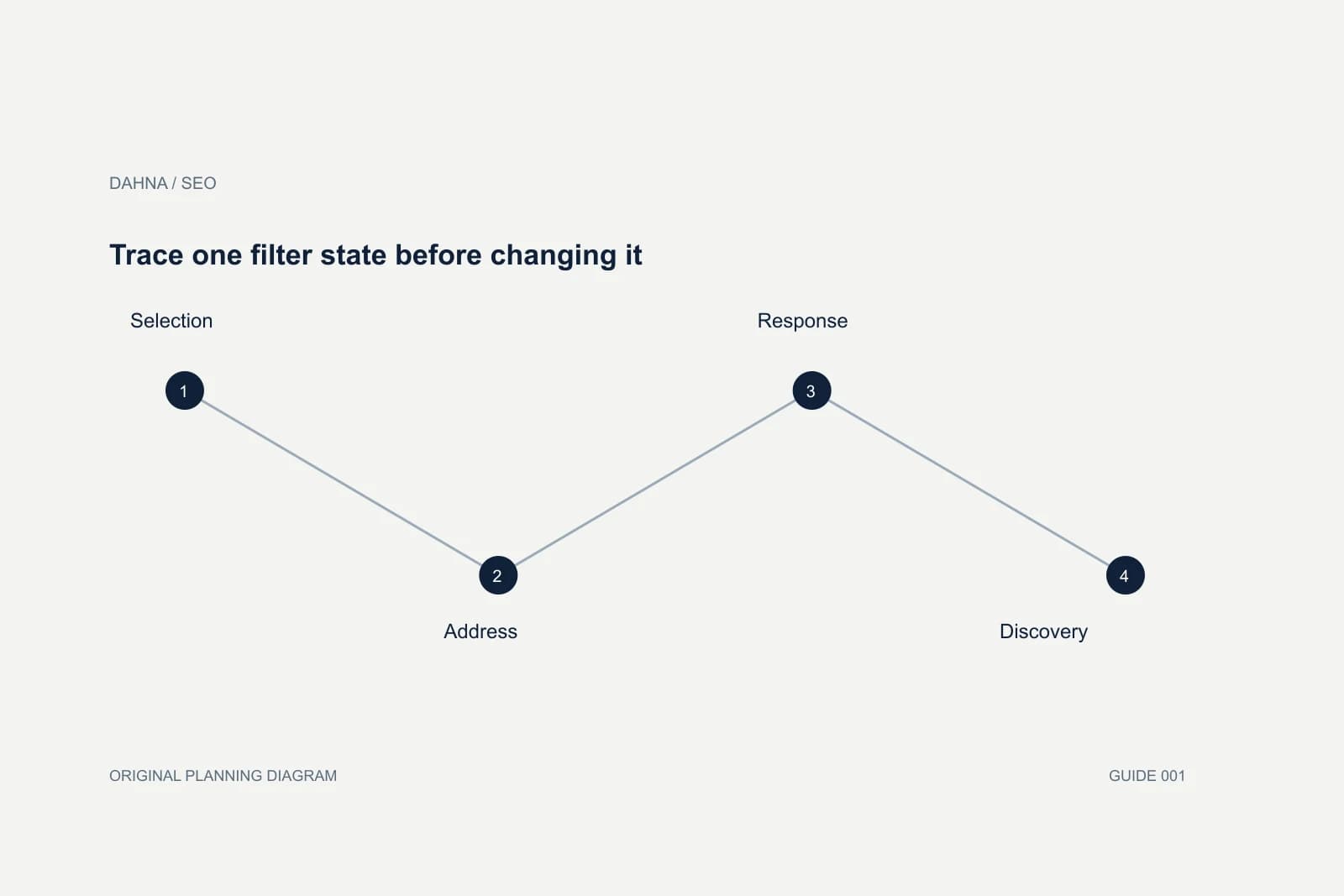
Test a copied variant link in a new browser session. Does the selected image match? Does the price change? Does the add-to-cart action use the intended SKU? Does a country switch preserve a valid equivalent, or does it quietly change the product? These tests matter because an address can look correct while client-side code resets the selection after loading.
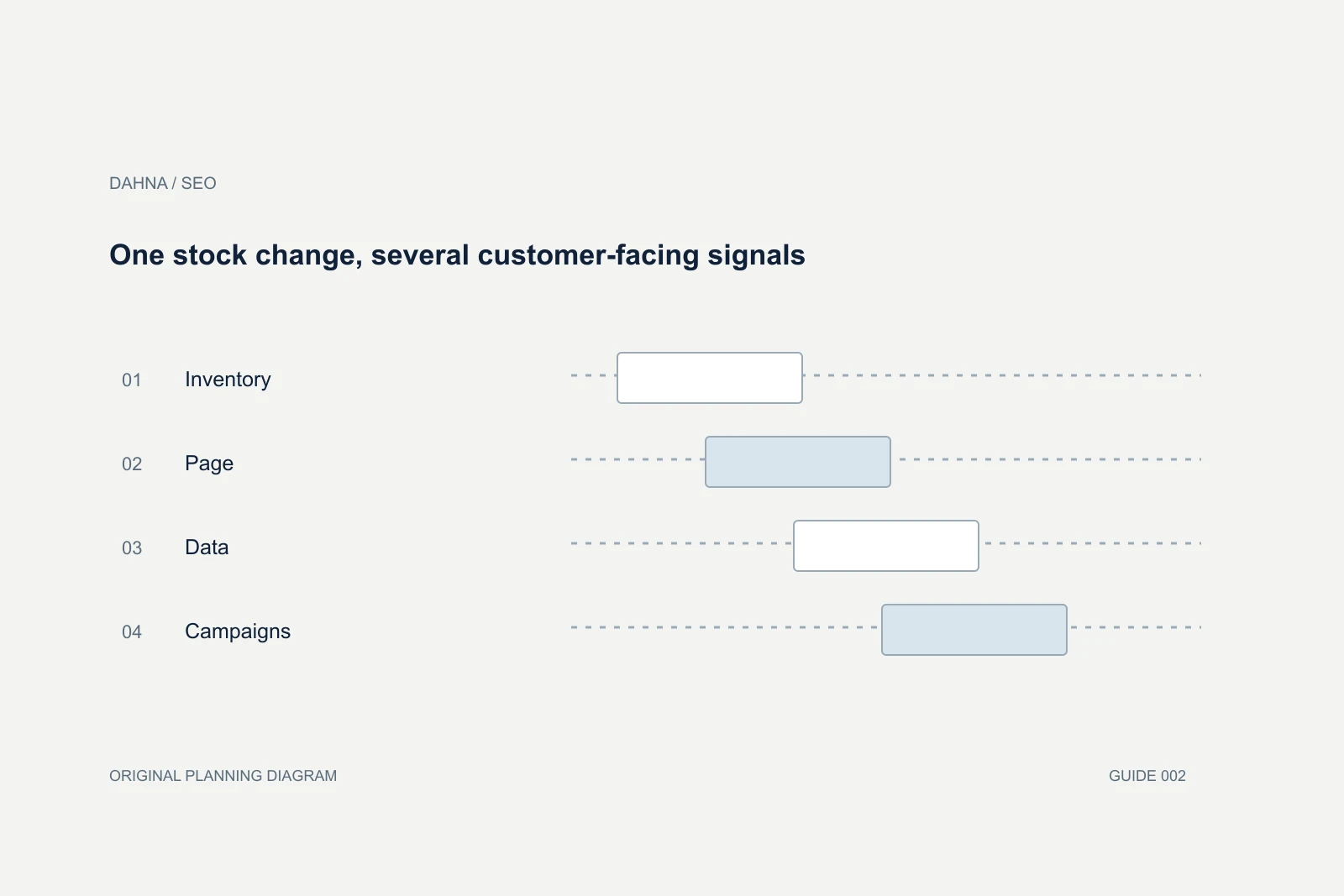
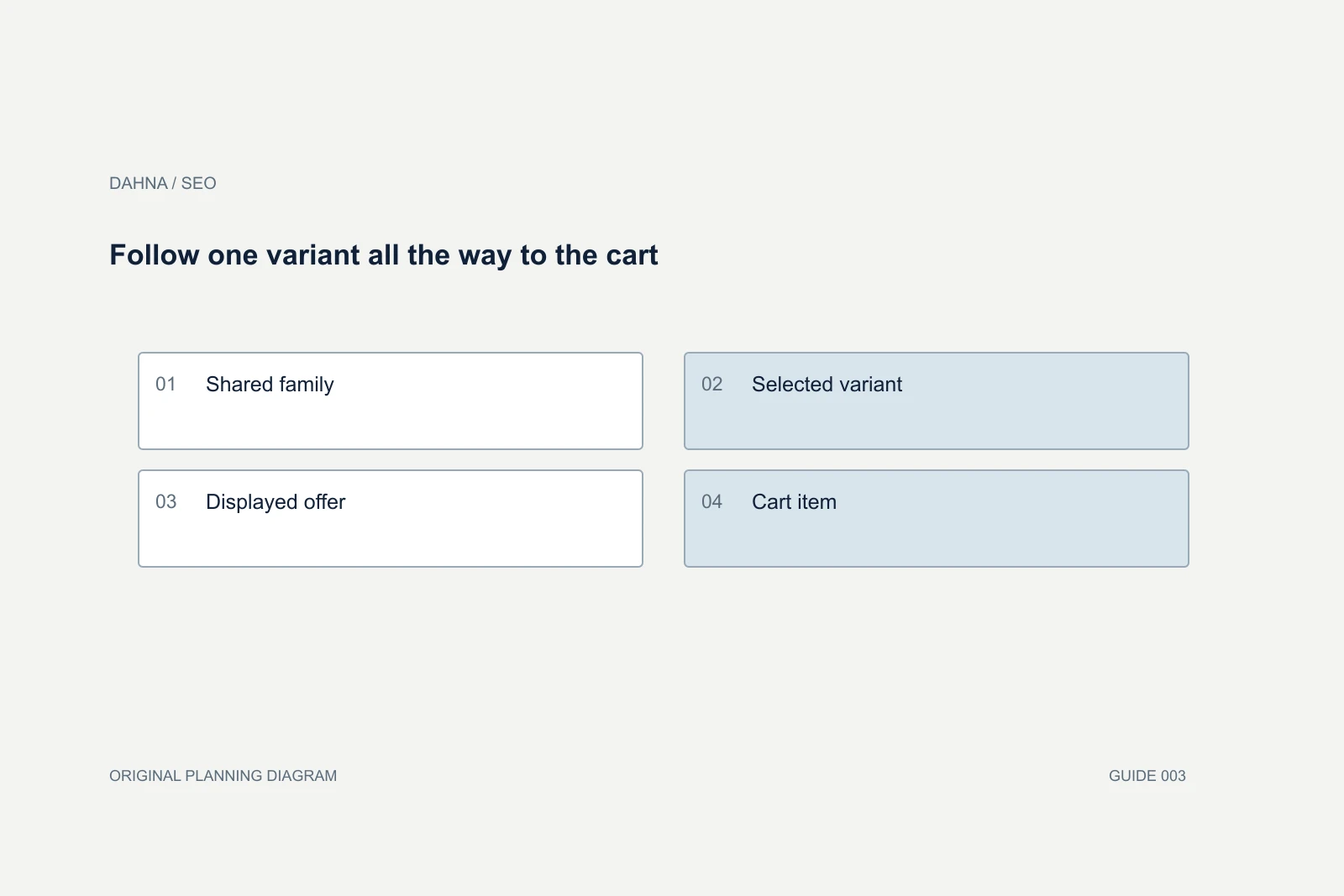
Follow one variant all the way to the cart
Shared family
Name and common product facts.
Selected variant
Size, shade, or model with a stable identifier.
Displayed offer
Matching image, price, currency, and stock.
Cart item
The exact SKU the shopper selected.
Validate the rendered output, including exceptions
Start with a few ordinary variants, then test the awkward cases: the sold-out shade, the promotional size, the newly added item, and a product with only one choice. Inspect the structured data generated on the live page and compare it with what a shopper can see. A successful syntax test is useful, but it does not prove that the price belongs to the selected product.
Ask the developer whether structured data is supplied by the theme, a review app, a feed app, or more than one source. Multiple scripts can coexist legitimately, but contradictory product identities or offers deserve investigation. Record which component owns the output and how future catalog changes are tested. This becomes especially important after installing a new merchandising app.
Illustrative launch: twelve shades, two sizes
Imagine a complexion product launching with twelve shades in two sizes. That creates 24 sellable variants, not 24 automatically useful editorial pages. The catalog matrix names each shade consistently, associates the correct pack image, and records the exact size. The merchandiser confirms which combinations are actually stocked before the developer creates URLs or feed rows.
The first QA pass finds that every small-size link opens the large size because a theme script selects the first available item. It also finds one old image showing retired packaging. Fixing those issues has direct customer value regardless of whether the search result changes. The example is fictional; it illustrates why variant work should include the buying journey rather than ending at a schema validator.
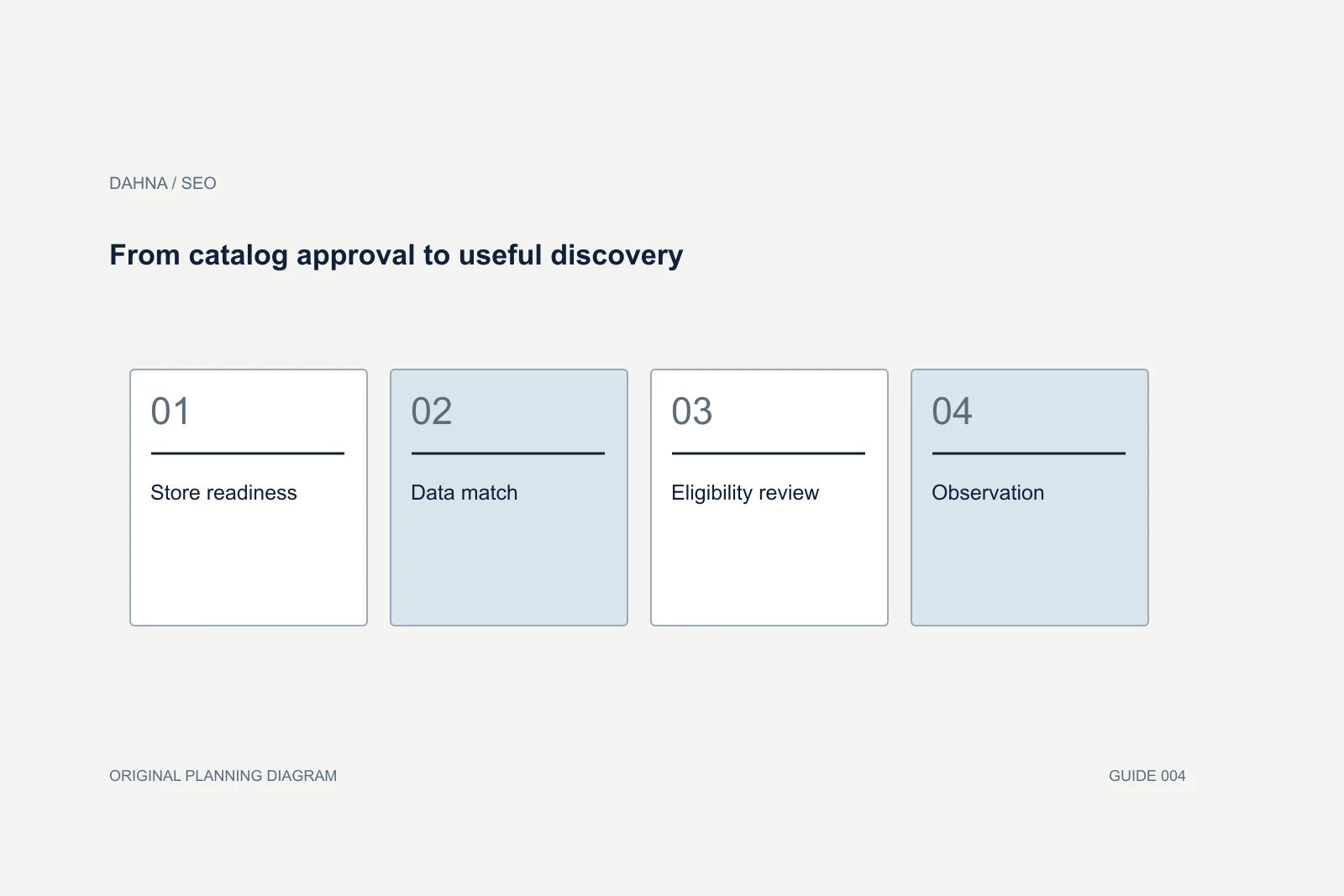
After the correction, a shared link to Shade 05 in 15 mL opens that variant and adds that SKU. The team keeps one approved source for names and identifiers, then tests a restock update to confirm it reaches the page and data exports. Search monitoring comes after this operational acceptance, not in place of it.
What a finished variant project should hand over
Require a mapping file, a list of changes, a representative QA set, and a maintenance owner. The mapping file should be useful to the team adding next season’s products, not just to the consultant who created it. Include a short explanation of exceptions such as regional catalogs or bundles.
Measure accuracy before visibility. Count broken direct selections, mismatched images, contradictory stock states, and invalid output in a defined sample. These are fixable implementation defects. Search appearance is influenced by additional factors, so eligibility for an enhanced result should not be described as guaranteed display.
| Check | Evidence |
|---|---|
| Direct selection | Fresh-session link opens the intended variant |
| Visible data | Selected image, quantity, price, and stock agree |
| Structured output | Product identity and offer match the rendered selection |
| Purchase path | Cart contains the intended SKU |
| Maintenance | New-variant entry follows the same documented process |
Check what happens when a selected variant disappears
A link may have been shared while a shade was available and remain in a creator caption after it sells out. Test that exact address after changing the stock state in a safe environment. The store should communicate what happened without silently adding a different shade or size to the cart. If an alternative is offered, the customer should understand and choose the substitution.
Also test the addition of a new variant. A manually maintained structured-data block can be correct on launch day and omit the next item. The acceptance brief should therefore include one catalog update, not just a static inspection. This reveals whether the mapping is part of the normal product workflow or a fragile one-time patch.
Bring the catalog into the SEO conversation
Dahna can help define the variant brief, connect catalog decisions to search requirements, and coordinate a focused verification pass with your store developer. Share a product export and three troublesome examples before asking for a site-wide schema proposal. That gives the team a concrete place to start and keeps the work proportional to the problem.
If your store also sells internationally, add the market to every test. The US item’s price and availability should not be inferred from a Korean or European listing simply because the packaging looks similar. A correct relationship between versions is more useful than a large amount of generic markup.
Continue with the related decision
Use these guides when the next question goes beyond the scope of this article.
Use the editable decision sheet
Download the completed tables as a CSV, then replace the example inputs and add your evidence, owner and review date. Illustrative figures are teaching examples, not default targets.
Sources & further reading
Bring this decision to Dahna
Use this guide to prepare a focused brief. Tell Dahna what needs to change, which evidence you already have and when you need a decision.
Why consider Dahna for this work?
Dahna brings bilingual Korean and English strategy together with creator, content, and measurement work for brands growing in the US. You can review the people behind the recommendations and the kind of work we propose before starting a conversation.
Founder experience includes prior and contracted roles. Sample deliverables illustrate our approach; they are not client results or a performance promise.