Out-of-stock and discontinued products: what should happen to the page?
Keep a temporarily unavailable product page useful and honest. Show its actual availability, explain the next option, and preserve information shoppers still need. A permanently discontinued product requires a separate decision: retain a support resource, direct people to a truly relevant replacement, or retire the page when it no longer serves a purpose.
Dahna, original planning diagram
In this article
Overview
Keep a temporarily unavailable product page useful and honest. Show its actual availability, explain the next option, and preserve information shoppers still need. A permanently discontinued product requires a separate decision: retain a support resource, direct people to a truly relevant replacement, or retire the page when it no longer serves a purpose.
Unavailable is not one status
A sold-out cleanser that returns next week, a limited edition that may return next year, and a retired skincare device with years of support needs should not receive the same treatment. Start with the product owner’s best knowledge of the lifecycle. If a restock date is uncertain, say so. An invented delivery promise creates a customer-service problem before it creates an SEO opportunity.
John Mueller’s Google Search Central guidance for temporarily pausing online commerce recommends retaining useful site information rather than taking the entire business offline. The practical principle for a product is similar: buying may be unavailable while specifications, usage instructions, and support remain valuable. That is our application of the guidance, not a claim that Google requires every retired SKU to remain indexed forever.
Choose a destination based on what the visitor still needs
Write the policy before the next stockout. Merchandising should identify restock expectations, customer support should identify continuing information needs, and SEO should review the existing destination’s role. This avoids hurried changes when a campaign sells through an item over a weekend.
| Situation | Useful page experience | SEO review question |
|---|---|---|
| Temporary stockout | Product facts, clear availability, optional restock notice | Does the page accurately describe the offer state? |
| Uncertain return | Explain uncertainty and show relevant alternatives | Would maintaining this resource help a visitor? |
| Genuine successor | Explain the change and compare compatibility | Is the successor an appropriate destination for this exact intent? |
| Discontinued with support needs | Prominent retirement notice, manuals and support | Should the resource continue serving owners and researchers? |
| Retired with no continuing utility | Deliberate removal or other appropriate treatment | Are links, references and historical promises accounted for? |
Update the offer everywhere it appears
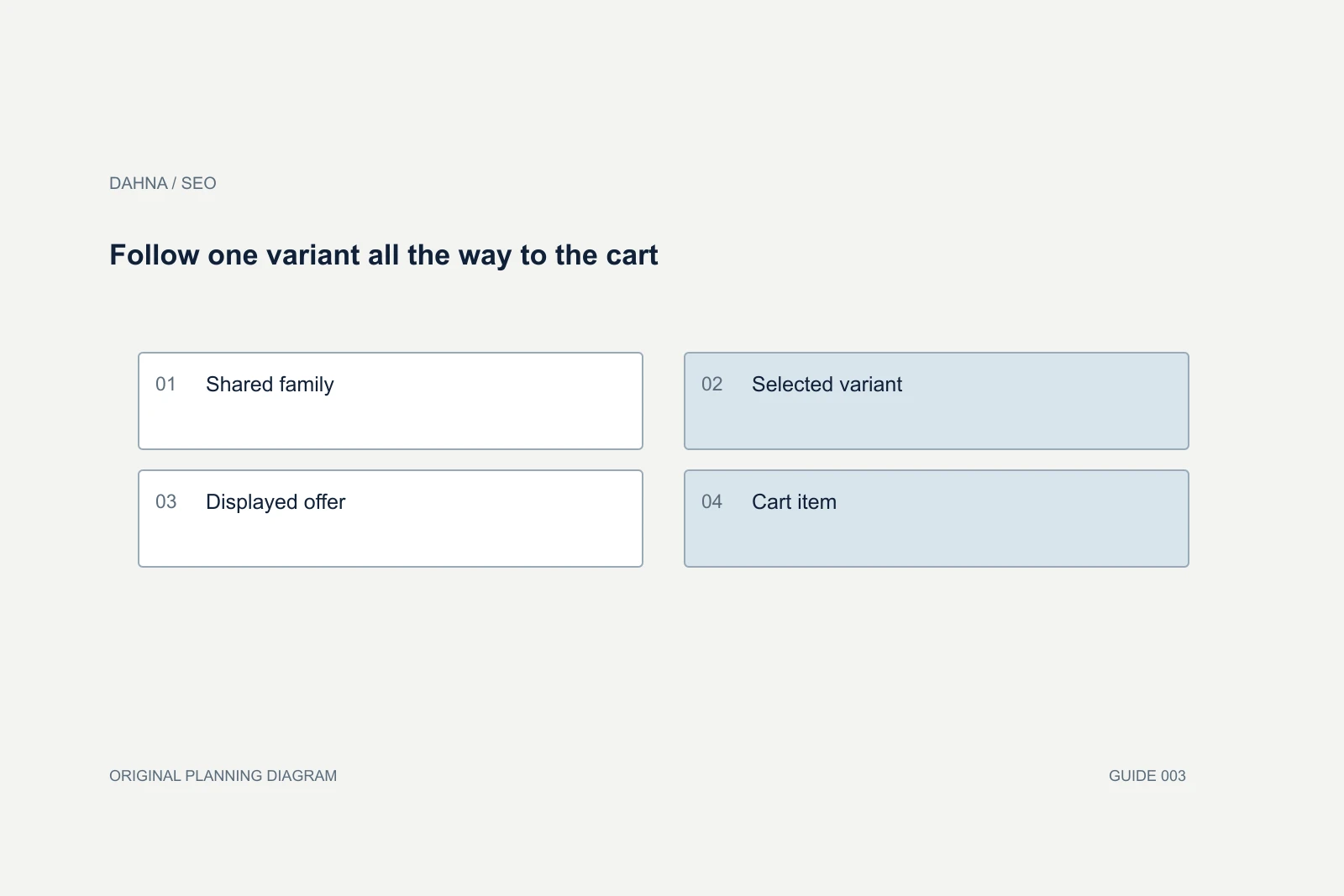
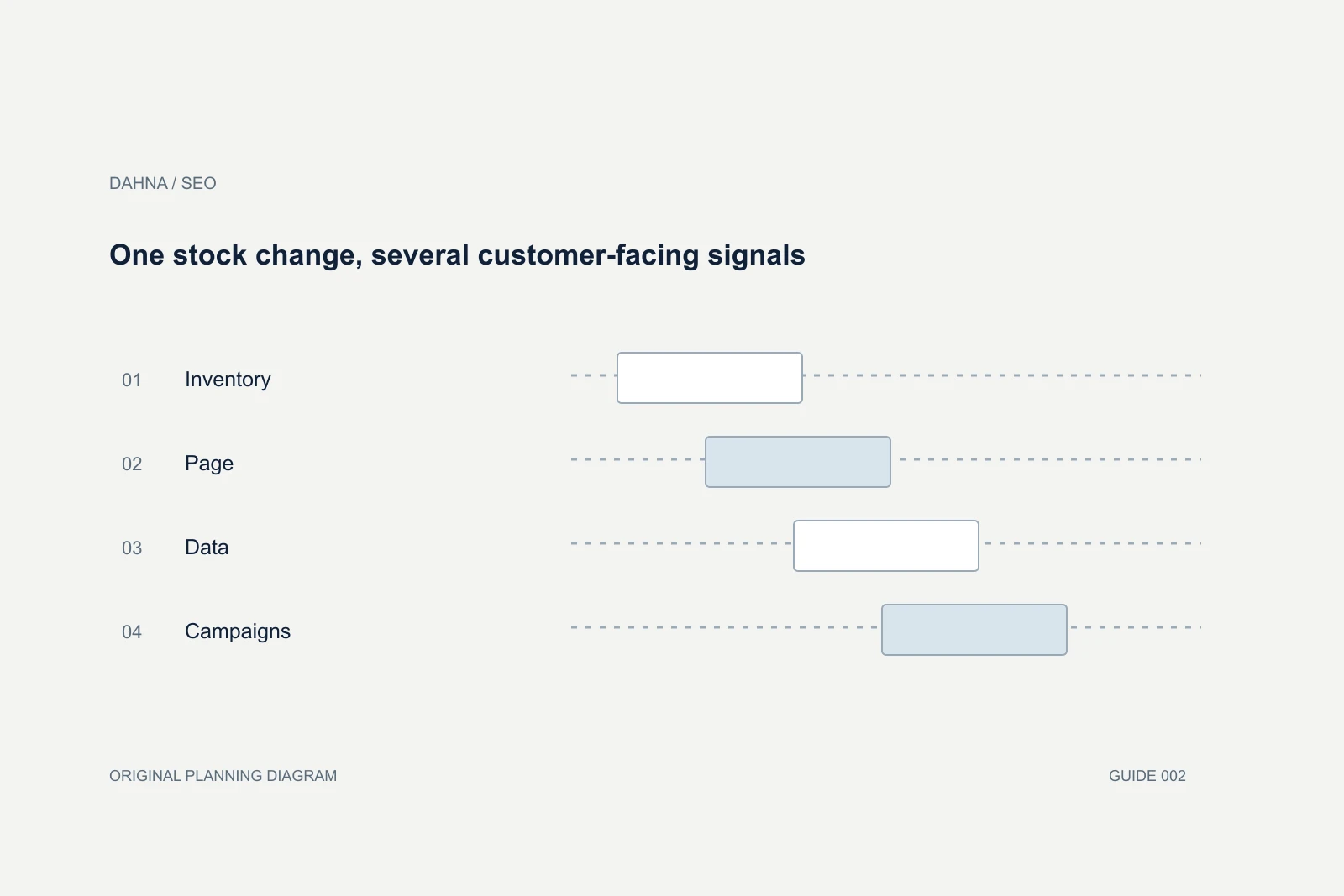
A visitor can see the right message while a product feed or structured-data offer still says “in stock.” That mismatch is a maintenance failure. Ask the team to trace availability from the inventory source to the product page, feed, structured data, collection card, and campaign destination. Include variant selection: one shade being sold out does not necessarily mean the entire product family is unavailable.
Google’s merchant-listing documentation includes product availability among offer information. Use the values and requirements documented for the implementation you actually run, and test the rendered page. A schema app’s settings screen is not evidence that the live page is correct. If two apps produce conflicting offers, assign one source of truth and remove the conflicting output through a reviewed change.
One stock change, several customer-facing signals
Inventory
Confirm the real item or variant state.
Page
Update buying controls and the explanation.
Data
Match feed and structured-data availability.
Campaigns
Review links still sending shoppers to the item.
A replacement must be useful to the same person
An automatic redirect from every discontinued item to the home page is easy to implement and often unhelpful. Someone searching for an old device’s compatible charging cable has not asked to browse a new skincare collection. A page explaining the old model may be the more useful destination, even if it generates little immediate revenue.
Where a true successor exists, make the relationship intelligible. State what changed, what remains compatible, and which choice makes sense for existing owners. Avoid describing two versions as identical when formulation, size, accessories, or market eligibility differ. A generic “new and improved” sentence does not answer these questions.
Any URL retirement or redirect should follow the store’s approval rules. Some organizations protect published URLs permanently; their practical option is to improve the existing page and link forward. Search advice does not override an existing URL commitment or a support obligation.
Illustrative example: a serum and a beauty device
Consider a serum sold in 30 mL and 50 mL bottles. The 30 mL size is temporarily unavailable, but the larger bottle remains available. A useful experience preserves the selected size, states the stockout, and offers the larger size with its actual price and unit quantity. It does not silently switch the cart to the larger bottle. The customer can compare the difference and decide.
Now consider a discontinued cleansing device with a newer successor. The old page can identify the retired model, retain the relevant manual, and link to a compatibility explanation before recommending the new device. The brand should verify whether replacement heads fit both models. This is an illustrative operating example, not a claim about a named manufacturer’s products.
The two pages need different commercial measures. The serum page can track restock interest and alternative purchases. The retired device page may be successful when owners find support without ordering the wrong accessory. Label those goals separately so a report does not declare every low-conversion support visit a failure.
Keep a small register that survives staff changes
The register should identify the SKU, original URL, lifecycle status, decision owner, next review date, replacement relationship, and required content. Add a reason when the team chooses to preserve a page. Six months later, that explanation prevents a different agency from deleting it during a superficial cleanup.
Assign a review trigger rather than allowing the page to drift indefinitely. A restock date passing, a successor launching, a supplier confirming discontinuation, or a recurring support question can trigger another decision. The product team owns the underlying fact; the marketing team owns how clearly the fact is communicated.
| Item | Status | Next review trigger | Success measure |
|---|---|---|---|
| 30 mL serum | Temporary stockout | Warehouse confirms inbound date | Accurate restock interest and alternate-size purchases |
| Retired device | Support resource retained | Replacement compatibility changes | Correct support and accessory journeys |
| Limited gift set | Seasonal, return uncertain | Merchandising approves next season | Visitors understand current availability |
Preserve the information needed by someone who already owns it
A retired item can still generate important visits from existing owners. Separate the purchase controls from manuals, care instructions, compatibility facts, and support contacts. If the page retains a prominent buy button for an unavailable product, a customer may misunderstand the status. If it removes all product information, the owner may be left with third-party instructions for a different version.
For a device transition, ask support to name the three questions most likely to recur after retirement. A replacement-part question, a charging question, and a warranty contact question may need distinct destinations even when the new model has a polished launch page. Keep the original model name visible in those resources. The handoff should also name who will maintain them after the launch team moves on. This review makes the page policy useful to customer service as well as acquisition.
Brief the agency around accuracy and useful recovery
Ask Dahna to review a sample of unavailable products, map the points where availability diverges, and propose a lifecycle policy the team can maintain. A useful scope includes copy changes, feed coordination, selected technical fixes, and an acceptance check. It should not promise that preserving a page will preserve every historical ranking.
For US expansion, include market-specific availability. A Korean or European item may exist globally while being unavailable in the US catalog. The page should make that distinction clear rather than letting a visitor reach an impossible checkout. Connect this work to international SEO when multiple regional stores are involved.
Continue with the related decision
Use these guides when the next question goes beyond the scope of this article.
Use the editable decision sheet
Download the completed tables as a CSV, then replace the example inputs and add your evidence, owner and review date. Illustrative figures are teaching examples, not default targets.
Sources & further reading
Bring this decision to Dahna
Use this guide to prepare a focused brief. Tell Dahna what needs to change, which evidence you already have and when you need a decision.
Why consider Dahna for this work?
Dahna brings bilingual Korean and English strategy together with creator, content, and measurement work for brands growing in the US. You can review the people behind the recommendations and the kind of work we propose before starting a conversation.
Founder experience includes prior and contracted roles. Sample deliverables illustrate our approach; they are not client results or a performance promise.